人民币国际化

Search documents
商务部部长王文涛:建设自主可控的人民币跨境支付体系
清华金融评论· 2025-12-08 03:54
文/ 商务部部长 王文涛 1 2月8日,商务部部长王文涛在《人民日报》发布《扩大高水平对外开放 (学习贯彻党的二十届四中全会精神)》文章表示,党的二十届四中全会 通 过 的 《 中 共 中 央 关 于 制 定 国 民 经 济 和 社 会 发 展 第 十 五 个 五 年 规 划 的 建 议》(以下简称《建议》),强调"扩大高水平对外开放,开创合作共赢 新局面"。这是以习近平同志为核心的党中央着眼以中国式现代化全面推 进 强 国 建 设 、 民 族 复 兴 伟 业 , 统 筹 国 内 国 际 两 个 大 局 作 出 的 重 大 战 略 部 署,为"十五五"时期扩大高水平对外开放提供了根本遵循和行动指南。文 章提到,有序推进人民币国际化,提升资本项目开放水平,建设自主可控 的人民币跨境支付体系。 党的二十届四中全会通过的《中共中央关于制定国民经济和社会发展第十五个五年规划的建议》(以下简称《建议》),强调"扩大高水平对 外开放,开创合作共赢新局面"。这是以习近平同志为核心的党中央着眼以中国式现代化全面推进强国建设、民族复兴伟业,统筹国内国际两 个大局作出的重大战略部署,为"十五五"时期扩大高水平对外开放提供了根本遵 ...


商务部部长王文涛在人民日报撰文:扩大高水平对外开放
Xin Lang Cai Jing· 2025-12-07 22:39
Group 1 - The core viewpoint emphasizes the importance of expanding high-level opening-up as a strategic deployment for China's modernization and national rejuvenation, providing fundamental guidelines for the 15th Five-Year Plan [1][17] Group 2 - The significance of expanding high-level opening-up is highlighted as a strong driving force for high-quality development, with the need for an open environment to achieve future economic growth [3][19] - The expansion of high-level opening-up is also seen as an internal requirement to meet the people's needs for a better life, with foreign trade and investment significantly contributing to employment and consumption upgrades [4][20] - It is positioned as proactive engagement in economic globalization, aiming to lead rather than follow in international trade and cooperation [5][21] - The initiative is viewed as a crucial step in building a community with a shared future for mankind, addressing global challenges through collaborative efforts [5][21] Group 3 - The principles for expanding high-level opening-up include combining opening-up with deepening reform, ensuring higher standards of openness [6][22] - There is a focus on coordinating autonomous and agreement-based opening-up to enhance overall capabilities [7][23] - The strategy promotes the synergy between domestic and international circulation, emphasizing the importance of an open dual circulation system [8][24] - Balancing China's needs with global expectations is essential for deeper cooperation and mutual benefits [10][25] - The approach also stresses the need to integrate development with security, ensuring a dynamic balance between the two [11][26] Group 4 - Key tasks for implementing high-level opening-up include actively expanding autonomous opening, particularly in the service sector, and enhancing market access [12][28] - Promoting trade innovation and enhancing the quality of foreign trade are critical for building a strong trading nation [14][29] - Expanding bilateral investment cooperation and creating a favorable environment for foreign investment are essential for attracting global capital [15][30] - High-quality construction of the Belt and Road Initiative is aimed at fostering mutual trust and win-win development with partner countries [16][31]
11月末外储规模小幅上升 央行连续13个月增持黄金
Zhong Guo Zheng Quan Bao· 2025-12-07 20:43
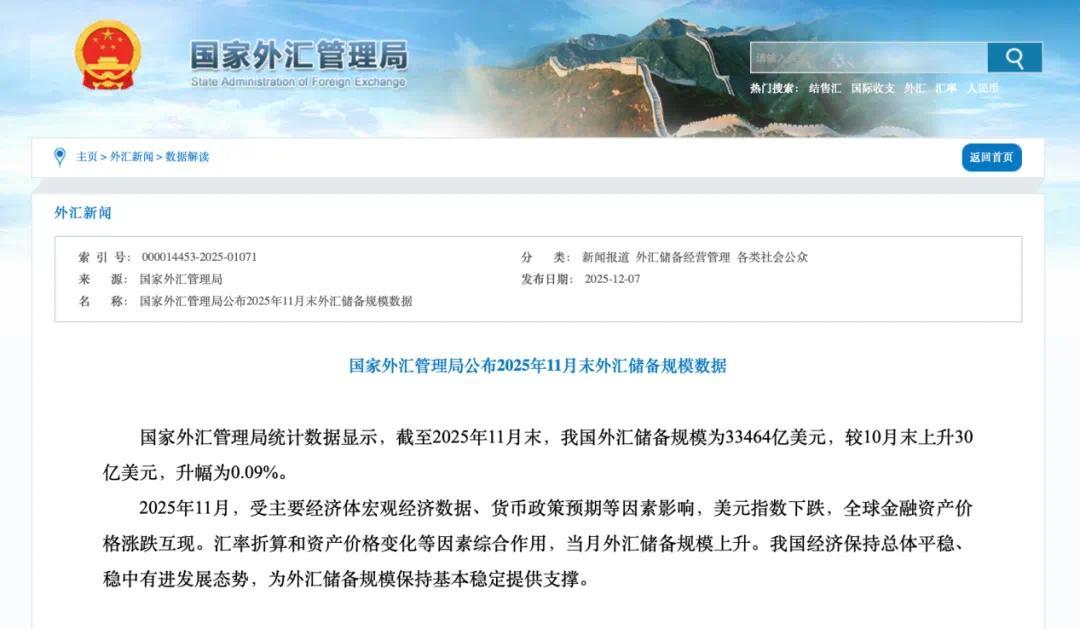
国家外汇管理局12月7日发布数据显示,截至2025年11月末,中国外汇储备规模为33464亿美元,较10月 末上升30亿美元,升幅为0.09%。11月末,中国黄金储备为7412万盎司,环比增加3万盎司,为中国央 行连续第13个月增持黄金。 国家外汇管理局表示,2025年11月,受主要经济体宏观经济数据、货币政策预期等因素影响,美元指数 下跌,全球金融资产价格涨跌互现。汇率折算和资产价格变化等因素综合作用,当月外汇储备规模上 升。 数据显示,中国外汇储备规模创2015年12月以来新高,较上年末增加1440亿美元,连续4个月保持在3.3 万亿美元之上。 "11月外汇储备规模延续此前3个月升势,反映了主要经济体货币政策及预期、宏观经济数据等因素影响 下,汇率折算和资产价格变化带来的正估值效应。"中银证券全球首席经济学家管涛说。 国家外汇管理局表示,中国经济保持总体平稳、稳中有进发展态势,为外汇储备规模保持基本稳定提供 支撑。 民生银行首席经济学家温彬分析,中国经济基础稳、优势多、韧性强、潜能大,是外汇储备规模保持基 本稳定的根本支撑。另外,在投资领域,中国稳步推进资本市场自主开放,近日中国证监会印发《合格 境外投资 ...
财政部持续十七年在香港发债有何深远影响
Zheng Quan Ri Bao· 2025-12-07 15:47
Core Viewpoint - The Ministry of Finance will issue the sixth tranche of RMB government bonds in Hong Kong on December 10, with a scale of 7 billion yuan, completing the plan to issue 68 billion yuan in RMB bonds in Hong Kong for the year. This marks the 17th consecutive year since 2009 that the Ministry has regularly issued sovereign bonds abroad [1][2]. Group 1 - The continuous issuance of RMB government bonds in Hong Kong enhances the offshore RMB yield curve, providing a pricing "cornerstone" for the market. The bonds, backed by national sovereign credit, are considered high-quality assets and stable investment tools. The issuance has diversified in terms of maturity, ranging from 2 years to 30 years, allowing for accurate reflection of offshore market supply and demand, thus serving as a core "benchmark anchor" for pricing other offshore RMB bonds [3][5]. - The issuance of high-credit government bonds supports the global reserve and allocation value of RMB assets, effectively promoting the internationalization of the RMB. The bonds issued in Hong Kong efficiently reach international investors, meeting their demand for RMB asset allocation. For instance, the average subscription multiple for the first five issuances this year was 3.27 times, with a peak of 3.96 times, indicating strong market interest and confidence in RMB assets [4][5]. - The regular issuance of RMB government bonds strengthens Hong Kong's status as an international financial center and supports the development of the real economy. This issuance promotes the improvement of the infrastructure for bond issuance, trading, settlement, and custody in Hong Kong, enhancing its international competitiveness. Additionally, funds raised from these bonds can support major national projects, contributing to the construction of the Guangdong-Hong Kong-Macao Greater Bay Area [5].
外汇储备连续四个月站稳3.3万亿美元
Bei Jing Shang Bao· 2025-12-07 15:42
Core Viewpoint - The latest foreign exchange reserve data indicates a slight increase in China's foreign reserves, with a notable rise in gold reserves, reflecting ongoing economic stability and strategic asset management by the People's Bank of China [1][3][5]. Foreign Exchange Reserves - As of November 2025, China's foreign exchange reserves reached $33,464 billion, an increase of $30 billion from October, representing a growth rate of 0.09% [1][3]. - The rise in reserves is attributed to various factors, including macroeconomic data from major economies and expectations regarding monetary policy, leading to a decline in the US dollar index [3][4]. - The reserves have remained above $3.3 trillion for four consecutive months, with a significant year-to-date increase of $144 billion, primarily driven by the depreciation of the US dollar and lower US Treasury yields [4]. Gold Reserves - China's official gold reserves increased to 7,412 million ounces (approximately 2305.39 tons) by the end of November, marking the 13th consecutive month of growth, although the increase was modest [1][5]. - The People's Bank of China has been gradually increasing its gold reserves, with the latest increment being the lowest since the resumption of purchases in November 2024, reflecting a strategic response to global economic conditions [5][6]. - Analysts suggest that the ongoing geopolitical risks and the anticipated easing of US monetary policy are driving the need for continued gold accumulation to optimize the international reserve structure [6][7].

事关消费投资,黄奇帆刘世锦等建言十五五开局之路如何走
Bei Ke Cai Jing· 2025-12-07 14:00
Group 1 - China's economy is showing resilience and vitality as it approaches the end of 2025, with a focus on navigating challenges and opportunities in 2026 during the "14th Five-Year Plan" period [1] - Experts believe that China is at a critical stage of structural adjustment, where breaking through reforms will lead to both quantitative and qualitative economic growth [2] - The "14th Five-Year Plan" marks a shift in China's economic growth from being primarily driven by investment and exports to being driven by innovation and consumption [3] Group 2 - Consumption is crucial for China's economy, and there is a need to actively implement a "strong consumption country" strategy [3] - Increasing the pension levels for low-income groups is seen as a key breakthrough for expanding consumption, with a strong necessity for transferring state-owned capital to support pension funds [3] - The proposal includes reallocating state-owned capital to social security funds and capital markets to create a comprehensive pension system that meets basic living needs and reduces urban-rural disparities [3] Group 3 - China has the potential to become the world's largest consumer market, surpassing the United States, and should implement a new strategy for balanced imports and exports [4] - There is a call to expand the offshore RMB financial product ecosystem to enhance the liquidity and usability of the RMB, promoting its internationalization [4] - As the RMB appreciates, domestic consumers will be able to purchase more and better imported goods and services, thereby enhancing the scale and quality of consumption [4] Group 4 - Deepening reform and opening up is seen as a crucial path for economic breakthroughs, with macro policy optimization being an important support [5] - The focus for 2026 is on establishing a solid foundation for national policies as it will be a year where major global economies compete economically [5] Group 5 - Reform and innovation are identified as fundamental drivers of China's economic development over the past 40 years and are essential for achieving the "Chinese Dream" by 2050 [6] - Addressing issues of urban-rural integration and technological innovation is deemed critical, with a need for better integration of scientific and industrial innovation [6][7] - The "14th Five-Year Plan" period should focus on resolving challenges related to insufficient investment in basic innovation and the transformation of technological advancements [7] Group 6 - The GDP growth target for China in 2026 is expected to remain around 5%, which is considered a significant achievement in an international context [8] - Infrastructure investment is highlighted as a key method for stabilizing growth, with a strong emphasis on large-scale infrastructure projects to support economic stability [8] - Consumer spending is viewed as a slow variable, indicating that a significant rebound in consumption may be challenging in the near term [8]
2026年宏观经济和市场展望:新一轮再定价周期
Haitong Securities International· 2025-12-07 12:06
Global Economic Outlook - The global economic growth rate is projected to slow to 3.1% in 2026, down from 3.2% in 2025, primarily due to rising protectionism and uncertainty[2][16]. - Global inflation is expected to decrease to 4.2% in 2025 and further to 3.7% in 2026, with significant disparities among different economies[2][17]. China Economic Forecast - China's GDP growth for the first three quarters of 2025 was 5.2%, slightly above the annual target of 5%, with a forecasted growth of approximately 4.8% in 2026[3][32]. - Structural challenges persist in the Chinese economy, including an aging population and weakened consumer spending, which may hinder long-term growth[3][32]. US Economic Outlook - The US economy has maintained a strong growth rate of 2.8% over the past two years, with a projected GDP growth of 2.3% in 2026, supported by fiscal policies and AI investments[4][34]. - Inflation in the US is expected to remain above target levels, impacting monetary policy decisions[4][34]. Asset Class Performance - Emerging market investments are anticipated to improve significantly starting in 2025, while developed markets have shown steady performance due to high profitability and AI themes[5][39]. - Gold has outperformed other assets as a hedge against inflation and currency risks, while global bond returns remain under pressure due to high interest rates[5][40]. Market Predictions - The Shanghai Composite Index is expected to rise to 5600 points in 2026, driven by improvements in economic fundamentals and corporate earnings[6][54]. - The Hang Seng Index is projected to reach 34,000 points, reflecting a broader market recovery and increased capital inflows[6][54].
刘世锦:建议国有资本划拨社保基金,破解“一低一高”结构性问题|和讯2025年会
和讯· 2025-12-07 11:10
Core Viewpoint - The article discusses the transition of China's economy from high-speed growth to medium-speed growth, emphasizing the need for structural reforms to boost consumption and address the underlying issues of low consumer demand and high savings rates [2][3]. Group 1: Economic Transition - Since Q1 2010, China's GDP growth has shifted from high-speed to medium-speed, with negative GDP deflator growth for ten consecutive quarters by Q3 2025 [2]. - The "14th Five-Year Plan" aims to increase per capita GDP from $10,632 in 2020 to $13,445 by 2024, indicating a long-term goal of reaching the income levels of moderately developed countries by 2035 [2]. Group 2: Consumption and Savings - The current economic challenge is characterized by insufficient consumption rather than low investment or exports, with a high savings rate correlating with low consumption levels [3][6]. - China's actual final consumption as a percentage of GDP is 44.46%, which is approximately 20 percentage points lower than the global average and about one-third lower than OECD countries [6]. Group 3: Structural Issues - There are two structural phenomena in the Chinese economy: low consumption as a percentage of GDP and a high proportion of state-owned capital in total net assets [3][6]. - The disparity in income distribution and the high share of state-owned capital are significant factors contributing to low consumption levels [7]. Group 4: Policy Recommendations - To effectively expand consumption, increasing pension levels for low-income groups is crucial, along with reallocating state-owned capital to support pension funds [8][9]. - The proposal includes transferring a total of 20 trillion yuan of state-owned capital to social security funds over five years, aiming to increase the average monthly pension from 246 yuan to 1,000 yuan [9]. Group 5: Future Economic Goals - Achieving the goal of reaching a per capita GDP of $35,000 to $40,000 by 2035 requires a focus on building a consumption-driven economy, enhancing public services, and addressing structural consumption disparities [10][11]. - The article suggests that China has the potential to become the world's largest consumer market, leveraging its population size and increasing the use of the renminbi in international trade [12][13].

中国央行放缓买金节奏,世界黄金协会:2026年黄金可能再出人意料
Xin Lang Cai Jing· 2025-12-07 10:09
Core Points - As of November 2025, China's foreign exchange reserves reached $33,464 billion, an increase of $30 billion from October, marking a 0.09% rise [3][17] - This is the fourth consecutive month that reserves have remained above $33 trillion, the highest level since December 2015 [4][6] - The stability in reserves is attributed to minor fluctuations in the dollar index and mixed performance in global financial assets [4][20] Foreign Exchange Reserves - The increase in foreign exchange reserves is primarily due to asset price changes and exchange rate fluctuations [4][20] - The dollar index fell by 0.3% in November, while non-dollar currencies showed mixed results, with the Japanese yen declining by 1.38% [5][20] - The U.S. is set to reduce tariffs on Chinese goods by 10%, which is expected to stabilize China's export scale to the U.S. [5][20] Gold Reserves - The People's Bank of China (PBOC) has increased its gold reserves for the 13th consecutive month, reaching 7,412 million ounces, with a stable increase of 3,000 ounces from the previous month [4][22] - The pace of gold accumulation has slowed down, with the total increase from January to November 2025 showing a declining trend [19][22] - The gold reserves now account for 9.28% of total foreign exchange reserves, a historical high [22][24] Market Outlook - The World Gold Council anticipates that geopolitical and economic uncertainties will continue to influence the gold market in 2026 [25][26] - If economic growth slows and interest rates decline further, gold prices may experience moderate increases [26] - The importance of gold as a diversification tool in investment portfolios is emphasized, especially in the context of increasing global uncertainties [26][24]

黄金大消息:央行出手,历史罕见
Zhong Guo Ji Jin Bao· 2025-12-07 10:08
12月7日,国家外汇管理局最新数据显示,截至2025年11月末,我国外汇储备规模连续4个月稳定在3.3万亿美元以上。同时,央行已连续13个月增持黄 金。 外储规模继续稳定在3.3万亿美元以上 数据显示,截至2025年11月末,我国外汇储备规模为33464亿美元,较10月末上升30亿美元,升幅为0.09%。 拉长时间来看,11月,我国外汇储备规模不仅连续四个月稳定在3.3万亿美元以上,还创下2015年12月以来新高。同时,较上年末已大幅增加1440亿美 元。 国家外汇管理局表示,2025年11月,受主要经济体宏观经济数据、货币政策预期等因素影响,美元指数下跌,全球金融资产价格涨跌互现。汇率折算和资 产价格变化等因素综合作用,当月外汇储备规模上升。我国经济保持总体平稳、稳中有进发展态势,为外汇储备规模保持基本稳定提供支撑。 数据显示,11月末央行黄金储备报7412万盎司,环比增加3万盎司。尽管增量连续第9个月处于低位,但这是央行继去年11月重启增持后,连续第13个月增 持黄金。 | | Official reserve assets | | | | | | | | | | | | | | | --- | --- ...