自动驾驶

Search documents
未知机构:申万汽车特斯拉25Q4财报核心要点继续关注业绩概览交付承-20260129
未知机构· 2026-01-29 02:05
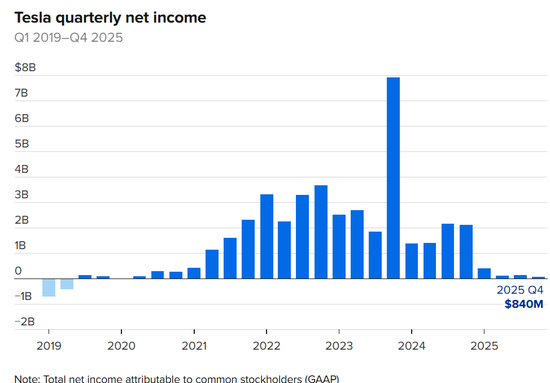
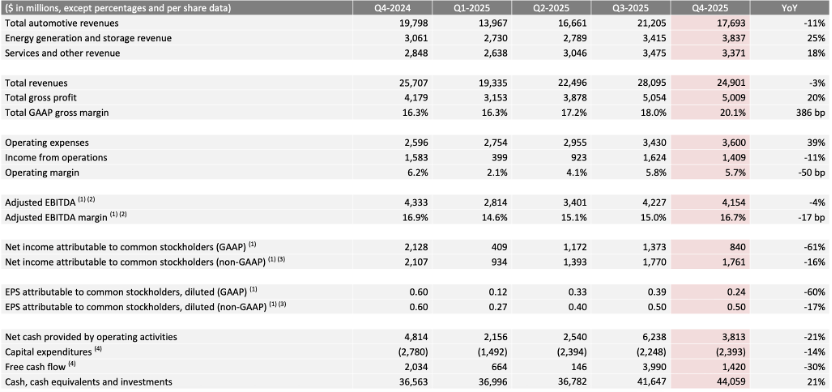
归母净利润8.4亿美元,同比-61%、环比-39%。 值得注意的是,公司综合毛利率同比提升3.8pct至20.1%,其中汽车业务毛利率20.4%,能源业务毛利率28.6%,显 示业务结构优化对冲了销量下滑影响。 【申万汽车】特斯拉25Q4财报核心要点,继续关注 业绩概览:交付承压,#盈利质量改善 特斯拉25Q4交付量41.8万辆,同比/环比均下降16%;营业总收入249亿美元,同比-3%、环比-11%。 归母净利润8.4亿美元,同比-61%、环比-39%。 值得注意的是,公司综合毛利率同比提升3.8pct至20.1%,其中汽车业务毛利率20.4%,能源业务毛利率28.6%,显 示业务 【申万汽车】特斯拉25Q4财报核心要点,继续关注 业绩概览:交付承压,#盈利质量改善 特斯拉25Q4交付量41.8万辆,同比/环比均下降16%;营业总收入249亿美元,同比-3%、环比-11%。 Robotaxi业务在奥斯汀开始有限度移除安全员运营,旧金山湾区维持安全员配置,计划26H1扩展至达拉斯、休斯 顿、菲尼克斯等七大城市。 #AI与机器人:资本开支重点倾斜 Optimus机器人产业化提速,V3版本预计26Q1发布,最终规 ...

未知机构:中信证券前瞻特斯拉2025Q4业绩速评当季盈利能力超预期26年Capex-20260129
未知机构· 2026-01-29 02:00
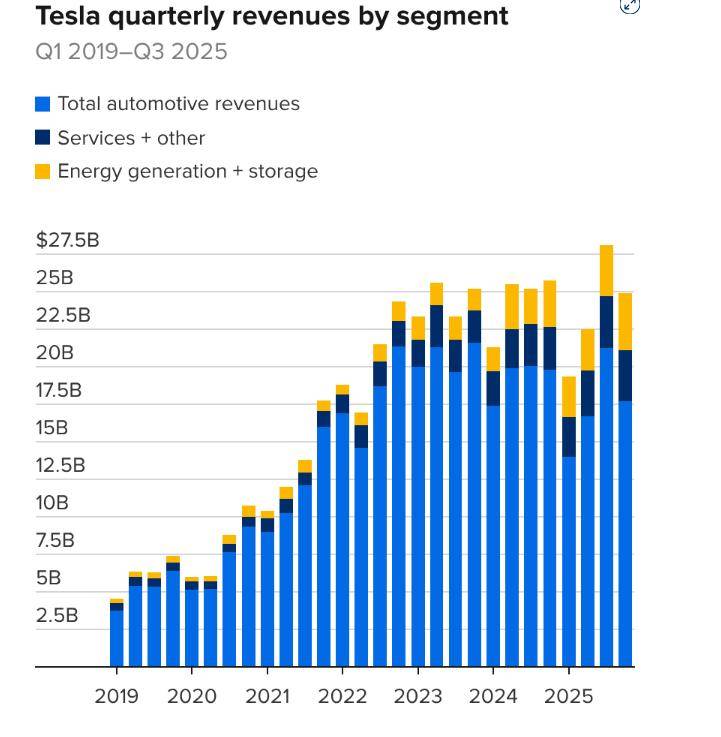
Summary of Tesla's Q4 2025 Earnings Call Company Overview - **Company**: Tesla, Inc. - **Quarter**: Q4 2025 Key Financial Metrics - **Total Revenue**: $24.901 billion (YoY -3%, QoQ -11%), below Bloomberg consensus of $25.111 billion [1] - **Automotive Revenue**: $17.693 billion (YoY -11%, QoQ -17%) [1] - **Energy Revenue**: $3.837 billion (YoY +25%, QoQ +12%) [1] - **Service and Other Revenue**: $3.371 billion (YoY +18%, QoQ -3%) [1] - **Annual Revenue**: $94.827 billion (YoY -3%) [1] - **GAAP Gross Margin**: 20.1% (YoY +3.86 ppts, QoQ +2.1 ppts), exceeding Bloomberg consensus of 17.1% [1][2] - **GAAP Net Profit**: $840 million (YoY -61%, QoQ -39%) [2] - **Non-GAAP Net Profit**: $1.761 billion (YoY -16%, QoQ -1%), above Bloomberg consensus of $1.596 billion [2] - **Annual GAAP Net Profit**: $3.794 billion (YoY -46%) [2] - **Annual Non-GAAP Net Profit**: $5.858 billion (YoY -26%) [2] - **Capital Expenditure**: $2.393 billion (YoY -14%, QoQ +6%) [2] - **Annual Capital Expenditure**: $8.527 billion (YoY -25%) [2] - **Free Cash Flow**: $1.420 billion (YoY -30%, QoQ -64%) [2] - **Annual Free Cash Flow**: $6.220 billion (YoY +74%) [2] Automotive Business Insights - **Production Volume**: 434,358 vehicles (YoY -5%, QoQ -3%) [3] - **Model 3/Y**: 422,652 vehicles - **Other Models**: 11,706 vehicles - **Sales Volume**: 418,227 vehicles (YoY -16%, QoQ -16%) [3] - **Model 3/Y**: 406,585 vehicles - **Other Models**: 11,642 vehicles - **Annual Production Volume**: 1,654,667 vehicles (YoY -7%) [3] - **Annual Sales Volume**: 1,636,129 vehicles (YoY -9%) [3] - **Model S and X**: Production will cease next quarter for line conversion to Optimus production [3] - **Semi and Cybercab**: Expected to begin ramping production in H1 2026 [3] AI Business Developments - **FSD Customers**: Nearly 1 million paid customers globally; subscription model to replace outright purchase starting Q1 2026 [3] - **Robotaxi**: Safety driver requirement to be removed in Austin starting January 2026 [3] - **Optimus V3**: Launch expected in Q1 2026 with a planned annual production of 1 million units by the end of 2026 [3] - **Competition**: Chinese companies expected to be major competitors; Tesla's advantage lies in real-world AI capabilities and design [3] Energy Business Performance - **Energy Storage Deployment**: 14.2 GWh for the quarter (YoY +29%, QoQ +14%) [4] - **Annual Deployment**: 46.7 GWh (YoY +49%) [4] - **Future Outlook**: Anticipated increase in deployment with the introduction of Mega Pack 3 and Mega Block, though profit margins may be pressured by low-cost competition [5] Additional Insights - **Investment in xAI**: Tesla reached an agreement to invest $2 billion in xAI, which may create synergies with Tesla's operations, such as improving the management efficiency of autonomous vehicle fleets [5] - **2026 Capital Expenditure**: Expected to exceed $20 billion, primarily for new factories (refinery, lithium iron phosphate batteries, Cybercab, Semi, Megafactory, Optimus) and AI infrastructure [5]
未知机构:东吴电新特斯拉年报储能交付创新高向实体AI领导者转型公司-20260129
未知机构· 2026-01-29 02:00
Summary of Tesla's Earnings Call Company Overview - **Company**: Tesla - **Industry**: Electric Vehicles and Energy Storage Key Financial Metrics - **Q4 2025 Revenue**: $24.9 billion, down 3% year-over-year and down 11% quarter-over-quarter [1] - **Q4 Gross Margin**: 20%, up 4 percentage points year-over-year [1] - **Non-GAAP Net Income**: $1.76 billion, down 16% year-over-year and down 1% quarter-over-quarter [1] - **Annual Revenue for 2025**: $94.8 billion, down 2% year-over-year [1] - **Annual Non-GAAP Net Income**: $5.86 billion, down 26% year-over-year [1] Automotive Performance - **Vehicle Deliveries**: Q4 deliveries were 418,000, down 16% year-over-year and quarter-over-quarter, influenced by the reduction of the $7,500 subsidy in the U.S. [3] - **Total Deliveries for 2025**: 1.636 million vehicles, down 9% year-over-year [3] - **Automotive Revenue for Q4**: $16.75 billion (excluding credits), down 10% year-over-year [3] - **Automotive Gross Margin**: 17.1%, up 4 percentage points year-over-year and up 2 percentage points quarter-over-quarter [3] - **Average Selling Price**: $41,000 per vehicle [3] - **Average Cost per Vehicle**: $34,000, down 4% quarter-over-quarter [3] Energy Storage Performance - **Q4 Energy Revenue**: $3.84 billion, up 25% year-over-year and up 12% quarter-over-quarter [3] - **Gross Margin for Energy**: 28.6%, down 3 percentage points quarter-over-quarter [3] - **Energy Storage Shipments**: 14.2 GWh, up 29% year-over-year and up 14% quarter-over-quarter [3] - **Annual Energy Shipments**: 46.7 GWh, up 49% year-over-year [3] Future Plans and Investments - **Capital Expenditure for 2026**: Over $20 billion planned for new production lines [3] - **Production Capacity**: - Fremont: 650,000 vehicles per year - Shanghai: over 950,000 vehicles per year - Texas and Berlin: over 375,000 vehicles each [4] - **Battery Production**: Texas factory to have 40 GWh capacity for 4680 batteries, with local manufacturing to mitigate trade barriers [4] - **Robotaxi Expansion**: Testing in Austin starting December, with plans to expand to 7 cities in H1 2026 [5] AI and Autonomous Driving - **FSD Subscription Growth**: 1.1 million active subscribers, up 38% year-over-year [5] - **AI Chip Development**: Progress on AI5/AI6 chips, with production planned for 2027 and 2028 respectively [5] - **Cortex Infrastructure**: Enhancements in computing power with plans to double the capacity in Texas [5] Additional Insights - **Production Shift**: Plans to cease production of Model S and Model X to focus on robot manufacturing [3] - **Megapack Production**: Initiation of Megapack 3 and Megablock systems production, with a total capacity of 86 GWh [4] - **Robot Development**: Optimus V3 expected to launch in Q1 2026, with a target annual production capacity of 1 million units [4]
马斯克称特斯拉需要自建芯片厂 现有供应商无法满足需求
Xin Lang Cai Jing· 2026-01-29 01:49
马斯克称,特斯拉需要建造并运营他所称的芯片工厂"TeraFab"来生产半导体。这将是一项耗资数十亿 美元的巨大工程,标志着该公司在核心电动汽车业务之外的又一次扩张。 "为了消除三四年内可能出现的瓶颈,我们必须建造一座特斯拉TeraFab工厂,"马斯克周三在特斯拉财 报电话会议上表示。"一座在美国本土的超大型芯片工厂,集逻辑电路、存储芯片和封装于一体。" 这家全球市值最高的汽车制造商把未来押注于人工智能(AI)、自动驾驶和机器人技术,这些项目对 芯片的需求量极大。目前,特斯拉从三星电子和台积电采购芯片。 马斯克表示,现有供应商台积电、三星和美光科技无法满足特斯拉所需的量。 "这对于确保我们免受地缘政治风险影响至关重要,"马斯克说。"我认为人们可能低估了某些地缘政治 风险,这些风险将在几年内成为重大因素。" 这位全球首富近来曾表示,特斯拉可能会自行生产芯片,以应对芯片供应短缺问题,他认为这是激烈的 AI竞赛中最大的瓶颈。 这家全球市值最高的汽车制造商把未来押注于人工智能(AI)、自动驾驶和机器人技术,这些项目对 芯片的需求量极大。目前,特斯拉从三星电子和台积电采购芯片。 马斯克表示,现有供应商台积电、三星和美光科 ...
特斯拉将停产Model S和Model X
新华网财经· 2026-01-29 01:46
Core Viewpoint - Tesla reported a decline in revenue and profit for Q4 2025, marking the first annual revenue drop in its history, primarily due to a decrease in vehicle deliveries [2][3]. Financial Performance - Q4 revenue was $24.9 billion, a year-on-year decrease of 3.1% - Operating profit was $1.41 billion, down 11% year-on-year - Free cash flow decreased by 30% to $1.42 billion - Gross margin stood at 20.1% - Earnings per share (EPS) was $0.24, down from $0.66 in the same period last year; adjusted EPS was $0.50, down from $0.73 [2]. Annual Overview - Total revenue for 2025 was approximately $94.8 billion, a decline of 3% year-on-year - Net profit for the year was about $3.794 billion, down 46% year-on-year - Global vehicle deliveries for 2025 were 1.636 million units, a decrease of approximately 8.6%, marking the second consecutive year of decline in deliveries [2][3]. Product Line Changes - Tesla CEO Elon Musk announced the discontinuation of Model S and Model X production to focus on a future centered around autonomous driving [2]. - The production lines for Model S and Model X at the Fremont factory will be replaced with an Optimus production line, aiming for an annual output of one million robots [2][4]. Future Plans - Tesla plans to invest $20 billion this year to pivot towards robotics and autonomous driving technologies [4]. - The company intends to invest approximately $2 billion in xAI to enhance its capabilities in developing and deploying AI products and services [4]. - Musk emphasized the need for a "Terafab" chip factory in the U.S. to prevent potential capacity bottlenecks in the coming years [4].

特斯拉计划投资200亿美元,转向机器人和自动驾驶;去年营收下滑,四季度净利暴跌六成
Sou Hu Cai Jing· 2026-01-29 01:25
另据智通财经,当地时间1月28日,特斯拉财报显示,特斯拉2025年第四季度实现总营收249.01亿美元,同比下降约 3%,这主要受到全球电动车需求放缓以及持续降价策略的影响,但超过了分析师平均预期的247.9亿美元。 据智通财经,当地时间1月28日,特斯拉在财报会议上透露,公司正精简其汽车产品线,同时规划今年投入200亿美 元,以转向机器人技术和自动驾驶领域。特斯拉今年计划在提升产能的同时改造部分工厂,构建人工智能基础设施, 并扩大Optimus人形机器人及无人驾驶Robotaxi车辆的产量。 图源:VCG 特斯拉表示,此次投资所采用的条款与该轮融资中其他投资者此前达成的市场化条款一致。公司同时称,在《总体规 划(MasterPlan)第四部分》框架下,特斯拉与xAI还签署了一项与该投资相关的框架协议,用于评估双方在人工智能 领域的潜在合作机会。 其中汽车业务收入为176.93亿美元,同比下降约11%,仍是公司收入的绝对主体,但占比继续下降。能源发电及储能 业务收入达到38.37亿美元,同比增长约25%,延续高增长态势。 GAAP(公认会计准则)净利润为8.4亿美元,同比下降约61%;非GAAP净利润为17. ...

1月29日国际晨讯丨国际黄金价格突破5500美元关口 特斯拉将停产ModelS和Model X车型
Sou Hu Cai Jing· 2026-01-29 01:12
当地时间1月29日,日韩股市开盘表现分化。日经225指数开盘跌0.11%,报53301.26点;韩国综合指数 涨1.40%,报5243.42点。 美东时间1月28日,美股三大指数收盘涨跌不一。截至收盘,道指涨12.19点,涨幅0.02%,报49015.60 点;纳指涨40.35点,涨幅0.17%,报23857.45点;标普500指数盘初首次触及7000点,随后涨幅收窄, 最终收跌0.01%,报6978.03点。 欧洲三大股指1月28日全线下跌。英国伦敦股市《金融时报》100种股票平均价格指数28日报收于 10154.43点,较前一交易日下跌53.37点,跌幅为0.52%。法国巴黎股市CAC40指数报收于8066.68点,较 前一交易日下跌86.14点,跌幅为1.06%。德国法兰克福股市DAX指数报收于24822.79点,较前一交易日 下跌71.65点,跌幅为0.29%。 黄金白银涨势难挡。1月29日亚市早盘,现货黄金盘中强势站上5500美元/盎司关口,一度触及5598美 元/盎司,随后快速回落,截至8时25分报5480.33美元/盎司;现货白银一度突破119美元/盎司,现报 117.682美元/盎司。国际黄金 ...
特斯拉Q4利润大降61%,马斯克用“科技宏图”撑起信仰:20亿美元押注xAI,太空算力与机器人掀起赛博狂欢
Sou Hu Cai Jing· 2026-01-29 01:01
Core Viewpoint - Tesla reported better-than-expected Q4 earnings, with record energy deployment, but faced a 3% decline in annual revenue for the first time in its history, alongside a significant 61% drop in Q4 net profit [1][5][10]. Financial Performance - Tesla's total revenue for Q4 was approximately $24.9 billion, slightly above Wall Street's expectation of $24.79 billion, despite a year-over-year decline of about 3% [2][5]. - The automotive business, which is Tesla's core revenue source, saw a significant year-over-year decline of 11%, dropping from approximately $19.8 billion to $17.7 billion [5]. - Adjusted earnings per share for Q4 were about $0.50, exceeding analysts' expectations of $0.45 [2]. Market Response - Despite the disappointing annual revenue and Q4 profit, Tesla's stock price rose in after-hours trading, reflecting investor confidence in CEO Elon Musk's vision for a "Tesla super technology empire" [1][2]. - The stock has seen a significant increase of 50% since the second half of 2025, indicating strong market sentiment despite ongoing performance challenges [1]. Strategic Investments - Tesla announced a $2 billion investment in xAI, a competitor to OpenAI, aiming to enhance its capabilities in AI applications [1][15]. - The investment aligns with Tesla's broader strategy to integrate AI into its products and services, as outlined in its Master Plan Part IV [16]. Future Growth Initiatives - Tesla is focusing on advancements in AI, autonomous driving, Robotaxi services, and the Optimus humanoid robot, which are seen as key drivers for future growth [12][14]. - The company plans to convert its Fremont factory production line to mass-produce the Optimus robot, with a target to start production by the end of 2026 [14]. Competitive Landscape - Tesla faces increasing competition, particularly from BYD in the Chinese market, which has impacted its vehicle sales in recent quarters [2][10]. - The company reported a 16% decline in electric vehicle deliveries for Q4 and an 8.6% drop in annual deliveries [8]. Energy and Storage Business - Tesla's energy generation and storage business reported revenue of approximately $3.84 billion, reflecting a year-over-year growth of 25%, which partially offsets the decline in automotive revenue [12][14]. - The company emphasized the importance of its energy business as a "hard support" against the downturn in automotive sales [5]. SpaceX and Broader Ecosystem - Tesla's long-term growth narrative is closely tied to SpaceX, with investors viewing Tesla stock as a proxy for exposure to SpaceX's potential IPO and its ambitious projects [2][18]. - SpaceX's plans for solar energy production and AI capabilities are expected to synergize with Tesla's goals, enhancing the overall valuation narrative for both companies [19][21].
Tesla, Meta, and Microsoft kick off Big Tech earnings, Fed holds rates steady, Trump Accounts summit
Youtube· 2026-01-29 00:53
分组1 - Tesla reported Q4 earnings with an adjusted EPS of $0.50, beating the consensus estimate of $0.45 [1] - Q4 revenue was $24.90 billion, slightly below the estimate of $25.11 billion [1] - Gross margins for Q4 were 20.1%, exceeding the estimate of 17.1% [1] 分组2 - Tesla's free cash flow for Q4 was $1.42 billion, compared to an estimate of $1.59 billion [1] - The company is utilizing 10,000 humanoid robots named Optimus in its factories, with plans to ramp up production to a million units by 2027-2028 [2][3][19] - Each Optimus robot is expected to generate a profit of $20,000, potentially leading to $20 billion in profits from robot sales alone [3][4][19] 分组3 - The humanoid robotics market is projected to grow from nearly $3 billion in 2025 to $15 billion by 2030, representing a 39% CAGR [5] - Tesla aims to unveil the production model of Optimus in Q1 of this year, with production expected to start by the end of the year [8] - The company is also preparing for production ramps of Tesla Semi and Cybertruck, along with the next-generation Roadster [7] 分组4 - Tesla's full self-driving (FSD) system will only be available as a subscription, which is expected to unlock additional profits as the technology advances [26] - The company is still considered the leader in the US EV market, offering competitive pricing for its vehicles compared to traditional internal combustion engine models [24] - Tesla's stock has reacted positively to the earnings report, reflecting strong profitability and updates on near-term plans for robotics and robo-taxis [16][17]

特斯拉:将推出第三代人形机器人
Xin Lang Cai Jing· 2026-01-29 00:48
来源:智通财经 美东时间周三盘后,特斯拉公布了好于预期的第四季度财报业绩,推动该公司股价盘后上涨3%。不 过,特斯拉全年的营收同比下降了3%,这是该公司有史以来首次出现年度营收下滑的情况。 以下是该公司的表现情况,与LSEG调查的分析师的预期相比: 每股收益:50美分(调整后),而预期为45美分 营收:249亿美元,同比下滑3%,预期为247.9亿美元 特斯拉去年净利润明显低迷 具体来看,特斯拉第四季度汽车业务板块从198亿美元降至177亿美元,降幅为11%。 特斯拉全年营收从2024年的977亿美元降至948亿美元。特斯拉在财报中写道,营收下降的部分原因 是"车辆交付量减少"以及"监管补贴收入降低"。 本月早些时候,特斯拉公布第四季度车辆交付量同比下降了16%,全年交付量下降了8.6%。 今年上半年推广Robotaxi业务 尽管特斯拉的核心汽车业务一直面临困境,但特斯拉CEO马斯克近几个季度来一直试图将投资者的注意 力转移到其他方面——例如他一直大力宣传的新兴自动驾驶出租车业务以及尚未上市的Optimus人形机 器人。 2025年,特斯拉推出了名为"Robotaxi"的叫车应用程序,并且已在美国得克萨斯州奥 ...