
资产配置

Search documents
ETF年内扩容超2万亿,四只指数挂钩产品增量破千亿
证券时报· 2025-12-15 02:14
今年以来,ETF市场扩容显著提速,少数核心指数挂钩产品的规模增长尤为突出。 4只千亿增量指数浮现 年内ETF市场延续扩容态势,资金持续流入推动整体规模稳步抬升。数据显示,截至12月12日,今年以来全市场ETF规模增量已超过2万亿元,在权益、债券、商品 及跨境等多个方向均有体现,ETF作为重要资产配置工具的吸引力不断增强。 在整体扩容的背景下,部分指数对应ETF产品的规模增长尤为突出。券商中国记者注意到,今年以来,有4个指数挂钩的ETF产品合计规模增量均超过1000亿元,分 别为中证AAA科技创新公司债指数(AAA科创债指数)、沪深300指数、SGE黄金9999指数以及恒生科技指数。 数据显示,截至12月12日,全市场ETF的年内规模增量已超过2万亿元。在此背景下,科创债、沪深300、黄金及恒生科技等四类指数挂钩ETF,年内规模增量均突 破1000亿元,成为ETF扩容过程中最具代表性的结构性样本。 其中,AAA科创债ETF的规模增长约1992亿元,沪深300ETF的规模增加约1935亿元,黄金ETF的规模增长约1476亿元,恒生科技ETF的规模增量约1138亿元。尽管 相关指数所处市场与风险属性各不相同,但均在 ...


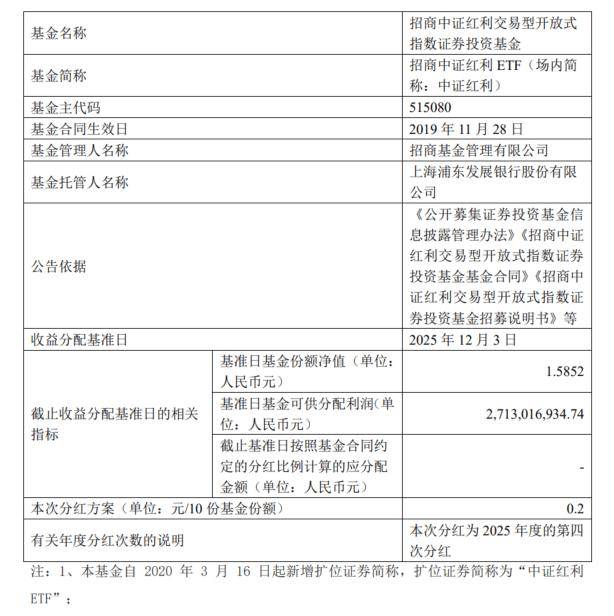
中证红利ETF(515080)发布年内第四次分红公告,每十份分红0.2元,年内累计分红4.21%
Sou Hu Cai Jing· 2025-12-15 02:09
Group 1 - The core point of the news is that the China Securities Dividend ETF (515080) announced its fourth dividend distribution for the year, amounting to 0.2 yuan per ten shares, with a dividend ratio of 1.26% [1] - This marks the 15th dividend distribution since the ETF's inception, with a total cumulative dividend of 3.85 yuan per ten shares [1] - The cumulative dividend ratio for the ETF in 2025, including this distribution, is 4.21% [1] Group 2 - As of December 12, the ETF has seen a net subscription of 342 million yuan over the past five days, and a total net inflow of 871 million yuan over the past 20 days [3] - The market outlook suggests that there may be a moderate improvement in micro liquidity, with a recommendation to focus on financial and dividend sectors as a base for long-term investments [3] - The suggestion is to remain cautious of external disturbances while positioning for potential opportunities as new capital flows in [3]
中金-银行:理财2026年展望:存款搬家、资产配置新叙事
中金· 2025-12-15 01:55
Investment Rating - The report provides a positive outlook for the wealth management industry, projecting an 8% growth in 2026, with potential expansion to 36 trillion yuan, and possibly up to 37.4 trillion yuan if market conditions improve [12][14]. Core Insights - The wealth management industry is expected to benefit from the trend of deposit migration and the release of existing floating profits, leading to unexpected growth in 2025 [3][14]. - In 2026, wealth management institutions will have opportunities for multi-asset allocation and a further decline in household savings rates, but they will also face pressure from valuation adjustments [3][4]. - The report emphasizes the importance of understanding the changes in residents' risk preferences and the implications for asset allocation, indicating a shift towards more liquid deposits and asset management products [23][39]. Summary by Sections Resident Risk Preferences - The report suggests that in 2026, residents will have a slight increase in risk appetite, leading to a trend of liquid deposits and asset management products [4][23]. - The potential for increased allocation to rights products is noted, although the growth elasticity may not be significant at this stage [4][23]. Deposit Migration Trends - In 2025, the average decline in retail deposit rates was approximately 30 basis points, with a notable slowdown in the growth of fixed-term deposits [4][44]. - The report anticipates that in 2026, 32 trillion yuan of fixed-term deposits will mature, with a re-pricing range of 70-170 basis points, creating conditions for further deposit migration [4][45]. Fund Flow from Excess Savings - The report estimates that from 2020 to 2025, there will be a total of 14.4 trillion yuan in excess savings, with a potential additional 2-4 trillion yuan flowing into non-fixed deposit investment areas in 2026 [5][46]. - A decrease in the savings rate by 1 percentage point could lead to an additional 0.9 trillion yuan in new funds directed towards wealth management, funds, insurance, and real estate [5][46]. Wealth Management Asset Allocation Outlook - The report predicts that pure fixed-income wealth management products will grow by 7.5% to 24.9 trillion yuan in 2026, contributing significantly to the overall growth of the industry [13][14]. - The demand for public fund outsourcing, particularly for bond ETFs and rights funds, is expected to grow rapidly, driven by the need for enhanced returns [13][14]. Valuation Adjustment and Market Conditions - The report highlights that wealth management products will face "true" net value adjustment pressures starting in 2026, which may lead to increased product volatility [11][54]. - The need for wealth management institutions to effectively meet investor demands for stable value growth while managing expectations is emphasized as a key challenge [11][54].
ETF年内扩容超2万亿,四只指数挂钩产品增量破千亿
Sou Hu Cai Jing· 2025-12-14 23:33
Core Insights - The ETF market has experienced significant expansion this year, with a total scale increase exceeding 2 trillion yuan as of December 12 [2][4] - Four specific indices linked to ETFs have seen scale increments surpassing 100 billion yuan each, namely the AAA Technology Innovation Bond Index, CSI 300 Index, SGE Gold 9999 Index, and Hang Seng Technology Index [2][4] - The growth of these ETFs reflects a shift in asset allocation strategies, with different indices catering to diverse risk profiles and investment needs [3][6] Group 1: ETF Market Expansion - The overall ETF market has shown a steady increase in scale, driven by continuous capital inflow across various asset classes including equities, bonds, commodities, and cross-border investments [2][4] - The AAA Technology Innovation Bond ETF has seen a scale increase of approximately 199.2 billion yuan, while the CSI 300 ETF has grown by about 193.5 billion yuan, indicating strong demand for these products [2][3] - The SGE Gold 9999 ETF and Hang Seng Technology ETF have also experienced significant growth, with increments of around 147.6 billion yuan and 113.8 billion yuan respectively [2][4] Group 2: Differentiated Growth Drivers - The growth of the AAA Technology Innovation Bond, Hang Seng Technology, and SGE Gold ETFs is primarily driven by net subscriptions, reflecting active capital allocation towards these assets [3][4] - In contrast, the CSI 300 ETF's expansion is largely attributed to the appreciation of the underlying index, showcasing the direct impact of asset price movements on ETF scale [3][4] Group 3: Asset Class Characteristics - The CSI 300 Index is recognized for its strong representation and suitability for long-term investment, with several fund companies reporting scale increments exceeding 10 billion yuan for their CSI 300 ETFs [4][5] - The Hang Seng Technology Index serves as a high-elasticity investment tool, with multiple ETFs linked to it experiencing rapid growth amid a recovering market for Hong Kong stocks and technology sectors [4][5] - Gold ETFs are positioned for risk hedging and asset diversification, with significant scale increases reported by various fund companies, highlighting their role in portfolio management [4][5] Group 4: Evolving ETF Utilization - The ETF market is evolving, with a clearer distinction in product positioning becoming essential for attracting new capital [7][8] - The introduction of the AAA Technology Innovation Bond ETF underlines the importance of policy support in developing new investment tools, differentiating it from more established indices [5][7] - The diversification of ETF investments is becoming more pronounced, with equity, bond, gold, and cross-border ETFs complementing each other to enhance portfolio stability and adaptability [6][8]
ETF年内扩容超2万亿,四只指数挂钩产品增量破千亿
券商中国· 2025-12-14 23:29
数据显示,截至12月12日,全市场ETF的年内规模增量已超过2万亿元。在此背景下,科创债、沪深300、黄金 及恒生科技等四类指数挂钩ETF,年内规模增量均突破1000亿元,成为ETF扩容过程中最具代表性的结构性样 本。 今年以来,ETF市场扩容显著提速,少数核心指数挂钩产品的规模增长尤为突出。 年内ETF市场延续扩容态势,资金持续流入推动整体规模稳步抬升。数据显示,截至12月12日,今年以来全市 场ETF规模增量已超过2万亿元,在权益、债券、商品及跨境等多个方向均有体现,ETF作为重要资产配置工 具的吸引力不断增强。 在整体扩容的背景下,部分指数对应ETF产品的规模增长尤为突出。券商中国记者注意到,今年以来,有4个 指数挂钩的ETF产品合计规模增量均超过1000亿元,分别为中证AAA科技创新公司债指数(AAA科创债指 数)、沪深300指数、SGE黄金9999指数以及恒生科技指数。 券商中国记者注意到,上述指数覆盖债券、权益、商品及跨境资产,风险属性与配置逻辑差异明显。在多类资 产并行扩容的过程中,ETF作为配置工具的使用方式正在发生变化,不同指数、不同产品在满足多层次配置需 求中的作用逐步显现。 其中,AAA ...

锐联景淳许仲翔: 深耕多元资产策略 把握中国市场长期机遇
Zhong Guo Zheng Quan Bao· 2025-12-14 20:29
作为知名外资私募锐联景淳海外母公司锐联的创始人,许仲翔博士在量化投资与资产配置领域一直扮演 着连接东西方市场的桥梁角色。从联合发明基本面量化策略(RAFI),到带领锐联深耕中国市场,再到8 年前锐联向华夏基金等公募机构进行策略授权,这位兼具深厚学术背景与全球资产管理经验的学者型投 资人,其观点备受市场关注。近日,许仲翔接受了中国证券报记者的专访,围绕公司的策略实践、2026 年市场前瞻及行业变革等议题,发表了自己的看法。 多元资产策略获市场认可 回顾2025年,许仲翔将公司最大的突破归结于核心策略——量化多元资产配置策略获得了市场的理解与 接纳。"过去一两年,这类配置型产品因其复杂性,投资者接受需要一个过程。"许仲翔坦言,市场环境 的变化成为了理念普及的催化剂。利率持续低位徘徊、传统"刚兑"理财消失、股市起伏震荡,这些因素 让投资者意识到,没有任何单一资产品种能持续获得收益。 "当市场处于单边趋势时,大家会追逐简单的贝塔;当有保底产品时,保守者也无需他求。但现在,我 们进入了一个'真正的大资管时代'。"许仲翔说,市场的波动不断告诉投资者:因为难以精准预测每一 类资产的涨跌,因此必须接受"通过科学配置将不同资产 ...
ETF规模年内涨逾两万亿元 四只指数挂钩产品增量均破千亿
Zheng Quan Shi Bao· 2025-12-14 18:19
今年以来,ETF市场扩容显著提速,少数核心指数挂钩产品的规模增长尤为突出。 数据显示,截至12月12日,全市场ETF的年内规模增量已超过2万亿元。在此背景下,科创债、沪深 300、黄金及恒生科技等4类指数挂钩ETF,年内规模增量均突破1000亿元,成为ETF扩容过程中最具代 表性的结构性样本。 证券时报记者注意到,上述指数覆盖债券、权益、商品及跨境资产,风险属性与配置逻辑差异明显。在 多类资产并行扩容的过程中,ETF作为配置工具的使用方式正在发生变化,不同指数、不同产品在满足 多层次配置需求中的作用逐步显现。 ETF市场持续扩容 4只指数均带出千亿增量 恒生科技指数则更多承担海外高弹性配置工具的角色。随着年内港股及科技板块行情回暖,多只挂钩恒 生科技指数的ETF规模快速增长,华夏、华泰柏瑞、易方达、大成等基金公司旗下的恒生科技ETF年内 规模增量均超过百亿元。其中,华夏恒生科技ETF年内管理规模增长257.5亿元。 黄金类ETF主要承担风险对冲与资产分散配置功能。年内,华安、博时、国泰等基金公司管理的黄金 ETF规模增量超过百亿元。以华安黄金ETF为例,该产品年内规模增长达到619.53亿元,今年增量占目 前 ...
金价要变天了?多信号暗示“历史重演”,还在观望的人可能要后悔!
Sou Hu Cai Jing· 2025-12-14 18:12
一、价差离谱!买黄金别当冤大头 现在买黄金跟开盲盒似的,不同渠道价格差得能让人惊掉下巴。伦敦盘报 4208 美元一盎司,国内黄金 T+D 每克 950 多,品牌店直接飙到 1328,深圳水贝 批发才 1100。两百多的差价,居然还有人说不贵,这心是得有多大? 有人说这是品牌溢价,这话没毛病,但溢价也得有个谱。品牌店的工费、房租、营销费都得摊进去,可这两百多的差价,跟花高价买流量却不用免费 WiFi 一个道理。水贝做批发的,走货快、利润薄,渠道成本低;银行金条价格实在,手续透明,适合踏实储值的人;品牌店卖的是颜值和仪式感,送礼、做首饰 没问题,要是想靠它保值,可别把情怀当资产算。 最后是央行疯狂加仓。中国央行已经连续十三个月增持黄金,全球央行加起来买了五十多吨,更关键的是,九成五的央行还打算继续买。央行可不是短线炒 作的散户,它们买黄金是为了调整外储结构,找个战略安全垫。这些 "大玩家" 都在悄悄上车,普通人可得看懂这背后的信号。 光有基本面还不够,技术面和资金面也在给黄金 "站台"。 从技术形态来看,黄金月线走势跟 2001 年那波行情开头特别像。那波行情不是猛涨的火箭,而是慢悠悠涨了十年的慢牛,看着不刺激, ...

曾经有一次美联储意外降息50点,却引发恐慌情绪,为什么?
Sou Hu Cai Jing· 2025-12-14 16:23
隔夜美联储突然宣布降息50个基点,美股却出现暴跌,黄金出现暴涨行情。美股为什么不上涨而是暴跌 呢? 虽然外围重挫,但从今天开盘来看,我们大A股还算是顽强的抗住了,小幅低开高走且量能急速缩减, 市场筹码仍然比较安稳,今天大幅下跌的概率较低,轻指数重个股。大基建(水泥,建材,建筑装饰) 强势卷土重来,在回调的过程中伺机低吸是相对安全的,大家多注意。 【外围影响】隔夜美联储虽然宣布降息,但市场并不买账,美股冲高回落,大幅收阴。这对A股也是利 空,今天指数大概率还会有下探,注意控制风险。建议个股仓位要降一降,保住利润;同时配置股指期 货的空单,对冲风险,通过机制优势和资产配置来扩大盈利。 ...

公募“固收+”业绩分化基金公司强化资产配置能力
Shang Hai Zheng Quan Bao· 2025-12-14 15:30
Group 1 - The core viewpoint of the articles highlights the growing popularity and performance differentiation of "fixed income plus" products in the investment market, with a significant increase in total market size and varying returns among different products [1][2]. - As of the end of Q3, the total market size of "fixed income plus" products reached 2.44 trillion yuan, an increase of over 500 billion yuan from the end of Q2, and a rise of 1.11 trillion yuan compared to the same period in 2024 [1]. - The average net value growth rate of "fixed income plus" products over the past year was 5.05%, with the top-performing product, Huazhang Zhilian LOF, achieving a net value growth of 50.40% [1]. Group 2 - Investors are increasingly favoring "fixed income plus" products due to declining interest rates and a growing demand for stable financial arrangements amid an aging population [2]. - The key to enhancing "fixed income plus" products lies in the strategic addition of various asset types, moving beyond simple stock-bond combinations to include diverse assets for better risk management and yield enhancement [2][3]. - The strategic asset allocation for "fixed income plus" products should consider market volatility and the current economic transition, focusing on controlling fluctuations while identifying investment opportunities in traditional cyclical sectors [3]. Group 3 - Three critical factors for large asset allocation in "fixed income plus" products include the development of AI technology and its impact on financial markets, changes in price levels, and geopolitical factors that are closely tied to industries like AI computing power [4].