物理AI

Search documents
太平洋证券:继续重视新能源龙头 新方向提供弹性
智通财经网· 2025-09-01 01:40
Group 1: New Energy Vehicle Industry Chain - The new cycle in the downstream smart electric vehicle sector has begun, benefiting companies like CATL and Eve Energy. Strong product capabilities in the supply chain are emphasized, with XPeng's vehicle deliveries reaching 197,200 units in the first half of the year, a year-on-year increase of 279%. The second quarter saw over 100,000 deliveries, a record high, with projected deliveries for Q3 2025 estimated between 113,000 to 118,000 units, representing a year-on-year growth of approximately 142.8% to 153.6% [1][2] Group 2: Performance of New Energy Leaders - The upward inflection point in the performance of new energy leaders is being confirmed, with companies like Putailai and Xinwanda benefiting. Putailai achieved a net profit of 999.2 million yuan in the first half of 2025, a year-on-year increase of 29.17%, with cash flow from operating activities reaching 1.223 billion yuan, up 439.11%. The revenue from the new energy automation equipment business was 1.844 billion yuan, with new orders exceeding 2.4 billion yuan [2] Group 3: Photovoltaic and Energy Storage Industry Chain - The leading companies in the photovoltaic and energy storage sectors are expanding their businesses, with beneficiaries including Sungrow, Haibo Technology, and Canadian Solar. Sungrow's net profit for the first half of 2025 was 7.735 billion yuan, a year-on-year increase of 55.97%, with R&D investment of 2.037 billion yuan, up 37.08%, and overseas business revenue accounting for 58.30% [3] Group 4: AI and New Energy, Wind Power Industry Chain - The synergy between new energy and humanoid robots is gaining momentum, benefiting companies like Zhenyu Technology and Zhejiang Rongtai. Zhenyu Technology reported a net profit of 211 million yuan in the first half of 2025, a year-on-year increase of 60.45%, with R&D investment of 165 million yuan, up 36.76% [4] - Wind power companies are expected to exceed expectations, with companies like Dajin Heavy Industry and Yunda Co. benefiting. Dajin Heavy Industry achieved a net profit of 547 million yuan in the first half of 2025, a year-on-year increase of 214.32%, with nearly 3 billion yuan in orders signed this year [5]

机械行业周报:看好人形机器人、可控核聚变和农机
Xin Lang Cai Jing· 2025-08-31 06:46
Market Overview - The SW Machinery Equipment Index increased by 1.01% during the trading days from August 25 to August 29, 2025, ranking 13th among 31 primary industry classifications [1] - Year-to-date, the SW Machinery Equipment Index has risen by 30.41%, ranking 6th among the same classifications, while the CSI 300 Index has increased by 14.28% [1] Core Insights - NVIDIA's latest release, Jetson Thor, is a high-performance computing platform designed for physical AI and robotics, enabling the evolution of "robot brains" [2] - Jetson Thor supports multiple AI models, including large language models (LLM), visual language models (VLM), and visual language action models (VLA), establishing a hardware foundation for multi-modal perception and decision-making in robots [2] - This release represents a significant leap in hardware performance and a systematic upgrade of NVIDIA's robotics ecosystem strategy, creating a complete ecosystem from underlying chips to upper-level applications [2] - Investment opportunities are suggested in the core supply chain of the robotics industry and new technology directions [2] Fusion Energy Sector - CFS, a U.S. nuclear fusion energy startup, announced $863 million in funding, with NVIDIA as an investor, bringing its total funding to approximately $3 billion, accounting for one-third of global fusion energy financing [3] - CFS aims to achieve a key technology milestone by 2027, paving the way for its commercial fusion power plant development in Virginia [3] - Investment focus is recommended on companies related to high-temperature superconducting materials and magnets, as well as opportunities driven by bidding in the nuclear fusion sector [3] Agricultural Machinery - July tractor production data shows improvement, indicating potential recovery in agricultural machinery demand [3] - In July 2025, large and medium tractor production was 0.57 and 1.41 million units, with year-on-year changes of -10.8% and +9.4%, respectively [3] - The monthly production decline for large tractors has been narrowing since May, while the year-on-year growth for medium tractors has been expanding, suggesting the worst period for the industry may be over [3] - Grain prices are expected to rebound, which could drive a recovery in agricultural machinery demand [3] Industry Performance Indicators - General machinery remains under pressure, while engineering machinery is accelerating upward [4] - Shipbuilding is experiencing a slowdown, oil service equipment is stabilizing at the bottom, railway equipment is steadily increasing, and gas turbines are also showing steady growth [4]

国务院发布“人工智能+”行动;马斯克成立「巨硬」针对微软?机器人界最强大脑出世|混沌AI一周焦点
混沌学园· 2025-08-30 12:02
Core Insights - The article emphasizes the comprehensive promotion of the "Artificial Intelligence +" initiative by the State Council, aiming to position AI as a core engine of new productive forces through systematic planning and targeted policies across six key areas [3][4][6]. Summary by Sections 1. Core Principles and Positioning - The action plan focuses on a people-centered approach, leveraging China's unique advantages in data, industrial scale, and application scenarios. It emphasizes forward-looking planning and systematic layout while encouraging open sharing under safe and controllable conditions [3]. 2. Roadmap and Goals - By 2027, the plan aims for over 70% penetration of new-generation smart terminals and applications in six key areas [4]. - By 2030, this penetration is expected to exceed 90% [5]. - By 2035, the initiative aims to propel China into a new stage of intelligent economy and society [6]. 3. Six Core Action Areas - The initiative will focus on six major areas: technology, industry, consumption, livelihood, governance, and global cooperation [8]. 4. User Application Layer - The plan aims to develop both service and product ecosystems, creating a seamless, integrated interaction experience through smart assistants and various smart terminal products [9]. 5. Technology Supply Layer - Eight key supports will be established to enhance model capabilities, data supply, intelligent computing power, application environments, open-source ecosystems, talent cultivation, policy frameworks, and safety capabilities [10][14]. 6. Industry Implementation Path - Enterprises are encouraged to deeply integrate AI into their strategies and operations, fostering "intelligent native" technologies, products, and services [11]. 7. Implementation Mechanism - The initiative will be coordinated by the National Development and Reform Commission, with local adaptations and specific implementation plans developed by various departments [12]. 8. Technological Innovation - The initiative promotes deep integration of AI with scientific and technological advancements, accelerating industrial intelligence development, enhancing consumer product quality, and improving social governance [13]. 9. Key Industry Trends - The article highlights the need for entrepreneurs to focus on specific vertical opportunities rather than broad approaches, aligning policy benefits with industry expertise to address concrete pain points [33]. - It discusses the necessity for startups to choose between building platform ecosystems or specializing in niche markets to compete against giants like Google [34]. - The evolution of visual AI technology is noted, with opportunities shifting from entertainment to deeper industrial applications [35]. - The article suggests a pragmatic approach to AI employee deployment, advocating for a "human in the loop" model to gradually increase AI's role in business processes [36]. - The hardware foundation for "physical AI" is established, opening new opportunities for domestic manufacturers to innovate in robot applications and core components [37].


人形机器人,需要多少算力?
创业邦· 2025-08-30 10:08
Core Viewpoint - The article discusses the advancements in humanoid robots, particularly focusing on the significant increase in edge computing power provided by NVIDIA's Jetson T5000, which boasts a computing power of 2070 TFLOPS, enabling more efficient AI inference and real-time processing of multimodal sensor data [6][10][15]. Group 1: Technological Advancements - NVIDIA's Jetson series has evolved from the initial Jetson TK1 with less than 1 TFLOPS to the current Jetson AGX Thor with 2070 TFLOPS, marking a significant leap in computational capabilities for robotics [11][13]. - The Orin series, with 100 TFLOPS, has become a foundational AI computing platform for many humanoid robots in China, showcasing the growing importance of computational power in the robotics sector [15][19]. Group 2: Industry Leaders and Their Impact - Elon Musk and Jensen Huang are highlighted as key figures in the resurgence of humanoid robots, with Musk's announcement of entering the humanoid robot space and Huang's continuous enhancement of computing platforms [7][10]. - Huang's vision for NVIDIA extends beyond traditional AI into the realm of "Physical AI," indicating a broader ambition for the company's role in robotics [15][19]. Group 3: Current Capabilities and Future Directions - Most humanoid robots currently utilize edge computing power in the range of 100-200 TFLOPS, which is sufficient for basic tasks like grasping and sorting [17][19]. - The article suggests a shift towards smaller models for AI processing, as demonstrated by Boston Dynamics' Atlas robot, which uses a 450 million parameter model to efficiently handle tasks while reducing computational load [21][22].

索辰科技(688507):系列报告(二):物理AI风起,赋能机器人及低空多维场景
Xinda Securities· 2025-08-29 09:07
Investment Rating - The investment rating for the company is "Buy" [3] Core Viewpoints - The report highlights that the company is leading the development of physical AI with five core technologies that enhance product innovation and operational efficiency [5][8] - The company aims to leverage physical AI in various sectors, including robotics, low-altitude flying vehicles, and renewable energy, showcasing significant advancements and applications [5][8] Summary by Relevant Sections Company Overview - The company,索辰科技 (688507), is positioned in the rapidly evolving field of physical AI, focusing on enhancing robotics and low-altitude scenarios [5][8] Financial Projections - Projected total revenue for 2025, 2026, and 2027 is estimated at 5.15 billion, 6.93 billion, and 9.11 billion yuan respectively, with year-on-year growth rates of 36.1%, 34.4%, and 31.4% [7][8] - Expected net profit attributable to the parent company for the same years is projected at 1.08 billion, 1.38 billion, and 1.64 billion yuan, with corresponding P/E ratios of 84.1, 65.7, and 54.8 [7][8] Technological Advancements - The company has developed a virtual training platform that integrates physical AI, significantly reducing training costs and improving efficiency in robotic training [5][12] - In the low-altitude flying vehicle sector, the company has created a three-dimensional physical map that can generate real-time data on wind and electromagnetic fields, enhancing flight safety [5][19][20] - The physical AI wind power platform showcased at the World Artificial Intelligence Conference demonstrates the company's capabilities in optimizing wind energy systems through advanced algorithms [5][26][27] Stock Performance - The company's stock closed at 102.1 yuan, with a market capitalization of approximately 90.98 billion yuan and a 52-week price range of 38.21 to 124 yuan [5]

英伟达推出“Thor”,谁赚了?
Tai Mei Ti A P P· 2025-08-29 07:57
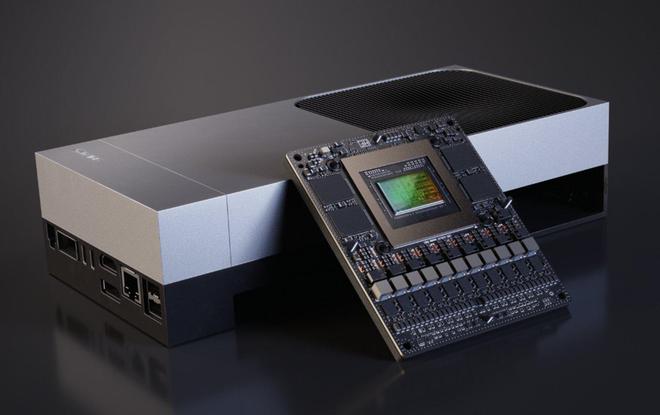
Core Insights - NVIDIA has launched Jetson Thor, a high-performance computing platform designed for physical AI and humanoid robots, which is being referred to as the "new brain for robots" [1][2][4] - Jetson Thor is based on the Blackwell architecture, offering significant performance improvements, including 2070 TFLOPS of AI computing power, which is 7.5 times that of the previous Orin series and 7000 times that of products from a decade ago [2][4] - The platform aims to create a unified computing architecture from cloud to edge, significantly reducing development complexity and accelerating the evolution of robotic technology [4][12] Performance and Efficiency - Jetson Thor boasts a 3.5 times improvement in energy efficiency, allowing developers to achieve more computational capabilities within limited power budgets, which is crucial for mobile robotic platforms [2] - The memory configuration includes 128GB LPDDR5X and a bandwidth of 273GB/s, supporting 100Gbit/s Ethernet [2] Market Positioning - NVIDIA positions Jetson Thor as an essential component for robot development, alongside its DGX systems for AI model training and the Omniverse platform for simulation testing, creating a closed-loop ecosystem [2][4] - The starting price for the Jetson Thor kit is $3,499, maintaining NVIDIA's strategy of providing top-tier hardware for high-performance computing while ensuring ecosystem partners can achieve sufficient returns [4] Ecosystem and Developer Engagement - The NVIDIA Jetson platform has attracted over 2 million developers and has a growing ecosystem of over 150 hardware systems, software, and sensor partners [5] - The launch of Jetson Thor comes at a time when the robotics industry is experiencing significant investment activity, with 88 financing events in the first half of 2025, a nearly 80% year-on-year increase [7] Strategic Intent - NVIDIA's introduction of Thor is aimed at capturing the emerging humanoid robot market, which is currently fragmented, by establishing itself as a standard provider through its hardware and software ecosystem [8][12] - The company is betting on the "physical AI" era, which includes systems that interact with the real world, such as robots and autonomous vehicles, with a focus on real-time understanding and decision-making capabilities [12][13] Competitive Landscape - The launch of Jetson Thor poses challenges for competitors like Qualcomm, Huawei, and Horizon, who may not remain passive in response to NVIDIA's strong market entry [16] - The increasing reliance on NVIDIA's technology may create pressure on other robotics manufacturers, as the performance of their products may become standardized around NVIDIA's capabilities [18] Industry Implications - The introduction of Jetson Thor may lead to a new phase of competition in the robotics industry, where the focus shifts from hardware performance to algorithm innovation and application commercialization [18] - Concerns arise for Chinese robotics manufacturers regarding the dependency on foreign chips, as geopolitical tensions may pose risks to their supply chains and operational stability [19]
索辰科技(688507):“天工+开物”双轮驱动业绩向好,收并购、合作事项持续良好推进
Great Wall Securities· 2025-08-29 03:10
Investment Rating - The report maintains a rating of "Accumulate" for the company [4] Core Viewpoints - The company's revenue growth is primarily driven by the engineering simulation software, with the TianGong series experiencing a year-on-year revenue increase of 88.84%, contributing to improved gross margins [2] - The company is actively exploring and expanding downstream application scenarios, accelerating the development of the physical AI industry, which has started to generate revenue [2] - Ongoing mergers and acquisitions, including the planned acquisition of Likong Technology, and strategic partnerships with iFlytek and the China Academy of Information and Communications Technology, are expected to enhance the company's technical service capabilities and market presence [3] Financial Summary - For the fiscal year 2023, the company reported a revenue of 320 million yuan, with a year-on-year growth rate of 19.5%. The projected revenues for 2025, 2026, and 2027 are 535 million yuan, 758 million yuan, and 1,078 million yuan, respectively, with growth rates of 41.1%, 41.7%, and 42.2% [9] - The net profit attributable to the parent company for 2023 was 57 million yuan, with a projected increase to 96 million yuan in 2025, 124 million yuan in 2026, and 147 million yuan in 2027, reflecting growth rates of 130.6%, 30.2%, and 17.9% respectively [9] - The report forecasts an EPS of 1.07 yuan for 2025, 1.40 yuan for 2026, and 1.65 yuan for 2027, with corresponding P/E ratios of 95.2X, 73.1X, and 62.0X [8]
英伟达(NVDA):FY26Q2财报点评:GB系列产品出货、量产积极,网络连接收入显著加速
Guoxin Securities· 2025-08-29 02:27
Investment Rating - The investment rating for the company is "Outperform the Market" [7] Core Insights - The company reported strong financial performance in FY26Q2, with revenue of $46.743 billion, a year-over-year increase of 56% and a quarter-over-quarter increase of 6%, exceeding the previous guidance of $45 billion [1][12] - The data center revenue reached $41.1 billion, up 56% year-over-year and 5% quarter-over-quarter, driven by significant growth in network connectivity revenue [1][13] - The company has raised its revenue expectations for FY26-28, projecting revenues of $205.6 billion, $271.4 billion, and $306.6 billion respectively, along with net profits of $102.7 billion, $146.9 billion, and $168.3 billion [3][4] Financial Performance - For FY26Q2, the company achieved a GAAP gross margin of 72.4%, with operating profit increasing by 53% to $28.4 billion and GAAP net profit rising by 59% to $26.4 billion [1][12] - The company expects FY26Q3 revenue to be around $54 billion, with a gross margin target of approximately 75% by year-end [24] Business Segments - Data Center: Revenue of $41.1 billion, with a strong contribution from network connectivity and cabinet sales [13] - Gaming: Revenue of $4.3 billion, benefiting from the continued sales of Blackwell architecture graphics cards [21] - Professional Visualization: Revenue of $601 million, driven by high-end workstation GPUs and AI workloads [21] - Automotive: Revenue of $586 million, primarily from sales growth in autonomous driving platforms [21] Market Trends - The global data center infrastructure investment is expected to reach $600 billion by 2025 and could grow to $3-4 trillion by 2030, driven by the surge in demand for AI [2][11] - The company aims to transition from a "GPU manufacturer" to an "AI infrastructure service provider" [11][12]
索辰科技(688507):物理AI产品开始体现收入,商业化进展加速
Shenwan Hongyuan Securities· 2025-08-28 09:41
Investment Rating - The investment rating for the company is "Buy" (maintained) [2] Core Insights - The company has shown a significant acceleration in the commercialization of its physical AI products, with expected revenue from these products reaching 30 million in 2025 and 50 million in 2026 [7] - The company reported a total revenue of 57.35 million in H1 2025, reflecting a year-on-year growth of 10.8%, and a narrowed net loss of 45.7 million compared to a loss of 66.43 million in the same period last year [7] - The company is focusing on two main product lines: "Tiangong" for traditional CAE software and "Kaimu" for physical AI-related products, with the latter generating 3.75 million in revenue in H1 2025 [7] Financial Data and Profit Forecast - Total revenue projections are as follows: 604 million for 2025, 850 million for 2026, and 1,105 million for 2027, with corresponding year-on-year growth rates of 59.5%, 40.7%, and 30.0% respectively [6] - The forecasted net profit for 2025 is 81 million, with a significant increase of 96.2% compared to the previous year, followed by 120 million in 2026 and 160 million in 2027 [6] - The company’s gross margin is expected to remain strong, with estimates of 72.4% in 2025, 73.9% in 2026, and 74.2% in 2027 [6] Market Position and Competitive Advantage - The company is leveraging its advanced physical AI capabilities to expand into various simulation scenarios, including lightning warning systems and wind power design efficiency optimization [7] - The development of a low-altitude three-dimensional map for real-time navigation and simulation training is expected to enhance the company's market position, with a contract already signed with Hangzhou Industrial Investment Group [7] - The company emphasizes its advantage in physical solving capabilities, positioning itself well in the emerging trend of physical AI commercialization [7]
东北证券:机器人训练向虚实融合、AI驱动通用化训练范式演变 物理AI大有可为
智通财经网· 2025-08-28 07:49
Group 1 - The robotics training industry is evolving from industrial customization to a virtual-physical integration and AI-driven universal training paradigm [1][2] - Early robotics training relied heavily on physical devices for specific scene training, but advancements in AI and simulation technology are shifting this focus towards virtual environments [2] - The current phase of the robotics industry is moving towards full-scene coverage driven by embodied intelligent large models, emphasizing the importance of training both the robotic brain and nervous system [2] Group 2 - Generative AI is reshaping the training paradigm, significantly enhancing data generation efficiency [3] - Generative AI allows users to quickly create new content based on various inputs, transitioning the data requirement from "data collection" to "data generation" [3] - Models like NVIDIA's Dream Gen and Qunke Technology's Spatial LM can generate diverse training data from a small number of samples, reducing data acquisition costs by 80% [3] Group 3 - Physical AI is transforming the underlying logic of robotics training from reliance on real data ("empiricism") to a basis in physical laws ("rationalism") [4] - NVIDIA is building a complete ecosystem from cloud training to edge deployment, facilitating the transition of physical AI from laboratory settings to industrial, medical, and domestic applications [4] - The integration of embodied intelligent large models with edge computing will enable robots to penetrate various human activities, aiming for the ultimate goal of thinking like humans but executing tasks more efficiently [4]