
生成式人工智能

Search documents
ServiceNow:生成式人工智能熊市或将到来
美股研究社· 2025-08-04 12:45
Core Viewpoint - ServiceNow has demonstrated exceptional execution and resilience against growth slowdown, positioning itself as a leader in the software industry with strong GAAP profitability, although analysts express concerns about the overall software sector outlook due to potential negative impacts from generative AI [1][3][15]. Financial Performance - In the most recent quarter, ServiceNow's subscription revenue grew by 22% year-over-year, reaching $3.113 billion, exceeding the highest forecast of $3.035 billion by 2.6% [6]. - The current remaining performance obligation (RPO) increased by 24.5% year-over-year, surpassing both the previous year and the last quarter's growth of 22% [7]. - The non-GAAP operating margin was reported at 29.5%, exceeding the expected 27%, while the company maintained profitability on a GAAP basis [8]. - The company ended the quarter with $10.7 billion in cash and investments against $1.5 billion in debt, indicating a strong net cash balance sheet [10]. Future Guidance - Management anticipates a 20.5% year-over-year growth in subscription revenue for Q3, slightly raising the full-year growth forecast to 20% [10]. - For Q3 2025, subscription revenues are projected between $3.260 billion and $3.265 billion, reflecting a growth of 20% to 20.5% [11]. - Full-year 2025 subscription revenue guidance is set at $12.775 billion to $12.795 billion, maintaining a growth rate of 20% [11]. Market Position and Valuation - ServiceNow's stock currently trades at a price-to-earnings ratio of approximately 55, with a projected P/E ratio of about 13 by 2034 [12]. - Analysts have noted that the company's growth expectations are more favorable compared to its peers, which appear to be reaching their peak [14]. - Despite the strong performance, the high valuation raises concerns about potential stock price declines, especially with the anticipated impact of generative AI on the software industry [15][16].



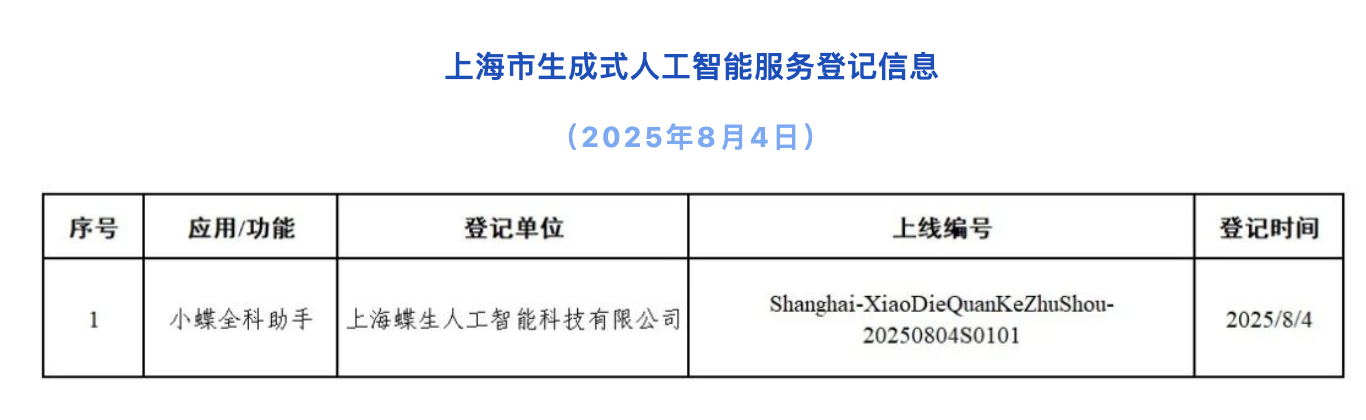
上海市新增1款已完成登记的生成式人工智能服务
Zheng Quan Shi Bao Wang· 2025-08-04 12:16
| 序号 | 应用/功能 | 登记单位 | 上线编号 | | --- | --- | --- | --- | | | 小蝶全科助手 | 上海蝶生人工智能科技有限公司 | Shanghai-XiaoDieQuanKeZhuSho 20250804S0101 | 人民财讯8月4日电,据"网信上海"公众号消息,截至8月4日,上海市新增1款已完成登记的生成式人工智能服务,累计已完成101款生成式人工智能服务登 记。 ...
直播电商“兴趣产业带”为实体经济发展注入新活力
Zhong Guo Xin Wen Wang· 2025-08-04 10:10
Group 1 - The core viewpoint is that short video and live streaming e-commerce platforms, such as Douyin, are becoming dominant organizational methods in the digital economy, enabling physical businesses to break spatial and temporal limitations and provide higher quality products and services through digital means [1][2] - The integration of live streaming e-commerce with "interest industry belts" significantly reduces transaction costs and enhances profitability for traditional manufacturing enterprises, allowing them to respond quickly to consumer demands and trends [3][4] - Live streaming e-commerce empowers "interest industry belts" by creating new consumption models and connecting supply and demand, enabling manufacturers to better target niche markets and adapt to changing consumer preferences [4][5] Group 2 - Short video and live streaming platforms help manufacturing enterprises build their own brands and meet new consumer demands by offering personalized products and enhancing consumer trust through direct content presentation [5] - The rise of "interest industry belts" driven by live streaming e-commerce fosters the development of new brands and stimulates diverse consumer needs, contributing to the overall growth of the digital economy [2][4]
苹果新成立“Answers”团队 计划推出精简版的ChatGPT竞品
Huan Qiu Wang Zi Xun· 2025-08-04 06:24
Core Insights - Apple has established a new team called "Answers" to develop a streamlined version of a ChatGPT competitor [1][3] - The company previously stated it would not create its own chatbot, opting instead to integrate ChatGPT into Siri [3] - Despite initial skepticism from some executives, Apple is moving towards creating a new search experience similar to ChatGPT [3][4] Group 1 - Apple is exploring a range of internal AI services aimed at creating a new search experience akin to ChatGPT [3] - The new team is focused on enhancing information experiences for key Apple products such as Siri, Spotlight, and Safari [4] - Job postings for the new team highlight the need for experience in search algorithms and engine development [4]


康宁二季度业绩超预期
Zhong Guo Hua Gong Bao· 2025-08-04 06:18
展望第三季度,管理层预计"Springboard"计划将继续推动卓越表现,核心销售额将实现两位数同比增 长,达到42亿美元,收益增速将再次快于销售额增速,核心每股收益预计在0.63美元至0.67美元之间。 康宁公司董事会主席兼首席执行官魏文德表示:"我们在第二季度取得了卓越业绩,核心销售额同比增 长12%,达到40.5亿美元,核心每股收益的增速更是超过核心销售额增长率的两倍,达到0.60美元。整 体来看,关键的长期结构性趋势以及我们的'More Corning'战略推动了市场对康宁解决方案的需求,我 们得以持续实现升级版'Springboard'计划所设定的强劲盈利增长目标。" 中化新网讯 近日,康宁公司公布2025年第二季度财务业绩。其第二季度业绩超出预期:核心销售额同 比增长12%,核心运营利润率扩大160个基点,核心每股收益同比增长28%,调整后的自由现金流同比 增长28%。这一业绩得益于市场对生成式人工智能新产品的持续强劲需求,公司光通信企业业务销售额 同比增长81%。 ...

科技创新和产业创新如何深度融合促进高质量发展?
Si Chuan Ri Bao· 2025-08-03 22:12
Core Viewpoint - The deep integration of technological innovation and industrial innovation is essential for promoting high-quality development and represents a strategic choice to seize opportunities in the new round of technological revolution and industrial transformation [1][2][3] Group 1: Importance of Integration - Technological innovation serves as the source and driving force for industrial innovation, while industrial innovation acts as the carrier and goal for technological innovation [1][2] - The integration of technological and industrial innovation is crucial for building a modern industrial system and achieving high-quality development [3][6] Group 2: Current Context and Challenges - The current period is marked by a surge in technological innovation, particularly with the large-scale application of generative artificial intelligence, which accelerates the integration of technology and industry [2][3] - External pressures, such as technological blockades from Western countries, necessitate a focus on enhancing the resilience of industrial and supply chains through deep integration [2][3] Group 3: Characteristics of Deep Integration - The integration is characterized by a non-linear, complex innovation process that breaks traditional linear models, fostering a dynamic interaction between technology and industry [3][4] - The collaboration among diverse innovation entities, including enterprises, universities, and research institutions, is essential for creating a synergistic innovation ecosystem [4][5] Group 4: Key Pathways for Integration - Establishing an efficient innovation sourcing system is vital, focusing on embedding industrial needs into the R&D process to enhance the quality of technological supply [6][7] - Strengthening the role of enterprises as innovation leaders is crucial, encouraging them to collaborate with academic and research institutions to address industry-specific challenges [6][7] - Accelerating the transformation and application of technological achievements is necessary to facilitate the integration of technology and industry [7]
芯原股份: 2025年第二季度经营情况的自愿性披露公告
Zheng Quan Zhi Xing· 2025-08-01 16:13
Group 1 - The company expects to achieve an operating revenue of approximately 584 million yuan in the second quarter of 2025, representing a quarter-on-quarter growth of 49.90% [1] - The company's order backlog is projected to reach 3.025 billion yuan by the end of the second quarter of 2025, marking a 23.17% increase from the end of the first quarter of 2025, and setting a new historical high [1][2] - The revenue growth is primarily driven by an increase in intellectual property licensing fees and volume business revenue, with expected licensing fee revenue of 187 million yuan, a quarter-on-quarter increase of 99.63% and a year-on-year increase of 16.97% [1] Group 2 - The company has been focusing on key application areas such as Chiplet technology and its applications in generative AI and smart driving, while continuously exploring emerging markets and expanding its client base [2] - The order backlog consists of nearly 90% one-stop chip customization business, indicating a significant increase in chip design business orders [2] - The company anticipates a decrease in the proportion of R&D investment as chip design business orders increase, with an estimated conversion rate of orders within one year being significant [2]

减少现金增持黄金,三成亚太区家族办公室拟增加对大中华区投资
Hua Xia Shi Bao· 2025-08-01 12:39
Core Insights - The report from UBS indicates a shift in asset management strategies among ultra-high-net-worth clients, with a notable decrease in cash holdings and an increased interest in gold and alternative investments [2][6] Group 1: Family Office Trends - The average net worth of surveyed family offices reached $2.7 billion, with total assets under management amounting to $651 billion [2] - Family offices plan to hold only 6% of their assets in cash by 2025, reflecting a desire to invest more in global assets [2] - 21% of family offices globally plan to increase their allocation to gold and precious metals, a significant rise from the 10%-16% range observed in the past five years [2] Group 2: Investment Allocation - In the U.S., alternative investments constitute 54% of family office portfolios, with private equity at 27% and real estate at 18% [5] - Swiss family offices allocate 56% to traditional assets, with 34% in stocks and 13% in fixed income, while 44% is directed towards alternative assets [5] - North America is the preferred region for family office investments, accounting for 55% of allocations, followed by Western Europe at 21% and the Middle East at 14% [5] Group 3: Motivations Behind Investment Shifts - The decline in cash holdings and the increase in gold investments are driven by low interest rates and geopolitical instability, making gold an attractive option for wealth preservation [6] - The current 4% interest rate on USD deposits is no longer appealing to ultra-high-net-worth clients, leading them to seek greater appreciation potential in gold and alternative investments [6] Group 4: Interest in Chinese Assets - 35% of family offices plan to increase investments in the Asia-Pacific region over the next five years, with 30% targeting Greater China [7] - 39% of family offices intend to boost their investments in China within the next 12 months, indicating a growing interest in the Chinese market [7] - There is a consensus among global family offices regarding investment opportunities in sectors like pharmaceuticals and generative AI, with a significant focus on healthcare technology and innovation [7] Group 5: Hong Kong Market Appeal - The Hong Kong stock market has become increasingly attractive to global family offices, particularly due to the strong performance of technology companies listed there [8] - The availability of high-growth A+H listed companies has drawn overseas investors to the Hong Kong capital market [8]


亚马逊(AMZN.US)Q2电话会:对未来发展持乐观态度 公司将继续投入更多资金用于数据中心等基础设施
智通财经网· 2025-08-01 12:26
智通财经APP获悉,亚马逊(AMZN.US)召开2025 年二季度财报电话会。公司第二季度 AWS 业务增长 17.5%,目前年化收入运行率已超过 1230 亿美元。公司持续帮助各类规模的组织加速向云端转型,并 与 PepsiCo、Airbnb、Peloton 等众多公司签订了新的 AWS 协议。在快速发展的生成式 AI 领域,AWS 正在构建一个规模庞大、快速增长(同比增长三位数百分比)、数十亿美元的业务,目前需求量大于所能 提供的供应量。 Q: 能否详细阐释关税在供应商、Amazon 和消费者之间的分摊机制,以及贵公司是否预测未来会有任何 变化? A: 公司目前仍无法确切预知关税的未来走向,尤其是在中国市场的具体实施细则。他指出,当公司为 第一方零售业务预购的商品库存以及第三方销售合作伙伴预先部署的商品耗尽后,情况将如何演变,目 前也难以判断。更关键的是,如果关税导致成本随时间推移而上升,公司目前尚不确定这些额外成本最 终将由供应商、Amazon 自身还是消费者来承担。然而,可以分享的是,根据今年上半年的观察,市场 需求并未出现显著下降,并且平均销售价格(ASP)也没有出现大规模上涨的现象。尽管上半年保持 ...

第二季度全球智能手机平均售价创下同期历史新高
Zheng Quan Shi Bao Wang· 2025-08-01 12:23
Group 1 - The global smartphone market revenue is projected to grow by 10% year-on-year in Q2 2025, surpassing $100 billion for the first time, marking the highest revenue for Q2 in history [1] - The global smartphone shipment volume only increased by 3% year-on-year, indicating a disparity between revenue growth and unit sales [1] - The average selling price (ASP) of smartphones reached a new high for Q2, increasing by 7% year-on-year to nearly $350 [1] Group 2 - Among the top five smartphone brands, all achieved year-on-year revenue growth in Q2 2025, with Apple leading at a 13% increase, capturing 43% of the global smartphone market revenue [1] - OPPO experienced the highest ASP growth among the top five brands, with a 14% increase year-on-year, and its revenue also grew by 10% [1] - Despite macroeconomic challenges, the global smartphone market saw both sales and revenue growth in Q2 2025, driven by relaxed U.S. tariff policies and strong demand for high-end devices in developed markets [2] Group 3 - The trend towards premiumization in the smartphone market is expected to continue, with revenue growth outpacing unit sales growth in 2025 [2] - Emerging trends such as generative AI smartphones and foldable devices are anticipated to create significant growth opportunities for the global smartphone market [2]