
电动化

Search documents
同力股份(834599):非公路宽体自卸车先行者,大型化+电动化+无人化共振驱动矿卡更换需求
Shenwan Hongyuan Securities· 2025-08-13 12:44
Investment Rating - The report initiates coverage with a "Buy" rating for the company [6][7]. Core Views - The company is a pioneer in the non-road wide-body dump truck sector, with a solid industry position and a focus on large-scale, electric, and unmanned vehicles driving demand for mining truck replacements [6][7]. - The company has shown impressive revenue growth, with projected revenues of 6.145 billion yuan in 2024 and 6.961 billion yuan in 2025, reflecting a year-on-year growth rate of 4.9% and 13.3% respectively [2][6]. - The report highlights the significant market potential for electric and unmanned mining trucks, with the market for new energy wide-body dump trucks expected to grow from 1.7 billion yuan in 2023 to 11.2 billion yuan in 2028, representing a CAGR of 45.7% [6][7]. Summary by Sections 1. Company Overview - The company, established in 2005, is the first in China to develop and manufacture non-road wide-body dump trucks, with products widely used in various mining and large engineering projects [6][16]. - The company has maintained a high revenue growth rate, with a CAGR of 22.4% for revenue and 24.15% for net profit from 2020 to 2024 [26]. 2. Market Trends - The trend towards larger, electric, and unmanned vehicles is reshaping the industry, driven by policy changes and economic efficiency [6][37]. - The report emphasizes that the demand for new energy and unmanned mining trucks is expected to increase, with the market for unmanned mining trucks projected to grow significantly from 2025 to 2030 [9][56]. 3. Financial Projections - The company is expected to achieve net profits of 868 million yuan, 963 million yuan, and 1.087 billion yuan for the years 2025 to 2027, respectively [2][7]. - The report anticipates that the company's revenue will reach 69.61 billion yuan in 2025, with a growth rate of 13.3% [7][8]. 4. Competitive Advantages - The company has a strong first-mover advantage in the non-road wide-body dump truck market, with a focus on R&D and collaboration with key partners [6][22]. - The report notes that the company's wide-body dump trucks have a lower unit weight cost compared to traditional mining trucks, making them a more economical choice for mining operations [46][48].

同力股份(834599):非公路宽体自卸车先行者大型化+电动化+无人化共振驱动矿卡更换需求
Shenwan Hongyuan Securities· 2025-08-13 12:42
Investment Rating - The report initiates coverage with a "Buy" rating for the company [6][7]. Core Viewpoints - The company is a pioneer in the non-road wide-body dump truck sector, focusing on large-scale, electric, and unmanned vehicles, which are driving the demand for mining trucks [6][14]. - The company has a strong market position and is expected to benefit from the trends of large-scale, electrification, and automation in the mining industry, with significant growth in revenue and net profit projected for the coming years [6][7][22]. Financial Data and Profit Forecast - Total revenue (in million yuan) is projected to be 6,145 in 2024, with a year-on-year growth rate of 4.9%. For 2025, the revenue is expected to reach 6,961, reflecting a growth rate of 13.3% [2]. - The net profit attributable to the parent company is forecasted to be 793 million yuan in 2024, with a year-on-year growth of 29.0%. By 2025, it is expected to increase to 868 million yuan, a growth of 9.4% [2]. - Earnings per share are projected to be 1.79 yuan in 2024 and 1.88 yuan in 2025 [2]. - The gross profit margin is expected to improve from 21.4% in 2024 to 23.1% in 2027 [2]. Market Data - As of August 13, 2025, the closing price of the company's stock is 23.20 yuan, with a market capitalization of 8,064 million yuan [3]. - The company has a price-to-book ratio of 3.3 and a dividend yield of 3.02% [3]. Industry Trends - The demand for non-road wide-body dump trucks is expected to grow significantly, with the market size for electric wide-body dump trucks projected to increase from 1.7 billion yuan in 2023 to 11.2 billion yuan by 2028, reflecting a compound annual growth rate (CAGR) of 45.7% [6][9]. - The report highlights that the transition to electric and unmanned mining trucks is becoming a necessity due to economic benefits and policy support, with the market for unmanned mining trucks expected to grow significantly in the coming years [6][9][49]. Company Overview - The company was established in 2005 and is recognized as the first in China to develop and manufacture non-road wide-body dump trucks, with a strong focus on research and development [6][14]. - The company has established partnerships with key players in the industry, such as Yikong Zhijia, to enhance its product offerings and market reach [6][14].
吉利汽车(0175.HK):吉利银河A7正式上市 开启下半年强势新车周期
Ge Long Hui· 2025-08-13 11:50
Core Viewpoint - Geely Galaxy A7 officially launched on August 8, 2025, with a price range of 81,800 to 117,800 yuan, featuring advanced energy efficiency and spacious design, aiming to set a new benchmark for large space family sedans [1] Group 1: Product Launch and Features - The Galaxy A7 offers seven models with a starting price of 81,800 yuan, including an 8,000 yuan limited-time trade-in incentive [1] - The vehicle is equipped with the Thunder AI Hybrid 2.0 system, achieving a fuel consumption of 2.67L per 100km and a range exceeding 2,100 km, maintaining a leading position in energy efficiency [1] - With a wheelbase of 2,845mm, the Galaxy A7 provides spacious interior dimensions, surpassing competitors like the Qin L DMI [1] Group 2: Competitive Advantages - The Galaxy A7 features a 535L trunk and advanced intelligent cockpit system, Flyme Auto, enhancing user experience [1] - The vehicle's intelligent driving capabilities are supported by a sensor suite and Horizon J6 chip, delivering a computing power of 128 TOPS for advanced driving assistance [1] - The launch is expected to boost sales of the Galaxy series significantly due to its competitive features and pricing strategy [1] Group 3: Strategic Focus and Future Plans - Geely is focusing on electrification and intelligence, with plans to launch 10 new energy models in 2025, including five under the Geely brand [2] - The company aims to enhance its intelligent driving capabilities across all brands, with new models featuring advanced driving assistance systems [2] - The overall profitability of the company is expected to improve, with a projected net profit of 16.1 billion yuan for 2025, reflecting a PE ratio of 10.5X [2]

爱建证券:首次覆盖金田股份给予买入评级
Zheng Quan Zhi Xing· 2025-08-13 10:59
Investment Highlights - Company is the largest producer of copper and copper alloy materials globally, with a complete industrial chain from smelting to deep processing [1] - By 2024, the copper processing capacity across eight production bases in Ningbo, Jiangsu, Guangdong, and Vietnam is expected to reach 2.2 million tons, with a product output of 1.916 million tons, leading the industry [1] - High-end copper product demand is rapidly increasing, providing new opportunities for the company, which is expected to enhance its market share as an innovative leader in copper processing [1] Market Trends - Structural growth in copper demand is driven by trends in industrial and consumer sectors, including AI data centers, electric vehicles, humanoid robots, and low-altitude economy, leading to a shift towards high-end, high-value-added copper products [1] - The low-price competition in the copper processing industry is ending, and innovative leading enterprises with scale, technology, and product advantages will benefit from the industry's consolidation [1] Competitive Advantages - The company leverages three main advantages: high-end, internationalization, and green initiatives, rapidly capturing downstream copper demand growth [2] - It supplies high-end copper-based products to renowned brands such as Apple, Huichuan Technology, Geely Automobile, and Samsung [2] - The company is one of the few in the global copper industry to offer a "one-stop full closed-loop low-carbon recycling materials" solution, providing 100% recycled copper materials [2] Profitability Outlook - The impact of copper price fluctuations on the company's gross profit is expected to weaken, with the processing fee rate for copper and copper alloy products projected to rise to 7.7% by 2024 [2] - The company employs a pricing model based on "raw material price + processing fee," which allows for indirect influence from copper prices on processing fees [2] - The company's hedging system further mitigates risks associated with copper price volatility, reducing the overall impact on costs and gross profit [2] Financial Projections - Revenue projections for the company from 2025 to 2027 are estimated at 134.68 billion yuan, 143.46 billion yuan, and 153.59 billion yuan, respectively [3] - Net profit attributable to the parent company is expected to be 711 million yuan, 999 million yuan, and 1.186 billion yuan for the same period, reflecting year-on-year growth rates of 53.92%, 40.52%, and 18.65% [3] - Earnings per share (EPS) are projected to be 0.48 yuan, 0.67 yuan, and 0.80 yuan, with corresponding price-to-earnings (PE) ratios of 17.9x, 12.7x, and 10.7x [3]


日本研究报告:解码全球汽车产业变革的底层逻辑与未来趋势
Zhong Guo Qi Che Bao Wang· 2025-08-13 02:51
Core Insights - The report highlights that the global automotive industry is undergoing a transformation driven by electrification and intelligence, with China leading this change [2][3] - It serves as a reference guide for corporate executives to navigate the rapidly changing market and technological landscape [2] Group 1: China's Automotive Market Position - China is the largest automotive market globally, significantly ahead in new energy vehicle penetration, export scale, and industry chain integration [3][4] - The report emphasizes that China's automotive industry is reshaping global market dynamics, with electric vehicles priced 20%-30% lower than their European and American counterparts [5][6] - China controls 60% of global battery production capacity, giving it pricing power in the new energy vehicle supply chain [5] Group 2: Technological Trends and Innovations - The report identifies key technological areas such as power batteries, automotive chips, algorithms, and vehicle-road collaboration that are crucial for investment timing [5][10] - Battery costs have decreased to approximately $100 per kWh and are expected to drop to $60-$70 per kWh by 2030 [7] - The penetration rate of L2+ autonomous driving has exceeded 30% in major markets, with mainstream models expected to achieve L3 capabilities by 2030 [7] Group 3: Global Market Dynamics - The global automotive market is entering a phase of "slowing growth and structural change," with new energy and intelligent trends significantly altering the industry landscape [6][10] - Different regions exhibit varying levels of new energy vehicle penetration, with Europe at 23% and North America at around 10% [7][9] - The report suggests that companies must adapt to regional differences in policies and market conditions to remain competitive [10][12] Group 4: Strategic Recommendations for Companies - Companies are advised to focus on supply chain security, technological iteration, global layout, business model innovation, and cross-industry integration [10][11] - The report stresses the importance of establishing a dual guarantee system for raw material supply through direct procurement and recycling [11] - It recommends careful selection of overseas factory locations, particularly in Southeast Asia and Eastern Europe, to meet local market demands and regulatory requirements [12]

合资车企“油电共进”初见成效
Zhong Guo Chan Ye Jing Ji Xin Xi Wang· 2025-08-13 01:12
Group 1 - Joint venture car manufacturers in China are experiencing a resurgence in the first half of 2025, with notable sales growth from companies like FAW Toyota at 16%, FAW-Volkswagen at 3.5%, and GAC Toyota at 11% [1][2] - The growth in sales is primarily driven by fuel vehicles, with many brands launching intelligent models equipped with advanced driving systems [1][4] - The market share of joint venture brands stabilized at 36% in the first half of 2025, reflecting effective market strategy adjustments, particularly in the fuel vehicle sector [2][3] Group 2 - The sales increase for joint venture brands is largely attributed to fuel vehicles, with significant contributions from models like the Volkswagen Lavida and Nissan Sylphy [3][4] - The strategy of maintaining stable pricing and channels has helped boost sales, with some companies adopting a "one price" model to enhance cost-effectiveness [2][3] - Despite the positive performance of some joint venture brands, the overall market remains competitive, with domestic brands gaining market share through their early advantages in new energy and intelligent vehicles [7] Group 3 - Joint venture car manufacturers are increasingly collaborating with local technology companies to enhance the intelligence of their fuel vehicles, implementing advanced driving assistance systems [6][7] - The "fuel + electric" dual development strategy is being adopted by major brands to meet diverse consumer demands and avoid missing market opportunities [4][6] - The penetration rate of new energy vehicles among mainstream joint venture brands remains low at 5.3%, indicating a significant gap compared to domestic brands [4][6]
雅江、新藏铁路等项目促新增需求 7月挖掘机销量数据超预期(附概念股)
Zhi Tong Cai Jing· 2025-08-12 23:41
Group 1 - The core viewpoint is that the Chinese construction machinery industry is experiencing significant growth, with excavator sales reaching 17,138 units in July 2025, a year-on-year increase of 25.2% [1] - Domestic sales accounted for 7,306 units, reflecting a growth of 17.2%, while exports reached 9,832 units, marking a substantial increase of 31.9% [1] - The government plans to issue 1.3 trillion yuan in ultra-long special bonds, an increase of 300 billion yuan from the previous year, to support infrastructure investment and stimulate demand for construction machinery [1] Group 2 - Zhejiang Securities suggests that the Chinese construction machinery industry is transitioning from import substitution to global supply, recommending a focus on industry leaders [2] - Everbright Securities highlights strong performance in both domestic and export sales in July, indicating a positive outlook for the industry driven by ongoing demand and policy support [2] - The report emphasizes that the internationalization and electrification of the construction machinery sector will likely benefit leading companies, with projects like the Yajiang and Xinjiang railways expected to further boost demand [2] Group 3 - Relevant companies in the Hong Kong stock market include Zoomlion Heavy Industry (000157), SANY International (00631), China Longgong (03339), and Zhengzhou Coal Mining Machinery (00564) [3]

春风动力不断完善产品矩阵
Zheng Quan Ri Bao Zhi Sheng· 2025-08-12 16:40
Core Insights - Zhejiang Chunfeng Power Co., Ltd. reported a significant increase in revenue and profit for the first half of 2025, with operating income reaching 9.855 billion yuan, a year-on-year growth of 30.9%, and net profit attributable to shareholders at 1.002 billion yuan, up 41.35% [1] - The company is focusing on a strategy of globalization, electrification, and intelligence, driving product innovation, market expansion, and industrial upgrades [1] - Chunfeng's all-terrain vehicle segment achieved sales of 101,800 units, generating revenue of 4.731 billion yuan, a growth of 33.95%, with exports accounting for 74.05% of the industry, solidifying its leading position in the export market [1] Business Segments - In the motorcycle segment, Chunfeng achieved sales of 150,300 units and revenue of 3.346 billion yuan, reflecting a modest growth of 3.03% [2] - The electric two-wheeler segment saw explosive growth, with sales of 250,500 units and revenue of 872 million yuan, marking an impressive increase of 652.06% [2] - The success of the electric two-wheeler segment is attributed to technological iterations and product innovations that meet consumer demands for performance, quality, and intelligence [2] Strategic Developments - Chunfeng has initiated a project to establish a production base with an annual capacity of 3 million motorcycles, electric vehicles, and core components, with a total investment of 3.5 billion yuan [2] - This production base will enhance the company's global manufacturing capabilities, optimizing resource allocation and collaboration across its facilities in Mexico, Thailand, and various locations in China [2]

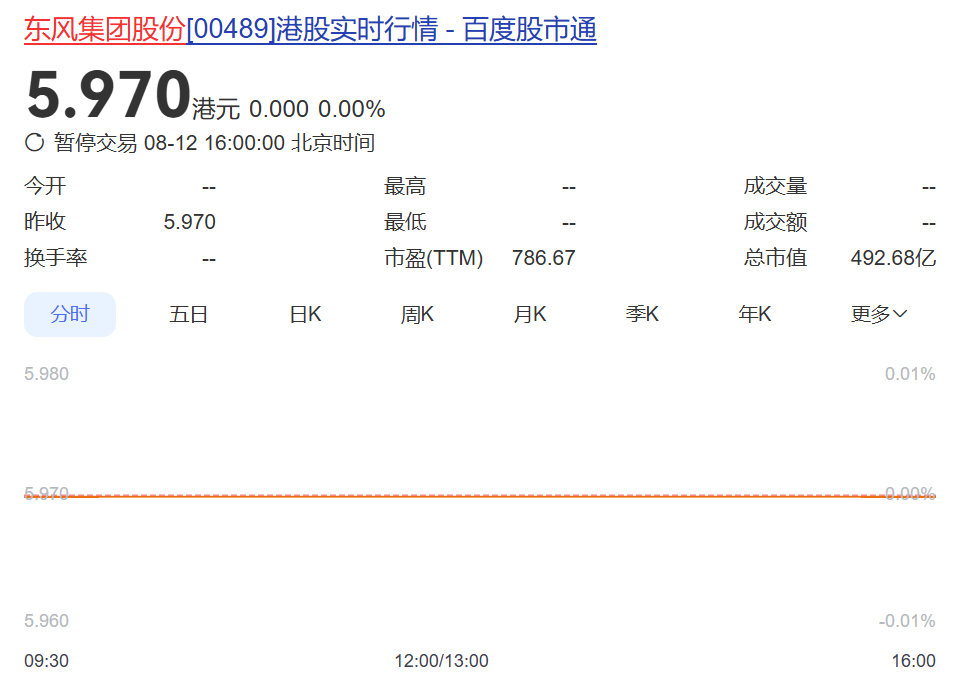
东风集团股份突然停牌,有大事要发生?上半年净利润预计最高下滑95%
Mei Ri Jing Ji Xin Wen· 2025-08-12 15:11
Core Viewpoint - Dongfeng Group has announced a temporary suspension of trading due to the release of insider information, with significant speculation surrounding potential corporate restructuring and performance forecasts [1][2]. Financial Performance - Dongfeng Group has issued a profit warning, projecting a net profit for the first half of 2025 to be between 30 million and 70 million yuan, representing a decline of approximately 90% to 95% compared to the same period in 2024 [2][4]. - The company attributes its performance decline to two main factors: a significant drop in sales and profits in the joint venture non-luxury brand market, and increased investments in R&D, brand building, and marketing in response to fierce market competition [4]. Sales Data - From January to July this year, Dongfeng Group's cumulative sales of new energy vehicles reached 249,600 units, a year-on-year increase of approximately 35.5%. However, overall vehicle sales declined by about 8.9% to 978,500 units [5]. - The parent company, Dongfeng Motor Corporation, reported a cumulative vehicle sales of 1,260,400 units during the same period, down approximately 10.8% year-on-year [5]. - Specific joint venture brands have seen notable declines: Dongfeng Nissan's sales fell by 16.8% to 306,400 units, Dongfeng Honda's sales dropped by 31.2% to 173,400 units, and Shenlong Automobile's sales decreased by 29.2% to 30,400 units [5]. Strategic Initiatives - In response to market pressures, Dongfeng Group has made several strategic adjustments, including the establishment of Yipai Automotive Technology Company to focus on the development of independent passenger vehicles [7]. - The company has set ambitious sales targets for the year, aiming for a total of 3 million vehicles sold, including 1 million new energy vehicles and 900,000 independent new energy vehicles [7]. - Dongfeng Yipai Technology is expected to enhance decision-making efficiency and market responsiveness through the integration of various brands and resources [10]. Product Development - Dongfeng Group is launching new models to address market demands, including the Dongfeng Nissan N7, which features advanced intelligent driving capabilities, and the Dongfeng Honda S7, which emphasizes high quality and performance [6]. - The newly formed Shenlong Automobile brand has introduced its first model, the Shijie 06, as part of its strategy to gain traction in the market [6]. - Dongfeng Yipai Technology plans to expand its product lineup significantly, with an expected 20 models by 2028, focusing on continuous innovation and market adaptation [10].

三大业务协同发力 春风动力上半年净利增长41.35%
Zhong Zheng Wang· 2025-08-12 11:01
Core Viewpoint - Zhejiang Chunfeng Power Co., Ltd. reported strong financial performance in the first half of 2025, with total revenue of 9.855 billion yuan, a year-on-year increase of 30.90%, and a net profit attributable to shareholders of 1.002 billion yuan, up 41.35% year-on-year, driven by its "globalization, electrification, and intelligence" strategy [1] Business Performance - The all-terrain vehicle segment led the industry with sales of 101,800 units and revenue of 4.731 billion yuan, reflecting a year-on-year growth of 33.95% [2] - The motorcycle business achieved sales of 150,300 units and revenue of 3.346 billion yuan, with domestic sales of 79,100 units generating 1.697 billion yuan, a 17.35% increase year-on-year [2] - The electric two-wheeler segment saw explosive growth, with sales reaching 250,500 units and revenue of 872 million yuan, a staggering increase of 652.06% year-on-year [3] Product Innovation and R&D - The company maintained a "technology-driven" approach, increasing R&D investment to 549 million yuan, which accounted for 5.57% of total revenue, a 19.86% year-on-year increase [4] - New product launches included various models in the four-wheeler and two-wheeler segments, enhancing market share and sales [4] - The company added 28 invention patents, 101 utility model patents, and 24 design patents during the reporting period, totaling 1,812 effective patents [4] Brand Development and Global Strategy - The company enhanced brand connection through global product launches and training events, leveraging new media for comprehensive brand outreach [5] - It optimized its global supply chain with efficient coordination among domestic production bases and strengthened supply capabilities in overseas markets like Mexico and Thailand [5] - The company aims to integrate capacity expansion with lean production techniques to improve efficiency and reduce costs, laying a solid foundation for becoming a "world-class power sports brand" [5]