
逆周期调节

Search documents
货币政策操作凸显前瞻灵活
Jing Ji Ri Bao· 2025-06-11 22:17
Group 1 - The People's Bank of China (PBOC) announced a 1 trillion yuan reverse repo operation on June 6, breaking the convention of announcing such operations at the end of the month, which has drawn significant market attention [1] - The reverse repo operation is aimed at enhancing liquidity management and stabilizing the financial system, especially in light of the high volume of interbank certificates of deposit maturing in June, estimated at 4.2 trillion yuan [2] - The operation is expected to result in a net liquidity withdrawal of 200 billion yuan for the month, indicating a strategic approach to managing liquidity levels [1][2] Group 2 - The PBOC's recent actions reflect a more transparent and effective communication mechanism with the market, as evidenced by the updated liquidity injection data for May, which includes various monetary policy tools [3] - In May, the PBOC's net liquidity injections included 1 trillion yuan from reserve requirements and 3.75 trillion yuan from medium-term lending facilities (MLF), while other tools showed net withdrawals, indicating a balanced approach to liquidity management [3] - Analysts expect the PBOC to continue using a combination of liquidity management tools, including reverse repos and MLF, to maintain ample liquidity in the banking system and support credit availability for businesses and households [2][3]
如何看待A股龙头蜂拥赴港上市
Sou Hu Cai Jing· 2025-06-10 14:07
Group 1 - Since 2025, A-share listed companies have shown a trend of going public in Hong Kong, with four companies including CATL and Hengrui Medicine successfully listing on the Hong Kong Stock Exchange in May, indicating a potential record high for new "A+H" companies in recent years [1] - A-share companies primarily consist of manufacturing sectors such as power equipment, automotive, and pharmaceuticals, while the Hong Kong market is more diversified, focusing on healthcare, consumer goods, and technology [1] - Over the past five years, there has been a significant divergence in financing scale between A-shares and Hong Kong stocks, with A-share financing remaining above $80 billion from 2021 to 2022, dropping to $60 billion in 2023, while Hong Kong's financing plummeted from $50 billion in 2020 to $6 billion in 2023, but is expected to rebound in 2024 [1] Group 2 - The choice to list in Hong Kong is supported by policy measures from the China Securities Regulatory Commission, which announced in April 2024 to support leading domestic companies in going public in Hong Kong, along with the Hong Kong Stock Exchange's "Tech Company Fast Track" for rapid review [2] - A-share companies are seeking internationalization due to tightened refinancing in the A-share market, with Hong Kong's flexible mechanisms for placement and rights issues providing more financing channels, as seen with CATL's fundraising for its Hungary project [2] - The valuation gap between certain sectors in Hong Kong and A-shares has narrowed post-policy adjustments, and listing in Hong Kong helps companies align with global valuation systems, supported by continuous inflow of southbound funds and the profitability of Hong Kong stocks [2] Group 3 - For companies, listing in Hong Kong provides access to a wider range of financing channels and flexible capital operation space, while inclusion in international indices like MSCI and FTSE Russell attracts more international passive investment [3] - The strict requirements for information disclosure and ESG in Hong Kong can compel companies to improve their governance structures, although lower valuations in some sectors may affect fundraising efficiency [3] - The influx of quality A-share companies into the Hong Kong market is expected to enhance market liquidity, improve market structure, and solidify Hong Kong's position as an international financial center, aided by reforms like dual-counter trading in RMB [3]
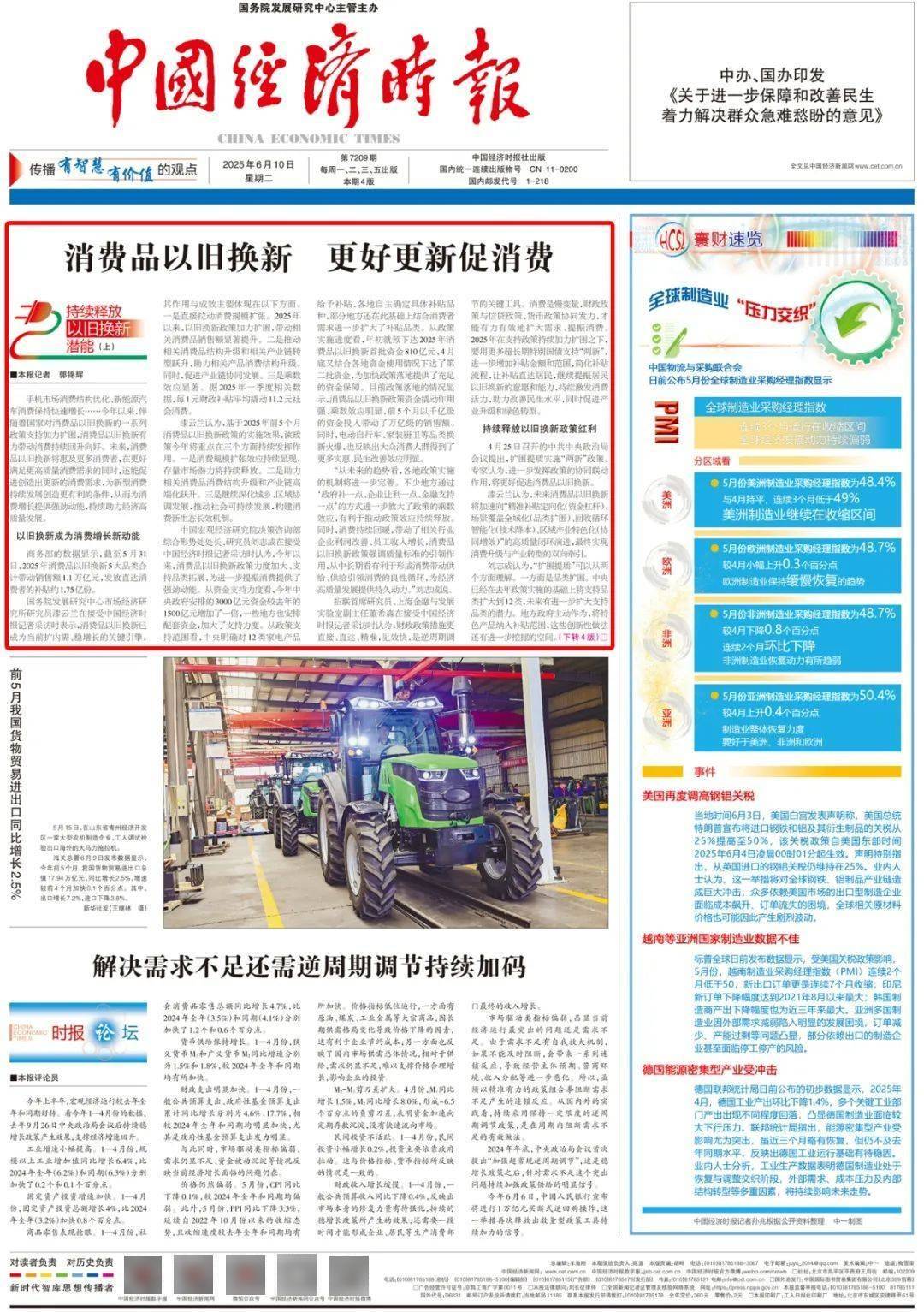
持续释放以旧换新潜能丨消费品以旧换新 更好更新促消费
Sou Hu Cai Jing· 2025-06-10 01:21
Core Viewpoint - The "old-for-new" consumption policy in China has become a key driver for economic growth, significantly boosting consumer spending and promoting structural upgrades in related industries [2][3][4]. Group 1: Policy Impact - As of May 31, 2025, the "old-for-new" policy has driven sales of 1.1 trillion yuan across five major categories, with approximately 175 million subsidies issued directly to consumers [2][21]. - The policy has been identified as a crucial engine for expanding domestic demand and stabilizing growth, with a notable multiplier effect where every 1 yuan of fiscal subsidy stimulates an average of 11.2 yuan in social consumption [2][3][4]. Group 2: Financial Support - The central government has allocated 300 billion yuan for the "old-for-new" policy in 2025, doubling the previous year's funding of 150 billion yuan, with local governments also increasing their support [3][4]. - The policy has been implemented with a focus on 12 categories of household appliances, with local governments having the flexibility to expand the list based on consumer needs [3][4]. Group 3: Future Trends - Experts predict that the "old-for-new" policy will evolve towards more precise subsidies, broader category coverage, and enhanced recycling technologies, ultimately driving both consumption upgrades and industrial transformation [5][11]. - The emphasis on quality standards within the policy is expected to foster a virtuous cycle where consumption drives supply and vice versa, contributing to sustainable economic growth [4][5].

央行万亿买断式逆回购提前出击 应对6月4.16万亿存单到期压力
Sou Hu Cai Jing· 2025-06-08 14:53
1年期AAA级大额可转让定期存单利率较5月8日上行3.5个基点。这一变化引发部分投资者对资金面进一步收敛的担忧。在月末叠加跨季等因素影响下,年中 流动性供求矛盾通常较为突出。央行通过买断式逆回购向银行体系供给万亿元基础货币,有效夯实了资金面充裕的基础。 6月通常是信贷投放的高峰期,金融机构资金需求量较大。将买断式逆回购操作时间提前至6月6日,有助于金融机构根据自身资金需求及时参与招标。这种 前瞻性安排为金融机构提前做好流动性管理创造了条件,确保半年度市场流动性保持充裕状态。 释放宽松政策信号的战略考量 央行于6月5日发布重磅公告,宣布将在6月6日开展10000亿元买断式逆回购操作。这一举措打破了以往月末公告的惯例,改为月初提前预告。操作期限为3个 月,采用固定数量、利率招标、多重价位中标方式进行。 此次操作标志着央行货币政策工具运用的重要变化。买断式逆回购作为2024年10月启用的新工具,与传统质押式逆回购不同,债券所有权在操作期间发生转 移。央行同时在官网新设"中央银行各项工具操作情况"栏目,披露5月各项工具合计净投放11196亿元。这种"月初公告+新设专栏披露"的形式,体现了央行 强化政策透明度的明确意图 ...

打破惯例、加强预期管理 央行“预告”万亿公开市场操作
Jing Ji Guan Cha Wang· 2025-06-06 00:34
Core Viewpoint - The People's Bank of China (PBOC) has announced a significant liquidity injection through a 10 trillion yuan buyout reverse repurchase operation, marking a departure from its usual end-of-month announcements, indicating a proactive approach to maintaining liquidity in the banking system [1][2]. Group 1: Announcement Details - On June 5, 2025, the PBOC released a notice about a 10 trillion yuan buyout reverse repurchase operation scheduled for June 6, with a term of 3 months (91 days) [1]. - This operation is part of a new monetary policy tool introduced in October 2024, allowing the PBOC to actively lend funds by purchasing bonds from primary dealers [2]. - The announcement is the first of its kind, as the PBOC typically discloses such operations at the end of the month [2]. Group 2: Market Implications - The early announcement is believed to be a response to the high volume of bank interbank certificates maturing, which helps maintain a stable liquidity environment and control market expectations [2][3]. - The PBOC's actions are aimed at encouraging banks to increase credit to the real economy and support government bond issuance, reinforcing the ongoing process of credit easing [3]. Group 3: Future Operations - Analysts expect the PBOC to continue using a combination of buyout reverse repos, medium-term lending facilities (MLF), and other liquidity management tools to ensure a stable liquidity environment [4][5]. - The buyout reverse repo tool complements existing liquidity tools by filling the gap for operations with terms ranging from 1 month to 1 year, thus enhancing the overall liquidity management framework [4].
央行将开展1万亿元买断式逆回购操作;国际金价再度站上3400美元丨金融早参
Mei Ri Jing Ji Xin Wen· 2025-06-06 00:25
丨2025年6月6日星期五丨 NO.1央行:6月6日将开展1万亿元买断式逆回购操作 6月5日,央行在官网开设"中央银行各项工具操作情况"栏目,并更新了2025年5月中央银行各项工具流 动性投放情况。该栏目公布了三大类九种工具的月度投放和回笼情况。根据该栏目公布数据,2025年5 月准备金净投放10000亿元,常备借贷便利(SLF)净投放5亿元,中期借贷便利(MLF)净投放3750亿 元,中央国库现金管理净投放2400亿元。 点评:市场分析普遍认为,央行开展1万亿元买断式逆回购操作不仅是年内规模性流动性投放的关键举 措,更以"月初公告+新设专栏披露"的形式,展现央行稳定资金面、强化政策透明度的双重决心。 NO.3存款降息,理财"吃饱" 低于1%的存款利率、2%左右的理财预期收益率,让不少储户觉得要改变打理"钱袋子"思路了。存款再 度降息后,"存款特种兵"变成"理财猎手",纷纷买入理财产品。理财公司趁势加大营销力度,助推银行 理财规模攀升。数据显示,截至6月3日,银行理财规模较4月末增长1400多亿元。 点评:业内人士认为,存款利率下调加大了银行揽储难度,而银行理财产品等迎来增量资金,年内理财 规模或将突破33万 ...
王青:央行打破惯例公告大规模逆回购操作或与近月银行同业存单到期规模持续处于高峰期有关
news flash· 2025-06-05 13:31
王青:央行打破惯例公告大规模逆回购操作或与近月银行同业存单到期规模持续处于高峰期有关 金十数据6月5日讯,东方金诚首席宏观分析师王青认为,在当前资金面及债市都处在平稳运行状态的背 景下,央行月初打破惯例,公告大规模逆回购操作,或与近月银行同业存单到期规模持续处于高峰期有 关。这有助于保持银行体系流动性持续处于充裕状态,控制资金面波动,稳定市场预期。另外,5月7日 央行等部门推出一揽子金融政策措施后,当前的一个重点是激励银行加大对实体经济信贷投放力度,支 持政府债券发行。现阶段加大中期流动性投放,释放了数量型政策工具持续加力的政策信号,有助于推 动宽信用进程,强化逆周期调节。预计后续央行还会综合运用抵押式逆回购、MLF、买断式逆回购等 中短期流动性管理工具,推动银行体系流动性持续处于充裕状态。这也是当前增加企业和居民信贷可获 得性、降低实体经济融资成本的重要一环。 (新华财经) ...
打破月末公布惯例 央行首次月初预告大规模买断式逆回购操作
Xin Hua Cai Jing· 2025-06-05 12:14
Group 1 - The People's Bank of China (PBOC) announced a large-scale reverse repurchase operation of 1 trillion yuan on June 6, breaking the convention of announcing such operations at the end of the month [1] - The operation will include 500 billion yuan of 3-month reverse repos, with a total of 5 trillion yuan of 3-month and 7 trillion yuan of 6-month reverse repos maturing in June [1] - This move aims to maintain ample liquidity in the banking system and stabilize market expectations amid a peak period for bank interbank certificates of deposit [2] Group 2 - The PBOC's early announcement of the reverse repo operation is intended to encourage banks to increase credit to the real economy and support government bond issuance [2] - The central bank is expected to continue using various liquidity management tools, including reverse repos and medium-term lending facilities (MLF), to ensure sustained liquidity in the banking system [2] - June is typically a month of high credit demand, and the early operation allows financial institutions to better manage their liquidity needs [2]
央行将开展1万亿元买断式逆回购 为何打破月末公布惯例
Xin Jing Bao· 2025-06-05 11:49
Core Viewpoint - The People's Bank of China (PBOC) announced a significant operation of 1 trillion yuan in reverse repos to enhance market liquidity and stabilize financial markets, breaking the traditional end-of-month announcement pattern [1][2]. Group 1: Reverse Repo Operations - On June 6, the PBOC will conduct a 500 billion yuan reverse repo operation with a 3-month term, following the maturity of 500 billion yuan in 3-month and 700 billion yuan in 6-month reverse repos in June [1]. - The early announcement of the reverse repo operation is intended to maintain ample liquidity in the banking system, especially as the demand for funds typically increases in June [2][3]. - The PBOC's move to implement reverse repos is seen as a response to the high volume of bank interbank certificates maturing, aiming to control fluctuations in the money market [2]. Group 2: Monetary Policy Implications - The current high level of the Medium-term Lending Facility (MLF) interest rate has led to a decrease in financial institutions' demand for MLF, prompting the PBOC to use reverse repos as a substitute to lower funding costs [3]. - It is anticipated that the PBOC will continue to reduce the scale of MLF operations, with a consistent decline in its balance [4]. - The PBOC is expected to utilize various monetary policy tools, including reverse repos and MLF, to ensure sustained liquidity in the banking system, which is crucial for enhancing credit availability for enterprises and households [4][5].
规模一万亿元 央行首次“预告”买断式逆回购操作
Sou Hu Cai Jing· 2025-06-05 11:20
Group 1 - The People's Bank of China (PBOC) announced a 1 trillion yuan reverse repurchase operation on June 6, 2024, to maintain liquidity in the banking system, marking a significant monetary policy tool introduction [1] - The reverse repurchase operation will be conducted using a fixed quantity, interest rate bidding, and multiple price levels, with eligible collateral including government bonds, local government bonds, financial bonds, and corporate credit bonds [1] - Since October 2024, the PBOC has conducted reverse repurchase operations for eight consecutive months, with operation sizes ranging from several hundred billion to over 1 trillion yuan [1] Group 2 - The early announcement of a large-scale reverse repurchase operation by the PBOC is seen as a response to the high volume of bank interbank certificates maturing in recent months, aimed at stabilizing market expectations and maintaining liquidity [2] - In June, there are 500 billion yuan of 3-month and 700 billion yuan of 6-month reverse repos maturing, indicating that the PBOC's actions are part of a broader strategy to support credit growth and government bond issuance [2] - The timing of the reverse repurchase operation is intended to help financial institutions manage their liquidity needs effectively, especially during a month typically characterized by high credit demand [3]