避险情绪

Search documents
ETO Markets 交易平台:黄金市场波动加剧,短期调整后能否企稳?
Sou Hu Cai Jing· 2025-10-28 05:21
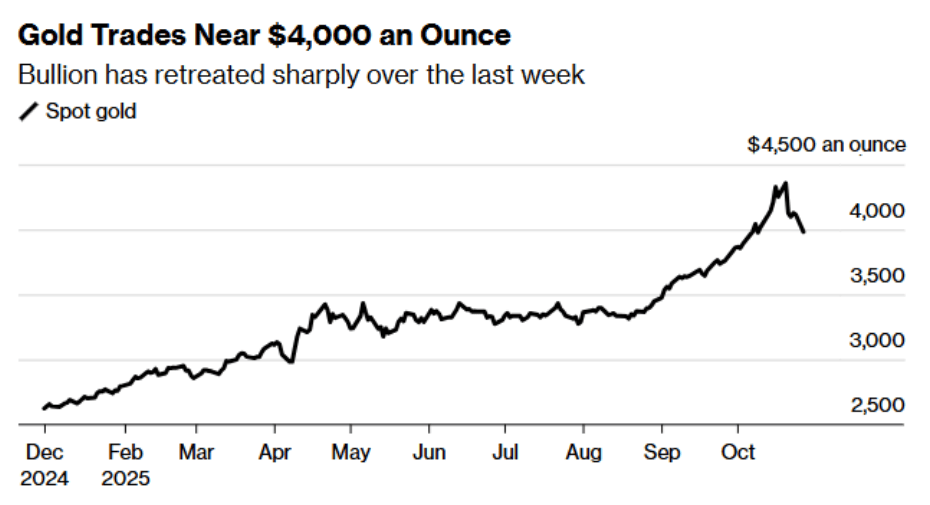
Group 1 - Recent fluctuations in the gold market are driven by changing risk sentiment and macroeconomic policy expectations, leading to intense market dynamics [1] - On Monday, gold prices fell by 3.2%, dropping below the psychological threshold of $4000 per ounce, marking a new low since October 10 [1] - Analysts noted that rising U.S. Treasury yields have diminished the appeal of gold as a non-yielding asset [1] Group 2 - On Tuesday, gold prices showed signs of stabilization, rebounding by 0.57% to $4004.26 per ounce, despite being down from the year's high of $4380 per ounce [1] - The year-to-date increase in gold prices remains over 50%, indicating long-term resilience in the market [1] - This performance is attributed to ongoing gold purchases by central banks and investor concerns over global fiscal deficits, which have driven demand for gold as a hedge against currency depreciation [1] Group 3 - Professional institutions are adopting a cautious stance regarding recent market volatility, with experts advising patience before making tactical investment decisions [4] - The World Gold Council's market strategist indicated that central bank gold purchases have slowed compared to previous peaks, suggesting that a more thorough price adjustment could benefit market health [4] - Citigroup's analysts predict that gold prices may face further adjustments in the coming months, potentially targeting around $3800 per ounce due to weakening upward momentum and reduced short-term risk demand [4] Group 4 - The macroeconomic environment suggests that the Federal Reserve is expected to lower interest rates by 25 basis points in its upcoming policy meeting, marking the second consecutive rate cut [4] - While a loose monetary policy environment typically supports gold, the recent rapid rise in U.S. Treasury yields has temporarily offset this positive impact [4] - Anticipated changes in the Federal Reserve's leadership are adding uncertainty to the global asset allocation landscape, which is being closely monitored by the market [4]

广发早知道:汇总版-20251028
Guang Fa Qi Huo· 2025-10-28 01:56
Report Industry Investment Rating No relevant information provided. Core Viewpoints of the Report The report analyzes the market conditions of various financial and commodity futures, including financial derivatives (financial futures, precious metals), shipping indices, and multiple commodity futures (non - ferrous metals, black metals, agricultural products, energy chemicals, etc.). It provides insights into market trends, influencing factors, and offers corresponding operation suggestions based on the analysis of each sector. Summary by Directory Financial Derivatives Financial Futures - **Stock Index Futures**: The macro sentiment improved, and stock indices rose across the board. A - shares opened higher and increased in volume. The four major stock index futures rose with the index, and the basis premium narrowed. The market was boosted by domestic economic data and Sino - US trade talks. It is recommended to try light - selling put options at support levels or construct bullish call spreads [2][3][4]. - **Treasury Futures**: The expectation of loose monetary policy strengthened, and the futures were expected to rise. Although the futures closed down, the speech at the Financial Street Forum released a signal of loose money. It is expected that the futures will open higher, and it is recommended to go long on dips and pay attention to the cash - and - carry arbitrage strategy [5][6][7]. Precious Metals - **Gold and Silver**: The risk - aversion sentiment subsided, and the market awaited the Fed's decision. The prices of gold and silver fell. In the short term, the market may be volatile, but in the long term, precious metals are expected to have a bull market. It is recommended to buy gold at low prices below $4000 [8][9]. Shipping Index - **Container Shipping Index (European Line)**: The futures market was volatile and declined, mainly affected by the reduction of quotations by MSC. However, the SCFIS European line index continued to rise, so a cautious bullish attitude is maintained. It is recommended to go long on the December contract on dips [12][13]. Commodity Futures Non - Ferrous Metals - **Copper**: Sino - US reached a preliminary consensus, and copper prices reached a new high. The macro environment and supply - demand fundamentals supported the price increase. It is recommended to focus on the support at around 86,000 yuan [13][14][17]. - **Alumina**: The spot trading activity increased, but the short - term oversupply situation was difficult to change. The supply was abundant, while the demand was weak. It is expected that the price will be under pressure, and the main contract will fluctuate between 2,750 - 2,950 yuan [17][18][19]. - **Aluminum**: The price was strong, and the spot discount widened. The macro environment was mixed, and the fundamentals were in a tight balance. It is expected that the price will remain in a strong and volatile range of 20,800 - 21,400 yuan [20][21]. - **Aluminum Alloy**: The price followed aluminum and was volatile and strong. The cost support was obvious, and the supply - demand was in a tight balance. It is recommended that the main contract operate in the range of 20,300 - 20,900 yuan [22][23]. - **Zinc**: The price rose slightly due to the squeeze on LME zinc and macro - level benefits. The supply was loose but the subsequent increase might be limited, and the demand was stable. It is expected to be in a range of 21,800 - 22,800 yuan [24][25][27]. - **Tin**: Supported by strong fundamentals, the price was strong. The supply was tight, and the demand was weak. It is recommended to wait and see, and the price is expected to be in a wide - range fluctuation [27][29][30]. - **Nickel**: The price was volatile, and the fundamentals were weak during the policy window period. The production was high, the demand was average, and the inventory was increasing. It is expected to fluctuate in the range of 120,000 - 128,000 yuan [30][31][32]. - **Stainless Steel**: The price was mainly volatile, and the fundamentals were weak. The raw material cost support was weakening, the supply was increasing, and the demand was not significantly boosted. It is expected to operate in the range of 12,500 - 13,000 yuan [34][35][36]. - **Lithium Carbonate**: The price was strong, and the strong demand was gradually realized. The supply - demand gap was expanding in the peak season. It is expected to run strongly, and the main contract is recommended to operate in the range of 80,000 - 84,000 yuan [37][38][41]. Black Metals - **Steel**: The apparent demand for steel recovered, and the price rose with coking coal. The cost was supported, the supply was affected by environmental protection, the demand was expected to be supported by policies, and the inventory decreased. It is recommended to hold long positions and pay attention to the previous high pressure [42][43][44]. - **Iron Ore**: The price rebounded. The supply and demand situation was complex, with the decline in arrivals and the increase in inventory. It is recommended to go long on the 2601 contract on dips and engage in the 1 - 5 positive spread arbitrage [45][46]. - **Coking Coal**: The price of coking coal was strong, and the downstream replenishment demand recovered. The supply decreased, and the demand had replenishment needs. It is recommended to go long on the 2601 contract on the short - term and engage in the long - coking - coal and short - coke arbitrage [47][48][49]. - **Coke**: The second - round price increase was proposed. The cost was supported, the supply decreased, the demand was weak, and the inventory was moderately reduced. It is recommended to go long on the 2601 contract on dips and engage in the long - coking - coal and short - coke arbitrage [50][51][52]. Agricultural Products - **Meal Products**: Sino - US relations improved, and near - month soybeans had cost support. The price of domestic soybean meal decreased slightly, and the cost of imported soybeans was supported. It is expected that the domestic soybean meal will be on a strong trend [53][54][55]. - **Pigs**: The secondary fattening boosted the price of pigs. The spot price rose, and the market demand improved. However, there will be an increase in the number of pigs to be slaughtered in November and December. It is recommended to exit the arbitrage position and re - enter after the spot price stabilizes [56][57]. - **Corn**: The supply pressure remained, and the price was weak and volatile. The supply was abundant, the demand was mainly for rigid needs, and the price was affected by the selling rhythm of farmers and policy support [58][59].
港股异动 | 黄金股普遍低开 避险情绪缓和压制贵金属 金银价格显著回调
智通财经网· 2025-10-28 01:31
Core Viewpoint - Gold stocks experienced a significant decline following a sharp drop in gold prices, influenced by recent developments in US-China trade relations and market sentiment towards gold investments [1] Group 1: Market Performance - As of the report, major gold stocks in Hong Kong opened lower, with China Gold International down 3.31% to HKD 125.7, Tongguan Gold down 2.92% to HKD 2.66, Shandong Gold down 1.73% to HKD 33, China Silver Group down 1.56% to HKD 0.63, and Chifeng Jilong Gold down 1.43% to HKD 28.96 [1] - On October 27, spot gold prices fell sharply by 3%, briefly dropping below the USD 3900 mark [1] Group 2: Influencing Factors - The decline in gold prices is attributed to a reduction in safe-haven demand following the establishment of a "substantial framework" in trade negotiations between the US and China, which included a temporary easing of 100% tariffs on Chinese goods [1] - According to CITIC Futures, the recent developments have led to a noticeable decrease in the demand for gold as a safe-haven asset, negatively impacting short-term gold price performance [1] Group 3: Investment Sentiment - A report from Shenwan Hongyuan Securities indicates that gold is no longer considered a wise investment choice in the short term, as the "long gold" position has become overcrowded according to a Bank of America survey [1] - High leverage in gold ETFs has resulted in a rapid price decline from historical highs, with current volatility severely affecting the risk-reward ratio for gold investments [1] - Despite the short-term outlook, the institution maintains that gold still holds long-term investment value [1]
金价持续调整,机构提示风险
Guo Ji Jin Rong Bao· 2025-10-28 00:43
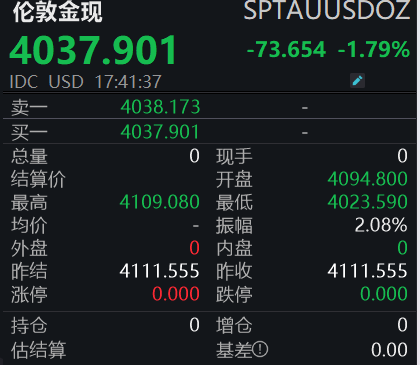
Core Viewpoint - The international gold price is experiencing a significant decline, approaching the critical support level of $4000 per ounce, influenced by short-term market factors and profit-taking after a substantial price increase [1][4][5]. Price Movement - As of October 22, the London gold price fell by 1.79% to $4037.901 per ounce, with a low of $4023.59 during the trading session [1][2]. - COMEX gold futures also dropped by 2.1%, reaching $4051.0 per ounce, with a minimum of $4034.2 [2][3]. Market Analysis - The recent adjustment in gold prices is attributed to crowded trading conditions and geopolitical news disturbances, leading to profit-taking after a $1000 increase since September [4]. - Analysts suggest that the easing of geopolitical tensions and the stabilization of silver markets have contributed to the current price adjustments [3][4]. Future Outlook - Despite the short-term decline, there is optimism for a medium to long-term increase in gold prices due to central bank purchases and rising investment demand [3][4]. - The market is advised to closely monitor developments in US-China trade negotiations, as any positive outcomes could further influence gold prices [5].
黄金跌破4000美元
Sou Hu Cai Jing· 2025-10-27 22:39
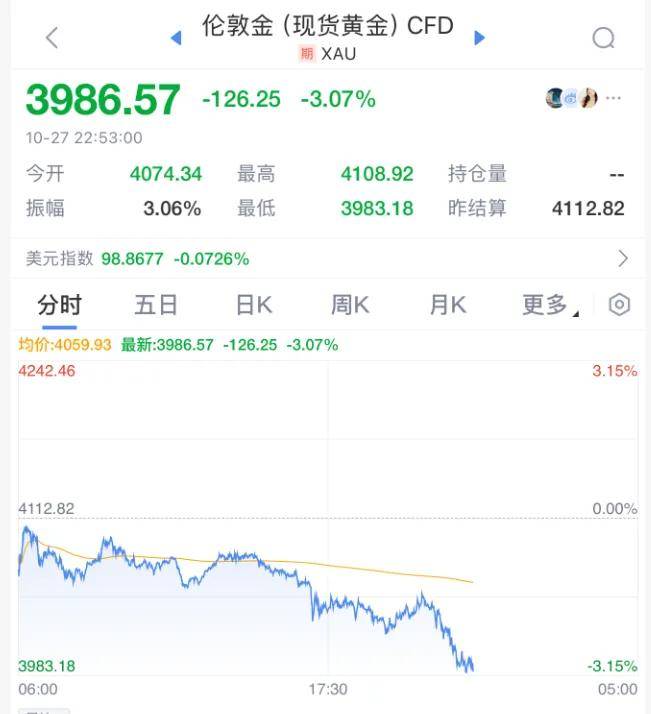
Core Viewpoint - The current market shows a decrease in safe-haven sentiment, leading to a significant drop in gold and silver prices, with gold falling below $4000 per ounce and silver dropping over 4% [1] Group 1: Market Performance - As of the latest report, spot gold has reached a low of $3987 per ounce, marking a daily decline of 2.8% [1] - Spot silver is reported at $46.5 per ounce, reflecting a decline of over 4% [1] Group 2: Market Sentiment - The reduction in safe-haven sentiment is noted as a key factor influencing the current market dynamics [1] - Market expectations regarding the Federal Reserve's interest rate cuts have been gradually absorbed, contributing to increased volatility in precious metals [1]
金价冲高回落,现在是上车的好时机吗?
Sou Hu Cai Jing· 2025-10-27 17:02
Core Viewpoint - Recent fluctuations in gold prices, including a drop of over 3% below $4000 and $3900, are driven by multiple factors, raising questions about the long-term investment logic of gold and how investors should position themselves [1][3]. Group 1: Factors Driving Gold Price Movements - Concerns over the U.S. dollar credit system have intensified, with the national debt exceeding $37 trillion, marking a historical peak in GDP ratio since World War II, and risks of government shutdown exacerbating market fears [3]. - Escalating trade tensions, particularly between the U.S. and China, have heightened risk aversion, increasing gold's appeal as a traditional safe-haven asset [3]. - Central banks globally are returning to a loose monetary policy, with a 90% probability of further rate cuts anticipated by the market following the Federal Reserve's recent actions [3]. Group 2: Market Sentiment and Technical Analysis - The gold market may have entered a high-level consolidation phase, with short-term sentiment indicators suggesting overheating, which could lead to increased volatility [5]. - Some short-term factors that supported previous price increases are reversing, such as easing U.S.-China tensions and stabilizing European political conditions, which may lead to significant price fluctuations in the future [7]. Group 3: Long-term Outlook and Institutional Predictions - Despite short-term volatility, the long-term logic for gold as a reserve asset remains intact, with 95% of surveyed central banks planning to increase their gold holdings in the next 12 months [7]. - Global gold ETFs saw a net inflow of 145.6 tons in September 2025, bringing total holdings to 3837.7 tons, indicating strong ongoing demand [7]. - Historical comparisons show that gold has experienced significant long-term price increases, suggesting potential for further appreciation in the current cycle [7]. Group 4: Investment Strategy Recommendations - Investors are advised to focus on strategic allocation rather than short-term speculation, with a recommendation to allocate approximately 15% of their portfolio to gold as a hedge against currency credit risks and geopolitical uncertainties [11]. - Gold-related funds are suggested as a preferred investment vehicle due to their liquidity and lower entry barriers, while physical gold and futures are recommended for more knowledgeable investors [11].
黄金跌破4000美元
第一财经· 2025-10-27 14:44
Core Viewpoint - The current market shows a decrease in risk aversion, leading to a decline in precious metals prices, with gold dropping below $4000 per ounce and silver falling over 4% [1]. Group 1 - As of October 27, spot gold prices fell to a low of $3987 per ounce, marking a daily decline of 2.8% [1]. - Spot silver prices reported at $46.5 per ounce, reflecting a drop of over 4% [1]. - Market participants indicate that the expectations for a Federal Reserve interest rate cut have been gradually priced in, contributing to increased volatility in precious metals [1].

贵金属有色金属产业日报-20251027
Dong Ya Qi Huo· 2025-10-27 10:28
Report Industry Investment Rating No relevant content provided. Core Viewpoints of the Report - The gold market is affected by multiple factors. The decline in risk - aversion sentiment and the expectation of improved Sino - US trade relations put pressure on gold prices, while the Fed's interest - rate cut expectation provides support. The uneven global economic recovery and the uncertainty of major central banks' monetary policies are the core factors causing gold market fluctuations [3]. - For copper, last week, macro - level positive expectations prevailed, but the weak downstream demand in the industrial chain restricted the price breakthrough. This week, the market will be in a game between the Fed's interest - rate decision and the industry's acceptance of high copper prices, with potential increased volatility [16]. - Regarding aluminum, macro - policies are the core factors affecting the price of Shanghai aluminum. The favorable macro - environment and overseas supply disruptions have led to the rise of aluminum prices. Alumina is in an oversupply situation, while cast aluminum alloy has strong support [34]. - For zinc, the supply - demand situation has not changed significantly recently. The price difference between domestic and overseas markets has widened. The domestic market is in a situation of strong supply and weak demand, and low inventory provides support for prices [57]. - In the nickel industry, the new regulations for Indonesia's nickel ore quota application in 2026 are stricter. The new energy sector is in the peak season, while nickel - iron prices lack upward momentum. Stainless steel may fluctuate widely [72]. - For tin, the supply is weaker than the demand. Short - term supply - side disturbances are difficult to resolve, and Shanghai tin is expected to remain strong [89]. - For lithium carbonate, considering both supply and demand factors, it may show a short - term oscillatory and strengthening trend [103]. - In the silicon industry chain, industrial silicon is in a situation of strong supply and weak demand. The polysilicon industry chain has weak fundamentals, and the polysilicon futures have high volatility [115]. Summaries by Related Catalogs Precious Metals - **Price Influencing Factors**: The decline in risk - aversion sentiment and the expectation of improved Sino - US trade relations put pressure on gold prices, while the Fed's interest - rate cut expectation provides support. The uneven global economic recovery and the uncertainty of major central banks' monetary policies are the core factors causing gold market fluctuations [3]. Copper - **Price Fluctuation and Market Situation**: Last week, macro - level positive expectations prevailed, but the weak downstream demand in the industrial chain restricted the price breakthrough. This week, the market will be in a game between the Fed's interest - rate decision and the industry's acceptance of high copper prices, with potential increased volatility [16]. - **Futures and Spot Data**: The latest prices of Shanghai copper futures (main contract, continuous one, continuous three) and London copper 3M are provided, along with their daily changes and percentage changes. Spot copper prices from different sources also show daily and percentage changes [17][20]. Aluminum - **Price Influencing Factors**: Macro - policies are the core factors affecting the price of Shanghai aluminum. The favorable macro - environment and overseas supply disruptions have led to the rise of aluminum prices. Alumina is in an oversupply situation, while cast aluminum alloy has strong support [34]. - **Futures and Spot Data**: The latest prices of Shanghai aluminum, London aluminum, alumina, and aluminum alloy futures, as well as their daily changes and percentage changes, are presented. Spot aluminum prices from different regions and related basis data are also provided [35][45]. Zinc - **Supply - Demand and Price Situation**: The supply - demand situation has not changed significantly recently. The price difference between domestic and overseas markets has widened. The domestic market is in a situation of strong supply and weak demand, and low inventory provides support for prices. Short - term attention should be paid to the opening of the export window and the possibility of macro - level upward drivers [57]. - **Futures and Spot Data**: The latest prices of Shanghai zinc and London zinc futures, along with their daily changes and percentage changes, are given. Spot zinc prices and related premium data are also provided [58][65]. Nickel - **Industry Situation**: The new regulations for Indonesia's nickel ore quota application in 2026 are stricter. The new energy sector is in the peak season, while nickel - iron prices lack upward momentum. Stainless steel may fluctuate widely. Macro - level factors such as Sino - US tariffs and interest - rate cut expectations also have an impact [72]. - **Futures and Related Data**: The latest prices of Shanghai nickel and London nickel 3M futures, along with their changes, are provided. Data on trading volume, open interest, and warehouse receipts are also included [73]. Tin - **Supply - Demand and Price Outlook**: The supply is weaker than the demand. Short - term supply - side disturbances are difficult to resolve, and Shanghai tin is expected to remain strong, with a predicted support level around 276,000 yuan [89]. - **Futures and Spot Data**: The latest prices of Shanghai tin and London tin 3M futures, along with their daily changes and percentage changes, are presented. Spot tin prices and related data are also provided [89][92]. Lithium Carbonate - **Supply - Demand and Price Trend**: Considering both supply and demand factors, it may show a short - term oscillatory and strengthening trend. The supply may increase with the release of lithium ore production capacity, while the demand from downstream lithium - battery material enterprises is expected to grow [103]. - **Futures and Spot Data**: The latest prices of lithium carbonate futures contracts, along with their daily and weekly changes, are given. Spot lithium prices from different sources and related price differences are also provided [104][108]. Silicon Industry Chain - **Supply - Demand and Market Situation**: Industrial silicon is in a situation of strong supply and weak demand. The polysilicon industry chain has weak fundamentals, and the polysilicon futures have high volatility. Attention should be paid to industry policies [115]. - **Futures and Spot Data**: The latest prices of industrial silicon futures contracts, along with their daily changes and percentage changes, are presented. Spot industrial silicon prices from different regions and related basis data are also provided [116].
降息充分定价,贵金属震荡属性增加
Ning Zheng Qi Huo· 2025-10-27 09:06
降息充分定价,贵金属震荡属性增加 摘 要: 中美经贸再度开启谈判议程,避险情绪略有降低,黄金在避险 情绪减弱的推动下,略有下行,目前为止震荡特征明显。目前美国 政府依然处于停摆过程中,关于美国经济的数据无法进一步获得, 但是从美联储官员的表述来看,市场基本对 10 月份继续降息已经 有所定价,后续市场更多关注的是地缘避险因素,及美国政府的内 部分歧和博弈情况。 美东时间 10 月 1 日 0 时,美国联邦政府因资金用尽,时隔近 七年再度"停摆"。数十万联邦雇员将被迫无薪休假,部分公共服 务或暂停、延迟,经济数据发布将受到一定影响。美国 9 月 CPI 同 比上涨 3%,创今年 1 月以来最高,但低于市场预期的 3.1%,核心 CPI 环比放缓至 0.2%,也低于市场预期。9 月服务业通胀放缓至 2021 年 11 月以来的最弱水平。数据公布后,市场已经完全消化美联储 年内剩余时间两次降息 25 个基点的预期。国家主席习近平将于 10 月 30 日至 11 月 1 日赴韩国庆州出席亚太经合组织第三十二次领导 人非正式会议并对韩国进行国事访问。就 APEC 会议期间中美元首 是否举行会晤相关问题,外交部发言人郭嘉 ...
美国主权信用评级被下调,利好黄金
Sou Hu Cai Jing· 2025-10-27 08:51
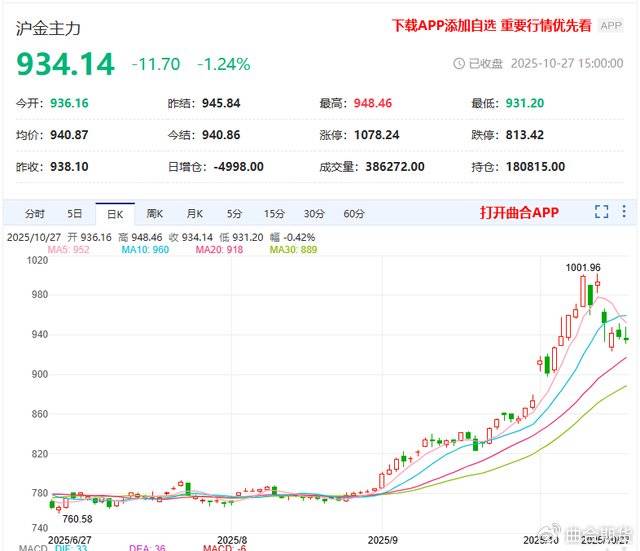
来源:曲合期货 欧洲信用评级机构范围评级公司日前发布报告,将美国主权信用评级从"AA"下调至"AA-"。 期货公司观点 广发期货: 美国经济运行和就业市场受到政府"关门"的冲击衰退风险有所增加,美联储政策降息路径"预期强化-独 立性受挫"的双重特征或强化从而打压美元指数。目前伴随美国政府关门和欧洲日本等发达国家的财政 货币政策动荡影响持续发酵,投资者新的资产定价体系将重塑利好金融属性强的商品货币,使贵金属有 望重现类似 1970 年代的牛市行情,价格易涨难跌,但短期特朗普内外政策不确定性和中美摩擦进程将 影响行情上涨节奏,在 10 月底韩国的 APEC 会议前市场波动将较反复。操作上单边在910 元上方可择 机轻仓买入并做好止盈止损。 报告预计,若缺乏实质性改革,美国政府债务占国内生产总值(GDP)比例到2030年将升至140%,远 高于大多数主权国家。 常规逻辑来看,信用评级被下调会引发避险情绪,对黄金是利好。 日内收盘不,沪金下跌1.24%,报收934.14元/克。 该机构表示,美国公共财政持续恶化主要表现在财政赤字持续高企、利息支出不断上升以及预算灵活性 受限。这些因素共同推动政府债务水平持续攀升。 ...