
扩大内需战略

Search documents
瑞达期货国债期货日报-20260120
Rui Da Qi Huo· 2026-01-20 09:22
国债期货日报 2026/1/20 | 项目类别 | 数据指标 | 最新 | 环比 项目 | 最新 | 环比 | | --- | --- | --- | --- | --- | --- | | 期货盘面 | T主力收盘价 | 108.180 | 0.13% T主力成交量 | 61868 | 9620↑ | | | TF主力收盘价 | 105.875 | 0.09% TF主力成交量 | 49231 | 5457↑ | | | TS主力收盘价 | 102.444 | 0.05% TS主力成交量 | 29819 | 6168↑ | | | TL主力收盘价 | 111.490 | 0.52% TL主力成交量 | 108559 | 30411↑ | | 期货价差 | TL2603-2606价差 | -0.11 | +0.00↑ T03-TL03价差 | -3.31 | -0.43↓ | | | T2603-2606价差 | 0.08 | +0.02↑ TF03-T03价差 | -2.31 | -0.05↓ | | | TF2603-2606价差 | 0.00 | +0.03↑ TS03-T03价差 | -5.74 | - ...
杨德龙:2026年我国经济整体发展态势持续向好
Xin Lang Cai Jing· 2026-01-20 09:20
Economic Growth - In 2025, China's GDP achieved a growth of 5%, meeting the initial target, but quarterly growth rates showed a declining trend: 5.4%, 5.2%, 4.8%, and 4.5% respectively, indicating a reasonable economic operation with some recovery growth [1][7] - The trade surplus reached a historic high of over $1.1 trillion, approaching $1.2 trillion, reflecting strong competitiveness of Chinese export products despite the tariff war [1][7] Domestic Demand - The main issue in domestic demand is insufficient demand, with an annual CPI growth rate of 0% and negative PPI growth, indicating that weak demand has prevented price increases and led to price wars in industrial products [1][7] - Measures such as the "old-for-new" consumption policy have been introduced to boost consumer spending, which is crucial for stabilizing economic growth as consumption has become a more significant driver than investment and exports [1][7] Industrial Performance - Industrial production in 2025 showed some growth, with the total industrial output value increasing by 5.9% year-on-year, driven by sectors like 3D printing, industrial robots, and new energy vehicles, which saw production increases of 52.5%, 28%, and 25.1% respectively [2][8] - The manufacturing PMI for December was 50.1, indicating a return to the expansion zone, while profits for large industrial enterprises totaled 66,269 billion yuan, reflecting a low growth rate of 0.1% year-on-year [2][8] Investment Trends - Fixed asset investment decreased by 3.8% year-on-year, with real estate development investment dropping by 17.2%, highlighting the pressure on investment stability due to real estate adjustments [3][9] - The National Development and Reform Commission emphasized the need to strengthen domestic demand and adapt to the upgrading of demand structures, planning to develop a strategy for expanding domestic demand from 2026 to 2030 [3][9] Future Opportunities - The focus for 2026 includes sectors like robotics, AI, innovative pharmaceuticals, and controlled nuclear fusion, which are expected to continue to attract attention as technology-driven opportunities grow [4][10] - The digital economy's added value is projected to reach 49 trillion yuan by 2025, accounting for about 35% of GDP, indicating significant future market potential [3][10] Market Outlook - The market is expected to continue a slow bull trend, with a focus on technology stocks, while caution is advised against speculative behaviors, especially in the context of recent high margin trading balances [5][11] - Brand consumer goods are seen as having stable profitability and growth potential, despite a slowdown in consumption growth, making them attractive for investment [5][11]
1月20日主题复盘 | 创业板大幅调整,化工股、黄金逆势走强,房地产也迎资金关注
Sou Hu Cai Jing· 2026-01-20 08:41
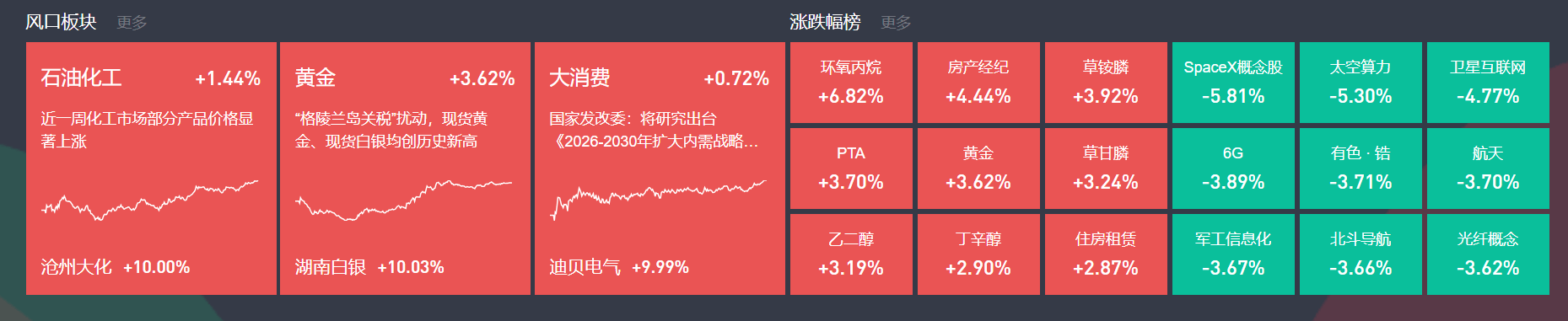
Market Overview - The market opened high but closed lower, with the ChiNext index dropping nearly 2%. Chemical stocks surged, with companies like Cangzhou Dahua and Xinxiang Chemical Fiber hitting the daily limit. Precious metals and consumer stocks also performed well, while real estate stocks rebounded. In contrast, the commercial aerospace sector faced adjustments, and computing hardware stocks fell sharply, with over 3,100 stocks declining across the Shanghai and Shenzhen markets, totaling a transaction volume of 2.8 trillion yuan [1]. Chemical Industry - The chemical sector experienced significant gains, with Cangzhou Dahua and Xinxiang Chemical Fiber achieving consecutive daily limits. Recent reports indicated that from January 12 to 18, the prices of certain chemical products, such as epoxy propylene, increased by 7.9% week-on-week, and prices for organic silicon intermediates also rose [4][5]. - The domestic epoxy propylene market continued its upward trend, supported by tight supply and low overall inventory levels. The price of propylene rose by 4.88% compared to the previous week, indicating strong cost support. The demand side was driven by the "last train" effect of the cancellation of export tax rebates for polyether, leading to active market trading [5][6]. Real Estate Sector - The real estate sector saw a significant rise, with companies like Hefei Urban Construction and Cheng Investment Holdings hitting the daily limit. Analysts noted that the changes in the second-hand housing inventory post-Spring Festival would be a key focus for the market, influencing supply-demand dynamics and financial institutions' concerns regarding collateral depreciation [7][8]. Gold Market - The gold sector remained active, with companies such as Hunan Silver and Zhaojin Mining reaching the daily limit. On January 20, spot gold prices broke the $4,700 per ounce mark, setting a new historical high. Since the beginning of the year, spot gold has consistently risen, surpassing multiple price thresholds [9][10]. - Analysts expect that the upcoming U.S. Federal Reserve meeting will influence gold prices, with a high likelihood of further interest rate cuts, which could provide upward momentum for gold [10][12]. Other Notable Sectors - The consumer sector, domestic chips, and smart grid industries showed localized activity, while AI applications and aerospace sectors faced the most significant declines [12].


视频丨国家发改委:研究制定出台未来五年扩大内需战略实施方案
Yang Shi Xin Wen Ke Hu Duan· 2026-01-20 08:33
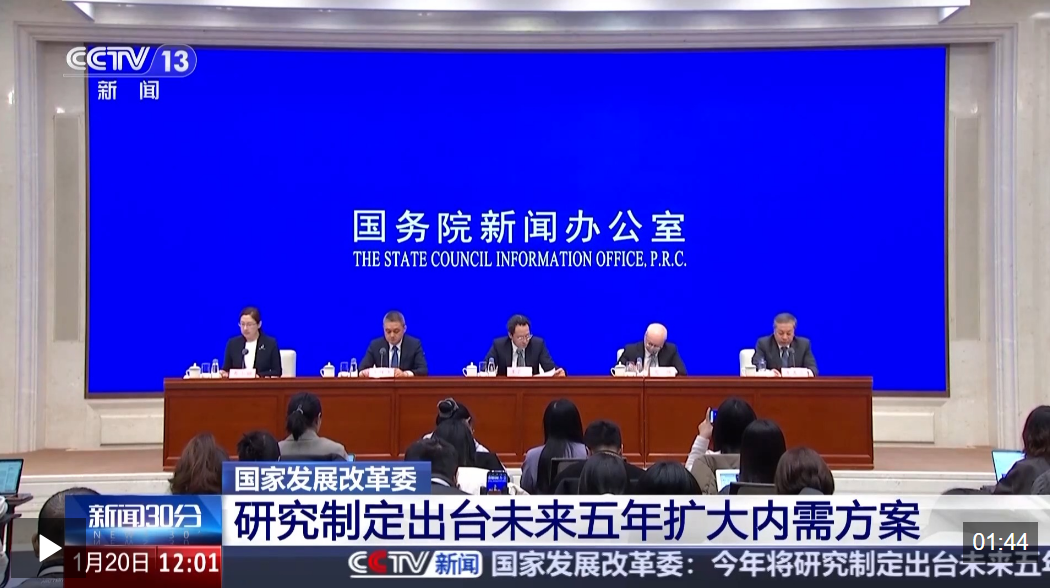
王昌林表示,目前我国正在谋划推进一批"十五五"时期的高技术产业标志性引领性重大工程。同时,围绕加快构建现代化产业体系,将研究设立国家级并购 基金,加强政府投资基金布局规划和投向指导,促进创新创业创造,加快培育和发展新质生产力。 此外,还将优化"两新"政策的支持范围和补贴标准,持续放大"两新"的政策效能。 国家发展改革委资源节约和环境保护司司长 王善成:在设备更新方面,进一步降低申报项目的投资门槛,加大对中小企业的支持力度,扩大政策惠及面。 在消费品以旧换新方面,综合考虑消费潜力、政策执行情况等因素,合理确定各地资金分配规模。对汽车报废更新、汽车置换更新、6类家电以旧换新、4类 数码和智能产品购新,在全国范围内执行统一的补贴标准。 今天,国务院新闻办举行新闻发布会,介绍推动"十五五"实现良好开局等有关情况。国家发展改革委有关负责人介绍,今年将研究制定出台2026—2030年扩 大内需战略实施方案,还将优化"两新"政策的支持范围和补贴标准。 国家发展改革委副主任王昌林表示,要坚持把宏观政策的发力点放在做强国内大循环上,全方位扩大国内需求。 国家发展改革委副主任 王昌林:重点是要适应需求升级的趋势,结合新一轮科技革 ...
国家发改委最新发声,释放四大重磅信号
21世纪经济报道· 2026-01-20 08:25
Core Viewpoint - The article discusses the implementation of the Central Economic Work Conference's spirit, focusing on achieving a good start for the "14th Five-Year Plan" with a projected GDP of 140.19 trillion yuan in 2025, reflecting a 5% growth compared to the previous year, which positions China among the leading global economies [1][10]. Economic Growth and Structure - By 2025, China's GDP is expected to reach 140 trillion yuan, achieving a 5% growth target, which is significant in the context of global economic performance [1]. - The National Development and Reform Commission emphasizes the need for strategic determination and effective measures to enhance economic quality and reasonable growth [1][10]. Innovation and Industry Development - The article highlights the importance of innovation-driven development, with a focus on key technologies in artificial intelligence, biomedicine, and robotics, which are leading globally [2]. - The manufacturing sector's added value has ranked first globally for 16 consecutive years, showcasing China's robust industrial capabilities [2]. Future Economic Outlook - By 2026, the economic structure is expected to continue improving, with new production capacities and significant development potential across consumption, investment, technology, and regional dynamics [5]. - New economic growth points are emerging in sectors like renewable energy, aerospace, and quantum technology, with new energy storage capacity exceeding 100 million kilowatts, accounting for over 40% of the global total [6]. Policy Measures for Demand and Supply - The article outlines the need to address the current economic imbalance characterized by strong supply and weak demand, emphasizing the importance of expanding domestic demand and optimizing supply [10]. - Key strategies include focusing macroeconomic policies on strengthening domestic circulation and adapting to demand upgrades through innovative measures [10][11]. Price Stability and Consumer Prices - In 2025, the Consumer Price Index (CPI) is expected to remain stable, while the Producer Price Index (PPI) is projected to decline by 2.6%, indicating a low overall price level [13]. - Recent trends show a positive shift in prices, with CPI rising by 0.8% year-on-year in December, marking a 34-month high [14]. Consumer and Investment Strategies - The government plans to implement a consumption boost initiative and a rural resident income increase plan, focusing on enhancing consumer capacity and optimizing supply [17]. - Investment strategies will emphasize both material and human capital, aiming to improve investment efficiency and promote job creation [17][18].
优化节假日安排、推动居民增收!国家发改委发声
Jin Rong Shi Bao· 2026-01-20 07:51
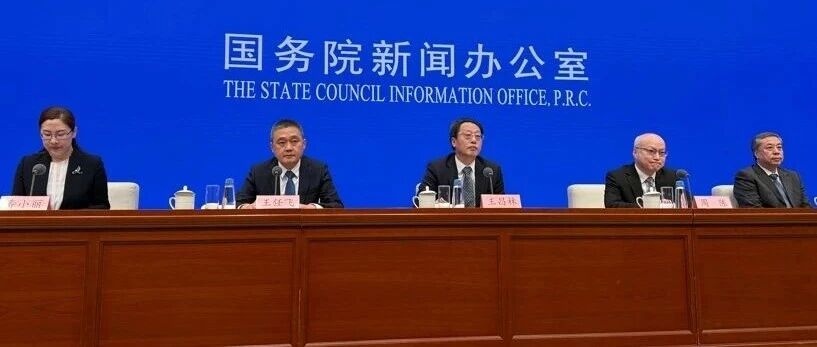
研究制定出台2026—2030年扩大内需战略实施方案 当前,我国经济发展中需求不足的问题较为突出,同时也存在供给不充分的问题。王昌林表示,要坚持 把宏观政策的发力点放在做强国内大循环上,全方位扩大国内需求。重点是要适应需求升级的趋势,结 合新一轮科技革命和产业变革的需要,研究制定出台2026—2030年扩大内需战略实施方案,为以新需求 引领新供给、以新供给创造新需求提供强有力的创新举措和要素保障,努力实现供需互促、循环升级。 研究设立国家级并购基金 1月20日,国新办举行新闻发布会,国家发展改革委介绍落实中央经济工作会议精神,推动"十五五"实 现良好开局有关情况,并对热点问题进行回应。 推动优化节假日安排 国家发展改革委副主任王昌林介绍称,2025年,着力解决群众急难愁盼,民生福祉实现新提升。面对人 民群众新期待,进一步加强普惠性、基础性、兜底性民生建设,努力促进高质量充分就业,全年城镇调 查失业率平均为5.2%,有序实施育儿补贴制度,逐步推行免费学前教育,推动优化节假日安排,让千 家万户有实打实的获得感,以惠民生为牵引,打开发展新空间。 谋划推进一批"十五五"时期的高技术产业标志性引领性重大工程 国家发展改 ...
中国将研究制定未来五年扩大内需战略实施方案
Zhong Guo Xin Wen Wang· 2026-01-20 06:58
中国将研究制定未来五年扩大内需战略实施方案 一是要坚持把宏观政策的发力点放在做强国内大循环上,全方位扩大国内需求。重点是要适应需求升级 的趋势,结合新一轮科技革命和产业变革的需要,研究制定出台2026—2030年扩大内需战略实施方案, 为以新需求引领新供给、以新供给创造新需求提供强有力的创新举措和要素保障,努力实现供需互促、 循环升级。 二是坚持把发展经济的着力点放在实体经济上,加快构建现代化产业体系。要发挥好国家创业投资基金 行业标杆作用,研究设立国家级并购基金,加强政府投资基金布局规划和投向指导,促进创新创业创 造,加快培育和发展新质生产力。 三是坚持把市场运行的调控点放在纵深推进全国统一大市场建设上,充分激发市场活力。重点是要综合 整治"内卷式"竞争,实现从"卷价格"向优价值转变。要完善市场准入、公平竞争、产能退出等机制,加 强产能调控,积极化解供大于求的阶段性矛盾。进一步细化地方招商引资鼓励和禁止事项边界,规范地 方经济促进行为。加强重点行业价格监管,依法依规治理企业低价无序竞争,形成优质优价、良性竞争 的市场秩序。大力实施质量品牌战略,引导破解"内卷式"竞争。(完) 来源:中国新闻网 编辑:张嘉怡 ...
国家发改委:正在研究制定城乡居民增收计划
第一财经· 2026-01-20 06:57
Core Viewpoint - The article emphasizes the importance of domestic demand as a driver for economic growth, highlighting government initiatives aimed at enhancing consumer capacity and optimizing supply [2][3]. Group 1: Domestic Demand and Economic Strategy - The central task for this year's economic work is to strengthen domestic demand and build a robust domestic market, as stated by the National Development and Reform Commission (NDRC) [3]. - The NDRC plans to develop a strategic implementation plan for expanding domestic demand from 2026 to 2030, focusing on new demand leading to new supply and vice versa [3]. - There is a commitment to improve market regulation, promote fair competition, and address issues of overcapacity through better management of market entry and exit mechanisms [3]. Group 2: Consumption and Investment Policies - The government is promoting large-scale equipment upgrades and a "trade-in" policy for consumer goods as key measures to implement the strategy of expanding domestic demand [5]. - In 2025, over 360 million people are expected to apply for subsidies under the "trade-in" policy, which is projected to generate sales exceeding 2.6 trillion yuan, contributing 0.6 percentage points to retail sales growth [5]. - The NDRC has announced enhancements to the "trade-in" policy for 2026, including increased funding and improved implementation mechanisms to ensure effective policy execution [5]. Group 3: Investment and Economic Growth - Investment is viewed as both current demand and future supply, with a focus on improving investment efficiency and enhancing both physical and human capital [6]. - The government aims to increase the proportion of public investment in livelihood projects and utilize new policy financial tools to attract more private and social capital [6]. - The strategy to expand domestic demand is framed as a long-term initiative requiring both strong policy support and reform efforts to facilitate a smooth supply-demand cycle [6].

国家发改委:将研究制定出台2026—2030年扩大内需战略实施方案!研究设立国家级并购基金
Guo Ji Jin Rong Bao· 2026-01-20 05:41
同时,王昌林表示,要发挥好国家创业投资基金行业标杆作用,研究设立国家级并购基金,加强政府投 资,基金布局规划等,促进创新创业创造,加快培育和发展新质生产力。 来源综合央视新闻客户端报道 国家发展改革委副主任王昌林在国新办新闻发布会上表示,当前我国经济运行存在供强需弱的问题,接 下来要坚持把宏观政策的发力点放在做强国内大循环上,全方位扩大国内需求,重点是要适应我们国家 需求结构升级趋势。结合我们新一轮科技革命和产业变革的需要,今年,发改委将研究制定出台2026年 —2030年扩大内需战略实施方案,以新供给创造新需求,提供强有力的创新举措和要素保障。 (文章来源:国际金融报) 1月20日,国新办举行新闻发布会,介绍落实中央经济工作会议精神,推动"十五五"实现良好开局有关 情况。 ...
午评:沪指跌0.3% 环氧丙烷板块领涨 卫星互联网板块领跌
Xin Hua Cai Jing· 2026-01-20 05:40
Market Overview - The Shanghai and Shenzhen stock markets opened lower on January 20, with major indices experiencing initial gains followed by declines, with the Shanghai Composite Index dropping by 0.82% at one point [1] - By midday, the Shanghai Composite Index closed at 4101.62 points, down 0.30%, with a trading volume of approximately 802.8 billion yuan; the Shenzhen Component Index closed at 14119.95 points, down 1.22%, with a trading volume of about 104.51 billion yuan [1] Sector Performance - The sectors showing initial gains included cultivated diamonds, semiconductors, rental purchase rights, storage chips, and cement materials, while sectors like Hainan, precious metals, and satellite internet showed initial declines [1] - By midday, the leading sectors in terms of gains were epoxy propylene, rental purchase rights, and insurance, while satellite internet, CPO concepts, and virtual robots were among the sectors with the largest declines [1] Institutional Insights - CITIC Securities highlighted that the AI application sector is expected to be a main focus in early 2026, with ongoing catalysts for AI applications and a trend towards accelerated implementation [2] - Huatai Securities noted that the high crowding risk in the defense and military sector has been alleviated, but funds flowing out have not moved to safer options, leading to significant internal sector differentiation and rapid rotation within the A-share market [2] Company Updates - CITIC Construction Investment reported that TSMC's latest financial results exceeded market expectations, indicating strong growth potential in the computing power sector, with a forecast for continued robust demand through 2027 [3] Policy Developments - The National Development and Reform Commission (NDRC) announced plans to formulate the "2026-2030 Strategy for Expanding Domestic Demand," aimed at aligning new demand with new supply through innovative measures [4] - The NDRC is also planning to advance significant projects in high-tech industries, targeting a manufacturing value-added share of over 17% by 2025 [5] - Additionally, the NDRC is researching the establishment of a national-level merger and acquisition fund to enhance government investment strategies and promote innovation and entrepreneurship [6]