新能源产业

Search documents
超12亿!房地产上市公司收购锂矿企业!
起点锂电· 2025-12-23 10:40
Core Viewpoint - Hualian Holdings is acquiring 100% of Argentum for approximately $175 million (RMB 1.235 billion), gaining an 80% stake in the Arizaro lithium project in Argentina, marking its entry into the lithium resource development sector [2][3]. Group 1: Transaction Details - The acquisition will allow Hualian Holdings to indirectly hold 80% of the Arizaro salt lake project, which is located in the Salta province of Argentina and is considered the largest undeveloped salt lake in South America's "lithium triangle" [3][4]. - The Arizaro project includes six mining rights covering an area of approximately 205 square kilometers [3]. - Hualian Holdings aims to diversify its business due to the stagnation in the domestic real estate market, adopting a strategy of "stabilizing real estate while promoting transformation" [3][4]. Group 2: Strategic Intent - The company plans to maintain its existing real estate operations while adding overseas lithium salt lake mining assets, which aligns with the broader trend of developing the new energy industry [4]. - This acquisition is seen as a significant step in the company's industrial transformation and a way to reduce reliance on the real estate market [4]. Group 3: Financial Position and Previous Investments - Hualian Holdings has a strong financial position, with cash flow exceeding total liabilities, indicating robust capability to fulfill the acquisition without impacting normal operations [5]. - The company has previously invested in lithium-related ventures through industrial funds, including Shenzhen Juneng and Zhuhai Juneng, which focus on lithium extraction and production [5]. Group 4: Challenges and Risks - The acquisition faces potential risks, including local legal and regulatory challenges in Argentina, which could increase operational costs and uncertainty [6][7]. - As a new entrant in the lithium sector, the company may lack the necessary technical expertise and experience in lithium extraction, which could affect production efficiency and project timelines [6][7]. - The competitive landscape in lithium mining is intense, with existing players already established in Argentina, posing additional challenges for Hualian Holdings [7].


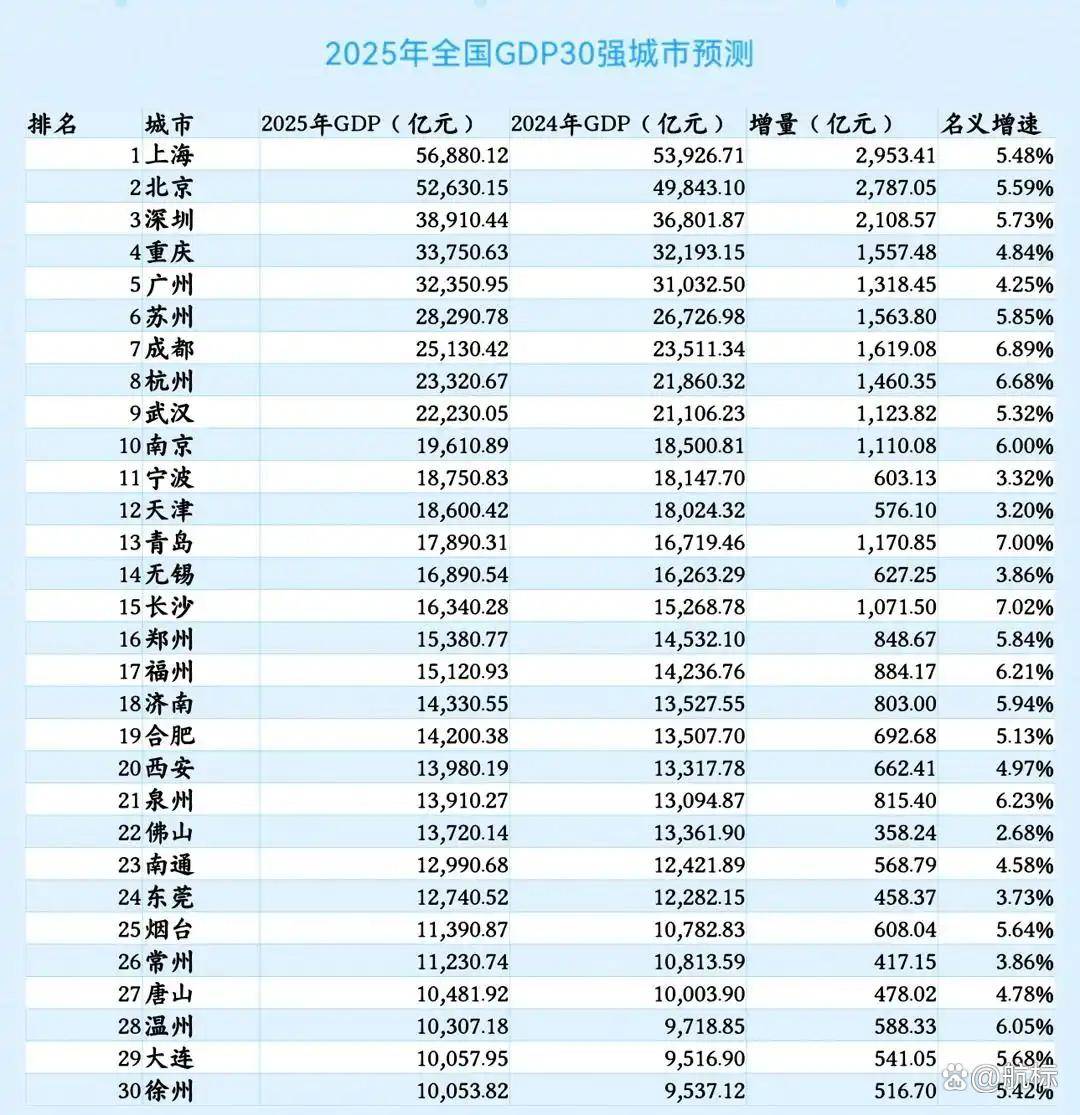
预测!2025年GDP30强城市出炉:深圳远超重庆,长沙增速超7%,温州突破万亿!
Sou Hu Cai Jing· 2025-12-22 04:02
Core Insights - The competition landscape among cities is being reshaped, with the 2025 GDP forecast highlighting economic vitality, innovation capability, and policy benefits across various regions [1] Group 1: Economic Forecasts - Shenzhen's GDP is projected to reach 38,910.44 billion yuan in 2025, growing by 5.73% from 2024, maintaining a leading position among first-tier cities [3] - Changsha's GDP growth rate is expected to be 7.02%, driven by industrial innovation and upgrades [6] - Wenzhou's GDP is forecasted to exceed 1 trillion yuan, reaching 10,307.18 billion yuan with a growth rate of 6.05% [8] Group 2: Key Economic Drivers - Shenzhen's digital economy core industries are expected to account for over 40% of its GDP, supported by investments in AI and 5G technology [4] - Changsha's engineering machinery industry is anticipated to improve production efficiency by over 30% through smart upgrades, with significant contributions from leading companies like Sany Heavy Industry [6] - Wenzhou's private economy is projected to contribute over 70% to its GDP, with the renewable energy sector emerging as a growth highlight [8] Group 3: Infrastructure and Connectivity - Shenzhen's transportation network and logistics system are crucial for economic growth, with its port maintaining a leading position in global cargo throughput [4] - Changsha's high-speed rail hub status enhances connectivity with major economic circles across the country [6] - Wenzhou's transportation network is improving, with a projected 10% increase in cargo throughput at Wenzhou Port in 2025 [8] Group 4: Policy and Innovation - Shenzhen's success is attributed to continuous technological breakthroughs and the transformation of tech achievements into core competitiveness [4] - Changsha's government is increasingly supporting emerging industries, attracting high-tech companies and innovative talent [6] - Wenzhou's economic vitality is driven by its adaptability to market changes and optimization of industrial structure [8] Group 5: Lessons and Implications - The economic development experiences of Shenzhen, Changsha, and Wenzhou provide valuable insights for other cities to leverage their advantages and seize policy opportunities for growth [10]
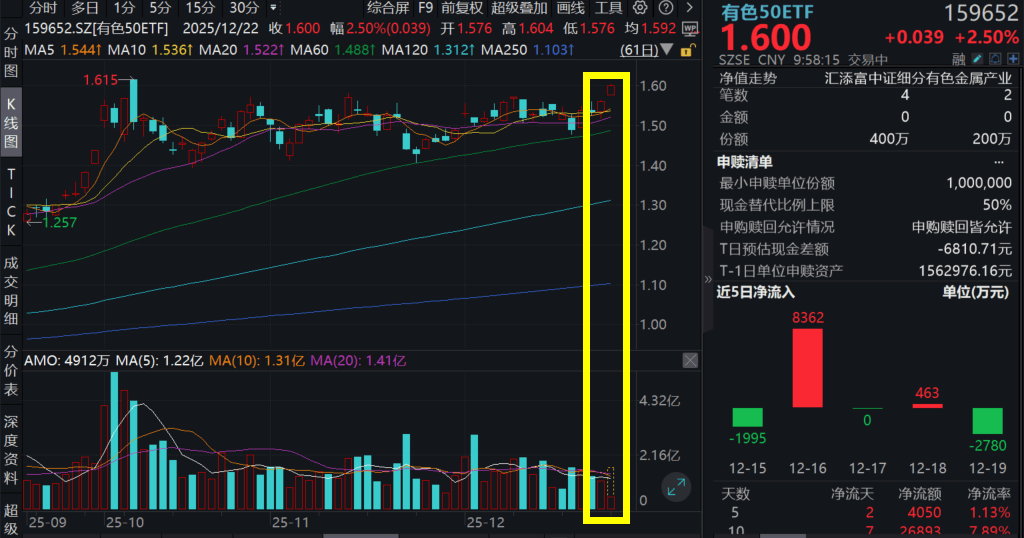
锂、金、银暴涨,紫金矿业涨超4%!有色50ETF(159652)跳空高开放量大涨,劲升2%,盘中资金涌入!年末收官将至,有色“夺冠在望”?
Sou Hu Cai Jing· 2025-12-22 02:23
Core Viewpoint - The A-share market is experiencing a significant upward trend, particularly in the non-ferrous metal sector, with the Non-Ferrous 50 ETF (159652) showing a notable increase and substantial trading volume [1][4]. Group 1: Market Performance - As of 9:58 AM, the Non-Ferrous 50 ETF (159652) opened with a gap up, rising by 2.5% and seeing a significant increase in trading volume, with 200,000 net subscriptions recorded during the session [1]. - Key stocks in the non-ferrous metal sector, such as Zijin Mining and Shandong Gold, have shown strong performance, with Zijin Mining increasing by 4.66% and Shandong Gold by 4.37% [2][4]. Group 2: Commodity Trends - Precious metals are experiencing a surge, with spot gold rising over 1% to exceed $4,383 per ounce, setting a new historical high, while silver has also reached a record of over $67 per ounce [3]. - The overall non-ferrous metal sector has seen an impressive increase of over 85% this year, indicating a strong market performance [4]. Group 3: Economic and Policy Context - Following the December Federal Reserve policy decisions, a monthly operation of $40 billion in reserve management purchases is expected to provide liquidity support to the market [7]. - The Bank of Japan has raised interest rates by 25 basis points to 0.75% to combat rising inflation, marking the highest rate in 30 years [7]. Group 4: Investment Opportunities - The Non-Ferrous 50 ETF (159652) is highlighted as a leading investment vehicle, covering a wide range of metals including gold, copper, aluminum, lithium, and rare earths, which are expected to benefit from the ongoing super cycle in the non-ferrous sector [18][20]. - The ETF has a high concentration of key metals, with copper accounting for 31% and gold for 14%, making it a competitive option in the market [20]. Group 5: Long-term Outlook - The long-term outlook for gold remains positive, driven by factors such as declining real interest rates and increasing central bank gold purchases, with forecasts suggesting gold prices could exceed $4,500 per ounce in the near future [15][16]. - The copper market is also expected to see a growing supply-demand gap, with projections indicating that copper prices may reach new highs due to robust demand from emerging sectors like AI and renewable energy [16][17].




“微”观行业之变 | 从一家传统电厂的“绿色蜕变”看煤电改造升级
Zhong Guo Jin Rong Xin Xi Wang· 2025-12-19 14:07
新华财经北京12月19日电(记者沈寅飞)随着我国新能源发电装机规模占比超过煤电成为常态,发电行业也产生了新现象和新变化。在新型电 力系统构建与绿色转型进程中,一些传统煤电企业开始面临生存挑战,行业转型升级似乎已迫在眉睫。 记者调研发现,国能江苏常州电厂通过掺烧污泥、回收废热等举措,蹚出生态效益与经济效益双赢新路;多地煤电企业亦加码技术创新,探索 灵活性改造与综合能源服务模式。国家层面出台专项实施方案为煤电升级指明方向,传统煤电正以技术与机制双重革新,书写"老骥伏枥"新答 卷。 "吃干榨净"城市废料 传统火电变身绿色引擎 在国能江苏常州发电厂厂区,记者发现这里鲜有传统火电厂的浓烟灰渣,却有不少全封闭运输车有序穿梭。3公里外的市政污泥处理车间内, 含水率80%的湿污泥经管道送入电厂,通过"低压蒸汽干化+高温焚烧"技术转化为能源;焚烧产生的灰渣则成为混凝土掺合料,被送往建筑企 业——"污泥—能源—建材"实现闭环循环,成为了这家运行20年老电厂绿色蜕变的注脚之一。 转自:新华财经 厂的冷却塔 沈寅飞摄 图为国家能源集团江苏常州公司发电 "过去电厂盯着烟囱要发电量,现在我们盯着城市'代谢'做服务。"该厂党委书记、董事长 ...

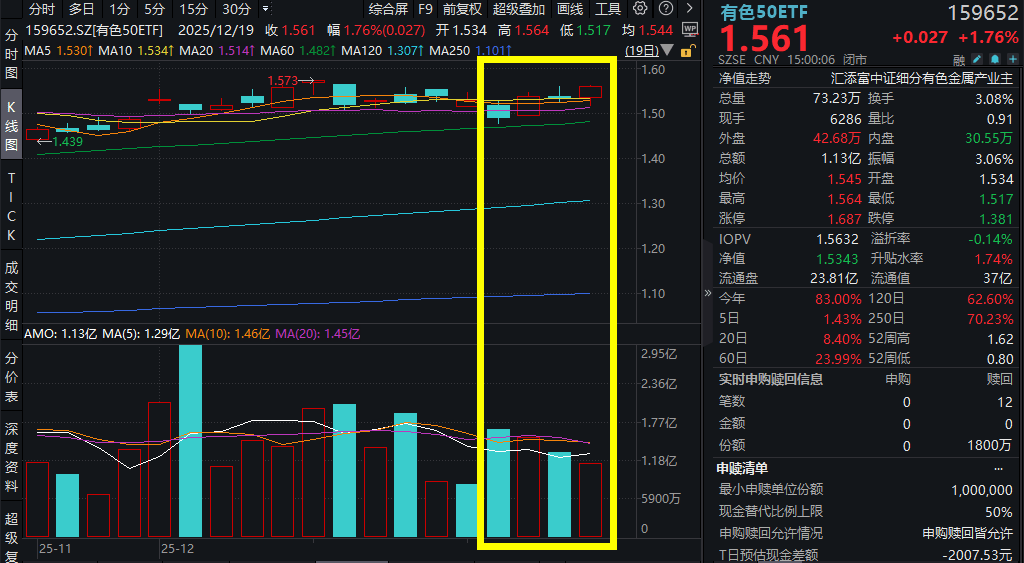
国内唯一、亚洲最大,山东海底发现巨型金矿!紫金矿业翻红,有色50ETF(159652)涨近2%!机构:通胀缓解+宽松预期,有色金属行情可期
Sou Hu Cai Jing· 2025-12-19 10:24
Core Viewpoint - The A-share market has shown significant recovery, with over 4,400 stocks rising, particularly in the non-ferrous metals sector, where the Non-Ferrous 50 ETF (159652) increased by 1.76% [1] Non-Ferrous Metals Sector Performance - The majority of the Non-Ferrous 50 ETF constituent stocks experienced gains, with notable increases such as Yun Aluminum Co. (000807) rising by 6.48%, and other companies like Northern Rare Earth, Huayou Cobalt, and China Aluminum seeing increases of over 3% [3] - The top ten constituent stocks of the Non-Ferrous 50 ETF include companies like Sanfour New Materials, Jialong Aluminum, and Northern Rare Earth, with varying performance metrics [4] Domestic and International News Impact - A significant domestic discovery of a giant underwater gold mine in Laizhou City, with proven gold reserves exceeding 3,900 tons, accounting for approximately 26% of the national total [5] - Internationally, U.S. inflation data showed a lower-than-expected increase in the core Consumer Price Index (CPI), leading to heightened expectations for Federal Reserve interest rate cuts, which positively influenced global commodity markets [6] Characteristics and Importance of Non-Ferrous Metals - Non-ferrous metals encompass all metals excluding ferrous metals, including precious metals (gold), industrial metals (copper, aluminum), energy metals (lithium), and rare earths, playing a crucial role in the economy [8] - Copper is highlighted as a key industrial metal, often referred to as the "doctor of the economy," and is increasingly recognized as essential in the AI era [9] Investment Outlook for Precious Metals - The outlook for gold remains positive due to factors such as declining real interest rates, ongoing central bank purchases, and the potential for a global debt crisis reshaping economic order [12][14] - Predictions indicate that gold prices could exceed $4,500 per ounce in the first quarter of next year, with long-term forecasts suggesting prices could reach $5,000 to $6,000 by 2026 [15] Copper Market Dynamics - The copper market is characterized by both supply rigidity and vulnerability, with increasing demand driven by traditional and emerging sectors, including AI and renewable energy [16] - Forecasts indicate a growing global copper supply-demand gap, with prices expected to rise significantly, potentially reaching $12,000 per ton by the end of the year [19] Non-Ferrous 50 ETF Advantages - The Non-Ferrous 50 ETF (159652) offers comprehensive exposure to various metal sectors, with a high concentration of copper (31%) and gold (14%), making it a leading choice for investors [21] - The ETF has demonstrated superior performance with a cumulative return leading its peers, driven by earnings rather than valuation expansion, indicating a strong investment experience [22][23]
杭氧发力新能源产业抢占未来制高点
Hang Zhou Ri Bao· 2025-12-19 05:12
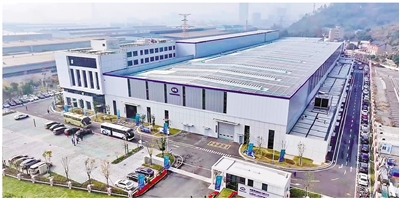
Group 1 - The modernization of the industrial system is the material and technical foundation for Chinese-style modernization, emphasizing the development of strategic emerging industries such as new energy and aerospace [1] - The "14th Five-Year Plan" suggests accelerating the development of strategic emerging industry clusters and implementing large-scale application demonstrations of new technologies and products [1] - The focus on future industries includes exploring diverse technological routes and typical application scenarios, aiming to make quantum technology, biomanufacturing, hydrogen energy, and nuclear fusion new economic growth points [1] Group 2 - The hydrogen energy equipment industrial base of Hangyang Group officially commenced production on December 18, marking a new journey towards green and new energy [2] - The base covers an area of 62.53 acres with a building area of approximately 95,000 square meters, focusing on the production of core liquid hydrogen equipment [4] - The facility features advanced production equipment and intelligent management systems, aiming for a significant leap in production efficiency [4] Group 3 - Hangyang Group has successfully won contracts in the field of controlled nuclear fusion, demonstrating its comprehensive technical strength in deep low-temperature technology [7] - A joint research center with Zhejiang University has been established to focus on key technological challenges in deep low-temperature technology and advanced computing [7] - The company is committed to providing comprehensive solutions for the clean energy industry, showcasing its transition to a low-temperature technology company [8] Group 4 - Hangyang Group's first "on-site green hydrogen production, storage, and application integration" demonstration station was launched, utilizing photovoltaic green electricity for hydrogen production [8] - The company is expanding its hydrogen energy projects across various regions, gradually building a hydrogen supply network to support industrial and transportation green transitions [8] - Hangyang Group has been a significant participant in China's industrialization process for 75 years and aims to be a pioneer in high-quality development in the new era [9]

港股概念追踪 电解锰价格13连涨创三年多新高 锰矿资源和锰材料企业受益(附概念股)
Jin Rong Jie· 2025-12-19 01:13
从下游需求来看,钢铁行业需求稳定,12月全国多数钢厂维持稳定生产节奏,年末补库需求逐步释放。 以200系不锈钢为代表的特定下游领域,其对电解锰的需求展现出较强的韧性。 数据显示,2025年12月国内39家冷轧不锈钢厂排产预计达144.59万吨,环比小幅增加。 此外,新能源领域也是行业增长的核心引擎,锰业正从钢铁时代的"工业味精",悄然蜕变为新能源产业 的"电池血液"。磷酸锰铁锂等新型电池技术的商业化应用,对高纯电解锰的需求呈现爆发式增长。 智通财经获悉,进入12月,电解锰价格一路走高,累计上涨超2300元/吨,最新价格创出三年多新高。 数据显示,12月18日,电解锰平均价为17820元/吨,环比上涨200元/吨。12月以来,电解锰已连续13日 上涨(不含双休日,每天都有涨价),累计涨幅近15%,价格创出2022年5月以来新高。 本轮电解锰价格上涨,主要由供应收缩、成本支撑及需求改善等多重因素共同驱动。进入10月份后,广 西、贵州等电解锰主产区处于秋冬季污染防治攻坚管控期,限制政策持续发力,部分环保设施不达标的 中小产能被迫减产或临时停产。 此外,南方主产区进入枯水期后,水电价格上涨推高了电解锰生产能耗成本,部 ...
疆电网新能源发电出力攀升至4017万千瓦 创历史新高
Zhong Guo Dian Li Bao· 2025-12-19 00:34
Core Insights - Xinjiang's new energy generation capacity reached a historical high of 40.17 million kilowatts, accounting for 58.3% of the total power output, indicating the increasing importance of new energy in the power supply system [1] - By the end of November, Xinjiang's new energy installed capacity reached 143 million kilowatts, a year-on-year increase of 64.6%, representing 60% of the total installed capacity [1] - The Tianshan North Gobi Energy Base, China's first "desert energy" export base, is nearing full capacity integration, capable of delivering 36 billion kilowatt-hours of green electricity annually to the Sichuan-Chongqing region [1] - The National Energy Investment Corporation's Tieliketai Wind Power Project has begun generating power, expected to reduce carbon dioxide emissions by approximately 930,000 tons annually [1] - Infrastructure development is accelerating, with the construction of the third AC transmission channel, which will enhance Xinjiang's external transmission capacity to about 4.8 million kilowatts [1] Industry Developments - State Grid Xinjiang Electric Power Company is enhancing the high-quality consumption of new energy by optimizing power generation and adjusting coal-fired power plants to operate at a minimum output of 20% of their rated capacity [2] - The company has improved the matching potential between external delivery curves and new energy generation curves, activating various adjustment resources including hydropower, thermal power, energy storage, and pumped storage [2] - Xinjiang's new energy generation reached 134.57 billion kilowatt-hours, reflecting a year-on-year growth of 21.4% [2]
电解锰价格13连涨创三年多新高 锰矿资源和锰材料企业受益(附概念股)
Zhi Tong Cai Jing· 2025-12-19 00:10
进入12月,电解锰价格一路走高,累计上涨超2300元/吨,最新价格创出三年多新高。 数据显示,12月18日,电解锰平均价为17820元/吨,环比上涨200元/吨。12月以来,电解锰已连续13日 上涨(不含双休日,每天都有涨价),累计涨幅近15%,价格创出2022年5月以来新高。 本轮电解锰价格上涨,主要由供应收缩、成本支撑及需求改善等多重因素共同驱动。进入10月份后,广 西、贵州等电解锰主产区处于秋冬季污染防治攻坚管控期,限制政策持续发力,部分环保设施不达标的 中小产能被迫减产或临时停产。 此外,南方主产区进入枯水期后,水电价格上涨推高了电解锰生产能耗成本,部分中小冶炼企业因成本 压力主动减产,进一步收紧供应。 与此同时,行业龙头宁夏天元锰业60万吨电解金属锰(一期)技改项目仍处于建设阶段,预计在2026年下 半年实现投产,技改期间部分老旧产能同步停产升级,加剧市场对供应缺口的预期。 此外,新能源领域也是行业增长的核心引擎,锰业正从钢铁时代的"工业味精",悄然蜕变为新能源产业 的"电池血液"。磷酸锰铁锂等新型电池技术的商业化应用,对高纯电解锰的需求呈现爆发式增长。 锰业相关港股: 南方锰业(01091):财务 ...
太“锰”了!电解锰价格连涨13天,创出三年多新高(附股)
Zheng Quan Shi Bao Wang· 2025-12-18 23:49
Core Viewpoint - The price of electrolytic manganese has risen continuously for 13 days since December, reaching a new high of 17,820 yuan/ton, with a cumulative increase of over 2,300 yuan/ton, marking a nearly 15% rise since the beginning of the month [1][3]. Price Drivers - The recent price increase of electrolytic manganese is driven by multiple factors including supply contraction, cost support, and improved demand [3]. - Environmental regulations in major production areas like Guangxi and Guizhou have led to reduced production from smaller facilities, contributing to supply tightness [3]. - Rising water and electricity costs due to the dry season have increased production costs, prompting some small smelting enterprises to cut back on output [3]. - The ongoing construction of a 600,000-ton electrolytic manganese project by Ningxia Tianyuan Manganese Industry is expected to further tighten supply until its completion in the second half of 2026 [3]. Demand Analysis - The steel industry shows stable demand, with many steel mills maintaining production rates and year-end inventory replenishment needs becoming apparent [4]. - Specific downstream sectors, such as the 200 series stainless steel, exhibit strong demand resilience for electrolytic manganese [4]. - Recent bidding prices for spherical electrolytic manganese have surged to 16,600 yuan/ton, reflecting a significant increase of 2,102 to 2,420 yuan/ton from the previous round, boosting market sentiment [4]. Growth in New Energy Sector - The manganese industry is transitioning from being primarily associated with steel to becoming a critical component in the new energy sector, particularly in battery production [5]. - The commercial application of new battery technologies, such as lithium iron phosphate manganese, is driving explosive growth in demand for high-purity electrolytic manganese [5]. - Projects like Yunnan Youneng's second phase, expected to be fully operational by the end of 2025, will add significant production capacity for lithium iron phosphate manganese [5]. Manganese Industry Stocks - Key manganese industry stocks include Sanxia Water, Hongxing Development, Xiangtan Electric, Western Gold, and Zhonggang Tianyuan, among others [6]. - Hongxing Development holds manganese mining assets with a total capacity of approximately 250,000 tons/year [6]. - Xiangtan Electric has a total capacity of 122,000 tons for electrolytic manganese dioxide and plans to expand its lithium manganese oxide capacity [7]. - Zhonggang Tianyuan is the largest producer of battery-grade manganese tetroxide, with a production capacity of 85,000 tons [7]. - Western Gold's subsidiary, Kebang Manganese, is the only electrolytic manganese producer in Xinjiang, benefiting from a complete industry chain [8].