新能源汽车市场竞争

Search documents
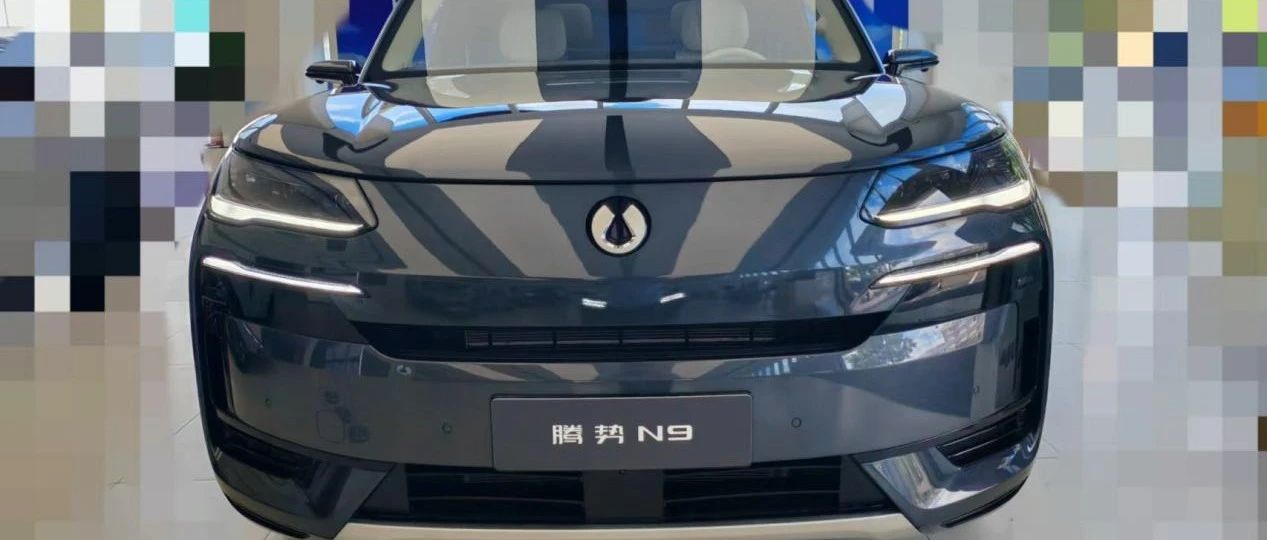
腾势N9:核心竞品是问界,打动客户靠服务
车fans· 2025-07-14 00:29
Core Viewpoint - The article discusses the launch and initial sales performance of the Tengshi N9, highlighting its appeal among consumers and the competitive landscape in the luxury electric vehicle market [2][6]. Sales Performance - The Tengshi N9 was officially launched on March 21, with deliveries starting in April. Initial sales were slow, with only 4 units delivered in the first batch, but an expectation of selling 6-8 units in June [2]. - The most popular model sold is the 2025 flagship version priced at 449,800 yuan, followed by the 2025 Honor version at 389,800 yuan. The most sought-after color is the limited edition "Black Warrior" [2]. Target Consumer Profile - The primary buyers of the Tengshi N9 are existing owners of BBA (BMW, Benz, Audi) vehicles, with a significant portion being leaders of state-owned enterprises and individual business owners [3][6]. Customer Experience - A notable customer, referred to as "Deng Ge," expressed high satisfaction with the service received at the dealership, which influenced his decision to choose the N9 over competitors [5]. - The reasons for purchasing the N9 include its competitive pricing among luxury flagship models and advanced technology features such as the "Heavenly Eye B" auxiliary driving system [6]. Competitive Landscape - The N9 is frequently compared to models like the Aito M8 and M9, as well as the Li Auto L9. The main reason for potential buyers opting out of the N9 is perceived brand influence, with some customers feeling that a larger discount would be necessary to consider the N9 over competitors [16]. Pricing and Discounts - Currently, the N9 is a tightly controlled model with no discounts offered at the dealership, although some maintenance or accessory gifts may be provided [8]. - The financial options available for purchasing the N9 include full payment or a 5-year low-interest plan, with detailed financial breakdowns provided [20]. Customer Complaints - Customers have reported issues such as uneven gaps in the rear tailgate and noise from the armrest and rear TV, which affect the overall user experience [22][25]. Customer Rights and Benefits - The article outlines various customer rights and benefits associated with purchasing the N9, including limited-time purchase gifts, trade-in subsidies, and free maintenance services [27].

车企“半年考”揭晓 新势力加速洗牌
Guang Zhou Ri Bao· 2025-07-08 06:54
广州日报讯 (全媒体记者邓莉)7月首周,2025年上半年车企成绩单陆续揭晓,其中比亚迪、上汽 领衔破200万辆,表现耀眼;新能源阵营则多点开花,合资品牌止跌回升。 上半年数据也反映出汽车产业的竞争态势。集团车企方面,"半年答卷"呈现了各集团推进品牌、管 理和资源整合的阶段性改革成效;新车企方面,随着华为、小米掌控"新"赛道,新势力车企加速分化和 洗牌。 大集团深化改革 强化品牌"战力" 今年上半年,国内主要汽车集团的发展主调是:改革、整合。以架构调整、产业链技术、资源统 筹、管理模式为核心的集团变革,强化一体化力量。汽车集团的"自我动刀",也重塑了头部车企的格 局。 上汽集团从2024年8月开始进行人事大调整,到2025年初成立大乘用车执管会,试图解决多品牌各 自为战的痛点。广汽集团在去年11月宣布开启三年"番禺行动",以四大改革举措、五大保障再造"新广 汽",2025年是其开启自主品牌一体化运营的第一年。中国一汽和东风汽车两家一级汽车央企,从去年 最后一个月进入组织架构体系变革,对总部职能部门进行调整,还重点整合集团资源运营自主乘用车事 业。此外,吉利汽车也从今年1月5日启动"一三三"战略,回归"一个吉利" ...
深夜,特斯拉突然狂泻,一度跌超8%
21世纪经济报道· 2025-07-07 15:20
Core Viewpoint - Tesla is facing a significant decline in sales and market share, attributed to product stagnation, quality issues with new models, regulatory challenges, and increasing competition from Chinese automakers [3][4][5][6][8][10]. Group 1: Sales Performance - Tesla's global deliveries in Q2 were 384,100 units, marking a year-on-year decline of 13.5%, the steepest drop since 2015 [3][4]. - In China, Tesla delivered 129,000 vehicles in Q2, contributing 34% to its total sales, but the cumulative sales for the first half of the year fell by 5.4% compared to the same period in 2024 [7][8]. Group 2: Product Issues - The product lineup remains heavily reliant on Model 3 and Model Y, which together accounted for 97.3% of total deliveries, while the high-end models like Model S/X and Cybertruck contributed only 10,400 units, a 50% year-on-year decline [3][4]. - The Cybertruck has faced multiple recalls and quality issues since its production began in 2023, significantly undermining market confidence [4]. Group 3: Regulatory and Competitive Challenges - Tesla's Full Self-Driving (FSD) technology is encountering regulatory hurdles in Europe and China, delaying its rollout plans [4][5]. - Chinese competitors, such as BYD, are rapidly gaining market share in Europe, with BYD's electric vehicle sales surpassing Tesla's for the first time in April, showing a year-on-year growth of 359% [5][6]. Group 4: Market Dynamics - Tesla's market share in China has shrunk from a peak of 15% in 2020 to 7.6%, facing intense competition from local brands that are improving in technology and pricing [8][9]. - The marketing landscape is shifting, with new entrants like Xiaomi's automotive venture directly competing with Tesla's offerings, further straining Tesla's market position [9][10].


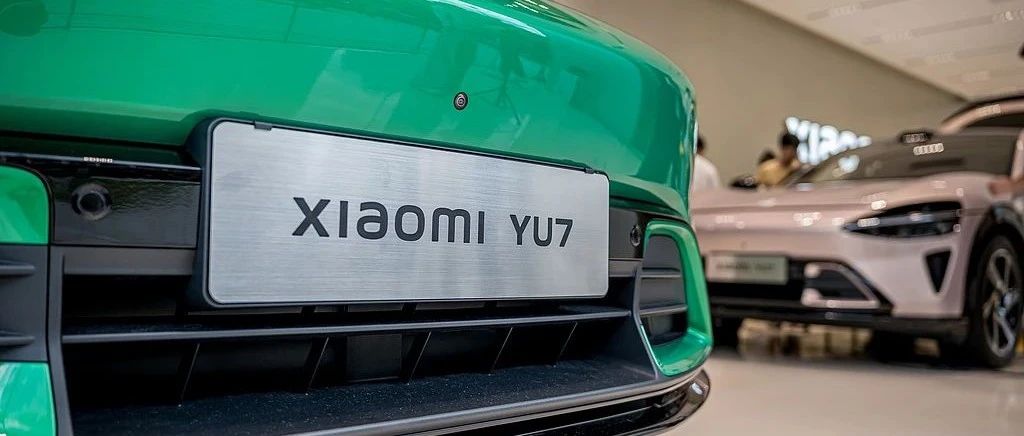
小米YU7风暴:雷军如何回应一场车圈“奇迹”
3 6 Ke· 2025-07-03 12:23
Core Insights - The article discusses the recent live broadcast by Lei Jun, where he addressed the overwhelming response to Xiaomi's new SUV model, YU7, which achieved over 200,000 pre-orders within three minutes of its launch [4][5][21] - The success of YU7 is attributed to its strong product appeal and the ability to attract new customers rather than merely transferring existing customers from the previous model, SU7 [8][20] Summary by Sections Product Launch and Market Response - Xiaomi's YU7 was launched at a starting price of 253,500 yuan, which was initially a concern for the company [5][16] - The pre-order numbers were astonishing, with 200,000 orders in three minutes and 289,000 in one hour, showcasing a strong market demand [5][21] - The company reported that the irrevocable order volume reached 240,000 within 18 hours, indicating significant consumer trust [5][21] Addressing Criticism and Market Strategy - Lei Jun addressed skepticism regarding the pre-order data, clarifying that the seven-day "hesitation period" is a common industry practice [8] - He emphasized that only 15% of YU7's orders came from existing SU7 customers, proving that YU7 attracted new buyers [8][20] - Lei Jun expressed a desire to focus on production and delivery rather than engaging in endless debates about numbers [9] User Demographics and Market Positioning - The average age of YU7 buyers is approximately 33 years, with a 30% female ownership rate, indicating a more mature and diverse customer base compared to SU7 [11][12] - Notably, 52.4% of YU7 buyers are iPhone users, suggesting a tech-savvy demographic [13] - The top three cities for sales are Shanghai, Hangzhou, and Beijing, which are also the strongest markets for Tesla's Model Y, indicating direct competition [14] Future Outlook and Company Philosophy - Lei Jun stated that Xiaomi will prioritize domestic delivery issues before considering international expansion, with a tentative timeline for export around 2027 [19] - He highlighted the importance of quality and consumer trust, acknowledging the scrutiny Xiaomi faces in the automotive sector [18][20] - The company aims to focus on product quality and innovation rather than engaging in negative competition with rivals [10]


新造车企业年中考:零跑首次领跑半年榜,仅小鹏目标完成过半
2 1 Shi Ji Jing Ji Bao Dao· 2025-07-03 01:34
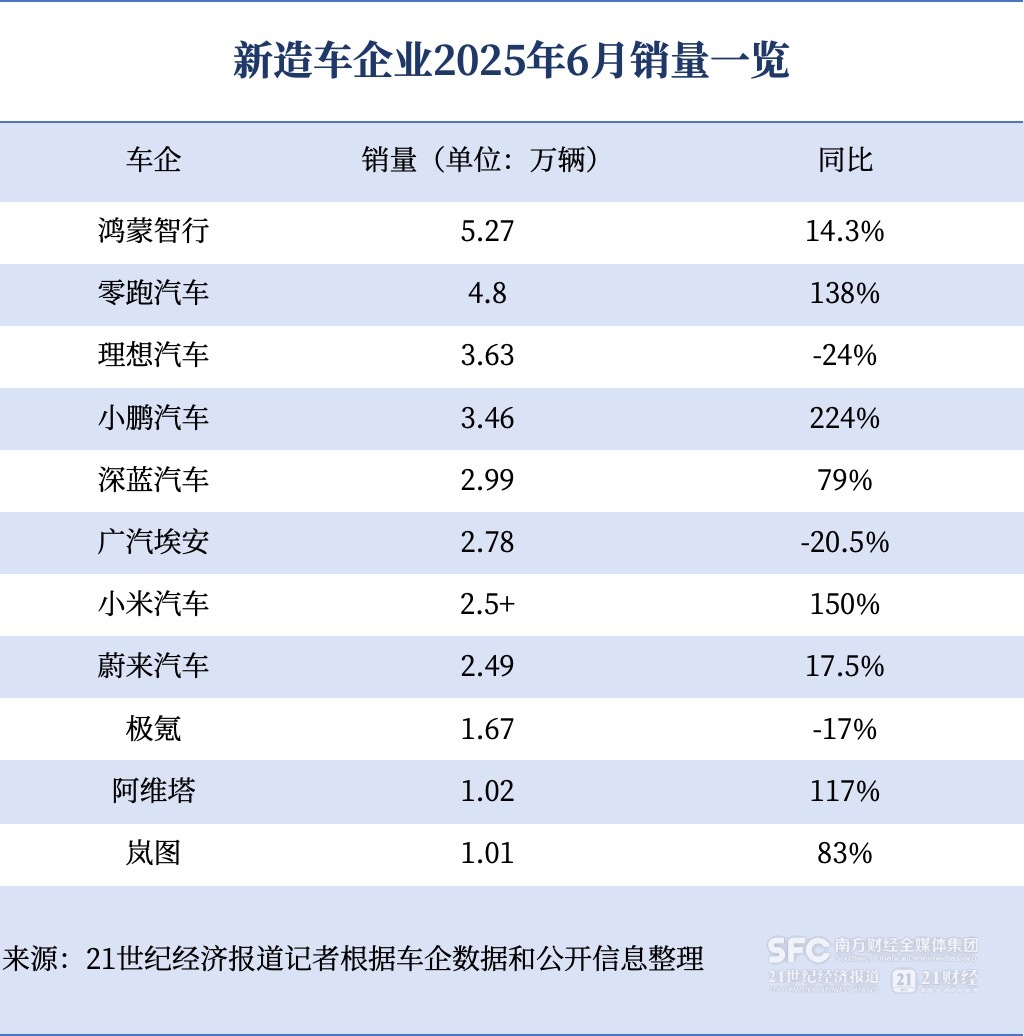
Core Insights - The new car manufacturing companies in China have shown significant year-on-year growth in sales for the first half of 2025, with some companies achieving remarkable increases in their sales figures [1][6][13] Sales Performance - Leap Motor achieved the highest sales in the first half of 2025, with 222,000 units sold, marking a 155.7% increase year-on-year [1][5] - Homologous Intelligent sold 206,200 units, a 6.2% increase, while Li Auto's sales grew by only 7.8% to 203,800 units, indicating a slowdown in growth [1][7][8] - GAC Aion experienced a decline in sales, dropping 14.2% to 152,300 units, while NIO's sales increased by 30.6% to 114,200 units, but it fell to seventh place in the rankings [1][3][8] Competitive Landscape - The competition among new car manufacturers is intensifying, with Leap Motor entering the top tier and Xiaopeng Motors rising to fourth place [1][6][13] - The sales completion rates for annual targets vary significantly among companies, with Xiaopeng achieving 51.9% of its 380,000-unit target, while over half of the companies have completion rates below 30% [1][9][10] Future Outlook - Leap Motor aims to sell between 500,000 and 600,000 units this year, with a current completion rate of 44% [6][9] - Xiaomi has set ambitious sales targets, with a completion rate of 42.9% and plans to increase production capacity to meet demand [10][11] - The second half of the year is expected to bring increased competition as companies prepare for the traditional peak sales season [12][13]


小米YU7爆单 消费者陷14个月超长等待期
Mei Ri Shang Bao· 2025-07-02 22:13
Core Insights - The Xiaomi YU7 has achieved remarkable sales figures, with over 200,000 units reserved within 3 minutes and 289,000 units within 1 hour of its launch, indicating a strong market demand [1] - The delivery timeline for the YU7 ranges from 38 to 61 weeks, leading to a significant backlog and creating a competitive environment among electric vehicle brands [2][4] - The YU7's design has attracted attention, particularly among younger consumers, many of whom are existing Xiaomi product users, highlighting the brand's strong ecosystem [3] Sales Performance - The YU7 has sold over 240,000 units within 18 hours of its launch, surpassing the annual sales volume of many new entrants in the market [1] - The standard version of the YU7 starts at 253,400 yuan, with the PRO and MAX versions priced at 279,900 yuan and 329,900 yuan respectively [2] Market Competition - Competing brands like Zeekr, NIO, and others have introduced incentives to attract potential YU7 buyers, offering subsidies for those who switch to their vehicles [5][6] - The emergence of a gray market for YU7 orders has been noted, with resale prices for orders reaching up to 20,000 yuan, reflecting the high demand and long wait times [4] Production Capacity - Xiaomi's current production capacity is limited to 150,000 vehicles per year at its Beijing factory, with plans to implement a double-shift system starting June 2024 to increase output [4] - The construction of additional factories is underway to address the backlog of orders for both the YU7 and the previously launched SU7 model [4]
小米YU7上海卖最好,提车等太久?雷军回应友商想“截胡”
Sou Hu Cai Jing· 2025-07-02 15:34
Core Insights - Xiaomi's Yu7 is positioned as a competitor to Tesla's Model Y, with a focus on luxury and high performance in the SUV market [4][5] - The Yu7 has received significant initial demand, with over 289,000 pre-orders within the first hour of its launch [4] - Xiaomi aims to enhance production capacity to meet the high demand, with delivery timelines extending up to 14 months for certain models [6] Group 1: Product Launch and Market Positioning - The Yu7 is available in three configurations and nine color options, with prices starting at 253,500 yuan, which is 10,000 yuan cheaper than the Model Y [4] - The average age of Yu7 users is 33, with a female customer ratio of 30%, indicating a slight increase in female interest compared to previous models [4][5] - The top three cities for Yu7 sales are Shanghai, Hangzhou, and Beijing, which are also the best-selling cities for the Model Y [4] Group 2: Competitive Landscape and Industry Dynamics - Xiaomi's CEO expressed concerns about the competitive landscape, acknowledging the strength of the Model Y and the challenges in the SUV market [4][5] - Other car manufacturers are attempting to attract potential Yu7 customers by offering to cover deposits for cancellations, indicating a competitive response to Xiaomi's launch [6] - The CEO emphasized the importance of mutual respect among competitors, suggesting that companies should focus on their strengths rather than disparaging others [6] Group 3: Production and Delivery Challenges - Current delivery timelines for the Yu7 range from 39-61 weeks depending on the model, reflecting the overwhelming demand [6] - Xiaomi has revised its production target for the year from 300,000 to 350,000 units to better align with demand [6] - The company is prioritizing domestic deliveries and plans to consider international expansion only after 2027 [6]
果然,又爆了!
Zhong Guo Ji Jin Bao· 2025-07-01 15:22
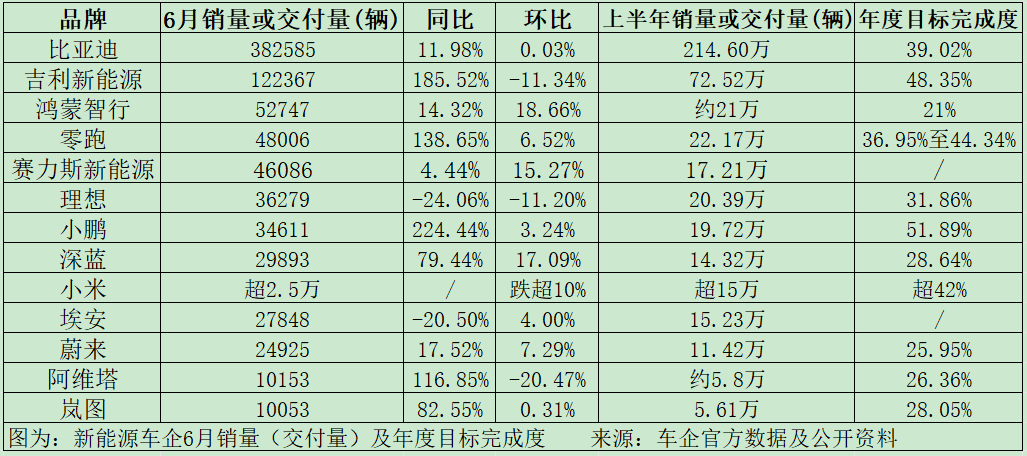
Core Insights - The performance of new energy vehicle companies in June shows significant differentiation among them, with BYD maintaining a leading position in sales [1][11] - The overall sales data for the first half of 2025 indicates that only XPeng has exceeded 50% of its annual sales target [2][11] Group 1: BYD Performance - BYD's June sales reached 382,585 units, a year-on-year increase of 11.98%, with a total of 2.146 million units sold in the first half of 2025, up 33.04% year-on-year [4][10] - BYD's pure electric vehicle sales exceeded 1 million units in the first half of 2025, with a growth rate of over 40% [10] - BYD's overseas sales have also reached new highs, with June's overseas sales accounting for 23.54% of total sales [10] Group 2: Other New Energy Vehicle Companies - Leap Motor led the new energy vehicle segment with June deliveries of 48,006 units, a year-on-year increase of 138.65% [12][14] - Li Auto's June deliveries were 36,279 units, down 24.06% year-on-year, indicating a declining trend in monthly deliveries [15] - Xiaomi's June deliveries fell to over 25,000 units, continuing a downward trend [18] Group 3: Market Trends and Future Plans - The competition among new energy vehicle companies is intensifying, particularly in the SUV market, with several companies planning new product launches [25][26] - Upcoming models include the 2026 version of Leap Motor's C11, XPeng's G7 AI smart SUV, and Li Auto's i8 and i6 electric SUVs [26][28] - NIO plans to launch three new models in the second half of 2025, including the third-generation ES8 and the L90 flagship SUV [28]


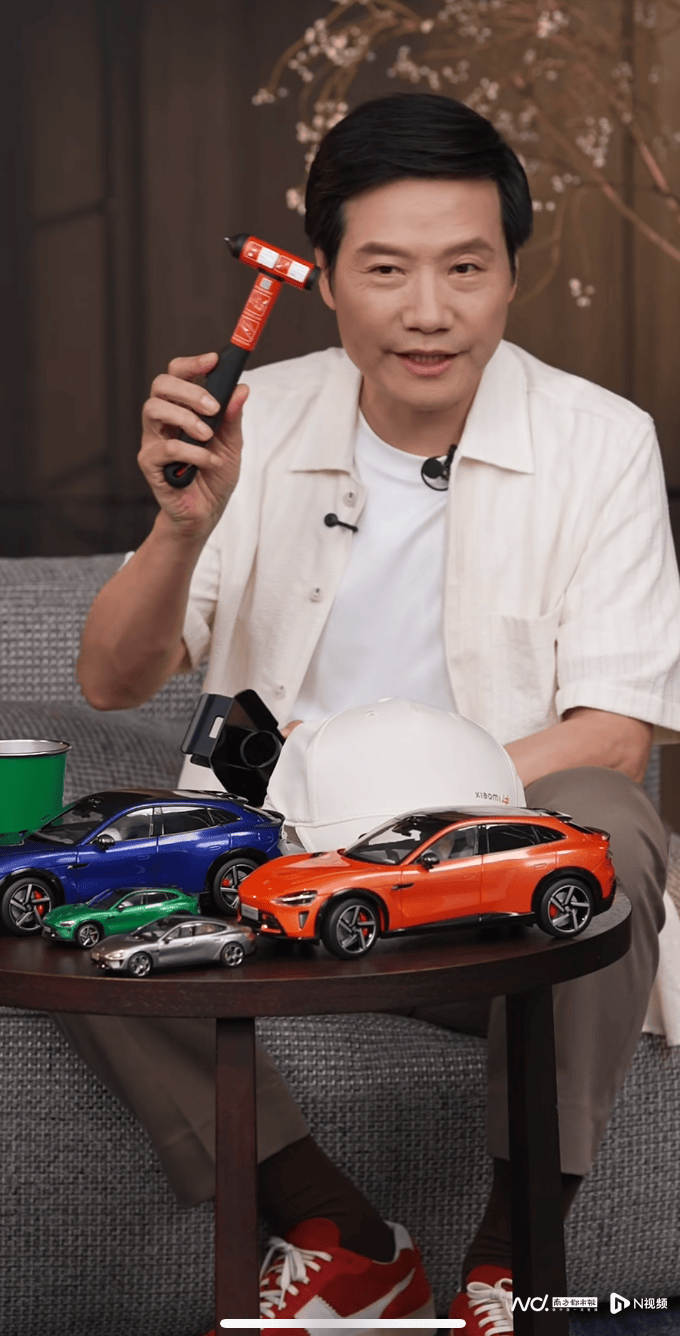
车企CEO,都在研究小米YU7
创业邦· 2025-07-01 12:00
Core Viewpoint - The launch of Xiaomi's YU7 SUV has created significant disruption in the automotive market, leading to a surge in orders and impacting competitors' sales and stock prices [3][4][6]. Group 1: Market Impact - Xiaomi's YU7 received over 289,000 orders within the first hour of its launch, with a total order value exceeding 600 billion yuan, indicating it may be the fastest-selling car in history [4][6]. - Competitors such as Xpeng, NIO, and Li Auto saw their stock prices drop by 3-7% following the YU7's launch, while Xiaomi's stock surged nearly 10% [6][7]. - The order backlog for YU7 is substantial, with delivery times extending up to 14 months for certain models, raising concerns about Xiaomi's production capacity [7][11]. Group 2: Competitive Landscape - The YU7 is positioned to compete directly with Tesla's Model Y, offering a lower starting price of 253,500 yuan, which is 10,000 yuan less than the Model Y [9][10]. - Industry analysts suggest that the YU7's entry into the market could trigger a price war among competitors, as they prepare to respond with price cuts and enhanced offerings [7][9]. - The competitive dynamics in the 250,000 to 350,000 yuan electric SUV segment are fragile, with many brands at risk of losing market share to the YU7 [15][16]. Group 3: Long-term Considerations - While the initial order volume for YU7 is impressive, analysts caution that its long-term sales performance will depend on delivery timelines and customer satisfaction post-purchase [11][13]. - The YU7's success may also influence the strategies of other brands, particularly those in the same price range, as they reassess their market positioning in light of Xiaomi's aggressive entry [19][24]. - The automotive industry is witnessing a shift in focus towards emotional value and user experience, as highlighted by Xiaomi's marketing strategy for the YU7, which emphasizes user-centric features over technical specifications [24].
多家车企“截胡”小米YU7订单
财联社· 2025-07-01 02:00
Core Viewpoint - The launch of Xiaomi's YU7 has generated significant market interest and competition among electric vehicle manufacturers, highlighting both the demand for the model and the challenges related to production capacity and delivery timelines [1][2]. Group 1: Market Response and Demand - Xiaomi's YU7 achieved an impressive 240,000 locked orders within 18 hours of its launch, showcasing the brand's strong market appeal [1]. - Despite the high demand, the delivery timelines for the YU7 are extended, with the standard version expected to take 57-60 weeks for delivery, and the Pro and Max versions taking 50-53 weeks and 37-40 weeks, respectively [1]. Group 2: Production Capacity Challenges - The current production capacity at Xiaomi's smart manufacturing base is limited to 150,000 vehicles annually, with the SU7 model consuming a significant portion of this capacity [2]. - Although the second phase of the manufacturing project has completed planning and acceptance, the timeline for mass production remains uncertain, which could lead to delays in fulfilling the 240,000 locked orders [2]. Group 3: Competitive Landscape - Other electric vehicle manufacturers, such as NIO, Avita, and Zeekr, are offering compensation policies to customers who switch their orders from the YU7 to their own models, indicating a competitive response to Xiaomi's success [1]. - The emergence of "scalpers" reselling YU7 orders at a premium has further complicated the situation, as buyers face longer wait times and may opt to purchase from competing brands instead [3].