
高端化

Search documents
国产电视品牌占据超九成市场份额 达历史最高点
Zheng Quan Ri Bao· 2025-07-18 09:32
Core Insights - The Chinese television market is experiencing a significant concentration of market share among domestic brands, with the top seven brands accounting for 92.6% of total shipments in Q1 2023, marking a historical high [1][2] Group 1: Market Performance - In Q1 2023, the total shipment volume of televisions in China reached 8.52 million units, a slight decrease of 0.6% year-on-year and an 8.9% decline compared to 2021 [1] - The top seven domestic brands, including Xiaomi, Hisense, TCL, Skyworth, Changhong, Haier, and Konka, shipped a total of 7.89 million units, representing a year-on-year growth of 2.5% [2] - Hisense and its sub-brand Vidda achieved nearly 2 million units in shipments, with a year-on-year growth of 13% [2] - TCL, including its sub-brands, saw a remarkable 37% increase in shipments, the highest growth rate in the industry [2] Group 2: Competitive Landscape - The competition among leading brands is intensifying, with the first-tier brands like Hisense and TCL maintaining strong growth, while the second-tier brands are facing pressure [3] - Huawei's shipments dropped over 50% due to internal adjustments, highlighting the need for improved sales performance post-adjustment [3] - Foreign brands like Sharp, Sony, Samsung, and Philips have seen their combined market share fall below 10%, indicating a significant decline [2][3] Group 3: Strategic Directions - Domestic brands are focusing on high-end market segments and expanding into commercial and automotive sectors, indicating a shift towards diversification [3][4] - Companies are investing in OLED and miniLED technologies and are entering vertical integration phases by expanding into display, operating systems, and chip industries [4] - As the domestic market becomes saturated, companies like Hisense and TCL are increasingly targeting international markets, with strategies aimed at significant overseas expansion [5][6]





煅烧“冬储玻璃”的期货力量
Zheng Quan Ri Bao· 2025-07-16 16:22
Core Viewpoint - The transformation of the glass industry in Shahe, Hebei Province, showcases the evolution from a small workshop to a modern industrial cluster, highlighting China's manufacturing upgrade and the development of new productive forces [1][4]. Industry Development - The Shahe glass industry has evolved from producing low-end building glass using recycled materials to adopting advanced technologies like float glass production, significantly enhancing efficiency and reducing energy consumption [3][4]. - Currently, Shahe produces 20% of the national glass output, with over 600 deep processing enterprises and more than 1,000 product varieties, establishing itself as one of the largest glass industry hubs in China [4]. Technological Innovation - The industry has embraced automation and intelligent production, with companies like Dejin Glass implementing unmanned operations and real-time monitoring systems to enhance production efficiency [2][3]. - The focus on high-end, intelligent, and green production has led to the establishment of advanced production lines for automotive glass and other high-tech applications, breaking foreign technology monopolies [3][4]. Futures Market Impact - The introduction of glass futures has enabled local enterprises to manage risks associated with seasonal price fluctuations and inventory challenges, transitioning from passive to proactive risk management strategies [5][6][7]. - The futures market has become an essential tool for over 80% of glass production capacity in Shahe, facilitating better resource allocation and production planning [8]. Collaborative Efforts - The glass industry in Shahe has developed a collaborative ecosystem where production, trade, and processing enterprises work together to utilize futures for risk management, enhancing overall industry resilience [8][9]. - Future initiatives will focus on integrating price management, financial circulation, and technological upgrades to further advance the industry's transformation towards high-end, intelligent, and green production [8][9].
传音控股(688036):“非洲手机领军者”多元化布局,品类扩张+生态链延伸打开成长空间
Guotou Securities· 2025-07-16 07:34
Investment Rating - The investment rating for the company is "Buy-A" with a target price of 98.8 CNY, reflecting a dynamic price-to-earnings ratio of 20X for 2025 [5][9]. Core Insights - The company is positioned as a leader in the African mobile phone market, with a diversified product portfolio that includes smartphones, digital accessories, home appliances, and electric vehicles, aiming to create a comprehensive smart living ecosystem [2][4][27]. - The company has a strong market presence in emerging markets, with a global smartphone market share of 14.0% and ranking third among smartphone manufacturers, while maintaining over 40% market share in the African smartphone market [3][19]. - The company is focusing on high-end product development and expanding its product categories, leveraging advanced technologies such as AI and big data to enhance competitiveness in the mid-to-high-end market [8][9][19]. Summary by Sections 1. Company Overview - Founded in 2013, the company focuses on the design, research, production, sales, and brand operation of smart terminals, primarily targeting emerging markets [2][16]. - The company has established a strong brand presence with TECNO, itel, and Infinix in the smartphone segment, and has expanded into digital accessories and home appliances [2][16]. 2. Globalization and Market Expansion - The company has adopted a "global thinking, localized operation" strategy, achieving significant market share in Africa, South Asia, Southeast Asia, the Middle East, and Latin America [3][4]. - The company is expected to benefit from the growing smartphone demand in emerging markets, driven by population growth and increasing high-end product demand [3][4][19]. 3. Diversification and High-End Strategy - The company is expanding its product ecosystem to include digital accessories, home appliances, and electric vehicles, enhancing its market competitiveness [8][29]. - The company is investing in R&D to improve product quality and user experience, focusing on high-end product features such as multi-skin tone photography and AI integration [8][9][19]. 4. Financial Projections - Revenue growth is projected at 9.9%, 11.1%, and 12.9% for 2025 to 2027, with net profit growth of 1.4%, 16.1%, and 19.5% respectively [9][11].

(活力中国)“新中国汽车工业摇篮”:从传统制造迈向智能创造
Zhong Guo Xin Wen Wang· 2025-07-16 04:12
Core Viewpoint - China FAW Group is transitioning from traditional manufacturing to intelligent creation, focusing on digitalization, greening, and high-end development to achieve high-quality growth [2] Sales Performance - In the first half of the year, the total vehicle sales exceeded 1.571 million units, representing a year-on-year increase of 6.1% [2] - The sales of self-owned brands increased by 8.5% year-on-year [2] - Overseas sales have doubled for four consecutive years, reaching 43 countries and regions globally [2]


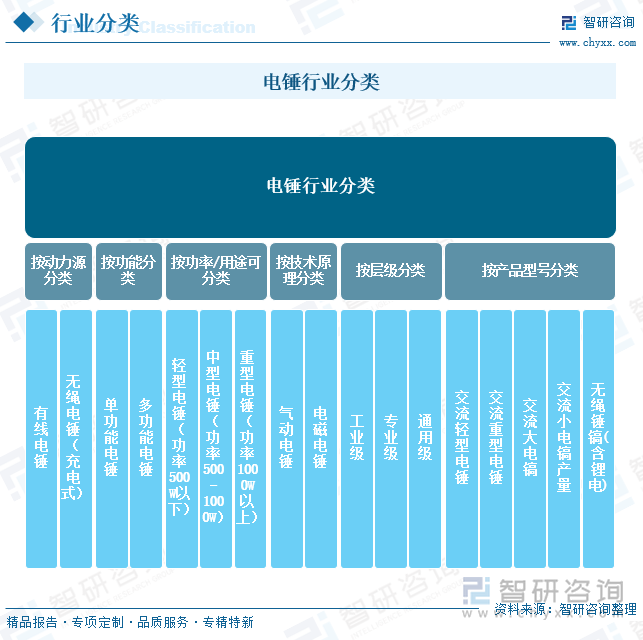
2025年中国电锤行业产业链、相关政策、市场规模、竞争格局及发展趋势研判:中国是全球最大的建筑市场之一,电锤需求量巨大,市场规模将达到21.4亿元[图]
Chan Ye Xin Xi Wang· 2025-07-16 01:26
Industry Overview - The electric hammer industry plays a significant role in the economy and related sectors, with increasing demand driven by urbanization, infrastructure construction, real estate growth, and home decoration market expansion [1][4][6] - The market size of electric hammers in China is projected to grow from 1.21 billion yuan in 2019 to 1.92 billion yuan in 2024, and is expected to reach 2.14 billion yuan by 2025 [1][4][6] Production and Value Growth - China's electric hammer production is expected to increase from 13.48 million units in 2019 to 17.33 million units in 2024, with industry value rising from 4.45 billion yuan to 6.31 billion yuan during the same period [1][6] - By 2025, the production is anticipated to reach 18.85 million units, with a value of 7 billion yuan [1][6] Industry Chain - The upstream of the electric hammer industry includes raw materials such as metals (steel, aluminum, copper), plastics, battery materials, motors, impact mechanisms, and electronic components [8] - The midstream involves research and development as well as manufacturing, while the downstream focuses on sales through online and offline channels, serving applications in construction, home decoration, industrial maintenance, and new energy infrastructure [8] Policy Environment - The government has introduced various policies to support the electric tool industry, promoting technological innovation and guiding the industry towards smart, green, and high-end development [10][11] Competitive Landscape - The market features competition between international brands like Bosch and Hilti and domestic companies such as Zhejiang Deshuo Technology, Jiangsu Dongcheng Electric Tools, and others [12][13] - Key players include Ruiqi Holdings, which focuses on high-performance electric tools, and Giant Star Technology, which emphasizes innovation and global expansion [15][17] Development Trends - The electric hammer industry is expected to evolve towards smart, diversified, specialized, and green solutions, reflecting the broader trends in China's construction market [19]



复杂环境下卫星化学经营韧性彰显 上半年净利润预增31.32%至53.20%
Zheng Quan Shi Bao Wang· 2025-07-16 01:17
Core Viewpoint - Satellite Chemical is expected to achieve a net profit of 2.7 billion to 3.15 billion yuan in the first half of 2025, reflecting a year-on-year growth of 31.32% to 53.20%, demonstrating the company's operational resilience in a complex environment [1][2]. Financial Performance - The company anticipates a net profit of 1.132 billion to 1.582 billion yuan in Q2 2025, which shows a quarter-on-quarter decline but a year-on-year increase of over ten percent compared to 1.033 billion yuan in Q2 2024 [1]. - Despite challenges such as U.S. export restrictions on ethane, the company managed to achieve a year-on-year profit growth in Q2, indicating strong operational performance [1][2]. Strategic Response - The company has effectively responded to external challenges by optimizing capacity structure, innovating, and enhancing collaboration with customers to better seize market opportunities [2]. - The normalization of U.S.-China ethane trade has alleviated previous concerns regarding the company's profitability, allowing it to return to stable operations [2]. Industry Position and Growth Potential - The company plans to invest 10 billion yuan in R&D over the next five years to enhance its technological leadership and achieve high-end product domestic substitution, which is seen as a "third round of growth" [3]. - Upcoming projects include the production of 80,000 tons of new pentanediol, 40,000 tons of EAA, and 160,000 tons of environmentally friendly water-based polymer emulsions, which are expected to accelerate performance release [3]. - The chemical industry is currently benefiting from a "de-involution" trend, with the company being viewed as a rare investment opportunity by multiple brokerages [3].

五大造船央企上半年净利润预计超50亿元!中国船舶、中国重工贡献超八成
Hua Xia Shi Bao· 2025-07-15 12:58
Core Viewpoint - The five major state-owned shipbuilding enterprises in China are expected to report a combined net profit of 50.2 billion to 60.5 billion yuan for the first half of 2025, showcasing the robust strength of China's shipbuilding industry and boosting confidence in the global shipbuilding market [2][3]. Group 1: Company Performance - China Shipbuilding and China Heavy Industry are projected to achieve a combined net profit of 43 billion to 49 billion yuan in the first half of 2025, reflecting a year-on-year growth of approximately 121% to 152% [3]. - China Heavy Industry anticipates a net profit of 15 billion to 18 billion yuan, representing a year-on-year increase of 181.73% to 238.08% due to a significant rise in the number of civil ship deliveries [3]. - China Shipbuilding expects a net profit of 28 billion to 31 billion yuan, with a year-on-year increase of 98.25% to 119.49%, attributed to higher prices for civil ship products and effective cost control [3]. - China Shipbuilding Industry Corporation and China Power are also expected to report substantial profit increases, with China Power projecting a net profit of 8 billion to 11.5 billion yuan, a year-on-year growth of 68.28% to 141.9% [6]. Group 2: Market Trends - The global shipbuilding market is experiencing a downturn, with new ship orders in the first half of 2025 declining by 54% year-on-year, totaling 647 ships and approximately 19.38 million compensated gross tonnage (CGT) [8][9]. - Despite the drop in new orders, Chinese shipyards maintain a strong delivery performance, accounting for 48% of global deliveries, while South Korea and Japan hold 31% and 13%, respectively [9]. - The shipbuilding industry in China is expected to continue benefiting from cost advantages, resilient supply chains, and technological innovations, solidifying its position as the world's largest shipbuilding nation [9]. Group 3: Future Outlook - The Chinese shipbuilding industry aims to enhance its core competitiveness through increased technological innovation, talent development, and collaborative industrial chain growth, while actively participating in international market competition [10].


湖北省副省长程用文:以更大力度推进东风公司高质量发展 引领全省汽车产业转型升级
news flash· 2025-07-15 05:44
Core Viewpoint - The Vice Governor of Hubei Province emphasizes the need for Dongfeng Motor Corporation to accelerate its high-quality development and lead the transformation and upgrading of the automotive industry in the province [1] Group 1: Company Development - Dongfeng Motor Corporation is urged to accurately grasp global automotive industry transformation trends and enhance its role as a leading enterprise [1] - The company is expected to accelerate the iteration and quality improvement of new energy and intelligent connected vehicle products [1] Group 2: Strategic Focus - The focus should be on intelligence, high-end, and green development, closely aligning with customer demands [1] - There is a call to break through key core technologies and promote deep integration of technological and industrial innovation [1] Group 3: Collaborative Innovation - Dongfeng Motor Corporation is seen as a link to promote collaborative innovation among upstream and downstream enterprises, as well as the integration of large, medium, and small enterprises [1] - The aim is to enhance the resilience and safety of the industrial and supply chains [1] Group 4: Policy Support - The need to optimize and improve various policy measures is highlighted, along with strengthening full-cycle project services [1] - The government aims to address the development challenges faced by enterprises to assist Dongfeng Motor Corporation in becoming a world-class automotive company [1]

永冠新材: 上海永冠众诚新材料科技(集团)股份有限公司2025年半年度业绩预告
Zheng Quan Zhi Xing· 2025-07-14 09:20
Group 1 - The company expects a significant decrease in net profit for the first half of 2025, projecting a reduction of 52.55 million to 58.05 million yuan, which translates to a year-on-year decline of 61.43% to 67.86% [1] - The anticipated net profit attributable to the parent company, excluding non-recurring gains and losses, is expected to decrease by 91.05% to 93.94% compared to the previous year [1][2] - In the same period last year, the total profit was 87.43 million yuan, with a net profit attributable to the parent company of 85.55 million yuan, and a net profit excluding non-recurring gains and losses of 69.29 million yuan [1][2] Group 2 - The primary reasons for the profit decrease include rising uncertainty in the macroeconomic environment, changing trade conditions, and weakened industry demand, leading to intensified competition and a decline in overall gross margin [2] - The company is committed to enhancing traditional business quality and breaking through in emerging businesses, focusing on sectors such as automotive, new energy, and biodegradable materials, which are aligned with national policy priorities [2] - Despite the challenges, the company aims to optimize sales strategies, enhance brand value, and improve operational efficiency, with a steady increase in product sales compared to the previous year [2]

*ST松发半年度业绩预计大幅扭亏 重大资产重组实施完成
Zheng Quan Shi Bao Wang· 2025-07-14 06:57
Core Viewpoint - *ST Songfa is expected to achieve a net profit of 580 million to 700 million yuan for the first half of 2025, marking a turnaround from losses in the same period last year due to a significant strategic transformation from traditional ceramics to high-end equipment manufacturing [1][2] Group 1: Financial Performance - The company reported a main operating revenue of 57.46 million yuan in Q1 2025, an increase of 23.17% year-on-year [2] - The net profit attributable to the parent company for Q1 2025 was -20.87 million yuan, a decline of 97.54% year-on-year, indicating a substantial improvement expected in Q2 2025 with a projected net profit exceeding 600 million yuan [2] Group 2: Strategic Transformation - The company has undergone a major asset restructuring, acquiring 100% of Hengli Heavy Industry, which has become a wholly-owned subsidiary, facilitating a strategic upgrade to high-end equipment manufacturing [2] - Hengli Heavy Industry aims to become a world-class manufacturer in high-end, intelligent, and green shipbuilding, with a complete industrial chain from core components to complete ship manufacturing [1][2] Group 3: Market Position and Future Plans - Hengli Heavy Industry ranks fifth globally and fourth in China for new orders received in 2024, showcasing its competitive position in the market [2] - The company plans to invest in two key projects: the "Hengli Shipbuilding (Dalian) Green High-end Equipment Manufacturing Base" and the "International Ship Research and Design Center (Phase I)," which are expected to enhance production efficiency and technological innovation [2]
