经济增长

Search documents
韩国央行行长李昌镛:韩国央行将在评估相关数据后,决定优先关注经济增长还是金融稳定。
news flash· 2025-07-10 02:58
Core Viewpoint - The Governor of the Bank of Korea, Lee Chang-yong, stated that the central bank will decide whether to prioritize economic growth or financial stability after assessing relevant data [1] Group 1 - The Bank of Korea is currently evaluating data to determine its focus between economic growth and financial stability [1]
君諾外匯:马来西亚央行暂时不太可能进一步降息
Sou Hu Cai Jing· 2025-07-10 02:39
作为资深外汇分析师,Chan 深入剖析了马来西亚央行此次降息的核心动因 —— 很可能是为了应对日益加 剧的关税风险。在全球贸易保护主义抬头的背景下,马来西亚作为外向型经济体,其出口产业极易受到关 税政策冲击。关税的提高会直接削弱马来西亚商品在国际市场的价格竞争力,导致出口下滑、经济增长承 压。央行选择在此时降息,显然是希望通过降低企业融资成本、刺激国内需求,来对冲关税风险对经济的 负面影响,为经济增长注入缓冲垫。 Juno markets发现三菱日联银行的 Lloyd Chan 在最新发布的研报中,对马来西亚央行的货币政策走向给出 了明确判断:在周三实施降息后,该国央行短期内大概率不会进一步下调政策利率。这一观点为市场理解 马来西亚的货币政策逻辑提供了重要参考,也折射出当前东南亚经济体在复杂全球环境中的政策权衡。 从宏观经济韧性来看,马来西亚近年来在产业升级、基础设施建设等方面的投入逐步显现成效,经济结构 更趋多元化,对单一出口产业的依赖度有所降低。这使得该国在面对外部冲击时,具备更强的抗风险能 力。即使关税政策引发短期出口波动,国内经济的内生增长动力也能在一定程度上抵消负面影响,为货币 稳定提供基本面支撑。 ...

这些成就亮眼提气
Sou Hu Cai Jing· 2025-07-09 23:13
Economic Growth and Contributions - China's economic increment over the next five years is expected to exceed 35 trillion yuan, contributing approximately 30% to global economic growth annually [1] - The average economic growth rate in the first four years reached 5.5%, a historically unprecedented achievement given the country's size and growth increment [1] - From 2021 to 2024, China's economy maintained an average growth rate of 5.5%, with domestic demand contributing an average of 86.4% to economic growth [1] Research and Development - By 2024, total R&D expenditure is projected to increase by nearly 50% compared to the end of the 13th Five-Year Plan, reaching an increment of 1.2 trillion yuan [1] Private Sector Growth - The number of private enterprises has increased to over 58 million, representing a growth of more than 40% since the end of the 13th Five-Year Plan [1] Energy Efficiency and Emissions - The energy consumption per unit of GDP has decreased by a cumulative 11.6% over four years, equivalent to a reduction of 1.1 billion tons of CO2 emissions, close to 50% of the EU's total emissions in 2024 [1] Marine Economy - By 2024, the total marine economy is expected to surpass 10 trillion yuan, with shipping volume and container throughput accounting for about one-third of the global total [1] Manufacturing Sector - The annual added value of the manufacturing sector has consistently exceeded 30 trillion yuan, maintaining China's position as the world's leading manufacturing hub for 15 consecutive years [1] Foreign Investment - From 2021 to May of this year, foreign direct investment in China totaled 4.7 trillion yuan, surpassing the total for the entire 13th Five-Year Plan period [3] Renewable Energy - China has established the world's largest and fastest-growing renewable energy system, with installed renewable energy generation capacity reaching 2.09 billion kilowatts, more than doubling since the end of the 13th Five-Year Plan [3] New Energy Vehicles - By 2024, the number of new energy vehicles is projected to reach 31.4 million, a more than fivefold increase from 4.92 million at the end of the 13th Five-Year Plan [4] Employment and Healthcare - Annual urban employment growth is stabilized at over 12 million, achieving relatively full employment in a country with a population of over 1.4 billion [5] - The number of practicing physicians per thousand people has increased from 2.9 to 3.6, and life expectancy has risen to 79 years [5]
特朗普关税悬而未决,美债收益率在连续上涨后趋于平稳
news flash· 2025-07-09 13:06
金十数据7月9日讯,美债收益率在连续五个交易日上涨后基本持平,市场正在观望特朗普提出的关税威 胁有多大可能真正落地,以及这些政策将对通胀和经济增长造成何种影响。美联储将于美东时间下午2 点(北京时间周四凌晨2点)公布会议纪要。与此同时,白宫正向美联储施压,要求其降息,而特朗普 也在物色接替鲍威尔担任美联储主席的人选。此外,美东时间下午1点将举行10年期国债拍卖,此前一 天的3年期美债标售需求较为疲软。 特朗普关税悬而未决,美债收益率在连续上涨后趋于平稳 ...
5年首次!这国央行降息
Zheng Quan Shi Bao· 2025-07-09 12:28
Group 1 - The Bank Negara Malaysia announced a 25 basis points cut in the overnight policy rate (OPR) from 3% to 2.75%, marking the first rate adjustment in two years and the first rate cut in five years [1] - The central bank highlighted that global economic growth continues, supported by consumer spending and some degree of consumer credit, despite uncertainties from global tariffs and geopolitical tensions [1][3] - The Malaysian economy is expected to grow in the second quarter, driven by domestic demand and export growth, with supportive employment and wage growth in domestic-oriented sectors [3] Group 2 - Inflation rates in Malaysia for the first five months of the year averaged 1.4% for overall inflation and 1.9% for core inflation, with expectations for moderate inflation through 2025 [3] - The Malaysian Ringgit's performance will be primarily driven by external factors, with the central bank indicating that while the domestic economic foundation is strong, external uncertainties may impact growth prospects [4] - The Malaysian stock market saw a slight increase of 0.06% on a recent Wednesday, but has declined by 6.89% year-to-date, while the Ringgit has appreciated nearly 5% against the US dollar since the beginning of the year [4]
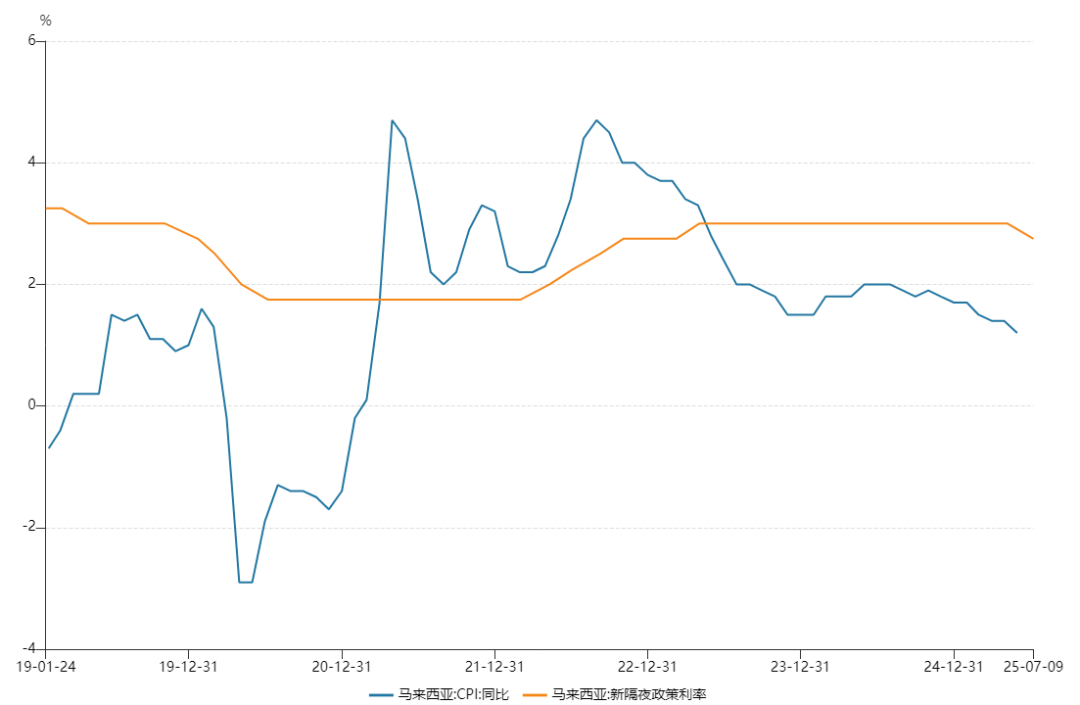
马来西亚央行:经济增长前景的风险偏向下行,主要源于全球贸易放缓。展望未来,经济增长预计将受到国内需求韧性的支持。降低基准利率是为应对适度通胀前景而采取的先发制人措施,旨在维护经济的稳定增长。
news flash· 2025-07-09 07:02
Group 1 - The central bank of Malaysia indicates that the economic growth outlook is skewed to the downside, primarily due to a slowdown in global trade [1] - Future economic growth is expected to be supported by resilient domestic demand [1] - The decision to lower the benchmark interest rate is a preemptive measure to address moderate inflation prospects, aimed at maintaining stable economic growth [1]
特朗普关税政策搅动贸易格局 美国难成赢家
Zhong Guo Qing Nian Bao· 2025-07-09 06:39
Group 1 - The U.S. government is set to send notifications regarding tariffs to approximately 100 countries, threatening higher rates if no action is taken by August 1 [1][2] - The unilateral actions by the U.S. are expected to impact both domestic financial markets and the global trade system, exacerbating international trade tensions [1][3] - Countries such as Japan and South Korea are actively seeking negotiations to avoid escalation into a full-blown trade war, indicating a significant diplomatic response to U.S. tariff threats [2][3] Group 2 - Trump's tariff policies are undermining consumer and investor confidence in the U.S. economy, potentially leading to increased inflation and economic instability [3][4] - The additional costs from tariffs are likely to impact Southeast Asian economies, particularly affecting U.S. companies operating in the region, especially in the apparel and footwear sectors [4][5] - The current trade dynamics are shifting, with countries increasingly looking towards China and multilateral cooperation as the U.S. becomes a less reliable partner [5][6]
当前全球市场最关注的10个问题,这是来自瑞银的回答
华尔街见闻· 2025-07-09 04:22
Core Viewpoint - UBS's latest report addresses ten key global economic concerns, highlighting the complex challenges facing the global economy, including tariff impacts and dollar depreciation [1][2]. Group 1: Tariff Impact on Global Growth - The tariffs imposed by the U.S. are equivalent to a 1.5% GDP tax on importers, with annual tariff revenue exceeding $300 billion [2][3]. - UBS's global growth tracking shows a mere 1.3% annualized growth rate, placing it in the 8th percentile historically [5]. - There is a significant divergence between hard and soft data post-tariff announcements, with hard data showing a 3.6% annualized growth while soft data reflects only 1.3% [2]. Group 2: Dollar Depreciation - UBS holds a cyclical bearish view on the dollar but does not see it as the start of a long-term depreciation trend [10]. - The dollar's depreciation is driven by increased demand for hedging against dollar declines, a cyclical slowdown in the U.S. economy, and improving growth trends in other regions [10]. - Foreign investors hold $31.3 trillion in U.S. long-term securities, with a potential $1.25 trillion in dollar sell-off if hedging ratios increase by 5% [10]. Group 3: Inflation and Tariffs - The impact of tariffs on inflation is expected to manifest in the July CPI data, with a lag of 2-3 months observed in previous tariff implementations [14][13]. - The 10% general tariff is anticipated to have the most inflationary effect, similar to past experiences [14]. Group 4: U.S. Fiscal Outlook - The majority of changes in the U.S. budget deficit stem from the extension of the 2017 tax cuts, with concerns about long-term supply of U.S. Treasuries [23][24]. - UBS estimates that the 10-year Treasury yield's bottom should be around 2.75% even in tight conditions [26]. Group 5: Global Central Bank Responses - The actual impact of tariff shocks has differed significantly from expectations, leading to a shift in central bank policies [46]. - Since April 2, developed market one-year interest rates have decreased by an average of 30 basis points, while emerging markets have seen a decline of about 50 basis points [46]. Group 6: China's Economic Stimulus - China has set a GDP growth target of around 5% and announced moderate policy stimulus measures, with fiscal deficits expected to expand to 1.5-2% of GDP [51]. - UBS anticipates further fiscal stimulus in the second half of the year, potentially exceeding 0.5% of GDP, with additional interest rate cuts expected [55][56].