价值投资

Search documents
巴菲特也在重金布局,这一板块,爆发!
Zheng Quan Ri Bao Zhi Sheng· 2025-11-10 05:32
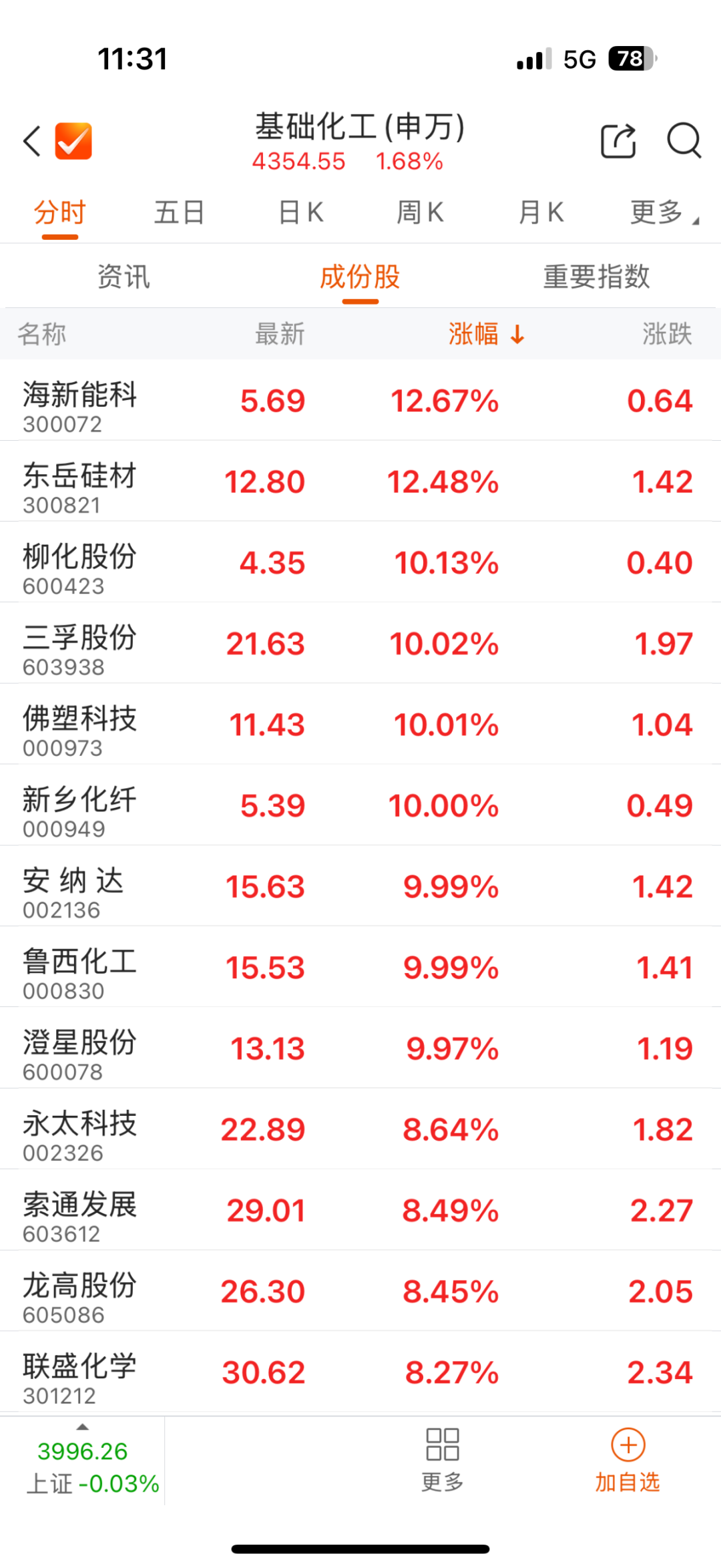
Core Viewpoint - The chemical industry, favored by Warren Buffett, has shown strong performance, with the A-share basic chemical sector index rising by 1.68% to 4354.55 points as of November 10, 2023, and a cumulative increase of 32.74% year-to-date [1][4]. Industry Performance - As of November 10, 2023, the basic chemical sector index recorded a trading volume of 112.149 billion yuan, with 275 stocks rising, 122 falling, and 6 remaining flat [1]. - Notable stocks include Liuhua Co. (600423), Sanfu Co. (603938), and Fusheng Technology (000973), which reached their daily limit up, while Hai Xin Neng Ke (300072) and Dongyue Silicon Material (300821) saw increases of 12.67% and 12.48%, respectively [1][2]. Market Dynamics - The recent surge in the chemical sector is attributed to a combination of improved supply-demand structure and enhanced market confidence [3][4]. - On the supply side, self-regulatory mechanisms among industry players have alleviated previous excessive competition, leading to a healthier supply-demand relationship [4]. - On the demand side, emerging industries such as energy storage and new energy vehicles are driving significant incremental demand for chemical products [4]. Investment Insights - Buffett's recent acquisition of OxyChem for $9.7 billion is seen as a strategic move to bolster confidence in the chemical sector, particularly in the chlor-alkali and PVC production segments [4]. - Analysts believe that the long-term value of the chlor-alkali industry is attractive, with signs of marginal improvement in demand in both the Chinese and U.S. markets [4]. Sector Trends - Current trading in the chemical sector revolves around three main themes: 1. The rise in demand from the energy storage sector is expected to enhance the supply-demand dynamics of upstream lithium battery materials [5]. 2. Continuous self-regulation in the chemical industry is helping to stabilize prices from the bottom [5]. 3. Certain chemical sectors are maintaining high growth rates in their core businesses [5]. Company Performance - Sanfu Co. reported a revenue of 1.547 billion yuan for the first three quarters of the year, a year-on-year increase of 15.2%, with a net profit of 64.136 million yuan, up 26.92% [5]. - The third quarter showed particularly strong performance, with revenue of 540 million yuan, a 23.52% increase year-on-year, and a net profit growth of 162.25% [5]. Global Supply Chain Impact - Domestic chemical companies are benefiting from a complete industrial chain and stable production capabilities, which provide opportunities for import substitution and expansion into overseas markets [6]. - The recent stabilization and recovery of prices for major commodities like crude oil are also supporting the profitability of the chemical industry [6].


2026年周期的风能否吹到化工
Hua Er Jie Jian Wen· 2025-11-10 05:22
Core Viewpoint - The article discusses the current state and potential future of the chemical industry in the U.S. and China, highlighting investment opportunities and risks based on macroeconomic factors and industry cycles. Group 1: U.S. Chemical Industry - The acquisition of Oxychem by Berkshire Hathaway for $9.7 billion is highlighted as a significant value investment, with an EV/EBITDA multiple of 6-8, compared to the industry average of 9 and specialty chemicals at over 12 [2][3]. - The U.S. chemical industry is potentially at a cyclical bottom, driven by low production costs and a current industry downturn leading to attractive valuations [3][14]. - The return on capital in the U.S. chemical industry is at its lowest in over 25 years, indicating a challenging environment for profitability [7]. - The demand for chemicals is primarily driven by the automotive and real estate sectors, which are currently subdued due to high interest rates, but may rebound if rates decrease [11][14]. Group 2: Chinese Chemical Industry - The Chinese chemical industry faces higher costs compared to the U.S., which may lead to increased uncertainty and risk in investments [16][24]. - Recent expansions in production capacity in China are nearing completion, which may impact future supply dynamics [16][22]. - The demand outlook for 2026 remains uncertain, influenced by both domestic and export factors, as well as the performance of traditional and new economy sectors [23][24]. - The article suggests that the Chinese chemical sector is characterized by higher risk and potential returns, with significant policy influences affecting supply-side reforms [24].
百亿私募今年1-10月收益揭晓!东方港湾、日斗投资近3年排名再上升!聚宽、鸣石上榜前10!
私募排排网· 2025-11-10 03:33
那么,作为行业中流砥柱的百亿私募,其主观、量化私募阵容与业绩表现又将随之呈现怎样的变化?下文,笔者将为大家揭晓百亿私募的最新名 单和业绩排名。 0 1 百亿私募增至113家!量化、主观数量差距再扩大! 根据私募排排网数据,截至2025年10月底,我国百亿私募增至113家,相比上月的96家净新增17家,百亿私募再度扩容!其中,有18家晋升百亿 私募、1家退出百亿私募阵营。 10月晋升百亿的18家私募分别为: 纽达投资、磐松资产、平方和投资、超量子基金、上海孝庸私募、大道投资、利位私募、远信投资、诚旸投 资、宽投资产、赫富投资、上海新方程私募、喜岳投资、旌安投资、元康私募、梅山保税港区凌顶投资、上海信璞私募、望正资产 。( 点此领 取全名单 ) 本文首发于公众号"私募排排网"。 (点击↑↑ 上图查看详情 ) 10月A股市场整体高位震荡,板块高低切明显。上旬受中美贸易摩擦升级影响,市场风险偏好承压;伴随中美关系缓和,叠加二十届四中全会出 台"十五五"规划指导意见,市场情绪逐步修复。 结构上看,煤炭、石油石化等传统板块整体走强,带动上证指数时隔10年再突破4000点,月度累计上涨1.85%,以科技成长风格为代表的创业 ...
当估值锚遭遇景气度:“老登小登”正面交锋
Zhong Guo Zheng Quan Bao· 2025-11-10 01:49
Core Viewpoint - The discussion of "Old Deng" and "Young Deng" has evolved into a new narrative in the investment community, reflecting a clash of investment styles and market cycles, with a focus on whether to adhere to value investing or embrace growth trends [1][3]. Group 1: Investment Styles - "Old Deng" refers to investors who prefer mature industry leaders and are less concerned with short-term fluctuations, while "Young Deng" investors chase emerging technologies and market trends [3]. - The performance gap between these investment styles has widened significantly in the current market environment, with "Young Deng" stocks like AI and semiconductor companies outperforming traditional sectors [3][4]. - Fund managers are increasingly recognizing the need to balance their investment strategies between maintaining a value-oriented approach and adapting to growth opportunities [4][10]. Group 2: Market Dynamics - The recent market has seen a stark divide, with some funds experiencing significant gains in technology sectors, while others focusing on traditional sectors face performance pressures [4][8]. - The ongoing debate highlights the importance of understanding market cycles and the potential for value recovery in traditional sectors like finance and real estate [8][9]. - Fund managers emphasize the need for a diversified investment approach, suggesting that maintaining a flexible strategy can help navigate market volatility [10][11]. Group 3: Future Outlook - There is a consensus among fund managers that the current technology cycle, particularly in AI and related fields, is expected to last for several years, presenting both opportunities and risks [6][8]. - The importance of a robust investment thesis based on verified profitability and growth potential is underscored, with caution advised against overly optimistic projections [6][7]. - The ability to adapt and expand one's investment capabilities is seen as crucial for long-term success in a rapidly changing market landscape [10][11].
健康,是投资最大的“本金”
Shang Hai Zheng Quan Bao· 2025-11-09 23:15
Group 1 - The core message emphasizes that health is the most significant capital in investment, as exemplified by the recent passing of Wang Guobin, a respected figure in value investing [1][4] - The article highlights that longevity is crucial for investment success, with Warren Buffett's wealth growth illustrating that 99% of his fortune was accumulated after the age of 60, underscoring the importance of time in compounding returns [1][2] - It discusses the historical context of compounding, noting that the Industrial Revolution created conditions for exponential growth, allowing capital to be efficiently allocated to promising sectors, thus facilitating a departure from linear growth [2][3] Group 2 - The significance of time in investment is further elaborated, indicating that investors, as financial stakeholders, can benefit from the growth of companies they invest in, reinforcing the idea that holding investments long-term can yield substantial returns [3] - The article stresses the need for a robust investment framework and emotional stability to allow compounding to take effect, advocating for a long-term focus rather than seeking immediate gains [3] - Buffett's principle of preserving capital is reiterated, equating an investor's health to their primary capital, emphasizing the necessity of maintaining personal well-being to ensure successful investment practices [4]
当估值锚遭遇景气度: “老登小登”正面交锋
Zhong Guo Zheng Quan Bao· 2025-11-09 22:17
Core Viewpoint - The discussion of "Old Deng" and "Young Deng" has evolved into a new narrative in the investment community, reflecting a clash of investment styles and market cycles, with a focus on whether to adhere to value investing or embrace growth trends [1][3]. Group 1: Investment Styles - "Old Deng" refers to investors favoring mature industry leaders with less focus on short-term volatility, while "Young Deng" represents those chasing emerging technologies and market trends [3][5]. - The performance gap between these investment styles has widened significantly in the current market environment, with "Young Deng" stocks, such as those in AI and robotics, outperforming traditional sectors like real estate and banking [3][4]. Group 2: Market Dynamics - The recent market has seen a stark divide, with some funds experiencing significant gains in technology sectors, while others, adhering to traditional value investing, have faced performance pressures [4][6]. - Fund managers are increasingly recognizing the need to balance their investment strategies between maintaining a focus on value and adapting to growth opportunities in emerging sectors [5][7]. Group 3: Future Outlook - The ongoing transformation in investment philosophies is tied to broader industry shifts and the evolution of investor demographics, indicating a potential long-term change in market dynamics [5][8]. - There is a consensus among fund managers that understanding the cyclical nature of markets and being adaptable in investment strategies will be crucial for future success [6][9].
“老登小登”正面交锋
Zhong Guo Zheng Quan Bao· 2025-11-09 20:15
Core Insights - The discussion of "Old Deng" and "Young Deng" reflects a divide in investment styles, with "Old Deng" representing value-oriented investors focused on mature industries, while "Young Deng" signifies those chasing emerging technologies and market trends [2][3] - The performance disparity between these investment styles has become pronounced in the current market environment, prompting a reevaluation of investment philosophies [2][4] Investment Styles - "Old Deng" investors tend to favor established industry leaders and are less concerned with short-term volatility, while "Young Deng" investors are more inclined to pursue new technologies and market fads [2][3] - The categorization of stocks into "Old Deng," "Middle Deng," and "Young Deng" reflects both age and investment style differences among investors, with significant performance gaps emerging as market conditions evolve [2][3] Market Performance - Fund managers have reported significant performance pressures, particularly in the third quarter, as technology stocks, especially in AI and computing power, have seen substantial valuation increases [3][5] - For instance, the Southern Fund's manager noted that their portfolio lagged behind due to a focus on cash flow and dividends, which became less relevant in the current growth-driven market [3][6] Investment Philosophy - The distinction between "Old Deng" and "Young Deng" lies in their pricing frameworks, with the former focusing on current valuations and the latter on future growth potential [4][5] - A senior value-oriented fund manager emphasized the importance of verified profitability and growth certainty in investment decisions, cautioning against overly optimistic projections based solely on current trends [5][6] Sector Insights - The technology sector, particularly in AI and related fields, is expected to experience sustained growth, with fund managers predicting a prolonged technology cycle lasting 5 to 10 years [5][6] - Conversely, traditional sectors like finance and real estate are being viewed as potential recovery opportunities, with expectations of improved asset quality and valuation recovery [6][7] Strategic Adaptation - Fund managers are encouraged to expand their investment capabilities and adapt to changing market conditions, balancing between maintaining their core investment philosophies and exploring new opportunities [7][8] - The ability to navigate market volatility and identify undervalued stocks is seen as crucial for long-term success, with a focus on thorough research before making investment decisions [8]
多家公司同日被立案彰显监管“零容忍”
Zheng Quan Ri Bao· 2025-11-09 16:23
Group 1 - The core viewpoint of the article highlights the stringent regulatory environment in the capital market, as evidenced by the investigation of five companies or their stakeholders for various violations, signaling a "zero tolerance" approach by regulators [1][2][4] Group 2 - The regulatory actions encompass a full chain from listing to delisting, ensuring accountability for any legal infractions, thereby fostering a culture of compliance and respect for the law among market participants [2][3] - The crackdown on financial fraud and information disclosure violations aims to protect investors' rights and promote a fair trading environment, which is crucial for the stability and growth of the capital market [3][4] - The enforcement of regulations is expected to enhance the focus on value investing, as it discourages malpractices that distort market pricing mechanisms and resource allocation, ultimately benefiting high-quality enterprises [4]
约翰·邓普顿的16条投资原则
Sou Hu Cai Jing· 2025-11-09 14:49
Group 1 - The purpose of investment is to achieve the maximum real total return after accounting for taxes, inflation, transaction commissions, and fees [2] - Investors should adopt a flexible and open attitude towards different types of investments, including blue-chip stocks, cyclical stocks, corporate bonds, convertible bonds, U.S. Treasury bills, and cash [2] - Buying at low prices is essential, which involves estimating a company's earnings and cash flow over five years to determine if the stock price is low relative to its intrinsic value [2][3] Group 2 - Focus on undervalued companies within high-quality stocks, such as those with strong sales or technology, proven management, low-cost production, strong capital, or well-known consumer brands [3] - Diversification is crucial, involving investments across different companies, industries, risks, and countries, but should not be done blindly [3][4] - Conduct thorough research before investing, which may include due diligence or hiring experts, as this is an irreplaceable step [3][4] Group 3 - Actively monitor invested companies, as stock prices can become overvalued and competitive advantages may diminish [4] - Learning from personal and others' mistakes is vital to avoid repeating them [4] - Recognizing that outperforming the market is challenging, requiring investors to be smarter than both general investors and professional fund managers [4] Group 4 - Successful investing is a continuous process of seeking answers to new questions, as economic, political, and investment landscapes are always changing [4] - Investment beliefs should be based on research rather than gut feelings or solely on analysts' recommendations [5] - Avoid being misled or intimidated by media pessimism, as the market's development and innovation can improve living standards [5]
任莉:泉清果硕忆国斌
中国基金报· 2025-11-09 13:33
以下文章来源于泉果视点 ,作者泉果基金 图1. 泉果基金创始人任莉女士做悼词发言 尊敬的各位来宾朋友们,国斌总的亲友们: 感谢大家从各地赶来,一起追思缅怀我们的国斌总! 我和国斌总是北大同窗,毕业后各奔东西。2006年,国斌总一声召唤,我毫不犹豫,跨洋回国,追随国斌总,一起打造东方红,进而共创泉 果。 泉果视点 . 泉果基金管理有限公司官方订阅号,第一时间分享泉果基金动态。以专业投研+专业服务,与您相伴在长期投资的道路上。 2025年11月9日上午,著名投资人、泉果基金创始人王国斌先生的追思会在上海龙华殡仪馆举行。他生前的家人、同窗、挚 友、伙伴……800余人于潇潇秋雨中静默站立,送了王国斌先生最后一程。 追思会上,王国斌先生的家属代表,母校北京大学的校友代表及好友代表等人,纷纷致辞,缅怀。泉果基金联合创始人任莉女 士,作为王国斌先生事业上的多年战友,亦真挚追忆。 她说: "我和国斌总是北大同窗,毕业后各奔东西。2006年,国斌总一声召唤,我毫不犹豫跨洋回国,追随国斌总,一起打造东方 红,进而共创泉果,30多年相知、相伴、相随,国斌总是我智慧的启迪者,事业的引路人,更是我最亲密的战友!" "国斌总的一生虽短暂 ...