AI科技周期

Search documents
现金流ETF(159399)涨超0.5%,结构升级提供长期动力
Mei Ri Jing Ji Xin Wen· 2026-01-26 07:42
Group 1 - The core viewpoint is that by 2025, the A-share market will see a stable advancement in "quality improvement and increased science," with the market capitalization of new economy and hard technology sectors further increasing [1] - The proportion of new economy (consumption + TMT + high-end manufacturing) in A-shares is expected to rise from 62.8% to 65.3% by 2025, while hard technology (high-end manufacturing + part of TMT + part of pharmaceuticals) will increase from 35.4% to 41.1%, breaking the 40% threshold for the first time [1] - This change is driven by the AI technology cycle, which has led global investors to reassess the strength of Chinese technology companies since the release of the DeepSeek new model at the beginning of 2025 [1] Group 2 - The electronics and communication equipment sectors are the main contributors to the rising market capitalization proportions [1] - The ongoing engineer dividend continues to provide long-term momentum for structural upgrades in the industry [1] - Investors are advised to pay attention to the cash flow ETF (159399), which has outperformed the CSI Dividend Index and the CSI 300 Index for nine consecutive years from 2016 to 2024 [1]
海外机构看好中国经济增长韧性,A500ETF基金(512050)强势吸金,换手率位居同类第一
Mei Ri Jing Ji Xin Wen· 2025-12-15 06:30
Group 1 - The A-share market indices continued to decline, with the CSI A500 index showing mixed performance among its constituent stocks, while the A500 ETF (512050) experienced a trading volume exceeding 7.5 billion yuan and a turnover rate of 30.85%, ranking first among its peers [1] - The IMF raised its 2025 GDP growth forecast for China by 0.2 percentage points to 5%, attributing this adjustment to a series of macroeconomic policies implemented by China, which are expected to contribute approximately 30% to global economic growth in the coming years [1] - The World Bank also increased its 2025 GDP growth prediction for China by 0.4 percentage points to 4.9%, citing supportive fiscal policies, moderately loose monetary policies, and diversification of export markets as key factors for domestic consumption, investment, and export resilience [1] Group 2 - According to Jiao Yin International Securities, the global economic resilience in 2025 is expected to exceed initial forecasts, with a continued AI technology cycle and coherent policies laying the groundwork for 2026 [2] - The new generation core A500 ETF (512050) is designed to help investors capture market growth opportunities by tracking the CSI A500 index, employing a dual strategy of "industry balanced allocation + leading selection" to cover A-share industry leaders [2] - The A500 ETF features three core highlights: a low fee rate of 0.2%, ample liquidity with an average daily trading volume exceeding 5 billion yuan over the past month, and a leading scale of over 20 billion yuan, making it an efficient investment choice for capitalizing on A-share valuation enhancement opportunities [2]
市场主流观点汇总-20251111
Guo Tou Qi Huo· 2025-11-11 11:10
Report Summary 1. Report Purpose - The report aims to objectively reflect the research views of futures and securities companies on various commodity varieties, track hot varieties, analyze market investment sentiment, and summarize investment driving logics [1]. 2. Market Data 2.1 Commodities - **Price Changes**: From November 3 to November 7, 2025, PTA rose by 1.70% to 4664.00, aluminum by 1.41% to 21625.00, while some commodities like methanol fell by 3.12% to 2112.00, and iron ore dropped by 4.94% to 760.50 [2]. 2.2 A - shares - **Index Performance**: The Shanghai - Shenzhen 300 Index rose by 0.82% to 4678.79, while the CSI 500 Index fell by 0.04% to 7327.91 [2]. 2.3 Overseas Stocks - **Index Fluctuations**: The Nasdaq Index dropped by 3.04% to 23004.54, and the Nikkei 225 Index fell by 4.07% to 50276.37 [2]. 2.4 Bonds - **Yield Changes**: The yield of China's 2 - year treasury bond changed from 2.84 to 1.43, and the 10 - year treasury bond yield decreased by 0.7 bp to 1.81 [2]. 2.5 Foreign Exchange - **Rate Movements**: The euro - US dollar exchange rate rose by 0.25% to 1.16, while the US dollar index fell by 0.18% to 99.55 [2]. 3. Commodity Views 3.1 Macro - financial Sector - **Stock Index Futures**: Among 9 institutions, 3 are bullish, 1 is bearish, and 5 expect a sideways movement. Long - term domestic stable - expectation policies, the global AI tech cycle, and the "V - shaped reversal" of US stocks are positive factors, while US economic data and high A - share valuations are negative factors [4]. - **Treasury Bond Futures**: Among 7 institutions, 2 are bullish, 0 are bearish, and 5 expect a sideways movement. Weak fundamentals and central bank operations are positive, while inflation recovery and government bond issuance are negative [4]. 3.2 Energy Sector - **Crude Oil**: Among 8 institutions, 1 is bullish, 3 are bearish, and 4 expect a sideways movement. OPEC's production suspension and oil price cost support are positive, while US inventory accumulation and emerging oil fields' production increase are negative [5]. 3.3 Agricultural Products Sector - **Rapeseed Oil**: Among 8 institutions, 3 are bullish, 1 is bearish, and 4 expect a sideways movement. Low inventory and production issues are positive, while lack of Chinese demand and import increase are negative [5]. 3.4 Non - ferrous Metals Sector - **Copper**: Among 7 institutions, 2 are bullish, 2 are bearish, and 3 expect a sideways movement. US government situation and supply concerns are positive, while US manufacturing data and high inventory are negative [6]. 3.5 Chemicals Sector - **Glass**: Among 7 institutions, 0 are bullish, 4 are bearish, and 3 expect a sideways movement. Inventory decline and low prices are positive, while weak demand and high capacity are negative [6]. 3.6 Precious Metals Sector - **Gold**: Among 7 institutions, 2 are bullish, 1 is bearish, and 4 expect a sideways movement. Market concerns and geopolitical risks are positive, while trade relations and Fed's stance are negative [7]. 3.7 Black Metals Sector - **Iron Ore**: Among 8 institutions, 0 are bullish, 4 are bearish, and 4 expect a sideways movement. Decrease in global shipments and increase in blast furnace operating rate are positive, while port inventory accumulation and weak downstream demand are negative [7].
股指期货:重新走稳
Guo Tai Jun An Qi Huo· 2025-11-10 01:04
1. Report Industry Investment Rating - Not provided in the content 2. Core Viewpoints of the Report - Last week's market continued to fluctuate, with most major indices closing higher. Power equipment, coal, and petroleum and petrochemical sectors led the gains, while beauty care, computer, and pharmaceutical and biological sectors led the losses [1]. - The upward trend of stock indices has not reversed. However, with the overall stock market valuation in the relatively expensive range, it is reasonable for the bull market driven by sentiment and liquidity to experience amplified fluctuations. It is expected that the slow - bull market will continue [2]. - In the short - term, the market lacks a direct catalyst for upward movement and may rely on short - term news fluctuations. Without relevant negative news, the generally positive sentiment may lead to a market rebound [2]. 3. Summary According to the Directory 3.1 Spot Market Review - Last week, global stock indices showed mixed performance. The Shanghai Composite Index rose 1.08%, the Shenzhen Component Index rose 0.82%, and the Hang Seng Index rose 1.44%. The NASDAQ fell 2.83%, and the Nikkei 225 fell 4.07% [11]. - Since 2025, major domestic indices have risen. The ChiNext Index has risen 49.8%, and the Small and Medium - sized Board Index has risen 27.9% [13]. - Last week, most major domestic indices rose. The Shanghai Composite Index rose 1.08%, and the CSI 300 Index rose 0.89% [15][17]. - In the CSI 300 Index, the energy sector rose 4.57%, and the pharmaceutical sector fell 2.93%. In the CSI 500 Index, the energy sector rose 5.71%, and the information sector rose 0.36% [18]. 3.2 Futures Market Review - Last week, among the stock index futures main contracts, the IH contract had the largest increase, and the IC contract had the largest amplitude [17]. - The trading volume and open interest of stock index futures declined [19][21]. 3.3 Index Valuation Tracking - As of November 7, the price - to - earnings ratio (TTM) of the CSI 300 Index was 14.28 times, and that of the SSE 50 Index was 11.95 times [25]. - The price - to - earnings ratio (TTM) of the CSI 500 Index was 33.38 times, and that of the CSI 1000 Index was 47.75 times [27]. 3.4 Market Capital Flow Review - The balance of margin trading in the two markets and the share of newly established equity - focused funds showed certain trends, and the capital interest rate dropped last week. The central bank conducted a net cash withdrawal [30]. 4. Strategy Recommendations - Short - term strategy: The intraday trading frequency can refer to the 1 - minute and 5 - minute K - line charts. The stop - loss and take - profit levels of IF, IH, IC, and IM can be set with reference to 76 points/95 points, 58 points/31 points, 66 points/121 points, and 84 points/142 points respectively [4]. - Trend - following strategy: Adopt the idea of buying on dips. It is expected that the core operating range of the IF main contract IF2510 is between 4533 and 4766 points; the IH main contract IH2510 is between 2941 and 3077 points; the IC main contract IC2510 is between 7072 and 7546 points; the IM main contract IM2510 is between 7179 and 7663 points [4]. - Cross - variety strategy: It is expected that the strength - weakness conversion will still be rapid, and caution is advised for the strategy of going long on IF (or IH) and short on IC (or IM) [5].
“老登小登”正面交锋
Zhong Guo Zheng Quan Bao· 2025-11-09 20:15
Core Insights - The discussion of "Old Deng" and "Young Deng" reflects a divide in investment styles, with "Old Deng" representing value-oriented investors focused on mature industries, while "Young Deng" signifies those chasing emerging technologies and market trends [2][3] - The performance disparity between these investment styles has become pronounced in the current market environment, prompting a reevaluation of investment philosophies [2][4] Investment Styles - "Old Deng" investors tend to favor established industry leaders and are less concerned with short-term volatility, while "Young Deng" investors are more inclined to pursue new technologies and market fads [2][3] - The categorization of stocks into "Old Deng," "Middle Deng," and "Young Deng" reflects both age and investment style differences among investors, with significant performance gaps emerging as market conditions evolve [2][3] Market Performance - Fund managers have reported significant performance pressures, particularly in the third quarter, as technology stocks, especially in AI and computing power, have seen substantial valuation increases [3][5] - For instance, the Southern Fund's manager noted that their portfolio lagged behind due to a focus on cash flow and dividends, which became less relevant in the current growth-driven market [3][6] Investment Philosophy - The distinction between "Old Deng" and "Young Deng" lies in their pricing frameworks, with the former focusing on current valuations and the latter on future growth potential [4][5] - A senior value-oriented fund manager emphasized the importance of verified profitability and growth certainty in investment decisions, cautioning against overly optimistic projections based solely on current trends [5][6] Sector Insights - The technology sector, particularly in AI and related fields, is expected to experience sustained growth, with fund managers predicting a prolonged technology cycle lasting 5 to 10 years [5][6] - Conversely, traditional sectors like finance and real estate are being viewed as potential recovery opportunities, with expectations of improved asset quality and valuation recovery [6][7] Strategic Adaptation - Fund managers are encouraged to expand their investment capabilities and adapt to changing market conditions, balancing between maintaining their core investment philosophies and exploring new opportunities [7][8] - The ability to navigate market volatility and identify undervalued stocks is seen as crucial for long-term success, with a focus on thorough research before making investment decisions [8]
全球市场全面回暖,港股为何“独立走弱”?汇丰(0005.HK)或成阶段性亮点
Sou Hu Cai Jing· 2025-11-07 03:15
Group 1 - Global capital markets are optimistic, with major US indices reaching historical highs, while Asian markets also show strong performance [1][3][4] - Despite external market strength, Hong Kong stocks exhibit a relatively cautious performance, with the Hang Seng Index fluctuating between 25,800 and 26,000 [1][7][9] - The focus of institutional investors is shifting from index trading to structural opportunities, particularly in HSBC Holdings, which shows signs of stabilization following its latest quarterly results and plans to privatize Hang Seng Bank [1][14] Group 2 - The driving logic behind the market's performance indicates a shift in global risk asset pricing from "negative reaction" to "expectation repair" [5] - The recent pullback in gold prices is seen as a normal adjustment phase amid improved market risk sentiment, rather than a trend reversal [6] - HSBC's recent performance and strategic moves are interpreted as enhancing capital efficiency and business synergy, positioning it for long-term value [14][17] Group 3 - Short-term outlook for Hong Kong stocks is influenced by key events, including potential Fed policy changes and the outcomes of the US-China summit, which may improve liquidity expectations [10][12] - The cautious sentiment in the Hong Kong market is attributed to investors' focus on the Chinese economy and policy rhythm, as well as the impact of the A-share market's consolidation [7][8] - Structural opportunities are emerging in sectors such as finance and technology, with HSBC expected to benefit from improved capital efficiency and a favorable interest rate cycle [15][16][17]

主动权益基金新发规模再创新高,基金公司紧急限制
Zheng Quan Shi Bao· 2025-09-03 08:00
Group 1 - The core viewpoint of the news is that the issuance of actively managed equity funds is recovering, driven by the rebound in the A-share market and improved fund performance, with a notable increase in the number and scale of new products [1][2] - On September 2, the招商均衡优选混合基金 (Zhaoshang Balanced Optimal Mixed Fund) set a fundraising cap of 5 billion yuan, and its first-day fundraising exceeded this limit, leading to an early closure of the fundraising period [2][3] - The fund aims for excess returns through a balanced approach across market, industry, style, and individual stocks, managed by Wu Xiao, who has over 8 years of experience [2][3] Group 2 - The active equity fund issuance has reached a record high this year, with the招商均衡优选混合基金 potentially becoming the largest actively managed equity fund launched this year if it reaches the 50 billion yuan cap [4] - As of September 2, the total issuance scale of active equity funds this year has reached 78.528 billion yuan, with 29 funds exceeding 1 billion yuan in scale [5] - The A-share market has shown significant recovery, with the Shanghai Composite Index rising by 12% in the second half of the year, contributing to the increased interest in actively managed equity products [4][5] Group 3 - The overall macro environment remains favorable for the equity market, with expectations of U.S. Federal Reserve rate cuts and a recovering economic cycle [7][8] - Investment opportunities are identified in sectors such as AI technology, retail, non-bank financials, and innovative pharmaceuticals, particularly in semiconductor and computing fields [8] - The market is experiencing a liquidity-driven rally, with a notable increase in trading volumes and investor confidence in Chinese assets [7][8]
新发规模再创新高!基金公司,紧急限制!
券商中国· 2025-09-03 07:09
Core Viewpoint - The issuance of actively managed equity funds is experiencing a rebound, driven by the recovery of the A-share market and improved fund performance, with significant fundraising activities observed recently [2][3]. Fund Issuance and Performance - Since the beginning of the year, the number and scale of newly issued actively managed equity funds have steadily increased, with a notable single-day fundraising exceeding 5 billion yuan [2][3]. - On September 2, the招商均衡优选混合基金 (Zhaoshang Balanced Optimal Mixed Fund) set a fundraising cap of 5 billion yuan and exceeded this amount on its first day of issuance, leading to an early closure of fundraising [3][4]. - The fund aims for balanced exposure across market, industry, style, and individual stocks to achieve long-term returns for investors, managed by Wu Xiao, who has over 8 years of experience [3][4]. Market Context and Trends - As of September 2, the total issuance scale of actively managed equity funds reached 78.528 billion yuan, with 29 funds exceeding 1 billion yuan in scale [6]. - The A-share market has shown positive performance, with the Shanghai Composite Index rising by 12% in the second half of the year, contributing to the increased issuance of actively managed products [5][6]. - The current macroeconomic environment, including expectations of U.S. interest rate cuts and a stable U.S.-China relationship, is favorable for the equity market [7]. Sector Focus and Investment Opportunities - Investment opportunities are identified in sectors such as AI technology, retail, non-bank financials, and innovative pharmaceuticals, particularly in semiconductor and computing fields [8]. - The liquidity improvement in the Hong Kong market is expected to benefit technology and consumer sectors, which may become key areas for fund allocation [8].
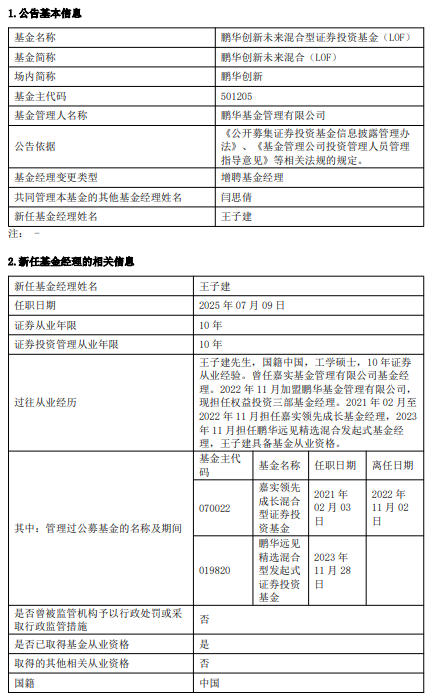
97万人关注!扭亏为赢有望?成立以来亏近50%!鹏华创新未来有了新动向!
Xin Lang Ji Jin· 2025-07-09 07:01
Core Viewpoint - The appointment of Wang Zijian as a new fund manager for Penghua Innovation Future (LOF) raises expectations among investors for a turnaround after significant losses since its inception, with hopes for new investment strategies to improve performance [1][9][17]. Fund Manager Change - Wang Zijian has been appointed as a co-manager alongside Yan Siqian, effective July 9, 2025 [2][3]. - Wang has 10 years of experience in the securities industry and previously managed funds at Harvest Fund Management [1][5]. Fund Performance - Since its establishment on September 30, 2020, Penghua Innovation Future has reported a total return of -46.60%, significantly underperforming its benchmark [9][11]. - The fund has experienced a total investment loss of 3.411 billion yuan, contrasting sharply with the 217 million yuan in management fees collected during the same period [11]. - Recent performance shows a recovery with a one-year return of 51.92%, indicating potential for regaining investor confidence [13][15]. Investment Strategy and Focus - Wang Zijian is expected to bring a new perspective and investment methodology, focusing on technology and growth sectors, which may enhance portfolio management efficiency [5][17]. - The dual-manager model aims to leverage the strengths of both managers in technology growth, potentially improving stock selection and risk management [17]. Historical Context - The fund has faced challenges with previous managers, with returns of -44.73% and -3.38% under different management periods, both failing to outperform benchmarks [11]. - The fund's investor base has shrunk from 2.866 million accounts and 11.999 billion yuan in assets to 971,000 accounts and 2.176 billion yuan by the end of the previous year [11].