
科技自立自强

Search documents
光控资本:本轮A股慢牛行情的根基并未动摇
Sou Hu Cai Jing· 2025-11-04 04:58
Group 1 - The A-share market showed a rebound on Monday, with all three major indices turning positive, indicating a potential recovery phase despite previous declines [3] - Market risk appetite has decreased, reflected in reduced trading volume and a shift towards undervalued stocks, particularly in the context of the recent performance of profit and micro-cap indices [1][3] - The technology sector has undergone adjustments, and while other sectors have shown activity, there is a lack of a new leading theme to drive the market, suggesting cautious sentiment among investors regarding high valuations [1][3] Group 2 - The Federal Reserve's member Waller indicated that further interest rate cuts may be necessary in December due to potential job growth slowdowns, which could influence market dynamics [3] - The upcoming November period is critical for policy effectiveness and fourth-quarter earnings verification, with the "14th Five-Year Plan" focusing on high-quality development and technological self-reliance, potentially supporting market sentiment [3] - The market is expected to continue its slow bull trend, with the possibility of the A-share index challenging the 4000-point mark, although individual stock performance will require close monitoring [3]


迈向“十五五”:中国经济如何实现质量与速度的双重跃升?
Jin Rong Shi Bao· 2025-11-04 04:51
Core Insights - The 20th Central Committee's Fourth Plenary Session has outlined the direction for China's future development, emphasizing "high-quality development" as the core theme for the 15th Five-Year Plan, aiming for "qualitative effective improvement" and "reasonable quantitative growth" [1] Group 1: Transformation Core - The essence of China's economic transformation is a long marathon of market-oriented reforms that challenge and break through existing systemic barriers [2] - The current dilemma in the digital economy reflects a coexistence of arbitrary administrative intervention and a lack of institutional rules, necessitating continuous market-oriented reforms to replace policy arbitrariness with stable and transparent institutional certainty [2] Group 2: Growth Momentum - Sustainable growth must derive from "institutional dividends" rather than "policy dividends," focusing on enhancing fundamental institutional environments like property rights protection and fair competition to stimulate endogenous innovation [3] - The old approach of relying heavily on policy support while neglecting institutional guarantees has hindered innovation, indicating a need for deeper institutional reforms to allow market mechanisms to play a decisive role in resource allocation [3] Group 3: Development Goals - High-quality development is not merely about slowing down growth but involves a unified improvement of efficiency and fairness, requiring the dismantling of administrative dominance over resource allocation [4] - The focus should be on "opportunity fairness" and "result adjustment," ensuring that the benefits of reform and development are equitably shared among all citizens [4] Group 4: Open Wisdom - In the face of global challenges, true autonomy requires strengthening competitiveness through open competition, which involves aligning with international high-standard economic and trade rules to drive domestic institutional reforms [5] - Ensuring the security of industrial and supply chains relies on occupying an irreplaceable position in global division of labor, which necessitates institutional innovation to attract global talent, technology, and capital [6] Group 5: Roadmap for the 15th Five-Year Plan - Achieving "qualitative effective improvement" and "reasonable quantitative growth" requires a systematic support framework, focusing on technological self-reliance and breakthroughs in strategic fields like artificial intelligence and biomanufacturing [6] - Expanding domestic demand and deepening income distribution reforms are essential to stimulate consumer potential, while maintaining a stable macroeconomic policy to ensure economic operation within a reasonable range [6]
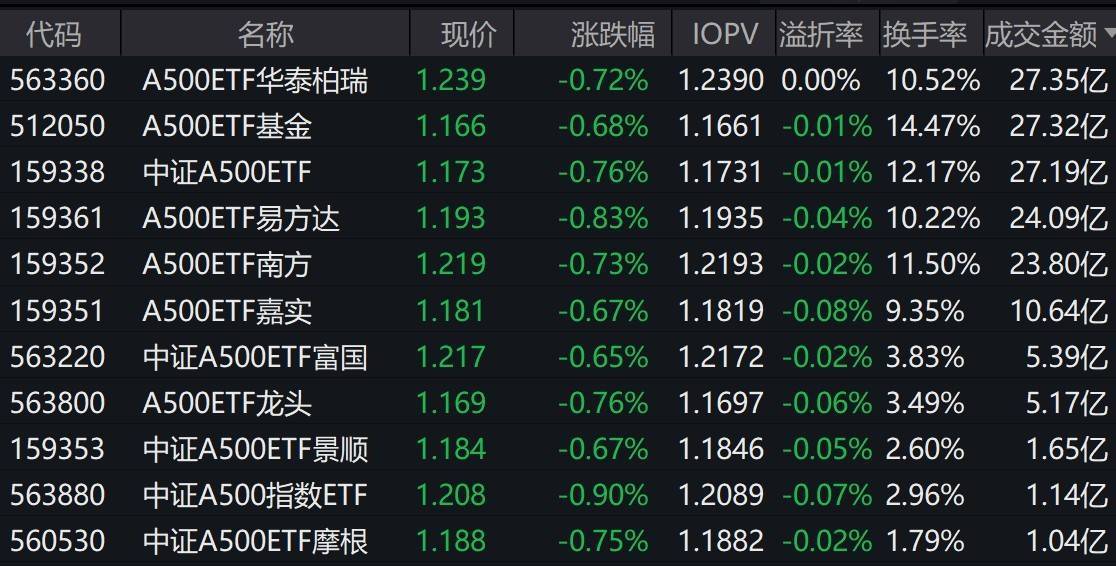
市场早盘震荡调整,中证A500指数下跌0.69%,3只中证A500相关ETF成交额超27亿元
Sou Hu Cai Jing· 2025-11-04 03:53
Market Overview - The market experienced fluctuations in the morning session, with the Shenzhen Component Index and ChiNext Index both declining over 1%, while the CSI A500 Index fell by 0.69% [1] - The Fujian sector showed resilience, with semiconductor equipment stocks rebounding, and the coal sector remained active [1] - Conversely, robotics concept stocks collectively declined, innovative drug concepts faced adjustments, and several gold concept stocks fell [1] ETF Performance - As of the morning close, ETFs tracking the CSI A500 Index saw slight declines, with 11 related ETFs having transaction volumes exceeding 100 million yuan, and 3 surpassing 2.7 billion yuan [1] - Specific transaction amounts for A500 ETFs included: - Huatai-PB A500 ETF: 2.735 billion yuan - A500 ETF Fund: 2.732 billion yuan - CSI A500 ETF: 2.719 billion yuan [1][2] Future Market Outlook - Analysts suggest that entering November, the market will enter a critical window for policy effectiveness and fourth-quarter profit verification [1] - The "14th Five-Year Plan" draft focuses on high-quality development and technological self-reliance, which may provide positive support for market sentiment, indicating that the index may continue a slow bull market amidst fluctuations [1]
中际旭创、寒武纪逆市活跃,百分百布局新质生产力的——双创龙头ETF(588330)拉升1%,近3日吸金4345万元!
Xin Lang Cai Jing· 2025-11-04 03:12
Group 1 - The core viewpoint of the news highlights the active performance of the Double Innovation Leader ETF (588330), which has seen a recent increase in funds and is expected to benefit from the growing focus on technology and innovation in China [1][2] - The ETF has experienced a net inflow of 43.45 million yuan over the past three days, indicating investor confidence in the sector's future [1] - Key sectors driving the ETF's performance include optical modules and semiconductors, with notable gains from leading companies such as Zhongji Xuchuang and TSMC [1][2] Group 2 - The new five-year plan emphasizes the importance of technological self-reliance, with "new quality productivity" being a key focus area [2] - The Double Innovation Leader ETF (588330) is characterized by its diversified market allocation, targeting large-cap companies in strategic emerging industries, including new energy and semiconductors [2] - The ETF has shown significant growth, with a cumulative increase of 87.05% since its low point on April 8, outperforming other indices such as the ChiNext Index and the STAR Market Index [2]

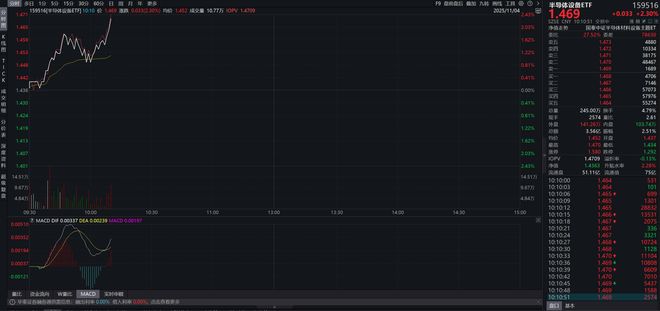
存储供应链或存 “断粮”危机?芯片景气上行,半导体设备ETF(159516)领涨超2%
Mei Ri Jing Ji Xin Wen· 2025-11-04 03:05
Group 1 - Samsung has taken the lead by suspending the October DDR5 DRAM contract pricing, prompting SK Hynix and Micron to follow suit, indicating a continued upward trend in chip market conditions [1][3] - The suspension of contract pricing is expected to lead to further increases in DDR5 spot prices, which have surged by 25% within a week due to supply constraints [3] - The storage supply chain may face a "food shortage" crisis, with expectations that contract pricing will not be restored until mid-November, despite prior predictions for resolution by the end of October [3] Group 2 - The semiconductor equipment ETF (159516) has seen a significant increase, with a year-to-date growth of over 200%, currently exceeding 7 billion yuan, making it the largest in its category [1][6] - The "14th Five-Year Plan" emphasizes technological self-reliance, positioning the domestic computing power sector as a market focus, while also supporting the storage cycle and innovation in consumer electronics driven by AI [4][5] - The semiconductor equipment sector is identified as a critical area for investment, with the ETF tracking the progress of semiconductor materials and equipment, highlighting potential opportunities for investors [7]
中国经济微观察 “四链融合”“中国造”越来越有分量了
Ren Min Wang· 2025-11-04 03:00
Core Viewpoint - China has made significant strides in overcoming "choke point" technologies through a new type of national system under centralized leadership, emphasizing self-reliance in technology and innovation [1][2]. Group 1: Technological Advancements - The "Four Chain Integration" aims to facilitate the transformation of scientific achievements into industrial applications, enhancing the speed at which laboratory innovations become market-ready products [2][3]. - During the "14th Five-Year Plan" period, R&D expenditure increased from 2.44 trillion yuan to 3.61 trillion yuan, maintaining the second position globally, with R&D intensity rising from 2.40% to 2.68%, surpassing the EU average for the first time [3]. - At least 21 out of 35 previously identified "choke point" technologies are expected to be overcome by 2024, supported by 77 major national scientific infrastructure projects [3]. Group 2: Funding and Support Mechanisms - A new "enterprise innovation points system" has been implemented, allowing companies to secure funding without collateral based on their innovation scores, which consider factors like talent and patents [4]. - Over 1,500 government-guided funds have been established nationwide, attracting over 3 trillion yuan in social capital investments [4]. Group 3: Industry and Innovation Integration - The Guangdong-Hong Kong-Macao Greater Bay Area serves as a model for integrating industry and innovation, where leading tech companies collaborate with universities and research institutions to address the disconnect between R&D and market needs [5]. - The national technology contract transaction volume reached 6.8 trillion yuan in 2024, 1.8 times that of 2020, indicating a rapid acceleration in the integration of innovation and industry [5]. Group 4: Future Directions - Looking ahead to the "15th Five-Year Plan," there is a commitment to further enhance the integration of innovation chains, industry chains, funding chains, and talent chains [6]. - Emphasis will be placed on strengthening basic research and original innovation while promoting a better synergy between effective markets and proactive government initiatives [6].
丁薛祥人民日报撰文
Zhong Guo Ji Jin Bao· 2025-11-04 02:23
Core Points - The article outlines the main goals for China's economic and social development during the "15th Five-Year Plan" period, emphasizing the importance of achieving decisive progress towards socialist modernization by 2035 [2][3] Group 1: Strategic Requirements - The "15th Five-Year Plan" is crucial for laying the foundation for achieving socialist modernization, with a projected GDP of approximately 140 trillion yuan by 2025 [3] - The plan aims to establish a solid foundation for future goals, building on the achievements of the "14th Five-Year Plan" [3] - The development environment is complex, with both opportunities and challenges, necessitating a focus on domestic demand to stabilize economic growth [4] Group 2: Main Goals of Economic and Social Development - High-quality development is prioritized, with a goal for per capita GDP to reach the level of middle-income countries by 2035 [6] - Significant improvements in self-reliance in technology are targeted, with a focus on enhancing the national innovation system and talent cultivation [7] - Comprehensive reforms are to be deepened, particularly in the economic system, to enhance market efficiency and government roles [8] - Social and cultural development is emphasized, aiming to improve both material and spiritual wealth [9] - The quality of life for citizens is to be enhanced, focusing on employment, income, and social security [10][11] - Environmental sustainability is a key focus, with goals for green development and carbon emissions peaking by 2030 [12] - National security measures are to be strengthened to address both traditional and non-traditional risks [13] Group 3: Implementation Strategies - The implementation of the plan requires adherence to Xi Jinping's thought and strong centralized leadership from the Communist Party [14] - A proactive approach to challenges is necessary, emphasizing the importance of struggle and resilience [15] - Detailed action plans are to be developed to ensure the successful execution of the outlined goals [16]
丁薛祥人民日报撰文
中国基金报· 2025-11-04 01:39
Core Viewpoint - The article outlines the main goals for China's economic and social development during the "15th Five-Year Plan" period, emphasizing the importance of achieving decisive progress towards socialist modernization by 2035, while addressing both opportunities and challenges in the current development environment [9][11]. Group 1: Strategic Requirements - The "15th Five-Year Plan" is a critical period for laying the foundation for achieving socialist modernization, with a projected GDP of approximately 140 trillion yuan by 2025, alongside advancements in technology, reform, ecological civilization, and public welfare [12][11]. - The plan aims to establish a solid foundation for future goals, with a focus on strong national construction and the rejuvenation of the nation, requiring precise identification of tasks and strategies in various fields [13]. - The development environment is complex, with both strategic opportunities and risks, necessitating a combination of goal-oriented and problem-oriented approaches to maintain strategic initiative in international competition [13]. Group 2: Main Goals of Economic and Social Development - High-quality development is essential, with a target for per capita GDP to reach the level of middle-income countries by 2035, emphasizing the need to enhance domestic demand and improve consumption mechanisms [15]. - The level of technological self-reliance must significantly increase, with a focus on strengthening national strategic technological capabilities and fostering a robust innovation ecosystem [16][17]. - Comprehensive reforms are necessary to enhance the socialist market economy, improve governance, and expand high-level openness, with a focus on deepening reforms in various sectors [18]. - Social and cultural development must be prioritized, enhancing both material and spiritual wealth, and promoting cultural confidence and core socialist values [19]. - The quality of life for citizens should improve, with a focus on stable employment, equitable income distribution, and enhanced social security systems [20]. - Environmental sustainability is crucial, with a commitment to achieving peak carbon emissions by 2030 and promoting a green economy [21]. - National security must be reinforced, addressing both traditional and non-traditional security challenges to ensure stability and resilience [22]. Group 3: Implementation Strategies - The implementation of the "15th Five-Year Plan" goals requires a comprehensive understanding of Xi Jinping's thought on socialism with Chinese characteristics, serving as a guiding framework for modernization efforts [23]. - Strengthening the centralized leadership of the Communist Party is vital for achieving development goals, ensuring alignment with the Party's directives [23]. - A proactive approach to addressing risks and challenges is necessary, fostering a spirit of struggle and resilience in the face of difficulties [24]. - Effective execution of the plan's objectives is essential, with a focus on practical implementation and mobilizing collective efforts across the nation [24].
欧洲多家智库:为欧中绿色合作指明方向
人民网-国际频道 原创稿· 2025-11-04 01:08
Core Insights - The "14th Five-Year Plan" is seen as a roadmap for China's high-quality development and a significant indicator for understanding global economic trends [1][2] - European think tanks emphasize the importance of China's green transition and its implications for global climate governance [1][2] Group 1: Green Transition and Cooperation - The Bruegel Institute highlights that China's climate and energy policies will play a crucial role in global emission reduction efforts [1] - The IEEP identifies green transition as a key area of consensus for cooperation between China and Europe, with China's advantages in new energy and green manufacturing presenting unprecedented opportunities for low-carbon investment [2] - European experts suggest that the "14th Five-Year Plan" provides a new opportunity for China-Europe relations, focusing on deepening cooperation in green transition and technological innovation [2] Group 2: Investment Environment and Market Dynamics - European business leaders note that China's commitment to building a high-standard market system and enhancing intellectual property protection will boost confidence and cooperation among European enterprises [2] - The emphasis on "high-quality development" and "technological self-reliance" in China's planning indicates increased investment in key industries such as semiconductors, new energy vehicles, and biotechnology, potentially leading to a new round of adjustments in global supply chains [2] - The report suggests that China's evolving policies will have a "chain effect" on Europe's ability to achieve its "Green Deal" goals, necessitating enhanced coordination in emission reduction technologies and climate financing [1][2]
坚定走高水平科技自立自强之路
Jin Rong Shi Bao· 2025-11-04 00:53
《中共中央关于制定国民经济和社会发展第十五个五年规划的建议》(以下简称《建议》)提 出"建设现代化产业体系,巩固壮大实体经济根基""加快高水平科技自立自强,引领发展新质生产力"等 要求。 分析人士认为,与"十四五"规划相比,《建议》进一步强化了"科技自立自强"的要求。基于全会对 形势的判断,意味着"十五五"期间我国必须实现科技自立自强,强化产业链安全。 "中国式现代化要靠科技现代化作支撑。'十五五'时期,中国必须更加坚定地走高水平科技自立自 强之路,巩固拓展优势,破除瓶颈制约,补短板强弱项,在激烈的国际竞争中赢得战略主动。"中银证 券全球首席经济学家管涛表示。 建设现代化产业体系 为高质量发展注入持久动能 《建议》将"建设现代化产业体系,巩固壮大实体经济根基"摆在战略任务的第一条。 产业是实体经济发展的物质基础。我国已经是制造业强国,传统产业增加值在制造业中占比80%左 右,是我国产业体系的基本盘。同时,新兴产业正成长为经济增长新引擎。2024年,我国"三新"经济增 加值占国内生产总值比重已经超过18%。 在此背景下,《建议》部署了四方面重点任务。"可以从'固本升级、创新育新、扩容提质、强基增 效'来把握。" ...
