
量子计算

Search documents
谷歌芯片实现量子计算新突破,人工智能AIETF(515070)持仓股用友网络上涨超2%
Mei Ri Jing Ji Xin Wen· 2025-10-28 05:55
Group 1 - The A-share market saw a decline in major indices in the afternoon, with sectors such as quantum technology and AI showing initial strength before tapering off [1] - Google announced a significant breakthrough in quantum computing, achieving verifiable quantum advantage with its Willow module, running an algorithm 13,000 times faster than leading supercomputers, marking a step towards practical applications in fields like medicine and materials science [1] - Tianfeng Securities highlighted that "AI+" will usher in a new era of smart economy in China, with clear development directions for AI applications, suggesting that generative AI remains a focus due to its high commercialization value [1] Group 2 - The AI ETF (515070) tracks the CS AI Theme Index (930713), selecting stocks that provide technology, resources, and applications for AI, focusing on the midstream and upstream of the AI industry chain [2] - The top ten weighted stocks in the AI ETF include leading domestic tech companies such as Zhongji Xuchuang, Xinyisheng, and Hikvision, among others [2] - Related products include the AI ETF (515070), the Huaxia Growth Enterprise Software ETF (159256), and the Huaxia 200 ETF (159573) [2]

券商晨会精华 | 看好量子计算和可控核聚变产业趋势向上
智通财经网· 2025-10-28 00:41
Group 1 - The market experienced a significant upward trend, with the Shanghai Composite Index rising over 1% and approaching 4000 points, marking a ten-year high [1] - The trading volume in the Shanghai and Shenzhen markets reached 2.34 trillion, an increase of 365.9 billion compared to the previous trading day [1] - Sectors such as storage chips, CPO, and controllable nuclear fusion saw the highest gains, while gaming and wind power equipment sectors faced declines [1] Group 2 - Guojin Securities expressed optimism about the upward trend in quantum computing and controllable nuclear fusion industries, supported by the "14th Five-Year Plan" which aims to promote these sectors as new economic growth points [2] - Citic Construction Investment recommended focusing on investment opportunities in the liquid cooling sector, anticipating significant growth in market penetration by 2025 due to increased chip power consumption and the adoption of liquid cooling solutions [3] -招商证券 projected a marginal improvement in the profit growth rate of non-financial A-shares in the upcoming quarterly reports, with high growth expected in information technology and midstream manufacturing sectors [4]



AMD(AMD.US)联手美国能源部 斥资10亿美元建造两台超级计算机
Zhi Tong Cai Jing· 2025-10-28 00:29
Core Insights - AMD is collaborating with the U.S. Department of Energy to develop two supercomputers, named "Lux" and "Discovery," aimed at advancing energy and scientific research [1][2] - The total public-private investment for this project will reach $1 billion, with partners including HPE and Oracle's cloud infrastructure division [1] - The supercomputers will utilize AMD's AI chips and are expected to enhance nuclear reactor modeling, accelerate approval processes, and support advancements in fusion energy and quantum computing [1][2] Investment and Strategic Goals - This collaboration aligns with the AI Action Plan released by the Trump administration, emphasizing federal support for research in artificial intelligence [2] - AMD's CEO highlighted that "Lux" and "Discovery" will become some of the most energy-efficient computing platforms globally, facilitating AI data sharing and model training for researchers across the U.S. [2] - The project aims to maintain U.S. leadership in critical technology fields through scientific discovery and open collaboration [2] Project Timeline and Specifications - "Lux" is scheduled to be operational by early next year, featuring AMD's MI355X chip, while "Discovery" will utilize the MI430X processor and is expected to be completed by 2028 [2]

券商晨会精华:看好量子计算和可控核聚变产业趋势向上
Xin Lang Cai Jing· 2025-10-28 00:29
Group 1 - The market experienced a significant upward trend, with the Shanghai Composite Index rising over 1% and reaching a ten-year high, approaching 4000 points [1] - The trading volume in the Shanghai and Shenzhen markets was 2.34 trillion, an increase of 365.9 billion compared to the previous trading day [1] - Key sectors that saw gains included storage chips, CPO, and controllable nuclear fusion, while gaming and wind power equipment sectors faced declines [1] Group 2 - Guotai Junan Securities expressed optimism about the upward trend in quantum computing and controllable nuclear fusion industries, supported by national policy and funding [2] - The 14th Five-Year Plan emphasizes the development of quantum technology and nuclear fusion as new economic growth points [2] Group 3 - CITIC Construction Investment highlighted the investment opportunities in the liquid cooling sector, predicting significant growth in market size due to increased adoption of liquid cooling in AI chip applications by 2025 [3] - The penetration of liquid cooling in the ASIC market and domestic market is expected to accelerate as the industry matures [3] Group 4 - China Merchants Securities anticipates a marginal improvement in the profit growth rate of non-financial A-shares in the third quarter, driven by a low base effect [4] - High profit growth is expected in sectors such as information technology and midstream manufacturing, while upstream resources and healthcare are projected to see a narrowing of performance declines [4]
国金证券:看好量子计算和可控核聚变产业趋势向上
Xin Lang Cai Jing· 2025-10-27 23:57
Core Viewpoint - The report from Guojin Securities highlights the emphasis on quantum technology and nuclear fusion energy as new economic growth points in the 14th Five-Year Plan proposed by the Central Committee of the Communist Party of China [1] Group 1: Industry Focus - The 14th Five-Year Plan aims to promote industries such as quantum technology, biomanufacturing, hydrogen energy, nuclear fusion energy, brain-computer interfaces, embodied intelligence, and sixth-generation mobile communications as new economic growth drivers [1] - Quantum computing and controllable nuclear fusion are expected to receive top-level policy support and funding, indicating a positive upward trend for these industries [1]
强化高处狙击防范措施,应对“独狼袭击”可疑人员,日本严密戒备迎接特朗普来访
Huan Qiu Shi Bao· 2025-10-27 23:02
Core Points - The article discusses U.S. President Trump's visit to Japan, marking his first visit during his second term, focusing on economic and defense discussions with Japan's new Prime Minister, Fumio Kishida [1][3][4] Group 1: Economic Discussions - The main topics of discussion between Trump and Kishida will include trade agreements and Japan's commitment to increase defense spending [1][4] - Japan is preparing a procurement plan that includes purchasing U.S. liquefied natural gas, pickup trucks, and soybeans, indicating a strong economic partnership [1][3][6] - A recent trade agreement reduced tariffs on Japanese goods from 25% to 15%, while Japan agreed to invest $550 billion in U.S. industries such as semiconductors, pharmaceuticals, and AI [4][5] Group 2: Defense Spending - Defense spending is a critical issue, with Japan aiming to increase its defense budget to 2% of GDP by 2026, a year earlier than previously planned [7] - There are concerns that if Trump pressures Japan to raise defense spending to 5% of GDP, it could lead to a stalemate in discussions [7] - Kishida's government is facing challenges in funding defense initiatives due to a depreciating yen and ongoing economic pressures [7] Group 3: Political Context - Kishida's limited diplomatic experience makes this meeting a significant test for her leadership [4] - The article highlights the potential instability of Kishida's government, which may affect her ability to negotiate effectively with Trump [7] - Kishida's administration is seen as trying to maintain continuity with former Prime Minister Abe's policies, which may influence U.S.-Japan relations [7]


氪星晚报|青岛啤酒:第三季度净利润13.7亿,同比增长1.62%;宋旸已接替邵京平(James)出任京东零售平台营销中心负责人;安踏体育:三季度安踏和F...
3 6 Ke· 2025-10-27 15:08
Group 1: Meituan's Health Initiative - Meituan has launched a "Health Double Eleven" campaign featuring special medical foods and health supplements, responding to a nearly 40% increase in related search volume on its platform [1] - The campaign includes products like Ejiao and bird's nest, along with special medical foods such as Ai Er Shu and Tai Min Shu, and offers significant discount coupons to users [1] - Users purchasing special medical foods can join a community for exclusive nutritionist consultations and additional discounts [1] Group 2: Qingdao Beer Financial Performance - Qingdao Beer reported a third-quarter net profit of 1.37 billion yuan, representing a year-on-year increase of 1.62% [2] - The company's revenue for the third quarter was 8.876 billion yuan, showing a slight decline of 0.17% compared to the previous year [2] Group 3: Changchun High-tech's Clinical Trial Approval - Changchun High-tech's subsidiary, GenSci, received approval for the clinical trial application of GenSci098 injection, which has potential for treating diffuse toxic goiter [3] - This approval is expected to facilitate the clinical development of the product for the target population [3] Group 4: Kingsoft Office Financial Performance - Kingsoft Office reported a third-quarter net profit of 431 million yuan, marking a year-on-year increase of 35.42% [4] - The company's revenue for the third quarter was 1.521 billion yuan, reflecting a growth of 25.33% year-on-year [4] Group 5: Foreign Exchange and Trade Statistics - In the first three quarters, China's foreign exchange receipts and payments reached 11.6 trillion USD, setting a record for the same period [5] - The foreign exchange market transaction volume is projected to grow by 37% in 2024 compared to 2020, with foreign exchange receipts increasing by 64% over the same period [5] Group 6: Three Squirrels Financial Performance - Three Squirrels reported a third-quarter net profit of 22.27 million yuan, which is a significant decline of 56.79% year-on-year [6] - The company's revenue for the third quarter was 2.281 billion yuan, showing an increase of 8.91% compared to the previous year [6] Group 7: Hengrui Medicine Financial Performance - Hengrui Medicine's third-quarter revenue was 7.427 billion yuan, reflecting a year-on-year growth of 12.72% [6] - The net profit for the third quarter was 1.301 billion yuan, which is a 9.53% increase year-on-year [6] Group 8: Anta Sports Retail Performance - Anta Sports reported low single-digit growth in retail sales for its Anta and FILA brands in the third quarter [9] - Other brands under the company achieved a significant retail sales growth of 45-50% year-on-year [9] Group 9: National Airlines Aircraft Purchase - National Airlines announced plans to purchase six A350F cargo aircraft from Airbus, with an option for four additional aircraft [10] - The total value of the aircraft, based on the January 2024 catalog price, is approximately 4.65 billion USD per unit, with potential discounts negotiated [10] Group 10: Investment and Financing Activities - Guoyi Quantum has completed a new round of strategic financing led by Hefei Xingtai Capital, aimed at enhancing its R&D capabilities in quantum computing and related fields [10] - Song Yang has replaced Shao Jingping as the head of JD Retail's marketing center, following Shao's departure for personal reasons [7] Group 11: New Product Launch by Meituan - Meituan's LongCat team has released and open-sourced the LongCat-Video video generation model, achieving state-of-the-art results in video generation tasks [10] - The model aims to enhance capabilities in various applications, including autonomous driving and interactive business scenarios [10] Group 12: Regulatory Changes in Foreign Investment - The China Securities Regulatory Commission has introduced a green channel and simplified processes for foreign institutional investors, including sovereign funds and pension funds [11]



氪星晚报|青岛啤酒:第三季度净利润13.7亿,同比增长1.62%;宋旸已接替邵京平(James)出任京东零售平台营销中心负责人;安踏体育:三季度安踏和FILA品牌零售额同比低单位数增长
3 6 Ke· 2025-10-27 14:56
Group 1: Company Performance - Meituan's special medical food activity section launched for Double Eleven, with a nearly 40% week-on-week increase in related search volume [1] - Qingdao Beer reported a third-quarter net profit of 1.37 billion, a year-on-year increase of 1.62%, with revenue of 8.876 billion, a slight decline of 0.17% [2] - Changchun High-tech's subsidiary received approval for clinical trials of GenSci098 injection, which has potential for treating diffuse toxic goiter [3] - Kingsoft Office reported a third-quarter net profit of 431 million, a year-on-year increase of 35.42%, with revenue of 1.521 billion, up 25.33% [4] - Anta Sports reported low single-digit growth in retail sales for Anta and FILA brands in the third quarter, while other brands saw a 45-50% increase [9] - Heng Rui Pharmaceutical reported a third-quarter net profit of 1.301 billion, a year-on-year increase of 9.53%, with revenue of 7.427 billion, up 12.72% [6] - Three Squirrels reported a third-quarter net profit of 22.27 million, a year-on-year decrease of 56.79%, with revenue of 2.281 billion, up 8.91% [5] - Kangtai Biological reported a third-quarter net profit of 11.62 million, a year-on-year decrease of 93.74%, with revenue of 671 million, down 17.74% [8] Group 2: Investment and Financing - Guoyi Quantum received strategic investment from Hefei Xingtai Capital, which will enhance its R&D capabilities in quantum computing and related fields [10] - Song Yang has replaced Shao Jingping as the head of JD Retail Platform Marketing Center due to personal reasons [7] - Song Yan Power completed nearly 300 million Pre-B round financing led by Fanggu Capital, with participation from several other investors [11] Group 3: Market Trends and Economic Indicators - China's foreign exchange revenue and expenditure scale reached 11.6 trillion in the first three quarters, a historical high, with a 37% increase in trading volume compared to 2020 [5] - The China Securities Regulatory Commission has implemented a green channel and simplified processes for foreign investment from sovereign funds, international organizations, and pension charitable funds [12] Group 4: New Products - Meituan LongCat-Video was officially released and open-sourced, achieving state-of-the-art performance in video generation tasks [11]


这个新股概念多,AI+存储+PCB……| 1027 张博划重点
Hu Xiu· 2025-10-27 14:55
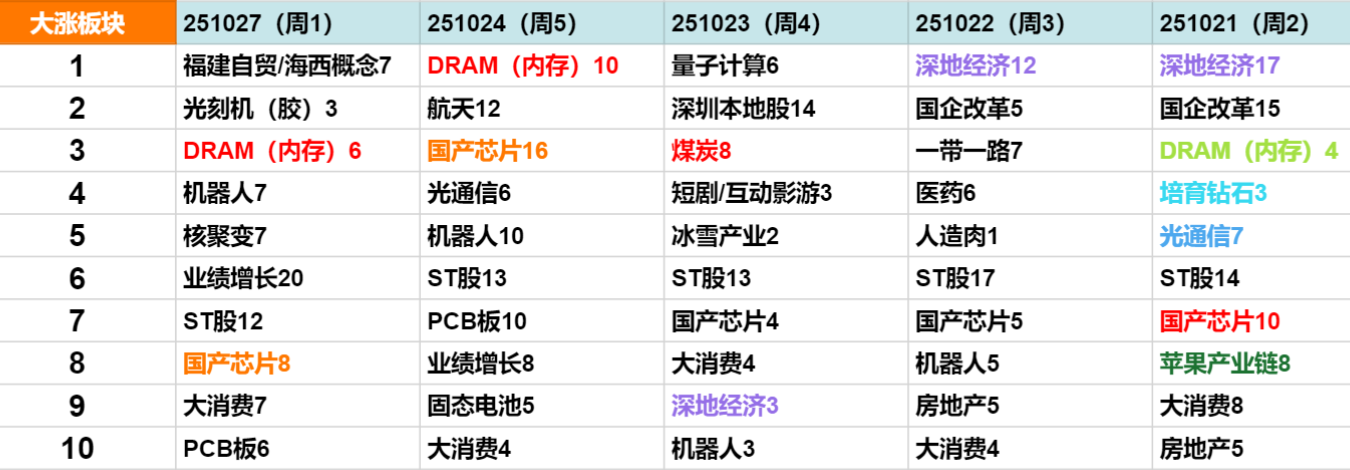
Core Points - The Shanghai Composite Index rose by 1.18% on October 27, reaching a high of 3999.07 points, the highest level since August 18, 2015, and is close to the 4000-point mark [1] - The financing balance in A-shares remains at a historical high, with a total of 24,398.18 billion yuan as of October 24, just below the peak of 24,401.38 billion yuan recorded on October 16, and 1,732 billion yuan higher than the peak of 22,666.35 billion yuan in 2015 [1] - The current financing balance accounts for approximately 2.5% of the circulating market value, significantly lower than the ratio during the 2015 peak [1] Sector Performance - The top-performing sectors include Fujian Free Trade Zone, DRAM (memory), quantum computing, and deep earth economy, with notable increases in their respective indices [2] - The sectors showing significant growth also include aerospace, domestic consumption, and coal, indicating a diverse range of investment opportunities [2] - The performance of ST stocks has been notable, with several stocks showing strong upward trends, reflecting market interest in companies undergoing restructuring or with growth potential [2]
加密货币、量子计算概念股盘初集体上涨
Ge Long Hui A P P· 2025-10-27 13:59
Core Viewpoint - The U.S. stock market saw a collective rise in cryptocurrency and quantum computing concept stocks, indicating positive market sentiment in these sectors [1] Group 1: Cryptocurrency Stocks - Robinhood, BMNR, and SBET stocks rose over 4% [1] - Strategy, Bitfarms, and IREN stocks increased by more than 3% [1] Group 2: Quantum Computing Stocks - IONQ and QBTS stocks surged over 5% [1] - RGTI, QUBT, and ARQQ stocks experienced an increase of more than 4% [1]