
算力

Search documents
通信ETF(515880)回调近3%,近20日净流入近40亿元,光模块行业长期景气度获市场关注
Mei Ri Jing Ji Xin Wen· 2025-11-24 05:38
Core Insights - The technology cycle of AI is unlikely to end in the short term, with a continued focus on computing power as a key driver [1] - NVIDIA's recent earnings report exceeded expectations, indicating that the demand for computing power is still rapidly growing [1] - Google's Gemini3 model has received positive market feedback for its strong capabilities [1] - The hardware sector for computing power is expected to see significant growth in light modules and other components in the coming year [1] Industry Overview - The ongoing investment in computing infrastructure both domestically and internationally is expected to sustain high demand in the light module market [1] - The Communication ETF (515880) is the largest in its category, with light modules accounting for 52% and servers for 22% of its composition as of October 28 [1] - When combined with fiber optics and copper connections, these components represent over 81% of the ETF, reflecting the fundamental strength of overseas computing power [1]
硬科技翻红!海光信息涨超1%,科创芯片50ETF(588750)V型翻红,回调砸出“黄金坑”?多只科创芯片类ETF获批!谷歌:每6个月将算力容量翻倍
Sou Hu Cai Jing· 2025-11-24 03:05
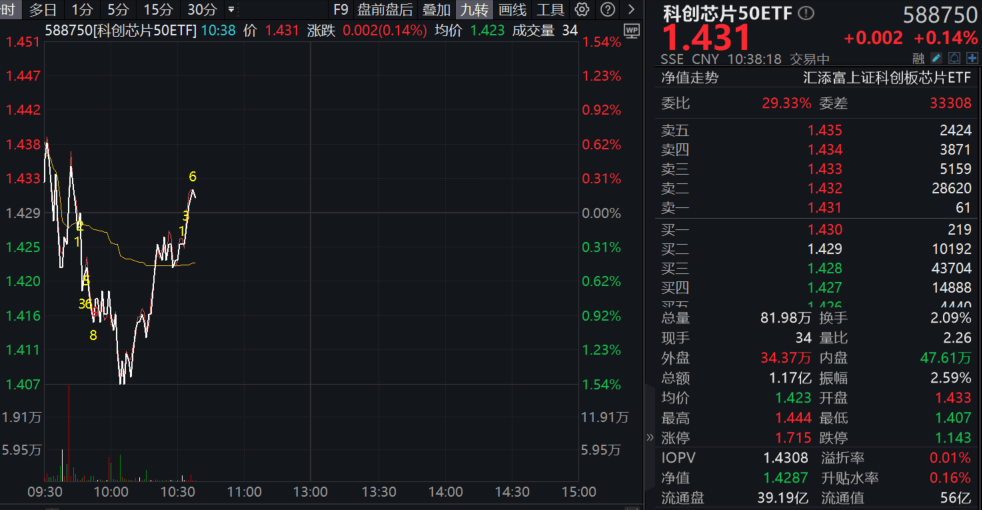
Core Insights - The A-share market showed a mixed performance on November 24, with the hard technology sector continuing its pullback, while the Kexin Chip 50 ETF (588750) rebounded slightly, up 0.14% as of 10:38 AM [1] Market Performance - The Kexin Chip 50 ETF (588750) saw varied performance among its constituent stocks, with some stocks like Chip Origin and Huahong Technology dropping over 4%, while others like Haiguang Information rose over 1% [3] - As of 10:38 AM, the top ten constituent stocks of the Kexin Chip 50 ETF displayed a mix of gains and losses, with notable movements including Haiguang Information up 1.36% and Tianyue Advanced leading with a 6.29% increase [4] IPO Developments - On November 24, Moer Thread officially launched its IPO subscription on the Sci-Tech Innovation Board, potentially becoming the first listed company focused on "full-function GPUs" in China. The IPO process has been notably swift, marking a significant milestone for the board [5] ETF Expansion - Fourteen hard technology ETFs were approved on November 21, including three focused on chip technology, indicating an expansion in the market for chip-themed ETFs and the potential influx of new investment capital into the sector [5] AI and Semiconductor Trends - The release of Google's AI model Gemini 3 on November 19 has intensified competition in the global large model sector, with expectations for sustained demand for AI computing power, which may present investment opportunities in the computing sector [6][7] - The semiconductor industry is projected to maintain optimistic growth trends, driven by AI applications and domestic substitution efforts, with significant performance expected in Q4 2025 [8] Kexin Chip Index Characteristics - The Kexin Chip 50 ETF (588750) focuses on the high-end upstream and midstream segments of the chip industry, with a core segment representation of 96%, indicating a higher growth potential compared to other indices [10][11] - The index has shown strong growth metrics, with a projected net profit growth rate of 100% for the full year of 2025, significantly outpacing similar indices [14] Investment Strategy - The Kexin Chip 50 ETF (588750) is recommended for investors looking to capitalize on the core technology of chips, offering high elasticity and growth potential, making it an attractive option for those interested in the semiconductor sector [15]


英伟达链迎利好,光模块逆市活跃!光库科技领涨超14%,创业板人工智能ETF(159363)金针探底
Xin Lang Ji Jin· 2025-11-24 02:47
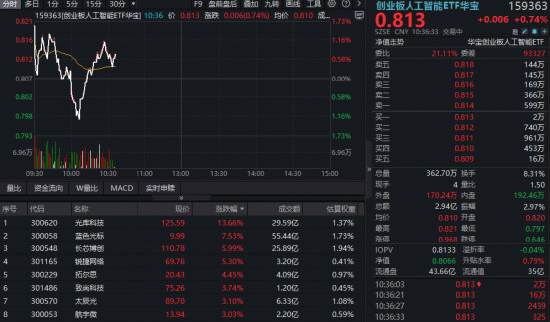
Core Insights - The news highlights a positive development for Nvidia's supply chain, particularly in the optical module sector, with significant stock price increases for companies like Guangku Technology and Changxin Bochuang [1] - The approval of Nvidia's H200 AI chip export to China is under consideration, which could alleviate short-term computing power bottlenecks and benefit companies closely tied to Nvidia's ecosystem [2][3] Industry Summary - The optical module sector is experiencing heightened activity, with Guangku Technology leading gains of over 14%, and other companies like Changxin Bochuang and Ruijie Network also seeing increases of over 5% [1] - The AI industry is characterized by a positive feedback loop where model upgrades drive demand for computing power, which in turn supports innovation in models [3] - The first AI-focused ETF on the ChiNext board, which has over 54% exposure to optical modules, is recommended for capturing AI-related investment opportunities [3] Company Summary - Guangku Technology and other optical module companies are benefiting from the anticipated demand for components compatible with Nvidia's H200 chip, which requires supporting optical modules [2] - The report emphasizes the importance of focusing on leading companies in the optical module industry as part of the broader computing power and AI application investment strategy [3]


谷歌新一代大模型Gemini3表现优异,创业板人工智能ETF华夏(159381)涨1.12%
Sou Hu Cai Jing· 2025-11-24 02:01
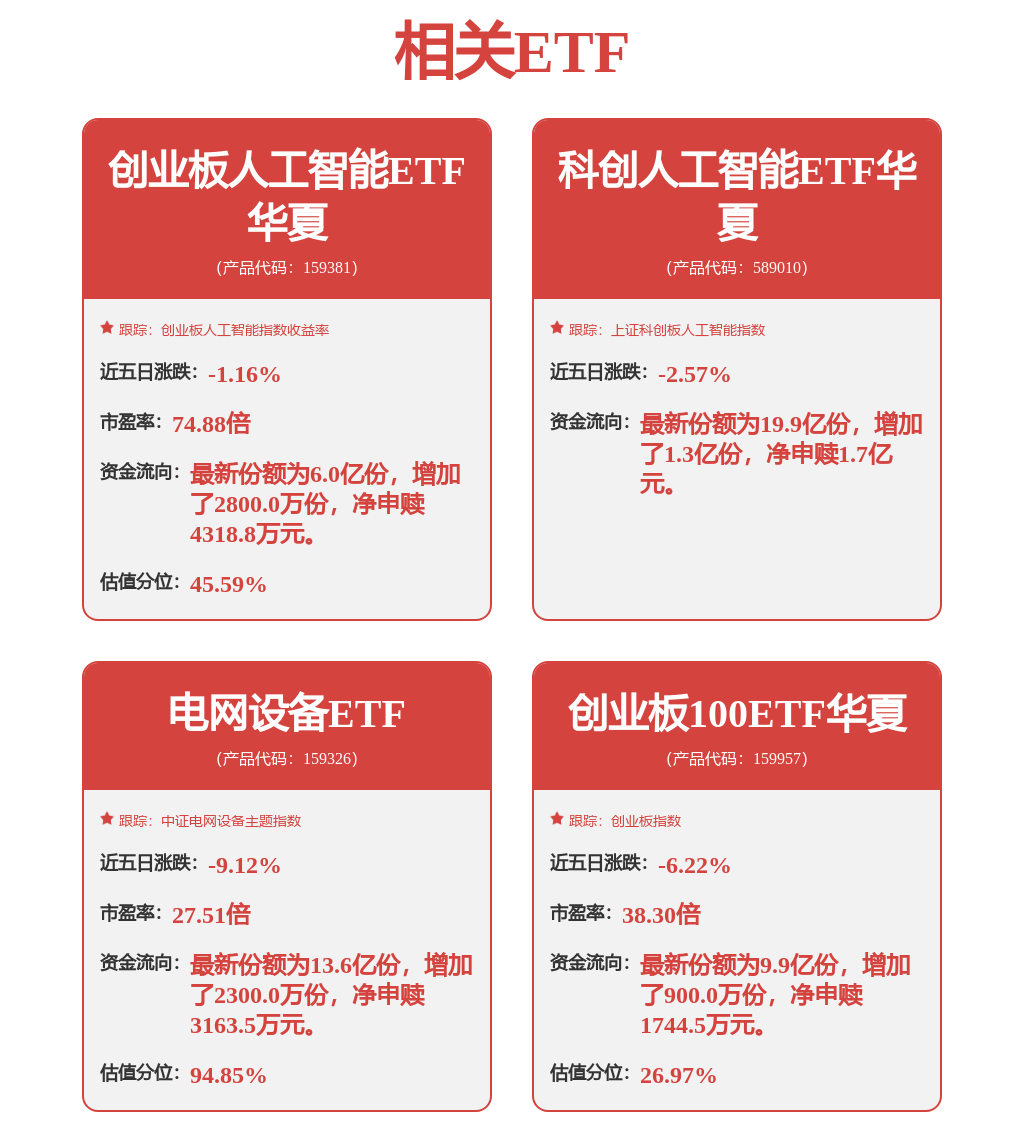
11月24日,三大股指早盘窄幅震荡,其中创业板人工智能指数小幅拉升。截至上午9:37,创业板人工智能ETF华夏(159381)涨1.12%,相关持仓股 方面,中际旭创涨2.71%、新易盛涨2.65%、天孚通信涨1.15%,中科创达、全志科技、协创数据等小幅跟涨。 消息面上,谷歌于2025年11月正式发布Gemini3,新一代大模型在多项基准测试中实现了断层式领先,展现出跨越式的性能提升。基础思考能力: Gemini3Pro在衡量AI能否解决人类顶尖难题的Humanity'sLastExam中得分37.5%(无工具)和45.8%(带工具),超过GPT-5.1的26.5%与ClaudeSonnet4.5 的13.7%。Gemini3在开发者工具领域实现了显著突破,重新定义了AI辅助编程的能力边界:在开发者社区运营的实战编码竞技场DesignArena中, Gemini3Pro在整体排名中位列第一 中信建投证券认为,近期,算力板块波动加大。复盘2023年以来的算力板块,三季报后调整比较常见,考虑到AI带动的算力需求依然非常旺盛, 我们认为调整是机会。目前,世界正处于AI产业革命中,类比工业革命,影响深远,不能简单对 ...

【公告全知道】算力+华为+AI智能体+信创+云计算!公司与华为联合发布大模型一体机
财联社· 2025-11-23 15:19
Group 1 - The article highlights the collaboration between a company and Huawei to launch a large model integrated machine, as well as a technical partnership with Moore Threads [1] - A company has signed a 100 million yuan contract for new energy power batteries, indicating a strong focus on renewable energy and storage solutions [1] - Another company has entered into a strategic cooperation agreement for humanoid robot components with a rolling bearing enterprise, showcasing advancements in humanoid robotics and automotive technology [1]

以认知破局 以调研求实——融通基金李进的成长投资之路
Shang Hai Zheng Quan Bao· 2025-11-23 13:51
Core Insights - The article highlights the investment philosophy of Li Jin, a fund manager at Rongtong Fund, emphasizing the importance of continuous cognitive iteration to capture investment opportunities in rapidly changing industries [1] Group 1: Investment Philosophy - Li Jin believes that investment is akin to natural sciences, where stock prices are ultimately determined by company performance and industry development [2] - The investment strategy involves a combination of balanced and concentrated approaches, focusing on both risk control and seizing growth opportunities [3] Group 2: Research and Analysis - Li Jin adheres to the principle of "no investment without research," emphasizing the necessity of in-depth field research to understand the true dynamics of industries [4] - The research process includes evaluating a company's business model, competitive barriers, and the visibility of its business performance [5] Group 3: Investment Strategy Evolution - Initially, Li Jin's portfolio had a high allocation to the artificial intelligence sector, which led to significant performance volatility; he has since adjusted his strategy to better manage risk and returns [3] - The current investment portfolio includes both value growth and cyclical growth assets, aiming for a balanced approach to maximize returns while maintaining a rational valuation anchor [3]
垫底基金杀出重围!弃白酒押AI翻身,规模暴增12倍藏暗雷
Sou Hu Cai Jing· 2025-11-23 11:57
Core Viewpoint - A public fund, which previously faced significant losses and reduced its scale to 40 million, has successfully transformed by investing in AI, achieving a 12-fold increase in scale and doubling its value within a year [1][4][20]. Fund Performance - The fund's unit net value experienced a maximum decline of nearly 60% in less than two years, dropping from 246 million to approximately 40 million [4]. - As of November 18, 2025, the unit net value surged to 1.52, with an annual return of 109.57%, effectively doubling its value [4][20]. Investment Strategy - Initially, the fund heavily invested in the liquor sector, with seven out of ten top holdings in well-known brands, but faced losses due to a downturn in the industry [6][8]. - The fund manager, Liu Xiaoming, pivoted to AI investments, recognizing the potential in CPO sectors, which began to show significant profit growth [12][14]. - In 2025, the fund aggressively increased its positions in key AI-related stocks, achieving substantial gains, with some stocks seeing increases of over 350% [14][16]. Fund Scale and Challenges - Following the impressive performance, the fund's scale grew from 344 million in Q2 2025 to 4.487 billion in Q3 2025, marking a 12-fold increase [20]. - The increase in scale presents challenges, as larger funds face reduced flexibility in trading and may struggle to manage liquidity effectively [22][24]. - The transition from a small, agile fund to a larger one requires not only a focus on sector selection but also skills in position management and industry diversification [24].
单日急跌近百点,A股震荡何时休?资金抄底创业板人工智能,低位食饮、港股AI韧性凸显
Xin Lang Ji Jin· 2025-11-23 11:46
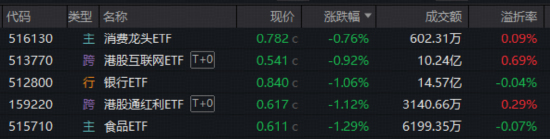
Market Overview - Global market risk aversion continues to escalate, influenced by significant fluctuations in US stocks, leading to declines in major Asia-Pacific indices [1] - A-shares experienced a substantial adjustment, with over 5,000 stocks in the red, and the Shanghai Composite Index fell 2.45% to 3,834.89 points [1] - The total market turnover reached 1.98 trillion yuan, showing a significant increase compared to the previous period [1] Sector Performance - Technology growth stocks were hit hard, with the hard technology broad-based dual innovation leader ETF (588330) down 4.1% [1] - The entrepreneurial board AI ETF (159363) opened lower and fell 4.83%, breaching all short-term moving averages [1] - Cyclical sectors such as non-ferrous metals and chemicals also faced declines, with both the non-ferrous leader ETF (159876) and chemical ETF (516020) experiencing significant drops [1] Defensive Stocks - Amidst the widespread decline, defensive stocks showed resilience, with China Bank rising 0.8% to set a new historical high [1] - Consumer stocks outperformed the market, with the consumer leader ETF (516130), food ETF (515710), and agriculture, animal husbandry, and fishery ETF (159275) all beating the market [1] - Eastern Securities forecasts that the food and beverage sector may experience "easy rises and difficult falls" by 2026 [1] ETF Insights - The food ETF (515710) showed significant resilience, outperforming the Shanghai Composite Index despite a 1.29% drop [10] - The Hong Kong Internet ETF (513770) saw a net inflow of 54.14 million yuan over the past five days, indicating strong buying interest despite recent declines [4] - The Hong Kong Internet ETF's top holdings include Alibaba, Tencent, and Xiaomi, which collectively account for over 73% of the fund [8] Future Outlook - Analysts suggest that the current market may continue a "weight protection + structural theme" oscillation pattern, with low-valuation financial stocks like banks offering defensive value [3] - The long-term "systematic slow bull" trend remains intact, with focus areas including large consumption, prosperity, traditional industries, and dividends [3] - The food and beverage sector is expected to see a fundamental turning point, with a potential recovery in earnings anticipated by 2026 [13]
创业板人工智能ETF较历史高点回撤超12%,果断布局还是谨慎观望?
Xin Lang Ji Jin· 2025-11-23 11:43
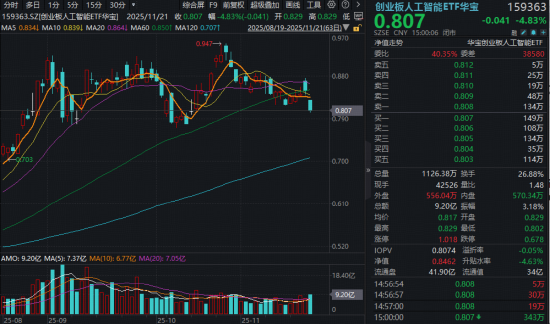
周五(11月21日),创业板人工智能跳空大跌近5%,主要受光模块等算力硬件剧烈回调影响,截至收 盘,新易盛跌超8%创9月份以来新低,天孚通信跌超7%,中际旭创跌逾5%。AI应用方向则逆市活跃, 易点天下20CM涨停,万兴科技、中文在线、蓝色光标等涨超2%。 热门ETF方面,光模块含量超54%的创业板人工智能ETF(159363)场内收跌4.83%,失守所有短期均 线,为10月高点回调以来新低,单日成交9.2亿元。资金进场大举抢筹,全天净申购1.76亿份。 【海内外多事件催化,AI应用或迎补涨行情】 配置上看,中银证券指出,2025年以来,AI产业链内部已经经历了从海外算力-国产算力-存力与电力的 行情轮动,AI应用作为下游对比之下涨幅有限,仍具备较高配置性价比,产业拐点催化之下,AI应用 或将迎来补涨行情。 【算力高景气度持续,光模块有望引领反攻】 英伟达超预期财报印证了全球算力高景气度。机构指出,在全球算力需求持续高企的背景下,1.6T光模 块零售价格上涨,800G及以下速率光模块降价速度减缓,光模块行业一改以往量增价跌的态势,出现 了"量价齐增"的现象。 数量方面,此前据市场测算,明年全球800G光模块有 ...
蓄力新高18:良机渐近,买在分歧
CAITONG SECURITIES· 2025-11-23 07:31
Group 1 - The report highlights a strategic shift towards large financial and consumer sectors, indicating a rebound window following the maximum negative impact from equal tariffs [1][9] - The report emphasizes that the market is approaching a phase bottom, with short-term adjustments not altering the long-term upward trend, despite liquidity pressures from the Federal Reserve's hawkish stance [2][9] - Historical analysis of the U.S. stock market shows that significant downturns typically require major negative shocks, with expected maximum adjustments around 10% in the current context [3][10][11] Group 2 - The report notes that market volume has decreased, with transaction amounts falling below 20 trillion yuan, indicating a lack of momentum in market leadership [4][12] - It suggests that the current market adjustment presents a good opportunity for accumulation, focusing on sectors with favorable risk-reward ratios, such as real estate and resource commodities [4][13][14] - The report identifies mid-term investment opportunities in high-growth sectors, waiting for renewed confidence in high-prosperity segments like storage and AI [4][13][14]