
自动驾驶

Search documents
国元香港晨报-20260122
Guoyuan Securities2· 2026-01-22 02:17
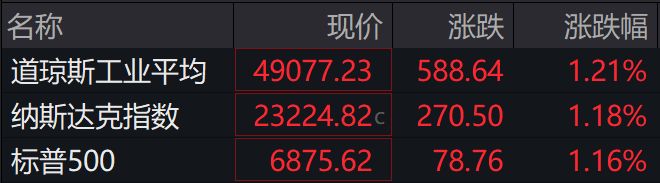
Economic Indicators - China's total retail sales of consumer goods are projected to reach CNY 50.1 trillion by 2025, reflecting a growth rate of 3.7%[4] - The 2-year U.S. Treasury yield decreased by 0.39 basis points to 3.584%[4] - The 5-year U.S. Treasury yield fell by 2.63 basis points to 3.822%[4] - The 10-year U.S. Treasury yield dropped by 5.16 basis points to 4.241%[4] Market Performance - The Nasdaq index closed at 23,224.82, up by 1.18%[5] - The Dow Jones Industrial Average closed at 49,077.23, increasing by 1.21%[5] - The S&P 500 index finished at 6,875.62, rising by 1.16%[5] - The Hang Seng Index closed at 26,585.06, up by 0.37%[5] - The Shanghai Composite Index ended at 4,116.94, with a slight increase of 0.08%[5]
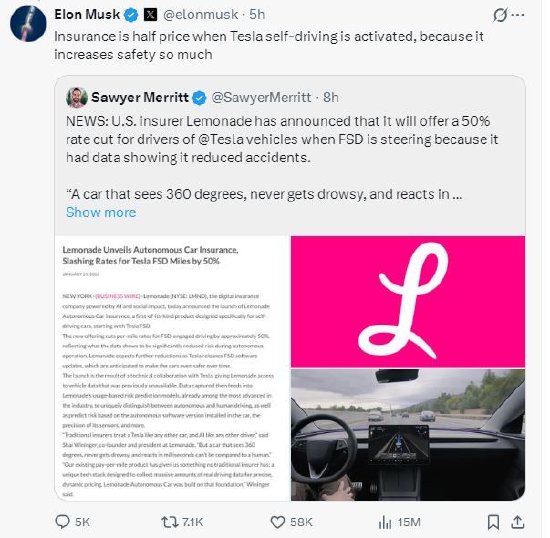
美保险商宣布为特斯拉降保费,马斯克回应:FSD极大提升了安全性
Jin Rong Jie· 2026-01-22 01:10
Core Insights - Lemonade, an American insurance company, announced a 50% discount on premiums for Tesla owners who activate the Full Self-Driving (FSD) feature, as data suggests this feature reduces accident rates [1] - Lemonade's co-founder and president, Shai Wininger, emphasized the superiority of FSD vehicles in terms of safety and responsiveness compared to human drivers, and stated that as the safety of FSD software improves, insurance prices will decrease [1] - Elon Musk confirmed that activating Tesla's autonomous driving feature leads to a significant reduction in insurance costs due to enhanced safety [1] Company Summary - Lemonade is positioning itself as a forward-thinking insurance provider by linking premium discounts to the adoption of advanced safety features in vehicles [1] - The collaboration with Tesla highlights the growing trend of integrating technology and insurance, potentially influencing future insurance models in the automotive industry [1] Industry Summary - The announcement reflects a broader trend in the automotive and insurance industries towards leveraging technology to improve safety and reduce costs [1] - The emphasis on FSD technology indicates a shift in how insurance companies assess risk, moving towards data-driven models that account for technological advancements in vehicle safety [1]



【立方早知道】两大央企换帅!涉及7家上市公司/“中国版英伟达”预亏近10亿/年内第一大牛股提示风险
Sou Hu Cai Jing· 2026-01-22 00:10
Group 1 - The Ministry of Finance announced a temporary exemption from personal income tax on capital gains from the transfer of CDRs for individual investors from January 1, 2026, to December 31, 2027 [5] - The People's Bank of China emphasized strict regulatory measures for payment institutions and the development of a modern payment system in 2026 [5] - The Ministry of Housing and Urban-Rural Development expressed support for reasonable financing needs of real estate companies to stabilize the market [10] Group 2 - The Ministry of Finance issued new regulations to address issues related to abnormally low prices in government procurement [8] - The Guangdong provincial government is promoting the orderly opening of autonomous driving road tests and applications [14] - The construction of China's first offshore liquid rocket launch and recovery test platform is underway, with plans for testing in early February [16] Group 3 - Moore Threads, referred to as "China's Nvidia," expects to achieve revenue of 1.45 billion to 1.52 billion yuan in 2025, representing a growth of 230.70% to 246.67% year-on-year [21] - Zhite New Materials announced potential stock suspension if its stock price continues to deviate significantly from its fundamentals [22] - Guotou Zhonglu received approval from the State-owned Assets Supervision and Administration Commission for its asset restructuring and financing plan [23] Group 4 - Han Jian Heshan is planning to acquire a 52.51% stake in Liaoning Xingfu New Materials Co., Ltd., leading to a stock suspension [24] - Aotai Bio plans to repurchase shares worth between 100 million and 200 million yuan [25] - Zhongchao Holdings received an order for 40 sets of thrust chamber covers from a rocket unit [26]



盘前必读丨美股三大指数均收涨超1%;晶科能源2025年预亏超59亿元
Di Yi Cai Jing Zi Xun· 2026-01-22 00:03
Group 1 - The Chinese government will extend tax policies for innovative enterprises' domestic issuance of depositary receipts (CDRs) from January 1, 2026, to December 31, 2027, including exemptions on individual income tax for capital gains and differentiated tax policies for dividends [1] - The Ministry of Finance and other departments announced the establishment of new duty-free shops at 41 ports, including Wuhan Tianhe International Airport, allowing residents from Macau to purchase duty-free goods up to 15,000 yuan [2] - The Ministry of Housing and Urban-Rural Development emphasized the ongoing progress of new urbanization and the potential for high-quality development in the real estate sector, advocating for city-specific policies to manage supply and demand [2] Group 2 - The Ministry of Finance issued a notice to address "abnormally low prices" in government procurement, requiring procurement entities to set reasonable maximum prices based on market conditions and project budgets [3] - The People's Bank of China will hold a meeting on January 15, 2026, to discuss the development of a modern payment system, focusing on cross-border payment systems and regulatory measures [3] - Guangdong Province introduced policies to promote high-quality development in transportation through artificial intelligence, encouraging the testing and application of smart connected vehicles [4] Group 3 - The European Parliament's International Trade Committee announced an indefinite freeze on the review of the EU-US trade agreement due to current geopolitical tensions [5] - Major US stock indices showed recovery, with the Dow Jones Industrial Average rising by 1.21% to 49,077.23 points, and significant rebounds in large tech stocks such as Nvidia and Tesla [6] - The Nasdaq China Golden Dragon Index increased by 2.2%, with notable gains in companies like Baidu and Alibaba [6] Group 4 - Analysts from various securities firms suggest that the current spring market rally is still in progress, with expectations for continued structural market trends and rotation of hot sectors [7] - There is a focus on earnings disclosures in the technology sector, particularly in chips and artificial intelligence, as well as the impact of domestic policies on capital expenditures [7]

【早知道】住建部:支持房企合理融资需求;央行:加快建设人民币跨境支付体系
Zheng Quan Shi Bao Wang· 2026-01-22 00:00
Group 1 - The Ministry of Housing and Urban-Rural Development supports reasonable financing needs of real estate companies and emphasizes the importance of the "white list" system for real estate financing [1] - The Ministry of Industry and Information Technology aims to achieve automated monitoring of computing power resources data across 31 provinces and key computing power enterprises by the end of 2026 [1] - The People's Bank of China is accelerating the construction of a cross-border payment system for the Renminbi, promoting interconnectivity in cross-border payments [1] Group 2 - The Ministry of Finance and four other departments are establishing new duty-free shops at 41 ports, including Wuhan Tianhe International Airport [1] - The Guangdong government is supporting the orderly opening of automated driving tests in multiple scenarios and expanding high-level automated driving application areas [1]
新华财经早报:1月22日
Xin Lang Cai Jing· 2026-01-21 23:41
Group 1 - The Ministry of Finance and other departments announced a temporary exemption from personal income tax on capital gains from the transfer of CDRs by individual investors for the years 2026 and 2027 [1][1] - The Ministry of Industry and Information Technology reported that the first phase of 6G technology trials has resulted in over 300 key technology reserves, with the second phase of trials already initiated [1][1] - The State Administration for Market Regulation is overseeing the rectification of the logistics industry to promote fair competition and protect the rights of truck drivers [1][1] Group 2 - The National Energy Administration reported that electricity demand reached a winter record high of 1.168 billion kilowatts from January 19 to 21, a 12.2% increase from last year's peak of 1.041 billion kilowatts [2][2] - The Guangdong provincial government introduced policies to encourage the development of artificial intelligence in transportation, including support for autonomous driving technology and regulatory platforms [2][2] - Moore Threads announced an expected net loss of 950 million to 1.06 billion yuan for 2025, a reduction in loss of approximately 5.58 billion to 6.68 billion yuan compared to the previous year, representing a narrowing of 34.5% to 41.3% [2][2] Group 3 - The Danish "Academic Pension Fund" plans to sell $100 million in U.S. government bonds due to concerns over the U.S. fiscal situation [6][6] - The Japan National Tourism Organization reported a significant decline of 45.3% in the number of visitors from mainland China in December, totaling 330,400 [6][6] - The International Energy Agency projected that global oil demand will grow by 930,000 barrels per day in 2026, an increase from the previously estimated 860,000 barrels per day [6][6] Group 4 - Companies such as Yalun Technology expect revenues of 1.45 billion to 1.52 billion yuan for 2025, while Daikin Heavy Industries anticipates a net profit increase of 121.58% to 153.23% year-on-year [8][8] - JinkoSolar expects a net loss of 5.9 billion to 6.9 billion yuan for 2025, while other companies like Tianfu Communication and Hekang New Energy project significant profit increases [8][8]

音频 | 格隆汇1.22盘前要点—港A美股你需要关注的大事都在这
Ge Long Hui A P P· 2026-01-21 23:11
Group 1 - U.S. stock indices rose over 1%, with Intel increasing by over 11% and the Chinese concept index surging by 2.21% [2] - The U.S. Treasury and other departments announced a temporary exemption from personal income tax on capital gains from the transfer of CDRs for individual investors in the next two years [2] - The People's Bank of China is accelerating the construction of a cross-border payment system to promote interconnectivity in cross-border payments [2] - The Ministry of Finance is addressing "involution" competition in government procurement and aims to resolve issues related to abnormally low bids [2] - Guangdong province is supporting the orderly opening of autonomous driving tests in multiple scenarios and expanding high-level autonomous driving application areas [2] Group 2 - Juhua Co. expects a net profit increase of 80%-101% year-on-year for 2025, although Q4 performance significantly underperformed expectations [3] - Longqi Technology saw a 19.74% increase in dark trading, with a profit of 612 HKD per hand [3] - Limin Co. anticipates a net profit growth of 471.55%-514.57% year-on-year for 2025, while Tianfu Communication expects a 40%-60% increase [3] - ST Chang Pharmaceutical is projected to have a negative net asset value by the end of 2025, which may lead to delisting [3] - Dongtong will be delisted and removed from the stock exchange [3]
陆家嘴财经早餐2026年1月22日星期四
Wind万得· 2026-01-21 22:40
Group 1 - The Ministry of Housing and Urban-Rural Development emphasizes two key areas for promoting high-quality development in real estate during the "14th Five-Year Plan": orderly promotion of "good housing" construction and accelerating the establishment of a new model for real estate development, including the implementation of a pre-sale system for commercial housing [3] - The U.S. President Trump announced a framework agreement with NATO Secretary General Jens Stoltenberg regarding Greenland, which, if implemented, would benefit the U.S. and all NATO member countries. Following this news, U.S. stock markets surged, with all three major indices rising over 1% [3] - NVIDIA CEO Jensen Huang stated at the Davos Forum that artificial intelligence has initiated the largest infrastructure construction in human history, with total investment expected to reach trillions of dollars, highlighting the need for more energy, land, and skilled workers [3] Group 2 - The Ministry of Finance and four other departments announced the establishment of duty-free shops at 41 ports, including Wuhan Tianhe International Airport, allowing residents from Macau to purchase duty-free goods worth up to 15,000 RMB [4] - The Ministry of Finance and three other departments extended the tax policies related to the CDR pilot phase for innovative enterprises until December 31, 2027, providing tax exemptions for individual investors and public funds on capital gains from CDR transfers [4] - To address "involution" in government procurement, the Ministry of Finance issued a notice to tackle abnormal low-price issues in government procurement, effective from February 1, 2026 [4] Group 3 - In 2025, Shanghai's GDP reached 56,708.71 billion RMB, growing by 5.4%, marking its first time ranking fifth among global cities [5] - Beijing's GDP surpassed 5 trillion RMB in 2025, achieving a total of 52,073.4 billion RMB, also growing by 5.4% year-on-year [5] Group 4 - A-shares experienced fluctuations with gold stocks surging, while large consumer and financial sectors saw corrections. The Shanghai Composite Index rose by 0.08% to 4,116.94 points, and the Shenzhen Component Index increased by 0.7% [6] - The Hong Kong Hang Seng Index rose by 0.37% to 26,585.06 points, with significant net buying from southbound funds [6] Group 5 - The Hong Kong Stock Exchange CEO announced that over 350 companies are in the IPO queue, including those that have submitted confidential applications [7] - The fourth quarter reports for public funds are being disclosed, with over 3,300 funds reporting, indicating a positive outlook for the A-share market in 2026, particularly in the technology sector [7] Group 6 - The first offshore liquid rocket launch and recovery test platform in China is under construction, expected to be operational by February 5, 2026 [11] - In 2025, China's commercial space sector is projected to complete 50 launches, accounting for 54% of the total space launches, with 311 commercial satellites entering orbit [11] - The Ministry of Industry and Information Technology forecasts that the core AI industry in China will exceed 1.2 trillion RMB by 2025 [11] Group 7 - The People's Bank of China announced adjustments to commercial property loan policies in Guangdong Province, setting a minimum down payment ratio of 30% for commercial properties [12] - The overall performance of China's bond market is strong, with yields on long-term bonds generally declining [20]

2025年中国汽车产业:“规模答卷”优异 “质量赛道”争先
Xin Lang Cai Jing· 2026-01-21 20:32
Core Insights - In 2025, China's automotive industry achieved significant milestones, with production and sales exceeding 34 million units, maintaining its position as the world's largest automotive market for 17 consecutive years [1][3] - The growth in the automotive sector is driven by technological innovations, improved market order, and safety regulations, transitioning from scale accumulation to quality enhancement [1][4] Production and Sales Performance - In 2025, China's automotive production reached 34.53 million units, while sales totaled 34.40 million units, reflecting year-on-year growth of 10.4% and 9.4% respectively, surpassing initial expectations [1] - The export of vehicles also performed well, with over 7 million units exported, marking a 21.1% increase year-on-year [3] New Energy Vehicles (NEVs) - The NEV market saw substantial growth, with production and sales reaching 16.62 million and 16.49 million units respectively, representing year-on-year increases of 29% and 28.2% [2] - NEVs accounted for 47.9% of total new car sales, an increase of 7 percentage points from the previous year [2] Technological Advancements - The penetration rate of L2 autonomous driving features in passenger vehicles reached 64%, with a year-on-year increase of 21.2% in sales of such vehicles [4] - The development of solid-state batteries is progressing, with several major manufacturers planning small-scale production by 2027 [6] Industry Standards and Regulations - The automotive industry is moving towards a more regulated and healthy development phase, with new standards and mechanisms being established to enhance product reliability and consumer safety [7] - The Ministry of Industry and Information Technology is actively working to address "involution" in competition, promoting a healthier market environment [8] Shift in Competitive Landscape - The automotive market is transitioning from a "price war" to a "value war," indicating a shift towards comprehensive capabilities in technology, cost, and business models [9] - Companies are focusing on operational efficiency and quality, with leaders emphasizing the need for continuous innovation and market expansion [9] Future Outlook - The automotive industry is expected to continue its high-quality development in 2026, with policies aimed at boosting consumer confidence and stabilizing market expectations [9]
A股晚间热点 | 央行发声!加快建设人民币跨境支付体系
智通财经网· 2026-01-21 15:21
Group 1 - The People's Bank of China emphasizes the acceleration of the construction of a cross-border payment system for the renminbi and the promotion of interconnectivity in cross-border payments, aiming for a diversified and multi-layered development of the payment system [1] - The Ministry of Finance and other departments announce the establishment of new duty-free shops at 41 ports to support consumption [2] - The National Investment Fund announces a suspension of trading for its silver fund due to significant price fluctuations, with the market price exceeding the net asset value by over 50% [3] Group 2 - The Ministry of Finance aims to address the issue of abnormally low prices in government procurement to foster a healthy competitive market environment [4] - China's Ministry of Foreign Affairs responds positively to the U.S. request for new trade negotiations, emphasizing the importance of implementing the consensus reached by the leaders of both countries [5] - The Ministry of Housing and Urban-Rural Development plans to support reasonable financing needs of real estate companies through a "white list" system [6] Group 3 - The People's Bank of Guangdong adjusts the minimum down payment ratio for commercial property loans to no less than 30% in 20 cities [7] - The Ministry of Finance and other departments extend tax incentives for innovative enterprises issuing depositary receipts [8] - Guangdong province promotes the application of autonomous driving technology, indicating a significant year for L4 autonomous driving commercialization [9] Group 4 - Positive announcements include share repurchase plans from companies like Aotai Bio and significant contract signings by companies such as Ice Wheel Environment and South Mining Group [13] - Negative announcements include share reduction plans from shareholders of companies like Yong'an Futures and Green Da [17]
