中国消费市场

Search documents
春节假期映照出一个活力满满、自信向前的中国(和音)
Ren Min Ri Bao· 2026-02-23 23:41
Group 1: Economic Resilience and Consumer Trends - The recent Spring Festival holiday saw over 2.6 billion cross-regional movements, with foreign visitors actively experiencing Chinese culture, highlighting the resilience and innovative spirit of the Chinese economy [1] - The "longest Spring Festival holiday" witnessed a robust consumer market, with offline transactions in travel and entertainment increasing by over 20% year-on-year [1] - The holiday period showcased a significant upgrade in consumption patterns, with a rise in quality travel options such as long-distance, deep, and customized tours, expanding new opportunities for healthy market development [1] Group 2: Technological Advancements - The Spring Festival was marked by notable technological innovations, including humanoid robots performing at the New Year's Eve gala, showcasing advancements in robotics and AI applications [2] - The usage of AI models surged, with over 10 billion interactions recorded from New Year's Eve to the third day of the new year, reflecting the integration of technology into traditional celebrations [2] - Various technological experiences, such as VR cultural projects, attracted international visitors, demonstrating the global appeal of China's technological progress [2] Group 3: International Tourism Growth - The Spring Festival is increasingly becoming a popular season for global tourists, with an expected average of over 2.05 million inbound and outbound travelers daily, marking a 14.1% increase from the previous year [3] - Foreign tourists are shifting towards immersive cultural experiences rather than traditional sightseeing, seeking deeper connections with China's rich cultural resources [3] - The trend of "celebrating the Spring Festival in China" is gaining traction among international visitors, supported by favorable policies such as tax refunds for departing tourists [3]
中国消费迎来“开门红”(国际论道)
Ren Min Ri Bao Hai Wai Ban· 2026-01-11 23:07
Core Insights - The Chinese consumer market is experiencing a significant transformation, moving from quantity to quality, driven by increased consumer confidence and diverse product offerings [8][9][12] - The New Year holiday saw 142 million domestic trips and total spending of 84.789 billion yuan, indicating robust consumer activity [8][12] - Policies aimed at boosting consumption, such as subsidies and financial support, are expected to sustain economic growth and enhance consumer spending [11][12][13] Consumer Activity - During the New Year holiday, ice and snow tourism became a major driver of winter consumption, with record visitor numbers to ski resorts and hot springs [9][10] - Hainan's duty-free sales reached 251 million yuan on January 1, a 93.8% year-on-year increase, highlighting the appeal of warm-weather destinations [9][10] - The rise of "China Shopping" reflects a shift in foreign tourists' purchasing preferences towards high-tech products and cultural items [9][10] Policy Support - The Chinese government is implementing a series of policies to stimulate consumption, including a more proactive fiscal policy and specific actions to boost consumer spending [11][12] - The Central Economic Work Conference emphasized the need for targeted actions to enhance consumption and investment, indicating a commitment to maintaining high growth rates [11][12] - Recent notifications from financial authorities aim to strengthen the collaboration between commerce and finance to further stimulate consumer spending [11][12] Economic Resilience - China's consumer market is showing signs of resilience, with retail sales of consumer goods increasing by 4% year-on-year in the first eleven months of 2025 [13][20] - The focus is shifting from investment and exports to services and consumption, indicating a structural change in the economy [12][20] - The government's measures to enhance social security and provide financial support are expected to improve mid-term growth prospects [13][20] Global Opportunities - International brands are encouraged to adapt their strategies to align with the evolving preferences of Chinese consumers, particularly in terms of value and local tastes [14][20] - The consumption vitality in China's smaller cities presents new investment opportunities for global investors [14][20] - The younger generation's increasing spending on experiential services, such as travel and cultural events, indicates a growing market for service-oriented businesses [14][20]


普华永道:四大关键因素支撑,中国消费市场展望乐观
Zhong Guo Jing Ying Bao· 2025-12-18 03:29
Group 1 - The core viewpoint of the reports by PwC highlights four key factors that will positively impact the future of the Chinese consumer market [1][2] - The first factor is the growth of the middle and high-income population, which is expected to stimulate demand. By 2024, households in China with a disposable income exceeding $25,000 are projected to surge to 64 million, nearly doubling by 2029, presenting significant opportunities for high-end and luxury brand operators [1] - The second factor is the rapid expansion of leading international and domestic grocery retailers, indicating strong consumer confidence in the Chinese market. These leading companies have recognized the importance of category management and private label development, setting benchmarks for the industry [1] Group 2 - The third factor is that Chinese consumers surpass global counterparts in their acceptance of health, sustainability, and international products, creating opportunities for new categories and products [2] - The fourth factor is the expectation that the Chinese yuan will strengthen by 2026, which, along with a stabilized real estate market, is anticipated to boost consumer confidence and stimulate local consumption [2]
CHIQ: Opportunities In The China Consumer Market Overlooked
Seeking Alpha· 2025-12-17 16:42
Core Viewpoint - China's equity market has been underperforming compared to other leading Asian emerging markets over the past few years, with a decline of approximately 13% in the last five years [1] Group 1 - The performance of Chinese equities has been overshadowed by other dominant Asian emerging markets [1] - The decline in Chinese equities is quantified at around 13% over the past five years [1]

报告:中国消费市场展望乐观,中高收入群体扩大成核心驱动力
Zhong Guo Xin Wen Wang· 2025-12-17 10:24
Group 1 - The core viewpoint of the reports is an optimistic outlook for the Chinese consumer market, driven by the expansion of the middle and high-income groups [1] - The first key factor positively impacting the Chinese consumer market is the increase in middle and high-income households, with an estimated 64 million households expected to have a disposable income exceeding $25,000 by 2024, nearly doubling by 2029 [1] - In 2024, there will be 26.8 million households (equivalent to 77 million people) with an annual income exceeding $35,000, presenting significant opportunities for high-end and luxury brand operators [1] Group 2 - The second key factor is the rapid expansion of international and domestic leading grocery retailers, indicating strong consumer confidence in the Chinese market [1] - The third key factor highlights that Chinese consumers surpass global counterparts in acceptance of health, sustainability, and international products, creating opportunities for new categories and products [1] - The fourth factor indicates that the financial market anticipates the Chinese yuan will strengthen by 2026, which, along with a stabilized real estate market, will boost consumer confidence and stimulate local consumption [2]

普华永道报告:中国消费市场展望乐观 中高收入群体扩大成核心驱动力
智通财经网· 2025-12-17 09:15
Core Insights - PwC's reports indicate an optimistic outlook for China's consumer market, driven by the expansion of the middle and high-income groups [1] - The reports highlight the need for retailers to enhance category management and develop private labels to drive growth amidst challenges [1] Group 1: Market Dynamics - The growth of the middle and high-income population is expected to stimulate demand for high-quality and differentiated products and services [2] - By 2024, households with disposable income exceeding $25,000 in China are projected to surge to 64 million, nearly doubling by 2029 [2] - China ranks second globally, with 26.8 million households (equivalent to 77 million people) expected to have an annual income exceeding $35,000 in 2024, presenting significant opportunities for high-end and luxury brands [2] Group 2: Retail Sector Challenges - Retailers are facing weak consumer sentiment and intense price competition, necessitating a shift from traditional operations to omnichannel strategies [1] - Many retailers are seeking to reduce reliance on shelf fees, which are charges levied on brands for specific store placements [1] - The retail industry must accelerate category management and private label development to drive growth in the Chinese market [1] Group 3: Key Influencing Factors - Rapid expansion of international and domestic leading supermarkets reflects consumer confidence in the Chinese market [2] - Chinese consumers are surpassing global counterparts in their acceptance of health, sustainability, and international products, creating opportunities for new categories and products [2] - The financial market anticipates a strengthening of the RMB by 2026, which, along with a stabilized real estate market, is expected to boost consumer confidence and stimulate local consumption [2] Group 4: Policy and Investment Opportunities - China is actively promoting domestic demand and attracting foreign direct investment through various new policies [2] - Recent initiatives include tax incentives for reinvestment by foreign investors, the upcoming full closure operation of Hainan Free Trade Port, and tax benefits in the Greater Bay Area [2] - Companies are advised to strengthen tax internal controls to navigate challenges posed by new policies [2]
普华永道:中国消费市场展望乐观,中高收入群体扩大成核心驱动力
Ge Long Hui· 2025-12-17 06:03
Core Insights - PwC's report highlights four key factors that will positively impact China's consumer market in the future [1] Group 1: Population and Income Growth - The growth of the middle and high-income population is expected to stimulate demand, with an estimated 64 million households in China having a disposable income exceeding $25,000 by 2024, nearly doubling by 2029 [1] - In 2024, 26.8 million households (equivalent to 77 million people) are projected to have an annual income exceeding $35,000, presenting significant opportunities for high-end and luxury brand operators [1] Group 2: Market Expansion - Rapid expansion of both international and domestic leading supermarkets indicates strong consumer confidence in the Chinese market [1] Group 3: Consumer Preferences - Chinese consumers are surpassing global counterparts in acceptance of health, sustainability, and international products, creating opportunities for new categories and products [1] Group 4: Financial Market Outlook - The financial market anticipates that the Chinese yuan will strengthen by 2026, which, along with a stabilized real estate market, is expected to boost consumer confidence and stimulate local consumption [1]
汇丰前海证券首席执行官、总经理陆天先生与香港法国工商总会主席对话:聚焦中国的新消费群体
2 1 Shi Ji Jing Ji Bao Dao· 2025-12-03 06:38
Core Insights - Despite short-term pressures, the Chinese consumer market remains large and diverse, presenting opportunities for companies with clear product positioning [1][2] - Understanding Chinese consumers is crucial, as their purchasing power is a key driver of economic growth and corporate expansion [1] Consumer Behavior - Since 2020, factors like the pandemic and economic uncertainty have shifted consumer behavior from spending to saving, but this trend is reversing [1] - McKinsey's research indicates a recovery in consumer confidence, particularly among the urban Gen Z demographic born between 1995 and 2010 [1] - This demographic, while only 20% of the population, contributes approximately 40% of total consumption [2] Market Trends - By 2035, Gen Z's consumption scale is expected to grow by about 400% to 16 trillion RMB [1] - Young consumers favor experiential spending, such as travel and concerts, and are significant contributors to luxury goods consumption [2] - The average age of high-end consumers in China is only 29, indicating a young market with increasing purchasing power due to wealth inheritance [2] Brand Dynamics - Local brands are gaining market share across various sectors, including electric vehicles, beauty products, and luxury items, by better understanding consumer needs and offering competitive pricing [2][3] - The jewelry market exemplifies this trend, with consumers valuing craftsmanship and investment potential, creating opportunities for brands that emphasize cultural and artisanal expression [3] Travel and Consumption - The rapid recovery of outbound tourism is expected to impact domestic luxury consumption, as international flights are nearing pre-pandemic levels, with a 20% year-on-year increase in international passenger flights from January to August [3] - The growth of outbound tourism aligns with the demand for experiential consumption, although it may divert some spending from domestic luxury markets [3] Conclusion - Overall, the Chinese consumer market is diversifying, with local brands strengthening their positions and the Gen Z demographic's purchasing power being increasingly realized, suggesting a positive long-term outlook despite current challenges [3]
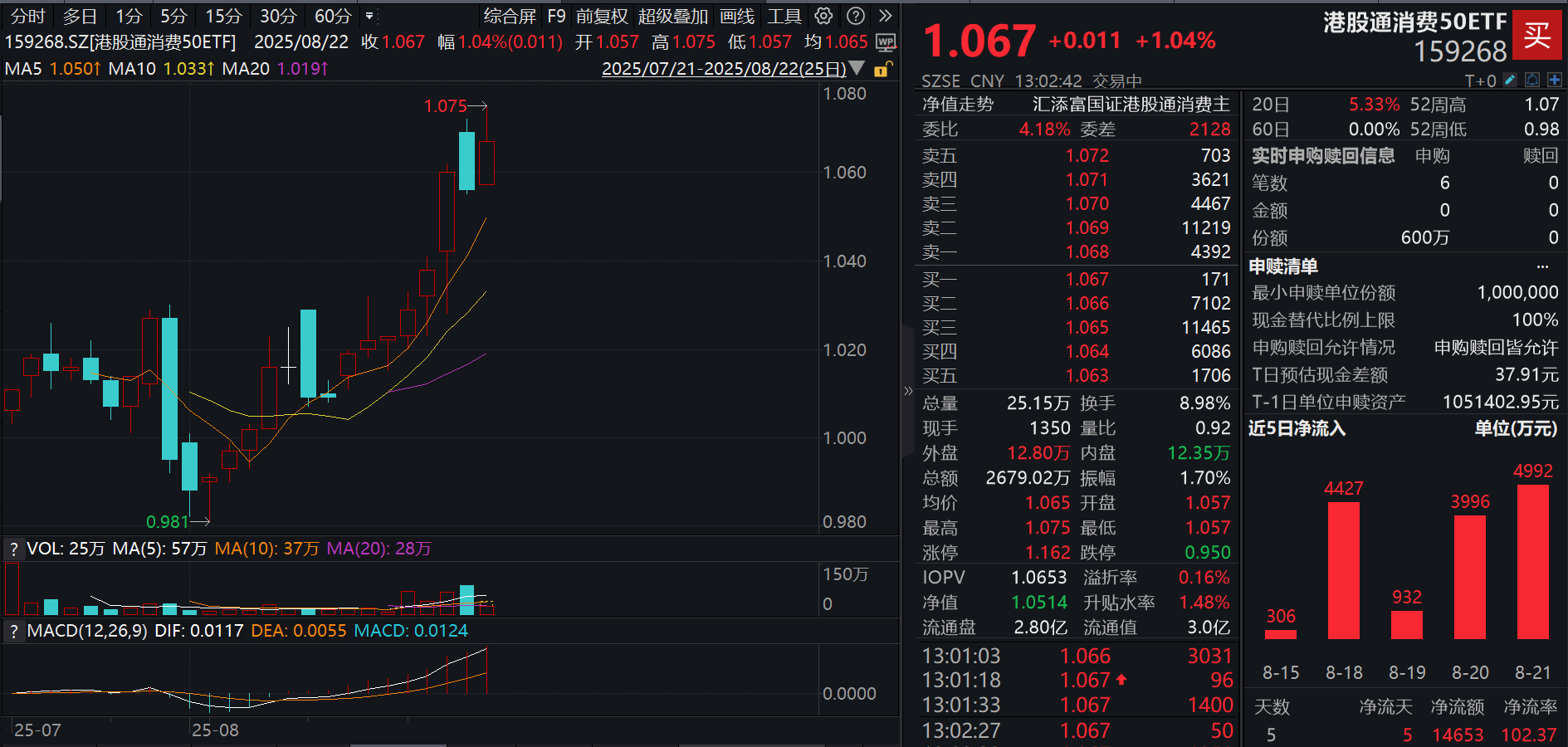
麦肯锡盘点中国消费市场的五大惊喜!港股通消费50ETF(159268)涨超1%!消费ETF(159928)昨日大举“吸金”超3.6亿元!
Xin Lang Cai Jing· 2025-08-22 05:30
Group 1: Market Performance - The Hong Kong A-shares and the Hong Kong Stock Connect Consumption 50 ETF (159268) both saw gains, with the ETF rising over 1% and attracting a net inflow of 6.4 million yuan for six consecutive days, totaling over 150 million yuan [1] - Notable stocks included Miniso, which surged over 18% post-earnings, Li Ning up over 7%, Anta Sports up over 3%, and Pop Mart up over 2% [1] Group 2: Company Earnings - Miniso reported a second-quarter revenue of 4.966 billion yuan, a year-on-year increase of 23.1%, with adjusted operating profit rising 8.5% to 852 million yuan and an adjusted operating profit margin of 17.2%, exceeding company guidance [2] Group 3: Consumer Trends - McKinsey highlighted five surprising trends in the Chinese consumer market for the first half of 2025, indicating a shift in consumer sentiment despite weak confidence and ongoing pressures in the real estate market [5] - The report noted a steady recovery in core retail categories, with air travel surpassing 2019 levels and China's automotive exports becoming the largest globally, with an expected export volume of nearly 5.5 million vehicles in 2024, eight times that of 2019 [6] Group 4: Tourism and Capital Markets - The number of inbound tourists to China reached a record high, with over 35 million visitors in the first quarter of 2025, a year-on-year increase of 19.6% [9] - The capital market's recovery in 2025 has been significant for consumer enterprises, with four of the top ten IPOs in Hong Kong coming from the consumption sector, indicating strong investor confidence in the long-term prospects of the Chinese consumer market [12] Group 5: Cultural and Product Trends - Pop Mart's Labubu character gained international popularity, with revenue from its monster series increasing by 726% in 2024, contributing significantly to the company's overall revenue [15]
外媒想不通,中国人半年存了17.94万亿,消费还能高达24.5万亿?
Sou Hu Cai Jing· 2025-07-23 18:58
Group 1 - The core viewpoint is that despite a significant increase in savings, China's consumption remains robust, with total consumption reaching 24.5 trillion yuan and online consumption growing by 8.5% in the first half of the year [2][3] - The increase in household savings does not indicate a decline in consumer willingness; rather, savings are viewed as emergency funds, and the diverse consumption structure supports ongoing growth [2][5] - Policy initiatives, such as consumption stimulus measures and trade-in programs, have injected over 300 billion yuan into the market, further boosting consumption [3][5] Group 2 - China's internal demand market is substantial, positioning the country as one of the largest consumer markets globally, with both traditional and emerging sectors contributing to growth [5][11] - The luxury goods market in China is thriving, with brands like Burberry and COACH offering discounts to attract younger consumers, particularly those born in the 1990s and 2000s [7][9] - The contrast between China's vibrant consumption market and the sluggish growth in many foreign markets highlights the unique characteristics of Chinese consumer behavior, where savings and consumption complement rather than compete with each other [9][11]