
债市企稳

Search documents
十年国债ETF(511260)盘中飘红,近10日净流入超6.1亿元,债市企稳支撑力量显现
Sou Hu Cai Jing· 2025-12-16 02:39
Group 1 - The bond market sentiment remains weak, but signs of stabilization are beginning to emerge due to easing supply pressures and potential adjustments in the supply curve [1] - On the demand side, banks are expected to experience a temporary easing of pressure, with new capital injections anticipated at the beginning of the year, potentially shifting from a reduction to an increase in holdings [1] - The decline in positions held by trading institutions indicates a diminishing selling force, which may lead to a market stabilization as these institutions may increase their positions after the market stabilizes [1] Group 2 - The 10-Year Government Bond ETF (511260) has consistently achieved new net value highs since its inception, with a one-year return of 4.17%, a three-year return of 14.04%, a five-year return of 23.39%, and a cumulative return of 35.77% since establishment [1] - The ETF has maintained positive annual returns for seven complete calendar years from 2018 to 2024, positioning it as a potential asset allocation tool that can navigate through market cycles [1]
朝闻国盛:11月消费、投资大降的背后
GOLDEN SUN SECURITIES· 2025-12-15 23:59
Core Insights - The overall economic performance in November shows a significant decline in consumption and investment, with consumption down for six consecutive months and retail sales growth at 1.3%, the lowest in nearly three years [2] - Fixed asset investment has been negative for three consecutive months, with a year-on-year decline of 12% in both October and November, and real estate investment showing a record drop of 30.3% in November [2] - The weak economic indicators suggest insufficient internal demand, with low inflation and a PMI below the threshold for eight months, indicating a lack of economic momentum [2] Consumption and Investment - Consumption has decreased for six months, with retail sales growth at 1.3%, marking the lowest level in almost three years [2] - Fixed asset investment has shown a negative cumulative year-on-year growth for three months, with November's investment down 12% compared to the previous year [2] - Real estate investment has been particularly weak, with a year-on-year decline of 30.3% in November, the largest drop recorded [2] Economic Outlook - The focus is on ensuring a good start for the 14th Five-Year Plan in 2026, with potential policy measures including "trade-in" programs and early fiscal allocations to stimulate consumption [2] - Anticipated policy actions may include interest rate cuts and adjustments to fiscal strategies to support economic recovery in the first quarter of 2026 [2] Market Performance - The report highlights the performance of various industries, with telecommunications and defense industries showing strong growth, while real estate and coal industries are experiencing significant declines [2] - The report indicates that the bond market is under pressure but may stabilize with upcoming policy changes and adjustments in government debt issuance [3]
哪些力量能够帮助债市企稳?
GOLDEN SUN SECURITIES· 2025-12-14 12:23
1. Report Industry Investment Rating No information provided regarding the industry investment rating. 2. Core View of the Report As the bond market adjusts, multiple factors are gradually brewing and strengthening to support its stabilization. The supply pressure of government bonds is easing, and there is a possibility of shortening the issuance duration. On the demand side, the pressure on bank indicators may ease around the end of the year, the rising long - term bond yields will increase the allocation value of long - term bonds and boost the allocation demand of institutions such as insurance companies. Meanwhile, the reduction of trading institutions' positions will weaken the short - selling force. It is expected that the bond market will gradually stabilize in the subsequent period, start a trending market in the second half of the first quarter, and the 10 - year Treasury bond is still expected to hit a new low in the first quarter of next year [3][23]. 3. Summary by Related Content Bond Market Performance This Week - The bond market strengthened slightly overall this week but was volatile. After the Central Economic Work Conference mentioned reserve requirement ratio cuts and interest rate cuts on Thursday, interest rates declined significantly, but on Friday, there was an obvious adjustment and most of the previous gains were given back. The 10 - year and 30 - year Treasury bonds both declined by 0.8bps to 1.84% and 2.25% respectively. The 3 - year and 5 - year AAA - perpetual bonds declined by 3.9bps and 0.4bps to 2.02% and 2.24% respectively. The 1 - year AAA certificate of deposit rose slightly by 0.5bps to 1.66% [1][7]. Supply - Side Factors for Bond Market Stabilization - The supply pressure of government bonds will ease in the future. As of December 12, the net financing of general Treasury bonds was 5.04 trillion yuan, the net financing of special Treasury bonds was 1.8 trillion yuan, the issuance of new special bonds was 4.6 trillion yuan, and the issuance of new general bonds was 770 billion yuan. Even considering the subsequent use of the 500 billion yuan local bond balance limit, the annual government bond issuance task is basically completed. Next week, government bonds will have a net repayment of 119.1 billion yuan, the first time since April this year that the net repayment exceeded 100 billion yuan, and the supply pressure before the end of the year may remain limited. Although there will still be significant supply pressure for government bonds next year, the supply pressure at the long - end may be limited at the beginning of the year [1][8]. - There is a possibility of adjusting the supply - side duration. As the interest rate of ultra - long - term bonds rises, the issuance cost of ultra - long - term bonds has increased significantly, which may lead to changes in the maturity selection of local government bonds. The spread between 30 - year and 10 - year Treasury bonds has climbed above 40bps, significantly higher than the low of about 16bps in the first quarter of this year. The average issuance term of local government bonds has decreased from 16.4 years in January this year to 14.8 years in October, which will alleviate the supply pressure of ultra - long - term bonds and support the market to stabilize [1][11]. Demand - Side Factors for Bond Market Stabilization - The phased alleviation of bank indicator pressure can help the market gradually stabilize. The recent bond market adjustment is mainly reflected in the decline of ultra - long - term bonds, mainly because banks have been continuously reducing their holdings of ultra - long - term bonds in the secondary market due to the pressure of the △EVE to Tier - 1 capital ratio. As the end of the year approaches, the pressure on bank indicators will gradually ease, and the motivation to significantly reduce long - term bond holdings will decline. At the beginning of the year, banks may obtain new capital supplements, and the pressure of indicator constraints may further improve, which will further reduce the selling demand and may even turn to buying [1][17]. - As interest rates rise, allocation - oriented institutions such as insurance companies may gradually increase their allocations. The slowdown in the insurance allocation rhythm in the fourth quarter is due to the slowdown in premium income growth, an increase in the equity ratio in asset allocation, and concerns about interest rate trends. However, as long - term bond interest rates continue to adjust, their cost - effectiveness has significantly increased. The insurance "good start" will bring new premium income, forming new allocation demand [2][17]. - The reduction of trading institutions' positions means the weakening of subsequent short - selling forces. Trading institutions such as securities firms and funds usually follow market trends, accelerating market adjustments during the recent market decline. However, as their positions decrease, the selling force will decline, alleviating market adjustment pressure. Once the market stabilizes, their position - adding may help the market stabilize [2][18]. - From the perspective of market position, the adjustment of long - term bonds will enhance their attractiveness in terms of absolute return and curve shape. The spread between mortgage loans and 30 - year Treasury bonds is at the lowest level since mid - 2017, and the spread with 30 - year local bonds is at the lowest level since relevant data became available, which will increase the allocation demand of institutions. The increase in the curve slope will enhance the cost - effectiveness of the barbell strategy, increasing the allocation of long - term bonds [3][18].
机构认为债市企稳条件逐渐显现,平安公司债ETF净值稳定贴士少
Sou Hu Cai Jing· 2025-08-26 01:57
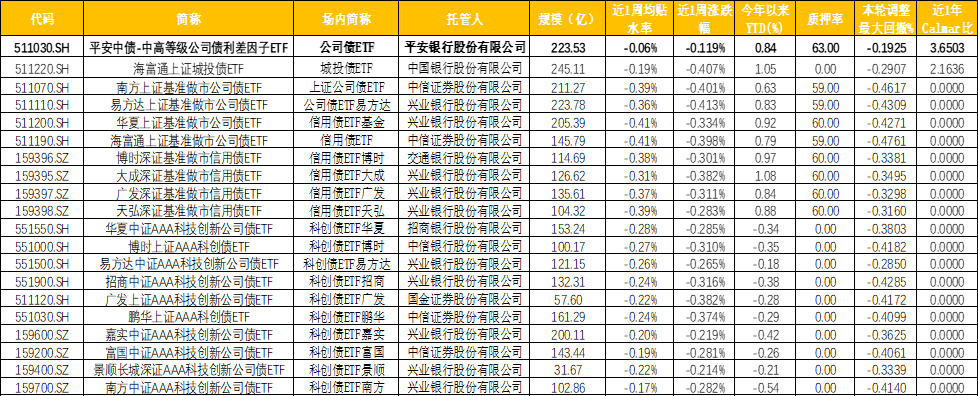
Core Viewpoint - The bond market is showing signs of stabilization, characterized by three key features: the narrowing of the 30Y-10Y yield spread, changes in trading volume of long-term local bonds, and the degree of retraction of excessive expectations by the end of 2024 [1] Group 1: Yield Spread - Since late August, the 30Y-10Y yield spread has widened to a high level for 2024, indicating a release of selling pressure on long-term bonds, with the 30-year treasury yield dropping significantly by 4 basis points [1] - The previous premium of 2.15 basis points over the 10-year bond has diminished, suggesting that the investment value of long-term bonds is becoming more apparent [1] Group 2: Trading Volume - Despite a mediocre issuance result for long-term bonds last Friday, the net buying of local bonds by insurance companies has increased, indicating a rising attractiveness of bond assets [1] - This marginal return of capital to the bond market is expected to further support its stabilization [1] Group 3: Interest Rate Levels - The bond market has begun to show signs of recovery below the 1.80% interest rate level, with market expectations aligning around a potential upper limit for this round of adjustments between 1.80% and 1.85% [1] Group 4: ETF Performance - The Ping An Company Bond ETF (511030) has demonstrated the best performance in controlling drawdowns during the current bond market adjustment, with minimal trading discounts and relatively stable net value [1]

固定收益点评:利率调整到位了吗?
Guohai Securities· 2025-08-18 12:32
Industry Investment Rating - No information provided Core Viewpoints - Since July, the long - end bond yields have risen and the yield curve has steepened. The adjustment of long - end rates is mainly due to the correction of deflation expectations, the rise of the stock market, and the improvement of market risk appetite. It is expected that when the 10 - year Treasury bond adjusts to around 1.80%, the bond market odds will be prominent, institutional trading willingness will increase, and the bond market may stabilize [8][17][29] Summary by Directory 1. Reasons for Recent Interest Rate Increases - The short - end interest rates have not changed significantly due to the continuous low - level of capital interest rates and the loose capital situation. Since April, the capital interest rate DR007 has continued to decline, and the inter - bank certificate of deposit rate has also shown a downward trend. Since August, the 1 - year inter - bank certificate of deposit rate has been running in the low - level range of 1.60 - 1.65% [11] - The "anti - involution" policy has led to an increase in inflation expectations and raised the long - end interest rate center. After the relevant policies were introduced in July, industries such as automobiles, photovoltaics, etc. started "anti - involution" actions, which increased inflation expectations [14] - The continuous rise of the stock market has suppressed the bond market. Since July, the stock market has accelerated its rise, the market risk preference has increased, and the long - end bond market has been suppressed [16] 2. Assessment of Interest Rate Adjustment - From the perspective of stock - bond correlation, the negative correlation between the Shanghai Composite Index and the 10Y Treasury bond yield is still strong. Since April this year, the negative correlation has been strong, and it is expected to remain so in the future, with the rise of equities continuing to suppress the bond market [19] - From the perspective of credit comparison, after the recent adjustment, as of August 15, the 10Y and 30Y Treasury bond yields have returned to a reasonable range compared with credit. The 10Y Treasury bond yield is 1.75%, slightly higher than the actual income of the first - home mortgage, and the 30Y Treasury bond yield is 2.05%, higher than the actual income of the second - home mortgage [20] - From the perspective of term spreads, the long - end interest rates still have room to rise. In previous similar adjustment periods, the term spreads increased by 25BP and 27BP respectively. In this round, from April 29 to August 15, the 10Y - 1Y term spread has increased by 21BP, and there is still 5BP of upward space [24]
债市有望延续企稳态势 指数债基成突破低利率的关键抓手
Mei Ri Jing Ji Xin Wen· 2025-08-12 06:57
Group 1 - The bond market has experienced increased volatility since July, but several institutions remain optimistic about its future direction, with Huaxi Securities suggesting that August may see a peak in the bond market due to weak demand, cooling commodity prices, and seasonal pressures [1] - Dongfang Securities maintains that the logic of a bond bull market remains unchanged, although the market is becoming sensitive to negative factors, indicating that the overall environment is still favorable despite potential disturbances [1] - According to CITIC Securities, the public bond fund market is expected to see a dual recovery in stocks and bonds by the second quarter of 2025, with the total bond fund scale projected to exceed 11 trillion yuan for the year [1] Group 2 - In the index bond fund sector, bond ETFs, particularly the benchmark credit bond ETF and the Sci-Tech bond ETF, have shown significant growth this year, with a combined scale reaching 240 billion yuan as of August 11 [2] - The Guangfa credit bond ETF has seen its scale grow over six times since its inception, reaching 13.904 billion yuan, and has experienced continuous net subscriptions for 29 days following its approval as collateral for general pledged repo [2] - Despite the bond market's volatility in July, the overall trend remains bullish, with medium and short-term credit bonds showing potential for yield spread opportunities, and the expectation that ETF discounts will narrow as market sentiment improves [2]
利率周记(7月第4周):债市再次回调,怎么看?
Huaan Securities· 2025-07-29 13:24
Group 1: Report Summary - The report focuses on the bond market correction in the 4th week of July 2025 and analyzes its causes and future trends [1][2] Group 2: Investment Rating - No investment rating for the industry is provided in the report Group 3: Core Viewpoints - The bond market correction on July 29 was mainly due to institutional behavior, and future attention should be paid to the decline in borrowing volume and the stabilization of bond fund redemptions [2][7] - The long - term bullish logic of the bond market has not changed, and it is still too early to talk about a bond market reversal [7] Group 4: Characteristics of the Bond Market Correction - Intra - day fluctuations were small, and interest rates continued to rise, different from the rapid decline in the late trading in 2024 [3] - The correction was not directly caused by factors such as the stock - bond seesaw, and it was difficult to explain from the macro - capital flow [3] - The adjustment of 10Y China Development Bank bonds and 30Y treasury bonds was the most obvious, with an upward amplitude of about 4bp [3] Group 5: Reasons from the Institutional Behavior Perspective - On July 29, both securities firms and funds were net sellers throughout the day, which was different from the past [4] - Medium - and long - term bond funds faced redemption pressure, and funds continued to flow out slightly [4] - Securities firms were borrowing and selling bonds, mainly borrowing 10Y China Development Bank bonds and 30Y treasury bonds for short - selling on the cash bond side, similar to the situation in the first quarter of this year [4] Group 6: Macro - background Factors - With increasing macro - disturbance factors such as the childcare subsidy policy and waiting for the Politburo meeting and Sino - US negotiations, securities firms may increase borrowing and selling [6] Group 7: Future Market Outlook - The bond market correction was a resonance of trading desks actively increasing borrowing and selling and continuous bond fund redemptions [7] - High - frequency attention should be paid to whether securities firms further increase short - selling through borrowing and whether the bond fund redemption pressure ends completely [7] Group 8: Impact of Insurance Institutions - The reduction of the预定 interest rate by insurance institutions may have a "short - term positive and long - term negative" impact on the bond market [6] - In the short term, increased premium income may lead to more purchases of ultra - long bonds during corrections, but in the long term, the preference for 30Y treasury bonds has declined, and local government bonds are the main allocation bonds [6] Group 9: Potential Scale of Securities Firms' Borrowing and Selling - If securities firms continue to increase borrowing and selling, the net selling scale may reach up to 35 billion yuan under a pessimistic assumption [6]
债市投资者预期调查:债市调整后,市场怎么看?
ZHONGTAI SECURITIES· 2025-07-25 06:48
Report Summary 1. Report Industry Investment Rating No industry investment rating is provided in the report. 2. Core Viewpoints - The bond market has recently undergone significant adjustments, and the adjustment may not be over yet. The market generally expects the yield of the 10 - year active bond to operate between 1.7% - 1.8% in the next month, with the yield top at 1.8% and the bottom at 1.6% in the second half of the year. The report maintains the mid - term strategy of 1.6% - 1.9% for the 10 - year treasury bond [3][8]. - The market generally expects the yield curve to steepen, with a higher probability of a bear steepening. Making the curve steeper remains a relatively high - probability strategy [11]. - The expected returns of bond funds have been significantly downgraded, and bonds are currently the least favored major asset class. The market expects the yield of medium - and long - term bond funds to be below 2% for over 80% of the time, and below 1.5% for 40% of the time this year [3][15]. - The bond market may experience some oversold rebounds, but the upside is limited due to insufficient internal positive factors. It is recommended to be cautious with duration, lower annual return expectations, maintain a low - volatility portfolio, and seize short - term trading opportunities [3][17]. 3. Summary by Related Catalogs Reasons for the Bond Market Adjustment - The rise of commodities and equities is considered the main reason. The stock and commodity markets have strengthened this week, with the duration and amplitude exceeding market expectations, which has weakened the sentiment in the bond market. The low interest rate level is a secondary reason, as the low cost - effectiveness of bond assets and limited downward space for interest rates lead to significant adjustments when there are negative factors [3][5]. Bond Market Stabilization - Most views believe that the bond market has not yet stabilized, but small - scale entry is possible. Some also think that sentiment has reversed and short - term stabilization is difficult, while few believe the adjustment has ended. The bond market has been affected by risk assets in the past few days, and yesterday's sharp decline was also due to the tightening of funds in July and the lower - than - expected MLF roll - over at the end of the session [3][5]. Yield Point Estimation - 1.8% is generally considered the upper limit of this round of adjustment. Most think the 10 - year active bond will operate between 1.7% - 1.8% in the next month, with the yield top at 1.8% and the bottom at 1.6% in the second half of the year. The report believes that there may be some repair around 1.8%, and oversold rebound operations can be carried out in the range of 1.75% - 1.8%, but the interest rate adjustment may not be over in the whole - year dimension [3][8]. Yield Curve Expectation - The market generally expects the yield curve to steepen, with a higher probability of a bear steepening. Since July, funds have been relatively loose, so the short - end adjustment has been significantly smaller than the long - end. The market generally expects funds to maintain the current level, while the long - end is more affected by other factors. Making the curve steeper remains a relatively high - probability strategy [11]. Risks and Opportunities in the Bond Market - The mainstream expectations for bond market opportunities are central bank bond purchases, A - share and commodity market corrections, while the attention to real estate and tariffs has weakened. Risk factors are more diverse, including A - share rises, institutional redemption pressure, central bank tightening of liquidity, and inflation increases. Although the decline in this round is less than that in the first quarter, the redemption of bond funds is stronger, and the secondary impact of redemptions needs to be vigilant [3][13]. Bond Fund Return Expectation - The expected returns of bond funds have been significantly downgraded, and bonds are currently the least favored major asset class. As of July 22, the year - to - date returns of the money market fund index and the long - term pure bond fund index are 0.77% and 0.70% respectively. Over 80% of the market expects the yield of medium - and long - term bond funds to be below 2% this year, and 40% expect it to be below 1.5%, indicating that the market expects the second - half returns to be difficult to exceed the first - half returns [3][15].