市场降温

Search documents
【老丁投资笔记】2026年2月展望:二月仍是政策调控期,也会是新一次的起点!
Sou Hu Cai Jing· 2026-01-30 13:11
Group 1 - The current market environment indicates a short-term turning point for precious metals, with a significant drop in prices due to ongoing policy cooling measures affecting the stock market [1] - The trend of policy regulation is expected to continue into February, with the aim of cooling the market, reflected in the decline of margin trading balances and index prices [1] - Despite the policy measures, the margin trading balance has not shown a significant decrease, suggesting that there will still be selling pressure in the market even in February [1] Group 2 - For the index to reach new highs, a reduction in trading volume is necessary, indicating that the market is still in a state of continuation rather than cooling [3] - There will be significant differentiation among sectors during the index suppression process, but they will ultimately remain aligned with the main trends [3] - High valuations across the market are causing hesitation among investors, and the passage of time may allow earnings to catch up with some valuations, which is a key piece of information for the market moving forward [3]

中泰证券:市场“降温”导向或延续 短期看好拥挤度相对低位板块
智通财经网· 2026-01-27 00:07
Group 1 - The current market sentiment is overheated, showing strong speculative inertia, leading to significant fund outflows from "Hui Jin" ETFs after the cooling guidance was implemented [1][2] - From January 15 to January 23, approximately 12 "Hui Jin" heavy ETFs experienced a total fund outflow of 559.09 billion yuan, averaging nearly 80 billion yuan per trading day [2][3] - The outflow was primarily from the CSI 300 index (59% of total outflow) and the CSI 1000 index (16%), while the ChiNext and STAR Market indices saw relatively less outflow [2][3] Group 2 - As of the end of 2025, "Hui Jin" held approximately 1.47 trillion yuan in 13 ETFs, with a significant portion (over 70%) of these ETFs being heavily held [3] - The share of these ETFs declined by approximately 13% to 54% during the specified period, with the CSI 1000 ETFs experiencing the most significant drop of over 40% [3] - Despite the unprecedented outflow, "Hui Jin" still retains a substantial remaining position of about 950 billion yuan, indicating no immediate risk of forced liquidation [3] Group 3 - The market structure shows that while large-cap stocks are under pressure, small-cap stocks are attracting more funds, indicating a shift in risk appetite towards smaller market cap segments [4] - Value stocks have been adversely affected, particularly in the CSI 50 index, which faced dual redemption pressures from both the CSI 300 and CSI 50 ETFs [4] - The overall market has not shifted towards low-volatility or defensive assets, with growth styles still prevailing despite the outflows [4]

万亿矿业龙头280亿收购大金矿,尾盘现40亿巨额压单
2 1 Shi Ji Jing Ji Bao Dao· 2026-01-26 15:11
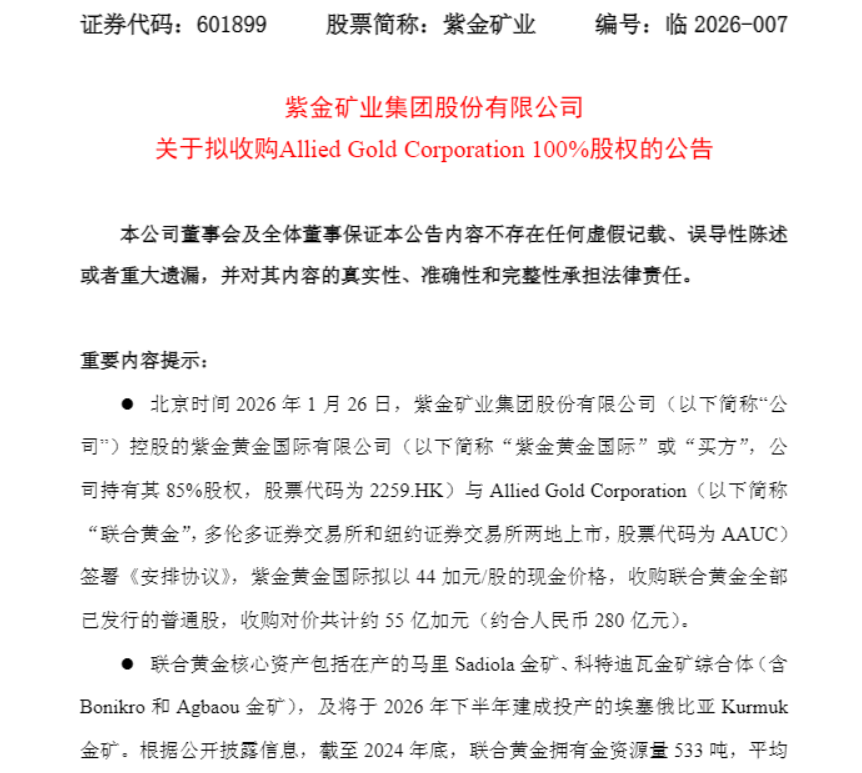
Group 1 - Zijin Mining announced a plan to acquire Allied Gold Corporation at a price of CAD 44 per share, totaling approximately CAD 5.5 billion (around RMB 28 billion) [1] - Allied Gold Corporation, headquartered in Canada, has core assets including the Sadiola gold mine in Mali and the Côte d'Ivoire gold complex, with a projected gold production increase to 25 tons by 2029 [3] - The acquisition price represents a premium of approximately 5.39% over the closing price on January 23, 2026, and an 18.95% premium over the weighted average price of the previous 20 trading days [3] Group 2 - On the announcement day, Zijin Mining's stock price reached a historical high, with the total market capitalization exceeding RMB 1 trillion [4] - The market is experiencing a cooling effect, with significant sell orders observed in multiple heavyweight stocks, including Zijin Mining, indicating a shift from a bullish to a more volatile market environment [6]

宽基ETF资金大幅流出:规模,节奏与影响
ZHONGTAI SECURITIES· 2026-01-26 02:50
Group 1: Market Overview - A-share market showed signs of overheating, with a cumulative increase of over 10% in just 17 trading days from December 17, 2025, to January 12, 2026[8] - From January 15 to January 23, 2026, approximately 12 ETFs heavily held by the Central Huijin experienced significant outflows totaling 5590.87 billion yuan, averaging nearly 800 billion yuan per trading day[11] - The outflow was primarily from the CSI 300 (59%) and CSI 1000 indices (16%), while the STAR 50 and ChiNext saw relatively smaller outflows[13] Group 2: ETF Holdings and Impact - Central Huijin's total holdings in 23 major ETFs were approximately 1.28 trillion yuan as of mid-2025, with 12 ETFs having over 70% held by Huijin[21] - The outflow from the 13 ETFs during the specified period resulted in a share decline of approximately 13% to 54%, with the CSI 1000 ETFs experiencing the most significant drop of over 40%[21] - In extreme scenarios, the outflow could represent about 34.59% of Huijin's original holdings, leaving a remaining position of approximately 950 billion yuan[22] Group 3: Market Sentiment and Structure - Despite the outflows, market sentiment remained relatively warm, with no significant risk aversion observed, as trading activity and thematic trading remained active[25] - The market structure showed a shift towards smaller-cap stocks, with micro and small-cap indices performing strongly during the ETF redemption period[29] - Value stocks faced significant pressure, particularly in the CSI 50 index, which was impacted by simultaneous redemptions from both the CSI 300 and CSI 50 ETFs[35]
专家:政策呵护牛市,适度“降温”举措确有必要
Di Yi Cai Jing· 2026-01-25 06:48
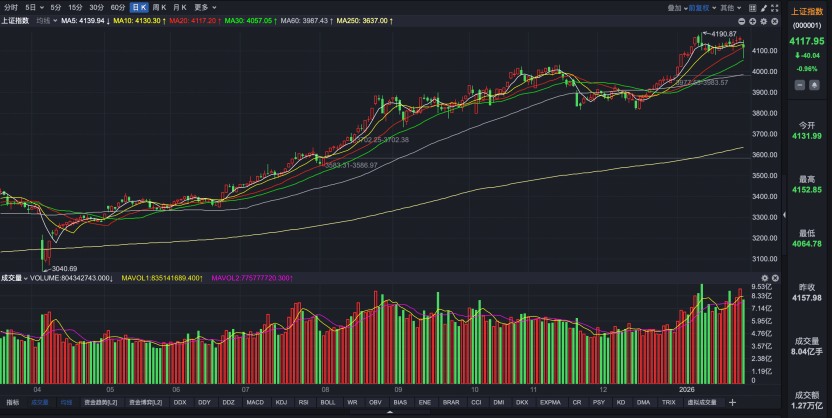
Market Overview - The A-share market has continued its upward trend since the beginning of 2026, with the Shanghai Composite Index breaking through significant psychological levels [2][3] - As of January 22, 2026, the Shanghai Composite Index closed at 4136.16 points, reflecting a 0.33% increase, with a total trading volume of 3.12 trillion yuan [3] Policy Support - The current market rally is characterized by a cautious approach from policymakers, aiming to prevent both overheating and sharp declines in the market [2][6] - The effectiveness of policies has been highlighted, with a focus on maintaining a stable market environment through careful regulatory measures [5][6] Economic Impact - There is a belief that the stock market can stimulate economic growth, although the extent of this impact may be limited [9][10] - The economic growth forecast for 2026 suggests a "front low, back high" pattern, with improvements expected in the latter half of the year due to lower base effects and increased policy support [11] Monetary Policy - Recent monetary policies have been described as accommodative, but not as extensive as those implemented during previous market rallies [7][12] - The focus for 2026 is expected to be on fiscal policy, with structural monetary policies serving as supplementary measures [13]

野村陆挺:政策呵护牛市,适度“降温”举措确有必要
第一财经· 2026-01-25 06:18
Core Viewpoint - The current A-share market is experiencing a "slow bull" trend, which is different from the "crazy bull" of 2015, with policies aimed at nurturing the market while preventing overheating and significant downturns [3][4][7]. Market Performance - Since the beginning of 2026, the Shanghai Composite Index (SSE) has risen from 4000 to 4136.16 points, with a 0.33% increase as of January 22, and a total trading volume of 3.12 trillion yuan [5]. - The SSE has increased from approximately 2700 points in the "924" market rally, reaching 3500 points in July and 3800 points by the end of last year [5]. Policy Effectiveness - The current market policies are described as moderately loose, with effective measures taken by financial regulatory bodies to stabilize the market while being cautious [6][8]. - Since July and August of the previous year, policies have been more conservative to prevent a repeat of the 2015 bubble [7]. Financing and Market Cooling - There has been a moderate recovery in IPOs, but the number of new stock issuances has not surged significantly [9]. - It is deemed necessary to cool down the market to prevent overheating and to ensure alignment between the stock market and economic fundamentals [9]. Economic Growth Predictions - The stock market is expected to have a limited but positive impact on economic growth, with a consensus that the economy will not perform poorly in the second half of the year [11]. - Economic growth in 2026 is predicted to follow a "front low, back high" pattern due to base effects, with potential improvements in the third and fourth quarters if policies continue to support the economy [12][13]. Policy Focus - The core of this year's policy is expected to be on fiscal measures, with structural monetary policies serving as supplementary tools [14].

野村陆挺:政策呵护牛市 适度“降温”举措确有必要
Di Yi Cai Jing· 2026-01-25 04:28
Core Viewpoint - The current A-share market is experiencing a "slow bull" trend, which is different from the "crazy bull" of 2015, with policies aimed at nurturing the market while preventing overheating and significant downturns [1][4]. Market Performance - Since the beginning of 2026, the Shanghai Composite Index (SHCI) has risen from around 2700 points to 4136.16 points, marking a 0.33% increase as of January 22, with a total trading volume of 3.12 trillion yuan [2][3]. - The market has shown signs of cooling, with major exchanges raising margin requirements and a decrease in trading volume, indicating a need to prevent overheating [1][6]. Policy Measures - The effectiveness of policies in this slow bull market is evident, with a cautious approach taken since mid-2022 to avoid a repeat of the 2015 bubble [4][5]. - Recent monetary policies have been described as accommodative but less aggressive compared to previous significant adjustments, indicating a more measured approach to market support [5][6]. Economic Outlook - The stock market is expected to have a limited but positive impact on economic growth, with a consensus that the economy will improve in the latter half of the year due to a favorable stock market [7][9]. - Economic growth is predicted to follow a "front low, back high" pattern in 2026, influenced by base effects and potential policy support in the second half of the year [8][9].
廖市无双-市场降温ing-攻守之间如何选择
2026-01-19 02:29
Summary of Conference Call Notes Industry Overview - The conference call discusses the current state of the stock market, particularly focusing on the performance of small and mid-cap growth indices compared to larger indices. The market has shown signs of cooling after a strong upward trend since April 2025, with a notable shift in investor sentiment and trading volume [1][2][3]. Key Points and Arguments 1. **Market Performance and Trends** - The market has experienced a strong upward trend since April 2025, identified as the main wave of a bull market. However, recent signs indicate a cooling off, with trading volumes decreasing and market sentiment softening [1][2][5]. - The Shanghai Composite Index is expected to hover around the 5-week moving average or the 20-day line, with potential for a larger adjustment if it breaks below these levels, although it is not anticipated to drop below 3,800 points [3][10]. 2. **Investment Strategy and Recommendations** - Investors are advised against making counter-trend moves, as the upward trend remains intact. The focus should be on small and mid-cap growth stocks, which are expected to outperform larger indices due to increased retail investor participation [6][14]. - In the current market environment, maintaining a balanced portfolio with a focus on sectors with high institutional preference, such as electronics, communication, and machinery, is recommended [15][21]. 3. **Sector Performance** - The technology sector, particularly computer and electronics industries, has shown strong performance, with significant gains in TMT-related sectors. Other sectors like machinery, power equipment, and automotive also performed well [8][21]. - Conversely, sectors such as real estate, steel, and consumer goods have underperformed, indicating a shift in market dynamics [9]. 4. **Market Sentiment and Future Outlook** - Despite the recent cooling, the overall market sentiment remains relatively strong, with expectations of continued interest in small-cap growth stocks. The market is likely to remain in a narrow trading range, with a target index level between 4,500 and 4,700 points [17][20]. - The potential for a significant market adjustment exists if investor sentiment shifts dramatically, but this is not expected to lead to a complete market downturn [10][11]. 5. **Investment Opportunities** - The conference highlights the importance of identifying sectors with favorable conditions for investment, such as electronics and chemicals, which are expected to maintain their attractiveness [21][22]. - Utilizing an industry scoring system can help investors identify high-value sectors and optimize their investment strategies [22]. Additional Important Content - The call emphasizes the importance of monitoring trading volumes and market sentiment as indicators of future market movements. A decrease in trading volume may signal a consolidation phase, while a resurgence in volume could indicate renewed interest in the market [5][12]. - The discussion also touches on the potential for Hong Kong stocks as a viable investment opportunity due to their lower liquidity but possible attractive entry points [19]. This summary encapsulates the key insights and recommendations from the conference call, providing a comprehensive overview of the current market landscape and future expectations.
光大证券:1月中旬后春节前市场或降温,关注多行业
Sou Hu Cai Jing· 2026-01-11 07:24
Group 1 - The core viewpoint of the report is that short-term market enthusiasm is expected to continue, but there may be a cooling period after mid-January leading up to the Spring Festival [1] - The report highlights that policy support will continue, maintaining growth within a reasonable range and solidifying the foundation for prosperous development [1] - It notes that the release of policy dividends will boost market confidence and attract various types of capital inflow [1] Group 2 - The report advises attention to potential market cooling from mid-January to the Spring Festival after a sustained market rise [1] - Industries to focus on include electronics, electrical equipment, and non-ferrous metals [1]

如若是场长久的“慢牛”,何妨一时降降温
天天基金网· 2025-09-05 11:11
Core Viewpoint - The article emphasizes the importance of a "slow bull" market for sustainable growth in the A-share market, suggesting that a cooling-off period is essential for the longevity of the market trend [2][8][19]. Market Cooling's Positive Significance - Valuation returns to a reasonable range, releasing risks from previously overheated sectors and revealing investment value [4]. - The optimization of the chip structure allows for the exit of short-term speculative chips, providing more opportunities for long-term investment funds [4]. - A healthier investment ecosystem is created as market volatility decreases, making it more attractive for medium to long-term capital to enter the market [4]. Historical Context and Investor Sentiment - From May to mid-August, the Shanghai Composite Index showed monthly increases of 2.09%, 2.90%, 3.74%, and 3.46%, indicating a slow but sustainable upward trend [5]. - A slow bull market is characterized by consistent upward movement in the index, reasonable valuation increases, and sustained investor confidence without excessive optimism [20]. - Historical examples illustrate that fast bull markets often lead to fleeting gains, while slow bull markets allow for real value creation and wealth distribution over time [11][18]. Structural Changes and Future Outlook - The current macro environment, market systems, and investor behaviors have undergone significant changes, suggesting a potential for a slow bull market [23]. - The unique safety of the A-share market and supportive policies since September 2024 have created a conducive environment for a slow bull market [24]. - A shift in wealth allocation is occurring, with a decrease in the proportion of housing assets in family wealth and a significant increase in public fund sizes, indicating a trend towards equity investments [26]. Investment Strategy - In a slow bull market, investors should focus on long-term trends rather than short-term fluctuations, with an emphasis on sectors like artificial intelligence [30]. - A dividend-based investment approach, supplemented by capital gains, remains a viable strategy in a slow bull market [31]. - Investors are encouraged to adopt a rational mindset, understanding the importance of time in realizing returns and managing risks effectively [36].