
广义流动性

Search documents
2月金融数据与开年广义流动性简评
GF SECURITIES· 2026-03-13 15:34
Group 1: Social Financing and Credit Growth - In February, social financing increased by 2.38 trillion yuan, exceeding the market expectation of 1.8 trillion yuan, with a year-on-year increase of 146.9 billion yuan[3] - The total social financing scale for the first two months of 2026 reached 9.6 trillion yuan, an increase of 316.2 billion yuan compared to the same period last year[3] - The growth rate of social financing stock remained stable at 8.2% compared to the previous month[3] Group 2: Loan Distribution and Trends - In February, loans to the real economy increased by 5.75 trillion yuan, a year-on-year decrease of 124.8 billion yuan, while foreign currency loans increased by 43.3 billion yuan, a year-on-year increase of 110.5 billion yuan[3] - Corporate loans increased by 5.94 trillion yuan in the first two months, with short-term loans rising by 2.65 trillion yuan and medium to long-term loans increasing by 4.07 trillion yuan[4] - The demand for loans from the corporate sector improved, with short-term loans increasing by 2.7 trillion yuan and long-term loans by 3.5 trillion yuan[4] Group 3: Government and Corporate Bonds - In February, government bonds increased by 1.4 trillion yuan, but this was a year-on-year decrease of 290.3 billion yuan due to a high base effect[6] - Corporate bonds saw a net financing increase of 655.4 billion yuan, a year-on-year increase of 39.8 billion yuan, with significant contributions from infrastructure and consumer sectors[6] - The issuance of new policy financial instruments and increased local government special bond quotas are expected to support corporate long-term loans and social financing expansion[6] Group 4: Monetary Supply and Deposits - M1 growth rate was 5.9%, up by 1.0 percentage points from the previous month, influenced by a low base and increased financing from the real sector[6] - M2 growth rate remained stable at 9.0% compared to the previous month[6] - In the first two months, total RMB deposits increased by 9.26 trillion yuan, with household deposits rising by 5.24 trillion yuan[6]
【广发宏观钟林楠】2月金融数据与开年广义流动性简评
郭磊宏观茶座· 2026-03-13 14:34
Core Viewpoint - The article discusses the increase in social financing (社融) in February, which amounted to 2.38 trillion yuan, exceeding market expectations and showing a year-on-year increase of 146.9 billion yuan. The growth rate of social financing stock remained stable at 8.2% [1][6]. Group 1: Social Financing and Credit - In February, social financing increased by 2.38 trillion yuan, higher than the market average expectation of 1.8 trillion yuan, with a year-on-year increase of 146.9 billion yuan [1][6]. - The stock of social financing grew at a rate of 8.2%, unchanged from the previous month. Notably, the increase in entity credit and non-discounted bank acceptance bills was significant, while government bonds saw a year-on-year decrease [1][6]. - Entity credit rose by 850 billion yuan in February, a year-on-year increase of 197.2 billion yuan, with a cumulative increase of 5.75 trillion yuan for January-February, comparable to the same period in 2023-2025 [7][10]. Group 2: Demand Structure and Financing Environment - The improvement in demand was primarily observed in the corporate sector, with short-term loans increasing by 270 billion yuan and long-term loans by 350 billion yuan. This was influenced by the central bank's requirement for "balanced credit allocation" [2][10]. - The financing environment for enterprises was supported by rising industrial prices, particularly in the non-ferrous and AI sectors, which improved profit expectations and led to increased inventory and capital expenditure [2][10]. - In contrast, household financing remained weak, with short-term loans decreasing by 195.2 billion yuan and long-term loans by 66.5 billion yuan, likely due to the timing of the Spring Festival affecting consumption patterns [2][11]. Group 3: Government Bonds and Corporate Bonds - Government bonds increased by 1.4 trillion yuan in February, but this was a year-on-year decrease of 290.3 billion yuan. The supply of government bonds this year is similar to that of 2025, shifting from a supportive to a neutral impact on social financing [3][11]. - Corporate bonds saw an increase of 152.1 billion yuan in February, although this was a year-on-year decrease of 18.1 billion yuan, primarily due to reduced financing in the real estate and construction sectors [3][12]. Group 4: Monetary Aggregates - The year-on-year growth rate of M1 was 5.9%, an increase of 1.0 percentage point from the previous month, influenced by a low base effect and increased financing from the real sector [4][13]. - M2's year-on-year growth rate remained stable at 9.0%. An analysis of January-February data showed a decrease in household deposits and loans, while non-bank deposits increased, indicating a trend towards deleveraging and a shift towards equity assets [4][13]. Group 5: Overall Financial Data Insights - Cumulatively, social financing increased by over 310 billion yuan year-on-year for January-February, with M1 and M2 growth rates improving, indicating overall liquidity remains relatively ample [5][14]. - The strong performance of equity assets in January-February was supported by significant exports and rising industrial prices, although geopolitical factors and rising oil prices in March may alter this dynamic [5][14].


2026年展望系列四:货币政策重心转移
China Post Securities· 2025-12-03 05:28
1. Report Industry Investment Rating No relevant content provided. 2. Core Viewpoints of the Report - The monetary policy operation will continue the loose tone, with the focus shifting to price control. The next - stage monetary policy is expected to maintain the general tone of moderate looseness, deepen price - control policy reform, and use structural tools around key areas [3]. - The interest rate transmission path of price - based tools is optimized, and there is still room for interest rate cuts. The "five - group interest rate comparison relationships" are gradually straightened out, and it is expected that the policy interest rate may be cut by 20BP in 2026, possibly in the first half of the year [4]. - For quantity - based tools, the high - volume roll - over of repurchase and MLF limits the space for reserve requirement ratio cuts. The necessity of reserve requirement ratio cuts is not high, and the focus in 2026 is on whether the current medium - and long - term liquidity injection model will continue [5]. - In the broad liquidity aspect, the de - leveraging cycle continues, and government bonds support the stabilization of the social financing growth rate. It is estimated that the social financing increment in 2026 will be slightly higher than that in 2025, about 34.5 trillion yuan [5]. - The narrow - sense liquidity will maintain a narrow - range fluctuation, and the expectation is to maintain a reasonable and sufficient level. The narrow - sense liquidity will continue the low - volatility and stable state, and the central bank is expected to ensure the stable operation of the capital market through flexible open - market operations [6]. 3. Summary According to the Directory 3.1 General Introduction: Monetary Policy Operation Continues the Loose Tone, with the Focus Shifting to Price Control - **Summary and Review**: In 2025, the monetary policy shifted from prudent to moderately loose. Quantity injection and price control jointly promoted reasonable and sufficient liquidity. The operation framework reform continued to deepen, and structural monetary policies effectively supported key areas [12][13][14]. - **Next - stage Monetary Policy Outlook**: In 2026, the liquidity is expected to remain reasonably sufficient, and the coordination between fiscal and monetary policies will continue to improve. The reform of the monetary policy framework will deepen, and structural tools will strengthen policy support in key areas [16][18][19]. 3.2 Price - based Tools: Interest Rate Transmission Path is Optimized, and Small - scale Interest Rate Cuts are Still Anticipated - **Five - group Interest Rate Relationships are Gradually Straightened Out, and the Possibility of a New Round of Interest Rate Cuts is Achieved**: The central bank proposed the "five - group interest rate comparison relationships" in the Q3 2025 monetary policy report. These relationships are in a relatively repaired state, providing a possibility for the central bank to further cut the policy interest rate in 2026 [21][31]. - **In 2026, Price Control will be Mainly Stable, and the Interest Rate Cut Space is Expected to be within 20BP**: Considering the economic situation, interest rate system, bank system's bearing capacity, and fiscal - monetary coordination, there is still about 20BP of space for policy interest rate cuts in 2026 [33][34]. 3.3 Quantity - based Tools: High - volume Roll - over of Repurchase and MLF, and the Space for Reserve Requirement Ratio Cuts May be Limited - **Medium - and Long - term Liquidity Injection is Well - coordinated, and MLF and Outright Repurchase are Expanded Synchronously**: In 2025, the liquidity injection of quantity - based tools formed an institutional arrangement. Outright repurchase and MLF were expanded synchronously, effectively hedging the impact of the concentrated maturity of structural monetary policies. Some structural policy tools are shrinking, and the central bank's bond - buying operation restarted cautiously [35][39][41]. - **System Optimization is a Necessary Prerequisite for Opening up the Space for Reserve Requirement Ratio Cuts**: Currently, the necessity of reserve requirement ratio cuts is significantly reduced. Unless the 5% constraint is broken, the trend is to淡化 reserve requirement ratio cuts and expand tools [43][44]. 3.4 Broad Liquidity: The De - leveraging Cycle Continues, and Government Bonds Support the Stabilization of the Social Financing Growth Rate - **Credit and Social Financing**: The de - leveraging cycle of residents and enterprises continues, and the credit growth rate faces continuous pressure. In 2025, the short - term loans and bill financing of enterprises increased significantly, and government and enterprise bond financing supported the social financing scale. It is estimated that the credit and social financing in 2026 will increase slightly [45][51][54]. - **Deposits**: Personal savings deposits maintain high - slope growth, non - bank deposits show high - volatility and high - growth characteristics, unit current deposits are weakly recovering, and unit time deposits are declining. The liability side of large banks is gradually stabilizing [56][58][59]. 3.5 Narrow - sense Liquidity: The Capital Market Fluctuates Narrowly, and the Expectation is to Maintain a Reasonable and Sufficient Level - In 2025, the capital market style changed significantly after the central bank's reserve requirement ratio cut and interest rate cut in May. The narrow - sense liquidity will continue the "low - volatility and stable state" in 2026, with the price center moving down and the volatility further converging. There may be potential liquidity frictions in the first quarter of 2026, but the central bank is expected to ensure the stable operation of the capital market [66][69][70].
流动性与同业存单跟踪:从核心超储偏低的视角理解资金面和分层利差
ZHESHANG SECURITIES· 2025-11-16 11:40
1. Report Industry Investment Rating No relevant information is provided in the content. 2. Core Viewpoints of the Report - In the situation of low core excess reserves, factors such as large - scale government bond net payments and frozen funds from new stock subscriptions on the Beijing Stock Exchange can lead to a tightening of the capital market and an increase in repurchase rates. However, the strong lending capacity of non - bank institutions like money market funds has kept the capital stratification spread low, which is favorable for inter - bank certificate of deposit (CD) pricing. But the investment in 1 - year CDs still requires consideration of cost - effectiveness [1][14][15]. 3. Summary According to the Table of Contents 3.1 From the Perspective of Low Core Excess Reserves to Understand the Capital Market and Stratification Spread - **Analysis of the Tightening Capital Market**: The official excess reserve ratio at the end of September 2025 was 1.40%, lower than that in September 2024 and the estimated value. The calculated core excess reserve ratio was 0.5%, lower than the previous forecast. Large - scale government bond net payments (nearly 500 billion yuan in the past week) and frozen funds from new stock subscriptions on the Beijing Stock Exchange (about 870 billion yuan) were the main reasons for the capital tightening in the past week. The impact of the full deposit of payment institution customer reserves during "Double Eleven" on the capital market was likely not the cause [2][12][13]. - **Analysis of the Compressed Capital Stratification Spread**: The continuous compression of the capital stratification spread indicates the strong lending capacity of non - bank institutions. Since 2024, regulatory measures have led to a shift of commercial bank deposits to non - bank institutions, increasing the lending power of non - bank institutions and decreasing that of commercial banks. This has compressed the spread between R007 and DR007. The compressed spread is beneficial for inter - bank CD pricing, but the investment in 1 - year CDs still needs to consider cost - effectiveness [4][14][15]. 3.2 Narrow - Sense Liquidity - **Central Bank Operations**: In November, the net investment of outright reverse repurchase was 50 billion yuan. In the past week, the net investment of pledged reverse repurchase was 626.2 billion yuan, with large net investments on Tuesday and Wednesday. As of November 14, the balance of reverse repurchases was 1122 billion yuan, at a relatively high level [16][17]. - **Institution Lending and Borrowing**: On November 14, the net lending amount of large - scale banks decreased compared to November 7, while the net lending balance of money market funds increased. The net lending of joint - stock banks was at a neutral level compared to previous years. The balance of bonds to be repurchased in the inter - bank market decreased, and the market leverage ratio declined [19][26]. - **Repurchase Market Transactions**: In the past week, the volume and price of the inter - bank pledged repurchase market were stable. The median daily trading volume decreased slightly, and the median R001 increased slightly. The liquidity friction was minimal [31]. - **Interest Rate Swaps**: The 1 - year interest rates of FR007 IRS and SHIBOR 3 - month IRS were basically flat compared to the previous week, and both were at relatively low levels in the historical range [38]. 3.3 Government Bonds - **Next - Week Net Payments**: In the past week, the net payment of government bonds was 472.5 billion yuan, and it is expected to be 362.9 billion yuan in the next week. The net payment pressure is relatively large, especially on Monday [39]. - **Current Issuance Progress**: As of November 14, the net financing progress of national debt was 91.5%, and the issuance progress of new local bonds was 93.3%. The issuance of refinancing special bonds has completed the annual task [40]. 3.4 Inter - bank Certificates of Deposit - **Absolute Yields**: On November 14, the SHIBOR quotes of various maturities and the yields of AAA - rated inter - bank CDs of various maturities showed different changes compared to November 7 [47][48]. - **Issuance and Stock**: In the past week, the total issuance of inter - bank CDs increased. In terms of issuance terms, the proportions of 6 - month and 9 - month CDs increased, while those of 1 - month, 3 - month, and 1 - year CDs decreased [50][52]. - **Relative Valuation**: On November 14, the spreads between the 1 - year AAA - rated inter - bank CD yield and R007, and between the 10 - year national debt yield and the 1 - year AAA - rated inter - bank CD yield were at certain historical quantiles [55].
【广发宏观钟林楠】三季度货政报告:四个专栏的信息解读
郭磊宏观茶座· 2025-11-11 15:53
Core Viewpoint - The central bank emphasizes the need to strengthen the foundation for economic recovery and maintain a relatively loose social financing condition, indicating a continuation of previous monetary policy frameworks and the "14th Five-Year Plan" recommendations [1][8]. Group 1: Financial Indicators - The central bank highlights that financial totals reflect the strength of financial support for the real economy, suggesting that social financing (社融) and M2 money supply will be more comprehensive indicators for evaluating monetary policy effectiveness [2][9]. - During the "14th Five-Year Plan" period, the annual growth rate of social financing and M2 is expected to be around 9%-10%, which is higher than the nominal economic growth rate [2][9]. - The central bank indicates that a loan growth rate that is slightly lower is reasonable, reflecting changes in the financial supply side structure, and emphasizes the importance of optimizing the use of existing funds [2][10]. Group 2: Monetary Policy Framework - The relationship between base money and currency is discussed, noting that changes in financial markets and financing structures have deep impacts on monetary control [3][11]. - The central bank is urged to shift its policy adjustment model to rely more on price (interest rate) controls due to the complexities in creating broad liquidity [3][12]. Group 3: Digital Economy Support - The central bank reports that by the end of September 2025, loans to core industries of the digital economy are expected to reach 8.2 trillion yuan, with a year-on-year growth of 13.0% [4][13]. - It is noted that over 4,600 projects for the intelligent and digital transformation of traditional industries have been supported, with loan contracts amounting to approximately 1.8 trillion yuan [4][13]. - The central bank plans to leverage the dual drivers of "digital technology + data elements" to enhance financial services and governance in the digital finance sector [4][14]. Group 4: Interest Rate Relationships - The importance of maintaining reasonable interest rate relationships is emphasized, as it is crucial for the effective transmission of monetary policy [5][15]. - The central bank's policy interest rates should guide market interest rates, ensuring that the yield curve remains upward sloping to provide positive incentives [5][16]. - The central bank has been actively working to ensure that deposit and loan rates reflect policy rate adjustments while maintaining stable risk pricing and interest margins [5][17].

央行Q3货政例会点评:“量宽价稳”的狭义流动性格局或持续
ZHESHANG SECURITIES· 2025-09-28 09:29
1. Report Industry Investment Rating No relevant information provided in the content. 2. Core Views of the Report - The central bank's Q3 monetary policy regular meeting continues the "supportive" monetary policy idea. While "maintaining abundant liquidity", it also "prevents fund idling", and the pattern of "ample quantity and stable price" in narrow - sense liquidity may continue. The mention of "implementing various monetary policy measures and fully releasing policy effects" does not necessarily mean that the focus of monetary policy is on existing policies, and incremental policies can also be expected [1][3]. - The cross - quarter capital market may be relatively loose. The cross - quarter capital price will first rise and then fall. The central bank's injection, fiscal expenditure, and smooth bank financing may contribute to a loose cross - quarter capital pattern [2]. 3. Summary According to Relevant Catalogs 3.1 Liquidity Tracking 3.1.1 Central Bank Operations: Active Injection of Medium - term Liquidity Continues - **Short - term liquidity**: In the past week (9/22 - 9/26), the central bank's open - market pledged reverse repurchase had a net injection of 6406 billion yuan. As of 9/26, the balance of the central bank's pledged reverse repurchase was 24674 billion yuan, slightly higher than the seasonal level in previous years. In the next week (9/28 - 9/30), the due amount of the central bank's pledged reverse repurchase is 5166 billion yuan, and the central bank may continue to support short - term liquidity [11]. - **Long - term liquidity**: In the past week, the central bank renewed 6000 billion yuan of 1 - year MLF, with 3000 billion yuan due, resulting in a net injection of 3000 billion yuan. MLF has had a net injection for 4 consecutive months [12]. 3.1.2 Government Bond Issuance: The Net Payment of Government Bonds in the Next Week is 212.1 Billion Yuan, with Small Supply Pressure - **Net payment of government bonds**: In the past week, the net payment of government bonds was 128.6 billion yuan, including a net repayment of 59.4 billion yuan for treasury bonds and a net payment of 188.1 billion yuan for local bonds. In the next week, the expected net payment of government bonds is 212.1 billion yuan, with a net payment of 157.3 billion yuan for treasury bonds and 54.8 billion yuan for local bonds. The overall net payment pressure is small, and the net payment pressure is relatively large on Monday [19]. - **Issuance rhythm and progress of government bonds**: As of 9/26, the net financing progress of treasury bonds is 81.1%, a decrease of 2.2% compared with the previous week, and the remaining net financing space in 2025 is about 1.26 trillion yuan; the issuance progress of new local bonds is 83.1%, an increase of 3.0% in the past week, and the remaining issuance space in 2025 is about 0.88 trillion yuan; the issuance progress of refinancing special bonds is 99.8%, and the remaining issuance space in 2025 is 4.3 billion yuan. The issuance rhythm of new local bonds is faster than that in 2024 but slower than that in 2022 and 2023 [20]. 3.1.3 Bill Market: Bill Interest Rates Slightly Recovered at the End of September At the end of September, bill interest rates rose significantly. On 9/26, the 3M direct - discount rate for national - share bills was 1.45% (1.33% on 9/19), and the transfer - discount rate was 1.34% (1.25% on 9/19); the 6M direct - discount rate was 0.92% (unchanged from 9/19), and the transfer - discount rate was 0.85% (0.86% on 9/19) [30]. 3.1.4 Capital Review: Cross - quarter Capital Costs First Rose and Then Fell - **Capital sentiment index**: Affected by the new - share subscriptions on the Beijing Stock Exchange and the central bank's reverse - repurchase injection falling short of expectations, the capital market tightened in the middle of the week, and the capital sentiment index reached 60 on Wednesday. After the central bank's large - scale injection of 14D reverse repurchase on Friday, the cross - quarter capital market significantly loosened [33]. - **Capital price**: Affected by the new - share subscriptions on the Beijing Stock Exchange and the central bank's reverse - repurchase injection falling short of expectations, capital interest rates rose from Tuesday to Thursday. After the central bank's large - scale injection of 14D reverse repurchase on Friday, the cross - quarter capital market significantly loosened. On 9/26, DR001 decreased by about 15bp to 1.32% compared with 9/19, and DR007 increased by 2bp to 1.53% [36]. - **Capital stratification**: Affected by the cross - quarter period, the spread between DR007 and DR001 widened by 17BP compared with the previous week. During the past week, two new shares were subscribed on the Beijing Stock Exchange, and GC001 rose to a maximum of 1.69% [37]. - **Pledged - repurchase trading volume and overnight trading volume ratio**: The overnight trading volume ratio is still relatively high but has decreased compared with the previous week. Affected by the cross - quarter period, overnight trading volume decreased significantly. Generally, "rolling overnight" is still a good strategy under the condition of loose capital. On 9/26, the overnight trading volume ratios of DR, R, and GC were 89%, 37%, and 86% respectively, still at a relatively high level [42]. - **Capital supply and demand**: Currently, the net financing of large - scale banks is still at a seasonal high. On 9/26, the net financing of the banking system was 3.8 trillion yuan, including 4 trillion yuan from large - scale banks, and joint - stock banks turned to net financing. The net financing demand of core institutions in the non - banking system remained basically stable, and the net financing scale of funds, securities firms, insurance companies, and other products was 5.54 trillion yuan, slightly higher than that on 9/19. The net financing scale of core net - financing providers in the non - banking system (money - market funds, wealth - management products, and other institutions) decreased slightly. In terms of different maturities, large - scale banks' net financing is mainly overnight; funds and securities firms' net financing is mainly R001; insurance companies and other products have longer financing maturities, mainly R007; money - market funds have a small amount of net financing in R001 and a large amount of net financing in R007 and R014 [46]. 3.1.5 Inter - bank Certificates of Deposit: Continuous Net Repayment, and the Long - term Liability Pressure of Banks May Be Controllable - **Issuance situation**: In the past week, the total issuance of certificates of deposit was 673.6 billion yuan, with a net repayment of 308.6 billion yuan. As of 9/26, the cumulative net financing of certificates of deposit for the whole year was about 574 billion yuan. In terms of different issuers, the issuance scale of inter - bank certificates of deposit in the past week was in the order of state - owned banks (313 billion yuan)> city commercial banks (236.1 billion yuan)> joint - stock banks (201.5 billion yuan)> rural commercial banks (36.1 billion yuan). In terms of different maturities, the weighted issuance term of inter - bank certificates of deposit increased slightly in the past week, and the weighted issuance term of state - owned, joint - stock, city, and rural commercial banks was 0.43 years [53]. - **Primary and secondary market prices**: The issuance interest rates of certificates of deposit of different maturities for state - owned and joint - stock banks remained basically stable. The average issuance interest rates of state - owned banks for 1M/3M/6M/9M/1Y in the week were 1.59%, 1.58%, 1.65%, 1.68%, and 1.69% respectively. The secondary - market yield of certificates of deposit increased slightly. On 9/26, the 1Y AAA certificate of deposit's maturity yield was 1.69%, up 1BP from 9/19 [58].
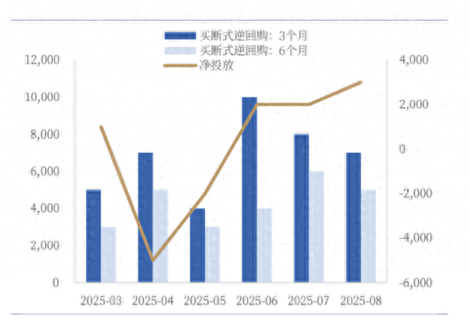
央行将开展1万亿元买断式逆回购,券商详解对资产价格影响
Huan Qiu Wang· 2025-09-05 01:05
Group 1 - The central bank announced a 1 trillion yuan reverse repurchase operation with a 3-month term, indicating a continuation of the 3-month reverse repurchase operations this month [1] - There are 300 billion yuan of 6-month reverse repurchase and 300 billion yuan of MLF maturing in September [1] Group 2 - Citic Securities' chief economist analyzed the possibility of excess rollover in the future [3] - GF Securities noted that the central bank's operation at the beginning of the month is typically a net withdrawal or an equal counteraction, indicating no net liquidity injection was expected this time [3] - The recent policy operations suggest that maintaining narrow liquidity easing remains the basic direction [3] Group 3 - GF Securities highlighted the substitution logic between narrow and broad liquidity, indicating that if broad liquidity has not effectively expanded, narrow liquidity will be relatively abundant [3] - Weak earnings may pose pricing resistance if narrow liquidity remains abundant for too long [3] - If broad liquidity expands effectively, the absorption effect of the real economy on funds will lead to a convergence of narrow liquidity, creating valuation pressures [3] Group 4 - The characteristics of July and August were marked by narrow easing and weak broad liquidity, with valuation improvement being one of the drivers for asset prices [3] - As valuations reach appropriate levels, pricing volatility may increase, shifting market focus to whether broad liquidity and corporate earnings can effectively support the market [3] - Attention should be paid to the impact of this process on market structure [3]
【广发宏观钟林楠】等待新变量,打破旧共识:2025年中期货币环境展望
郭磊宏观茶座· 2025-07-20 10:55
Core Viewpoint - The monetary policy in the first half of 2025 will be divided into two phases, focusing on stabilizing the economy and adjusting liquidity based on economic conditions [1][7][36] Monetary Policy Outlook - The first phase (January-February) will see a stable economic start with less pressure for counter-cyclical adjustments, focusing on preventing capital outflow and stabilizing exchange rates and interest rates [1][7] - The second phase (March-June) will shift towards stabilizing growth as previous policy goals are met, with potential for rate cuts and structural tool expansions [1][7][36] Liquidity Analysis - Narrow liquidity reflects the monetary policy stance, tightening initially and then loosening as the policy focus shifts [2][13] - The narrow liquidity is expected to remain limited in its further loosening due to macro-prudential considerations and the need to prevent capital outflow [2][13][62] Credit and Social Financing - Entity credit has stabilized in the first half of the year, with expectations for further improvement in the second half due to low base effects and proactive credit supply [17][66] - Social financing growth may slow down in the second half, with an expected year-end growth rate of around 8.2% [21][22] M1 Growth - M1 growth has rebounded, driven by low base effects, recovery in financing demand, and increased foreign exchange settlements, with expectations for continued support in the second half [25][26] - The M1 growth rate is projected to be between 3%-4% in the baseline scenario, with fluctuations expected throughout the year [25][26] Inflation and Asset Performance - Improvements in broad liquidity, particularly M1, typically indicate a rise in future inflation expectations and upward pressure on interest rates, yet current asset performance remains subdued [28][29] - Changing low inflation expectations requires new external forces, with recent policy signals indicating a focus on supply-side reforms and stabilizing demand [31][32] Structural Policy Tools - The central bank may restart government bond trading and consider further reserve requirement reforms, with potential structural tools focusing on digital finance and consumption [10][12][38] - The effectiveness of structural tools will depend on their implementation and the overall economic environment [38][39]

【广发宏观钟林楠】M1增速为何上行较快
郭磊宏观茶座· 2025-07-14 15:06
Core Viewpoint - The article highlights the significant increase in social financing (社融) in June, which amounted to 4.2 trillion yuan, exceeding market expectations and showing a year-on-year increase of 900.8 billion yuan, indicating a positive trend in credit and financing conditions [1][5]. Summary by Sections Social Financing Overview - In June, social financing increased by 4.2 trillion yuan, higher than the market average expectation of approximately 3.7 trillion yuan, with a year-on-year increase of 900.8 billion yuan. The stock growth rate of social financing was 8.9%, up by 0.2 percentage points from the previous month [1][5]. Factors Influencing Credit Growth - The increase in real credit amounted to 2.4 trillion yuan, with a year-on-year increase of 171 billion yuan, influenced by four main factors: stronger seasonal credit demand, the issuance of special government bonds, central bank liquidity support, and concentrated government-led project financing [1][6]. Structural Changes in Loans - Residential loans remained stable at low levels, while corporate loans showed significant changes. Short-term corporate loans increased by 490 billion yuan, reflecting stronger seasonal demand and the impact of structural tools. Corporate bill financing decreased by 371.6 billion yuan, and long-term loans saw a slight increase of 40 billion yuan [2][7]. Government Bond Financing - Government bonds increased by 1.35 trillion yuan, with a year-on-year increase of 507.2 billion yuan. The proportions of national bonds, local government new bonds, and special refinancing bonds were 58%, 30%, and 12%, respectively [2][8]. Foreign Currency Loans - Foreign currency loans increased by 32.6 billion yuan, with a year-on-year increase of 113.3 billion yuan, benefiting from a low base last year and a weaker US dollar [3][9]. M1 Growth - M1 growth in June was 4.6%, up by 2.3 percentage points from the previous month, with a monthly increase of 500 billion yuan, the highest in five years. This was attributed to strong financing from government projects, reduced debt repayment impacts, and high foreign trade settlement [3][10]. Overall Assessment - The overall expansion of credit and social financing in June, along with the initial elasticity in M1 growth, supports a positive market risk appetite. The first half of the year saw a year-on-year increase in real credit of 279.6 billion yuan and a total social financing increase of 4.74 trillion yuan, aligning with a moderately loose monetary policy [4][11].

【广发宏观团队】从弹性空间到“必要条件”
郭磊宏观茶座· 2025-03-02 10:34
Core Viewpoint - The article discusses the current macroeconomic environment in China, highlighting the importance of improving microeconomic expectations, innovation capabilities, and credit expansion to support market risk appetite and overall economic growth. Group 1: Microeconomic Conditions - The improvement in microeconomic expectations, particularly among private enterprises, has contributed to a significant increase in market risk appetite, with the Wind All A Index rising by 17.4% as of the end of February [1] - Technological breakthroughs, exemplified by innovations like Deep Seek and Spring Festival robots, have drawn attention to the innovation capabilities of Chinese enterprises [1] - The high opening of credit at the beginning of the year has opened up expectations for broad liquidity and credit expansion [1] Group 2: Economic Growth Conditions - The central economic work conference emphasizes the need to balance quality improvement and total volume expansion, indicating that corporate profitability will become a constraint as total pressure increases in the second and third quarters of 2024 [1] - The article outlines three necessary conditions for achieving nominal growth rates: effective recovery of consumption, stabilization of the construction industry, and reasonable price recovery [2][3] - In 2024, consumption is expected to recover effectively, with retail sales growth projected at only 3.5%, indicating significant potential for improvement [2] Group 3: Global Economic Context - The article notes a global "risk-off" sentiment, with major stock markets experiencing declines, including the S&P 500 and Nasdaq, which fell by 0.98% and 3.47% respectively [4] - The U.S. economy is facing risks of slowdown, with consumer confidence indices falling below expectations and personal consumption expenditures declining by 0.2% in January [5] - The potential for U.S. fiscal contraction is highlighted, with discussions around reducing the deficit from over 6% to 3% [5] Group 4: Liquidity and Investment - Narrow liquidity is expected to enter a phase of temporary easing, with broad liquidity likely to continue expanding due to government and corporate bond issuance [7] - The article mentions that the financing scale of government and corporate bonds in February is expected to approach 2 trillion yuan, significantly increasing year-on-year [7] - The focus on infrastructure projects is expected to accelerate, with the construction industry showing signs of recovery as funding rates turn positive [8] Group 5: Sectoral Insights - The manufacturing sector, particularly equipment manufacturing, is showing leading indicators of recovery, with industries like electrical machinery and automotive returning to pre-holiday highs [9] - The construction industry is experiencing improved conditions, with a notable increase in the recovery rate of construction sites and labor utilization [8] - The article indicates that while industrial raw material prices are generally declining, consumer goods prices are experiencing seasonal slowdowns, with no consistent improvement in inflation signals [10]
