油价上涨预期

Search documents
伊朗回应特朗普开放霍尔木兹海峡“最后通牒”
财联社· 2026-03-22 11:43
Core Viewpoint - The article discusses the escalating tensions between the U.S. and Iran, particularly regarding the strategic importance of the Strait of Hormuz and the potential impact on oil prices due to military threats [1][2]. Group 1: U.S.-Iran Relations - U.S. President Trump issued an ultimatum for Iran to open the Strait of Hormuz within 48 hours, threatening military action against Iranian power plants if they do not comply [2]. - Iranian parliamentary speaker, Ghalibaf, responded by stating that any attack on Iran's infrastructure would lead to significant retaliatory actions against energy and oil facilities across the Middle East, suggesting a long-term increase in oil prices [1]. Group 2: Impact on Oil Market - The potential military actions and threats could result in irreversible damage to critical energy infrastructure in the region, which may lead to sustained increases in oil prices [1].


突发!霍尔木兹海峡大消息!高盛重大警告!
天天基金网· 2026-03-12 08:28
Core Viewpoint - The ongoing tensions in the Strait of Hormuz are significantly impacting global energy markets, with Goldman Sachs warning that oil prices could surge to extreme levels due to prolonged disruptions in oil flow [4][7]. Group 1: Current Situation in the Strait of Hormuz - A cargo ship was hit by an unidentified projectile near the Strait of Hormuz, causing a fire on board, although all crew members are reported safe [5]. - The Strait of Hormuz is crucial for global oil transportation, accounting for approximately one-quarter of maritime oil transport and significant volumes of liquefied natural gas and fertilizers [5]. - The U.S. Navy has reportedly been declining requests for military escort in the Strait due to high risks of attacks, despite ongoing tensions [6]. Group 2: Impact on Oil Prices - Goldman Sachs has raised its oil price forecasts, predicting that if disruptions in the Strait of Hormuz continue, oil prices could exceed the historical peak of 2008 [7][8]. - As of March 12, Brent crude futures surpassed $100 per barrel, with WTI crude futures rising by 4.58% to $91.23 per barrel [7]. - Goldman Sachs adjusted its fourth-quarter oil price predictions, increasing Brent crude from $66 to $71 per barrel and WTI from $62 to $67 per barrel, reflecting a reassessment of the duration of potential disruptions [8]. Group 3: Future Scenarios and Risks - Goldman Sachs outlined scenarios where if disruptions last for 30 days, Brent crude could average $76 per barrel, while a 60-day disruption could push it to $93 per barrel [8]. - The firm emphasized that the risk balance is skewed towards upward price movements, indicating that investors should prepare for higher energy prices amid uncertain flow conditions [8].


霍尔木兹海峡,突发!高盛,重大警告!
券商中国· 2026-03-12 08:19
Core Viewpoint - The ongoing tensions in the Strait of Hormuz are significantly impacting global energy markets, with Goldman Sachs warning that oil prices could spike to $93 per barrel under extreme scenarios, potentially surpassing the historical peak of 2008 [2][6]. Group 1: Incident Overview - A cargo ship was hit by an unidentified projectile near the Strait of Hormuz, resulting in a fire on board, with all crew members reported safe [3][4]. - The incident occurred approximately 35 nautical miles north of Fujairah, UAE, and is part of a broader pattern of increased maritime security risks in the region [3][4]. - The Strait of Hormuz is crucial for global oil transportation, accounting for about one-quarter of maritime oil transport and significant volumes of liquefied natural gas and fertilizers [3][4]. Group 2: Market Impact - Following the escalation of military actions in the region, global oil prices have surged to their highest levels since 2022, with Brent crude futures surpassing $100 per barrel [6]. - Goldman Sachs has revised its fourth-quarter oil price forecasts upward, citing a longer expected disruption of oil flows through the Strait of Hormuz [6][7]. - The firm adjusted its baseline assumption for the duration of flow disruptions from 10% for 10 days to 21 days, followed by a gradual recovery over 30 days [7]. Group 3: Future Projections - Goldman Sachs predicts that if disruptions last for 30 days, Brent crude could average $76 per barrel, while a 60-day disruption could see prices rise to $93 per barrel [7]. - The report emphasizes that the risk balance is skewed towards upward price movements, indicating that investors should prepare for higher energy prices in the near term [7].

市场快讯:美国以色列对伊朗发动打击,原油或将大幅上涨
Ge Lin Qi Huo· 2026-03-03 01:33
1. Report Industry Investment Rating - No relevant information provided 2. Core Viewpoints of the Report - The military strike by the US and Israel against Iran may cause a significant increase in crude oil prices, and the current geopolitical conflict may push the Brent oil price above $75 per barrel [5] - If Iran closes the Strait of Hormuz, about one - third of the world's seaborne crude oil trade and one - fifth of the liquefied natural gas supply will be disrupted, and the global economy may face the risk of paralysis [6] 3. Summary by Related Content Military Action Background - On February 19, 2026, US President Trump stated that Iran needed to reach a "meaningful agreement" with the US within "10 to 15 days", or face "serious consequences". The US sent military forces to the Middle East while negotiating with Iran [5] - On February 27, the third round of US - Iran negotiations failed to reach a consensus on core issues. On February 28, the US and Israel officially launched a military strike against Iran [5] Military Action Details - At around 14:00 Beijing time on February 28, the US and Israel sent F - 35 fighter jets to conduct an air raid on Iran, targeting multiple locations including Tehran [5] - On February 28 local time, Israeli Prime Minister Netanyahu announced that the goal of the US - Israel military action was to overthrow the Iranian regime [5] - The US Pentagon named the air - raid operation on Iran "Epic Rage". President Trump said that after Israel's missile attack, the US had launched "large - scale combat operations" in Iran [5] - According to Iranian media on February 28, the Islamic Revolutionary Guard Corps of Iran declared that in response to the aggression, Iran had started a large - scale missile and drone attack on "territories occupied by Israel" [5] Comparison with Previous Military Actions and Impact on Oil Prices - In June 2025, the US launched a military strike against Iran to destroy its nuclear facilities. This time, the goal is to overthrow the Iranian regime, so the military action is expected to last longer, have a greater intensity, and a more serious geopolitical risk impact [5] - The 2025 Iranian geopolitical event pushed the Brent oil price to a high of $75 per barrel. The current geopolitical conflict may drive the Brent oil price above $75 [5] Potential Consequences of the Strait of Hormuz Closure - There are reports that the Iranian parliament has concluded that the Strait of Hormuz should be closed. If so, about one - third of the world's seaborne crude oil trade and one - fifth of the liquefied natural gas supply will be blocked, and the global economy may face paralysis [6]
北交所策略专题报告:美伊冲突升级推升油价与航运成本,关注北交所相关标的
KAIYUAN SECURITIES· 2026-03-01 12:41
Group 1: Oil and Gas Industry - The escalation of the US-Iran conflict is expected to drive international oil prices higher, potentially reaching the range of $75 to $80 per barrel, with a possibility of exceeding $100 per barrel if military actions disrupt Iranian oil supply [1][9][10] - The North Exchange has several companies involved in oil and gas extraction and shipping, including Keli Co., Biyang Technology, and Wan De Co., which are likely to benefit from rising oil prices and shipping costs [1][20][22] - The geopolitical tensions in the Middle East are significantly increasing the risk premium in the oil market, with the potential for historical price spikes if supply disruptions occur [1][10][11] Group 2: Chemical New Materials Industry - The chemical new materials sector on the North Exchange saw an increase of 2.60% this week, outperforming other sectors [2][27] - Key sub-sectors within the chemical new materials industry, such as battery materials and non-metallic materials, reported significant weekly gains of 5.35% and 4.52% respectively [2][28] - Notable stock performances included Keli Co. with a weekly increase of 21.79%, and Huifeng Diamond with 16.19% [2][34] Group 3: Company Performance Reports - Tian Gong Co. reported a decline in both revenue and profit for 2025, with a revenue drop of 21.25% to 631 million yuan, primarily due to weak demand in the consumer electronics sector [3][66] - Beiterui achieved a revenue growth of 19.29% in 2025, reaching 16.983 billion yuan, driven by strong demand in the new energy vehicle and energy storage markets [3][66] - Yinuowei reported a revenue increase of 9.37% to 7.5 billion yuan in 2025, indicating a sustained improvement in core business profitability [3][66]
美国对伊朗持续施压,“断供”风险推涨油价,利好油服行业
Sou Hu Cai Jing· 2026-01-14 00:45
Group 1 - The U.S. government announced a 25% tariff on any country doing business with Iran, indicating heightened geopolitical tensions [1] - The International Energy Agency predicts a global oil supply surplus of 3.84 million barrels per day by 2026, leading to a systemic decline in oil prices [1] - If U.S.-Iran conflict escalates, Iranian oil exports may be disrupted, exacerbating global supply tightness [1] Group 2 - Approximately 13 million barrels of oil are transported daily through the Strait of Hormuz, accounting for about 31% of global maritime oil transport [2] - Concerns over the closure of the Strait of Hormuz could increase oil prices by several dollars, with a complete closure potentially raising prices by $10 to $20 per barrel [2] - If the conflict leads to a complete halt of Iranian oil exports, a global supply gap of over 2 million barrels per day could occur, potentially driving Brent crude prices to $90-100 per barrel if sustained for six months [2] Group 3 - The geopolitical conflict is expected to boost oil price expectations, leading to increased exploration and development spending by oil and gas companies, which directly benefits oil service equipment demand [2]
油价调整:注意,预计上调95元/吨,油价继续上涨!
Jin Tou Wang· 2025-12-25 03:40
Core Viewpoint - The current oil price adjustment cycle indicates a potential increase in domestic oil prices by 95 yuan per ton, translating to an increase of 0.07-0.09 yuan per liter, surpassing the previous day's expected increase by 5 yuan per ton, suggesting a likelihood of price hikes [1] Group 1: International Oil Market - International oil prices remained stable due to decreased market trading activity influenced by the Christmas holiday, alongside geopolitical tensions and rising U.S. crude oil inventories, leading to a cautious market outlook [3] - The performance of crude oil markets showed a slight decline, with U.S. crude oil down by 0.14% to $58.38 per barrel and Brent crude down by 0.11% to $61.84 per barrel [3] - U.S. officials have indicated a preference for sanctions over military action regarding Venezuela, easing market concerns about potential disruptions in Venezuelan oil supply [3] - The ongoing stalemate in the Russia-Ukraine negotiations continues to support oil prices, as the revised peace plan has not resolved territorial disputes [3] Group 2: Domestic Oil Prices - The upcoming oil price adjustment is scheduled for January 6, 2026, at 24:00 [3] - Current gasoline prices across various regions in China are as follows: - Beijing: 92 gasoline at 6.7, 95 gasoline at 7.14, 98 gasoline at 8.62, 0 diesel at 6.37 - Shanghai: 92 gasoline at 6.67, 95 gasoline at 7.1, 98 gasoline at 9.1, 0 diesel at 6.31 - Jiangsu: 92 gasoline at 6.68, 95 gasoline at 7.11, 98 gasoline at 9.16, 0 diesel at 6.3 [4][5]

两艘超级油轮紧急掉头,油运运费大涨,高盛:油价恐上涨47%!A股港口股、军工股大涨!伊朗被曝曾警告特朗普,朝鲜谴责美国
Mei Ri Jing Ji Xin Wen· 2025-06-23 07:15
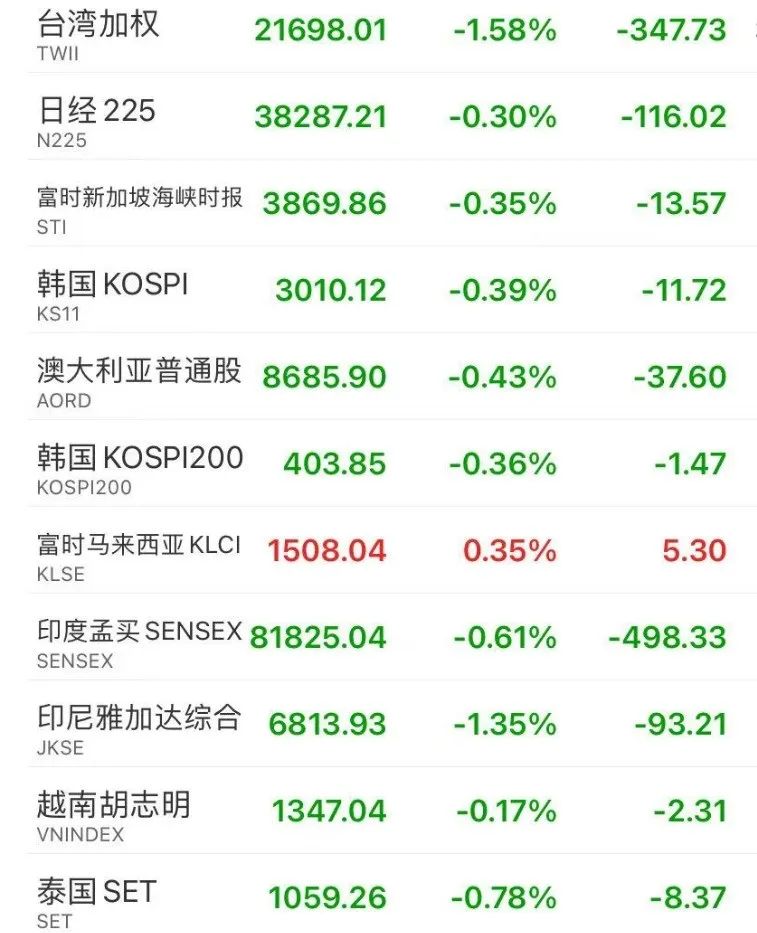
Market Reaction - The Asia-Pacific stock markets opened lower, with Taiwan's Weighted Index down by 1.58%, Japan's Nikkei 225 down by 0.3%, and India's SENSEX down by 0.61% [1][2]. Oil Market Impact - Tensions in the Middle East have led to a significant increase in oil prices, with U.S. oil rising over 6% and Brent oil increasing over 5% on June 23 [7][12]. - Goldman Sachs warned that Brent crude oil prices could spike to $110 per barrel if oil flow through the Strait of Hormuz is halved in the first month and remains 10% lower for the following 11 months [14]. - The Baltic Dirty Tanker Index (BDTI) reached $57,758 per day, the highest since April 2024, reflecting a 154% increase from $22,764 per day on June 12 [12]. Shipping and Trade Concerns - Two supertankers changed course near the Strait of Hormuz, indicating heightened caution among shipping companies regarding potential disruptions in this critical waterway [10][12]. - The Greek shipping department advised vessels planning to transit the Strait to reassess their routes due to the escalating situation [12]. Sector Performance - In the A-share market, shipping and oil & gas stocks saw significant gains, with several companies in these sectors reporting increases of over 10% [4][5][6]. - The military industry also showed strength, with companies like Changcheng Military Industry rising by 10.02% [7].


国际油价直线跳水,什么情况?
证券时报· 2025-06-20 12:49
Core Viewpoint - The article discusses the recent sharp decline in international oil prices, influenced by escalating tensions between Israel and Iran, and the potential implications for oil supply and prices in the future [1][5]. Oil Market Summary - On June 20, international oil prices saw a significant drop, with ICE Brent crude falling over 3% and NYMEX WTI crude dropping more than 1% [1]. - The current price of ICE Brent crude is reported at $75.98, down by $2.87 or 3.64% from the previous close [2]. Geopolitical Context - The conflict between Israel and Iran has entered its eighth day, with Israel conducting strikes on Iranian military facilities [5]. - Iranian officials have stated that they will not engage in dialogue as long as Israel continues its attacks, indicating a potential for further escalation [5]. - Iran has suggested that closing the Strait of Hormuz is a possible response to the ongoing conflict, which could severely impact oil supply [5]. Price Projections - Citigroup estimates that if Iran's oil exports of 1.1 million barrels per day are disrupted, oil prices could rise by approximately 15% to 20% [6]. - Morgan Stanley has indicated that in a worst-case scenario where the Strait of Hormuz is blocked, oil prices could surge to between $120 and $130 per barrel due to a potential reduction of 2.1 million barrels per day in Iranian oil exports [6]. Shipping Industry Response - Maersk Group announced the suspension of its ships docking at Haifa Port in Israel due to the risks associated with the ongoing conflict [7]. - The company stated that its operations in the region have not yet been further disrupted, but the decision was made after careful risk assessment [8].