
涨价逻辑

Search documents
类权益周报:以静制动-20260315
HUAXI Securities· 2026-03-15 14:08
Market Overview - From March 9 to 13, the equity market experienced a volatile correction, with the Wind All A closing at 6750.45, down 0.48% from March 6, and the China Convertible Bond Index down 1.10%[1] - The overall market sentiment remains cautious due to geopolitical uncertainties, leading to a decline in the number of rising stocks and trading volume around 2.5 trillion yuan[1][11] Key Trends - The main investment themes are price increases in oil, petrochemicals, and electricity, with significant inflows into these sectors observed since March[1][15] - The valuation of convertible bonds has decreased, with the valuation center for bonds priced at 80 yuan dropping to 56.75%, a decline of 2.05 percentage points from March 6[19] Strategy Recommendations - Investors are advised to maintain a cautious stance and control their positions until geopolitical tensions ease, as the current market conditions are less favorable compared to previous external shocks[2][34] - A key indicator for future market movements will be whether trading volumes can increase, signaling a shift from a consensus of caution to active buying[2][35] Sector Focus - The price increase logic is expected to continue dominating the market, particularly in oil, petrochemicals, and agricultural chemicals, while the agricultural sector shows lower crowding with a percentile of only 35%[2][40] - In the electricity sector, both generation and storage are supported by policy, but the high crowding in electricity equipment may lead to volatility before any significant upward movement[3][41] Risk Factors - The convertible bond market faces redemption pressures, and if the market remains weak, the impact on bond valuations could be significant[3][60] - The overall risk appetite in the equity market is under pressure, which may suppress investor enthusiasm for convertible bonds[3][47]
农业涨价逻辑受青睐:权益ETF周度跟踪-20260315
HUAXI Securities· 2026-03-15 07:50
1. Report Industry Investment Rating - Not provided in the report 2. Core View of the Report - As of the market conditions on March 13, combining the "Gain - Crowding" quadrant chart and ETF fund flow, the agricultural sector is worthy of continuous attention. The agricultural sector is steadily increasing in holdings, possibly due to capital betting on the price - rising logic. The breeding sector shows a net inflow of funds, and its upward space depends on policy strength. The coal and battery sectors have a net outflow of funds and may experience short - term fluctuations. The chemical sector has a high participation difficulty [1][23]. 3. Summary According to the Directory 3.1 Market Review - From March 9 - 13, the market fluctuated and declined. As of March 13, 2026, the closing price of the Wind All - A Index was 6750.45, a 0.48% decrease from March 6 [6]. - The ChiNext performed better. From March 9 - 13, most major stock indexes pulled back. The ChiNext Index and the Shenzhen Component Index rose by 2.51% and 0.76% respectively, while the Science and Technology Innovation 50 and the CSI 500 fell by 2.88% and 1.44% respectively [9]. - Stock - type ETFs maintained a net outflow. From March 9 - 12, stock - type ETFs had a net outflow of 20.904 billion yuan, with a larger outflow scale compared to March 2 - 5. Among them, broad - based index ETFs had a net outflow of 28.299 billion yuan, industry - index ETFs had a net outflow of 1.364 billion yuan, and theme - index ETFs had a net inflow of 4.807 billion yuan [11][12]. - At the industry level, batteries and coal led the gains. The battery index rose by 8.40%, and its crowding - degree quantile since 2020 rose to 68.6%, an increase of 37.4 percentage points. The coal index rose by 6.60%, and its crowding - degree quantile since 2020 rose 7.50 percentage points to 59.70%. Aerospace and military industry and non - ferrous metals fell significantly, and their crowding degrees declined from high levels. The agricultural and livestock sector rose moderately, with little change in crowding degree. The chemical industry index fell slightly, but its crowding degree increased significantly [15][16]. 3.2 Follow - up Attention - The agricultural sector is steadily increasing in holdings and is a direction for capital to bet on the price - rising logic. The agricultural ETF rose 2.68% this week, with a net inflow of 717 million yuan. It has had a net inflow for 9 consecutive days, with a cumulative 1.095 billion yuan, accounting for 29.48% of its fund scale [23]. - The breeding sector also shows a net inflow of funds, and its upward space depends on policy strength. The breeding ETF rose 1.54% this week, with a net inflow of 447 million yuan. If the policy implementation intensity increases, the price of live pigs may recover, and the sector still has upward space [23]. - The chemical sector has a high participation difficulty. From March 9 - 12, the chemical ETF fell 0.42%, with a net outflow of 557 million yuan. After the Spring Festival, the cashing pressure in the sector increased, and from February 24 to March 13, there was a cumulative net outflow of 1.39 billion yuan. The index crowding degree has risen to a relatively high level since 2020 [24]. - The coal and battery sectors have a net outflow of funds and may experience short - term fluctuations. The battery ETF and the coal ETF rose 8.49% and 6.63% respectively this week, with net outflows of 309 million yuan and 795 million yuan respectively. The battery sector may adjust in the short term, and the subsequent market of the coal sector is greatly affected by the situation in the Middle East [24].
地缘扰动和关税博弈强化中盘蓝筹涨价逻辑
Orient Securities· 2026-02-26 14:14
Group 1 - The report emphasizes that geopolitical disturbances and tariff negotiations are reinforcing the price increase logic for mid-cap blue chips, particularly in cyclical sectors such as non-ferrous metals, chemicals, and agriculture [7][10][34] - The recent geopolitical tensions, including the U.S. tariff disputes and the situation in Iran, have significantly supported precious metal prices, indicating potential price increases for strategic metals [10][12][15] - The report highlights the establishment of a national unified electricity market in China, which is expected to enhance the multi-dimensional value of electricity resources, with a timeline for market implementation set for 2027 [12][15] Group 2 - The real estate market shows stable trends during the Spring Festival, but the cyclical turning point remains to be observed, with expectations of policy easing and improvements in core city markets [13][15][34] - Consumer demand is diversifying, with increased foot traffic during the Spring Festival indicating a shift towards a consumption-driven growth model, supported by technological advancements and high levels of openness [14][15] - The report notes that mid-cap blue chips present a favorable risk profile, with overall market risks being manageable despite some fluctuations in short-term sentiment across various indices [16][34] Group 3 - The report identifies a trend of short-term volatility in hot sectors, with mid-cap blue chips showing resilience, while other sectors like basic chemicals and power grid equipment maintain stable medium-term uncertainties [21][25][31] - The analysis of trading behavior indicates a shift from strong trends to fluctuations in previously high-performing sectors, with only the power equipment sector maintaining its trend [21][25][31] - The report suggests that the overall market sentiment is gradually improving, with mid-cap indices showing slight recoveries in short-term emotions, while uncertainties in the mid-term remain relatively stable [16][25][34]
A股延续“红包”行情 连续两日百股涨停
Xin Lang Cai Jing· 2026-02-25 16:55
Core Viewpoint - The A-share market has experienced a structural rebound post-holiday, with significant differentiation in sector performance, indicating a shift from sentiment-driven speculation to fundamental-driven investment strategies [1][2]. Market Performance - On Wednesday, all three major A-share indices rose, with the Shanghai Composite Index up 0.72% to 4147.23 points, the Shenzhen Component Index up 1.29% to 14475.87 points, and the ChiNext Index up 1.41% to 3354.82 points [1]. - The total trading volume in Shanghai and Shenzhen reached 24.812 billion yuan, an increase of 2.628 billion yuan from the previous day [1]. - Over 3700 stocks rose, with more than a hundred hitting the daily limit [1]. Sector Analysis - Strong performance was noted in cyclical sectors such as rare earths, phosphate chemicals, lithium mining, shipping, and oil and gas, while sectors like media, banking, telecommunications, and home appliances showed weakness [1]. - The market has seen a clear divergence, with previously popular stocks related to the Spring Festival experiencing declines, while cyclical stocks based on price increase logic have led the gains [1][2]. Investment Strategy - The current market transition reflects a shift from emotion-driven trading to a focus on fundamental support, driven by multiple factors including pre-holiday market movements, overseas events, and the upcoming earnings disclosure window [2]. - The strength of cyclical price increases is supported by rising global commodity prices, the resumption of domestic production, and ongoing policy support for the real economy, indicating sustained momentum [2]. - Adjustments in technology and Spring Festival consumption stocks are attributed to short-term profit-taking and market rhythm mismatches, suggesting potential for structural recovery once market sentiment stabilizes [2]. Technical Analysis - The market continues to rebound with more stocks rising than falling, and trading volume has increased [3]. - The Shanghai Composite Index faces selling pressure around 4170 points, and without sustained volume, it may experience volatility [3]. - Investors are advised to focus on sectors with strong price increase logic and earnings certainty, while being cautious of blindly chasing high-performing cyclical stocks [3].
【公募基金】地缘关税扰动并存,市场结构趋势延续——公募基金指数跟踪周报(2026.02.09-2026.02.13)
华宝财富魔方· 2026-02-24 09:23
Investment Insights - The equity market showed some heat before the Spring Festival holiday (February 9-13, 2026), with the Shanghai Composite Index rising by 0.36%, the CSI 500 up by 1.88%, and the ChiNext Index increasing by 1.22%. However, market sentiment remained restrained, and trading volume did not effectively expand, staying around 2 trillion [3][5][6] - The holiday period introduced uncertainties due to the U.S. Supreme Court ruling on tariffs and the Middle East situation, impacting market dynamics. The U.S. inflation data exceeded expectations, with core PCE inflation rising to 3%, and the Fed's FOMC minutes indicated a cautious stance on further rate cuts, reducing optimistic expectations for monetary easing [4][6] - Domestic consumption data during the holiday was mixed, with travel traffic reaching a historical high, indicating a robust service economy focused on tourism. However, there was internal structural differentiation, with traditional sectors like film and real estate underperforming, while sectors like travel and smart wearable devices thrived [5][6] Fixed Income Market Insights - The bond market performed well in the week leading up to the Spring Festival (February 9-14, 2026), with the 1-year government bond yield decreasing by 0.62 basis points to 1.31%, the 10-year yield down by 2.03 basis points to 1.79%, and the 30-year yield down by 0.50 basis points to 2.25%. This performance was driven by pre-holiday demand for bond allocation [7][8] - There are mixed factors in the bond market, with potential short-term liquidity pressure due to the upcoming reverse repos. However, historical trends suggest that the central bank may maintain a supportive stance, making liquidity disturbances likely manageable [2][7] - The current 10-year government bond yield has fallen below 1.8%, indicating increased resistance to further declines. The market may experience reduced demand for bond purchases post-holiday, especially with the upcoming Two Sessions and a low probability of rate cuts [2][7] Sector Performance - The technology and media sectors were the main rebound hotspots, with a notable recovery in technology stocks. The market's main narrative continues to revolve around AI developments, with specific sectors like power generation and gas turbines seeing collective gains [3][6] - The upcoming Two Sessions on March 4 is expected to finalize the detailed planning for the 14th Five-Year Plan, which may solidify positive policy expectations for technology growth. However, there is a caution against overextending growth expectations, which could lead to a market correction [6][7]


主动量化周报:春节特别篇:低起点,大空间,维持乐观-20260223
ZHESHANG SECURITIES· 2026-02-23 13:33
- The report does not contain specific quantitative models or factors, nor does it provide detailed construction processes, formulas, or backtesting results for any quantitative models or factors. The content primarily focuses on market analysis, investment opportunities, and thematic discussions such as AI technology and price increase logic[2][3][10][11][12][13]
ETF复盘资讯|无意外杀跌,有色ETF(159876)跌停!白酒逆市爆发,高含酒量515710上探3.28%!银行顽强收红,资金火速涌入
Sou Hu Cai Jing· 2026-02-02 12:40
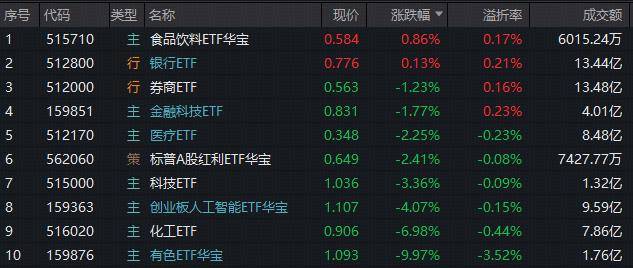
Core Viewpoint - The precious metals market has experienced a significant drop, leading to panic in the Asia-Pacific markets, with major indices falling over 2% on February 2, 2026 [1] Group 1: Market Performance - The A-share market saw all three major indices drop more than 2%, with the Shanghai Composite Index falling 2.48% to close at 4015.75 points [1] - The total market turnover was 2.61 trillion yuan, continuing a trend of reduced trading volume over two consecutive days [1] Group 2: ETF Performance - The Food and Beverage ETF (515710) rose by 0.86%, while the Banking ETF (512800) increased by 0.13% [2] - The Securities ETF (512000) fell by 1.23%, and the Technology ETF (515000) dropped by 3.36% [2] - The Precious Metals ETF (159876) saw a significant decline of 9.97%, indicating a strong sell-off in the sector [2] Group 3: Sector Analysis - The chemical and non-ferrous metals sectors faced heavy selling pressure, with the Chemical ETF (516020) down 6.98% and the Non-Ferrous ETF (159876) hitting the daily limit down [2] - Analysts from CITIC Securities suggest that the price increase narrative may continue throughout the first quarter, but caution is advised for the speculative precious metals sector [2] - The white liquor sector, particularly stocks like Kweichow Moutai, saw a surge, with the Food and Beverage ETF reaching a peak increase of 3.28% during the day [4][5] Group 4: Investment Opportunities - Analysts from CITIC Securities and other institutions are optimistic about the white liquor sector, predicting a potential bottoming out opportunity in the coming years [7] - The banking sector is gaining attention as a potential rebound opportunity, with significant inflows into the Banking ETF, which has attracted nearly 11 billion yuan in the last ten days [14][16] - The overall market remains active ahead of the Chinese New Year, with a focus on sectors with strong fundamental support [4][16]
超3600只个股下跌
第一财经· 2026-01-28 07:55
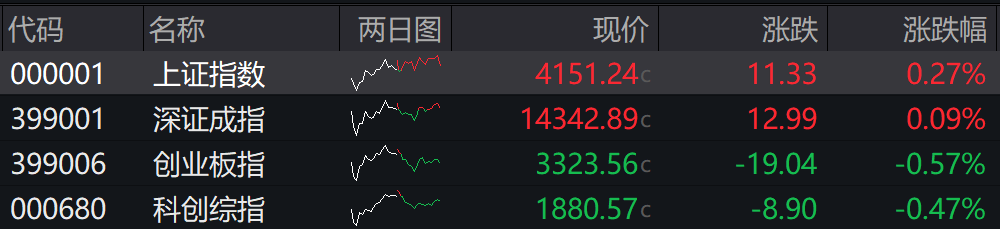
Market Overview - The A-share market experienced fluctuations on January 28, with the Shanghai Composite Index rising by 0.27% to 4151.24 points, and the Shenzhen Component Index increasing by 0.09% to 14342.89 points. However, the ChiNext Index fell by 0.57% to 3323.56 points, and the Sci-Tech Innovation Index decreased by 0.47% to 1880.57 points [3][4]. Sector Performance - The resource sector led the market, with significant gains in precious metals and oil and gas. The gold sector saw a surge, with China Gold achieving four consecutive trading limit increases, and Hunan Gold achieving three consecutive increases. Other notable performers included Zhongman Petroleum and Xiaocheng Technology, both with two limit increases in three days [4][5]. - The precious metals sector rose by 10.75%, while oil and gas extraction and services increased by 7.61%. The gold concept stocks also saw a rise of 7.54% [5]. Individual Stock Highlights - Notable stocks included Shanxi Coking Coal, which rose by 10% to 4.40, and Shaanxi Black Cat, which increased by 9.92% to 4.32. Other significant gainers included Lu'an Environmental Energy and Jinko Energy [6]. - The total trading volume in the Shanghai and Shenzhen markets reached 2.97 trillion, an increase of 704 billion compared to the previous trading day, with over 3600 stocks declining [6]. Capital Flow - There was a net inflow of capital into sectors such as non-ferrous metals, securities, and communication services, while sectors like photovoltaic equipment, aerospace, and automotive experienced net outflows. Notable inflows included China Aluminum with 1.909 billion, Northern Rare Earth with 1.855 billion, and others [8]. - Conversely, BlueFocus Communication Group, Sungrow Power Supply, and Kweichow Moutai faced significant sell-offs, with net outflows of 2.466 billion, 1.767 billion, and 1.333 billion respectively [8]. Institutional Insights - Dongfang Securities noted that capital is focusing on price increase logic, with technology and resources alternating in performance [10]. - Flash Gold Asset Management emphasized that short-term volatility does not alter the structural opportunities in high-end manufacturing [11]. - Huatai Securities indicated that historically, industries with sustained recovery capabilities during earnings forecast disclosures tend to yield excess returns [12].






收盘丨沪指放量震荡涨0.27%,资源股掀涨停潮
Di Yi Cai Jing· 2026-01-28 07:20
Market Overview - The A-share market experienced fluctuations on January 28, with the Shanghai Composite Index rising by 0.27% to close at 4151.24 points, while the Shenzhen Component Index increased by 0.09% to 14342.89 points. The ChiNext Index fell by 0.57% to 3323.56 points, and the Sci-Tech Innovation Board Index decreased by 0.47% to 1880.57 points [1][2]. Sector Performance - The gold and non-ferrous metal sectors saw significant gains, with resource stocks leading the market. Notable performances included China Gold achieving four consecutive trading limit increases, Hunan Gold with three consecutive increases, and China Aluminum hitting a 16-year high [1][2][3]. - The precious metals sector rose by 10.75%, oil and gas extraction and services increased by 7.61%, and the gold concept sector grew by 7.54%. Other notable increases included lead and zinc metals, which rose by 6.92% and 6.91%, respectively [3]. Coal Sector - The coal sector also performed well, with Shanxi Coking Coal and Shaanxi Black Cat both hitting the daily limit increase of 10%. Other companies in the sector, such as Lu'an Environmental Energy and Jinko Energy, also saw significant gains [4]. Trading Volume - The total trading volume in the Shanghai and Shenzhen markets reached 2.97 trillion yuan, an increase of 704 billion yuan compared to the previous trading day. However, over 3600 stocks in the market experienced declines [5]. Capital Flow - Main capital flows showed net inflows into non-ferrous metals, securities, and communication services, while there were net outflows from photovoltaic equipment, aerospace, and automotive sectors. Specific stocks like China Aluminum, N Hengyun Chang, and Northern Rare Earth saw net inflows of 1.909 billion yuan, 1.855 billion yuan, and 1.773 billion yuan, respectively [7][8]. - Conversely, BlueFocus Communication Group, Sungrow Power Supply, and Kweichow Moutai faced net outflows of 2.466 billion yuan, 1.767 billion yuan, and 1.333 billion yuan, respectively [9]. Institutional Insights - Dongfang Securities noted that capital is focusing on price increase logic, with technology and resources alternating in performance. Shanjin Asset Management emphasized that short-term volatility does not alter structural opportunities in high-end manufacturing [10]. - Huatai Securities highlighted that historically, industries with sustained recovery capabilities during earnings forecast disclosures tend to yield excess returns [11].
公募基金指数跟踪周报(2026.01.19-2026.01.23):“春季躁动”行情分化,逐步切换至绩优方向-20260126
HWABAO SECURITIES· 2026-01-26 11:42
1. Report Industry Investment Rating There is no information provided regarding the report's industry investment rating in the given content. 2. Core Viewpoints of the Report - In the equity market last week (2026.01.19 - 2026.01.23), under the environment of continuous regulatory policy suppression and abundant liquidity, the market structure was highly differentiated. Weight - stocks in consumption, medicine, and finance declined significantly due to large - scale ETF redemptions by policy funds, while the growth direction was active, and the commercial space sector regained strength after adjustment. As the earnings period begins, the market may rotate towards profit recovery and valuation repair. With the in - depth implementation of anti - involution policies, the investment growth rates of various industries have turned negative, implying future supply contraction, while demand stabilizes under the background of fiscal stimulus and economic recovery. This shift in the supply - demand contradiction consolidates the performance inflection points of leading companies in cyclical sectors such as non - ferrous metals and chemicals, and also drives the rise of sectors with price - increase logic like photovoltaics, lithium batteries, and coal [2][10][12]. - In the fixed - income market last week, short - term bond yields rose, and long - term yields fell. The 1 - year Treasury yield rose 3.95BP to 1.28%, the 10 - year Treasury yield fell 1.26BP to 1.83%, and the 30 - year Treasury yield fell 1.65BP to 2.29%, narrowing the term spread. Some funds entered the bond market for safety as the stock market cooled. The central bank governor's statement about potential reserve requirement ratio and interest rate cuts, along with positive news from the Ministry of Finance and good 7 - year Treasury bond issuance results, contributed to the narrowing of the term spread and the decline of long - term interest rates. There is support for the bond market sentiment, and there are opportunities to capture band trading in ultra - long - term interest - rate bonds [3][13]. 3. Summary by Relevant Catalogs 3.1 Weekly Market Observation 3.1.1 Equity Market Review and Observation - Index performance: Last week, the Shanghai Composite Index rose 0.84%, the CSI 300 fell 0.62%, and the ChiNext Index fell 0.34%. The average daily trading volume of the entire A - share market was 27,972 billion yuan, a decrease from the previous week [10]. - ETF funds: Overall, ETF funds showed a net outflow trend last week. The CSI 300ETF had the most significant share reduction, with 49.603 billion shares less in the past week. The CSI 1000, SSE 50, SSE STAR 50, and CSI A500 also had share reductions of 23.3 billion, 11.5 billion, 9.6 billion, and 7.9 billion respectively. Since January 15, patient funds have continuously redeemed a basket of ETFs, and during this period, some individual stocks with high weight in the index and actively priced by funds performed better. The market trading volume has shrunk from around 4 trillion to around 2.5 trillion, indicating that policy goals have achieved some results. Future market - overheating adjustment methods may focus on cracking down on hot money, relaxing IPOs, and executive share - sales, and the impact of ETF redemptions on the market may weaken marginally [11]. - External factors: The latest US economic data remains resilient, and the November PCE inflation data is in line with market expectations, with no obvious signs of inflation rebound. This week, the Federal Reserve will hold an interest - rate meeting, and the market will focus on the meeting and the earnings reports of large technology companies, especially on performance guidance and the sustainability of profit realization under high valuations. Overseas geopolitical conflicts are also an important short - term uncertainty factor, and market risk - aversion sentiment will remain before the situation in Iran is resolved [11]. 3.1.2 Pan - Fixed - Income Market Review and Observation - Domestic bond market: Last week, short - term bond yields in the domestic bond market rose, and long - term yields fell, narrowing the term spread. The 1 - year Treasury yield rose 3.95BP to 1.28%, the 10 - year Treasury yield fell 1.26BP to 1.83%, and the 30 - year Treasury yield fell 1.65BP to 2.29%. Some funds entered the bond market for safety as the stock market cooled. Positive factors such as the central bank governor's statement on potential reserve requirement ratio and interest rate cuts, the Ministry of Finance's press conference, and good 7 - year Treasury bond issuance results contributed to the narrowing of the term spread and the decline of long - term interest rates. There is support for the bond market sentiment, and there are opportunities to capture band trading in ultra - long - term interest - rate bonds [3][13]. - US Treasury yields: Last week, US Treasury yields fluctuated. The 1 - year US Treasury yield fell 2BP to 3.53%, the 2 - year yield rose 1BP to 3.60%, and the 10 - year yield remained flat at 4.24%. Trump's remarks about Greenland led to European selling of US Treasuries and a rise in yields, but his subsequent attitude reversed the trend. US Treasuries will likely continue to fluctuate in the future, with increased unpredictability [14]. - REITs: Last week, the CSI REITs Total Return Index rose 2.17% to 1047.51 points, and all types of REITs closed higher, with data centers, consumption, and warehousing leading the gains. In the primary market, 5 public REITs withdrew or terminated, including 4 initial projects and 1 expansion project [14][15]. 3.1.3 Public Fund Market Dynamics On January 23, 2026, the China Securities Regulatory Commission issued the "Guidelines for the Performance Comparison Benchmark of Publicly Offered Securities Investment Funds," and the Asset Management Association of China issued the "Operation Rules for the Performance Comparison Benchmark of Publicly Offered Securities Investment Funds." The official versions are generally consistent with the draft versions, with some adjustments including clarifying restrictions on benchmark changes, exempting money - market funds from disclosing performance - benchmark comparisons, and modifying the requirements for long - term performance evaluation by fund evaluation institutions [16]. 3.2 Fund Index Performance Tracking 3.2.1 Equity Strategy Theme - Based Index - Active Stock Fund Selection Index: The index selects 15 funds each period, with equal - weight allocation. It selects active equity funds based on performance competitiveness and style stability within value, balanced, and growth styles, and allocates them according to the style distribution of the CSI Equity - Oriented Fund Index (930950.CSI). The performance benchmark is the CSI Equity - Oriented Fund Index (930950.CSI) [20][21]. 3.2.2 Investment Style - Based Index - Value Stock Fund Selection Index: It includes both deep - value and quality - value styles. It selects 10 funds of deep - value, quality - value, and balanced - value styles based on multi - period style classification. The performance benchmark is the CSI 800 Value Index (H30356.CSI) [24]. - Balanced Stock Fund Selection Index: It selects 10 funds of relatively balanced and value - growth styles based on multi - period style classification. The performance benchmark is the CSI 800 (000906.SH) [24]. - Growth Stock Fund Selection Index: It aims to capture the performance and valuation double - click opportunities of high - growth companies and select "dark - horse" stocks. It selects 10 funds of active - growth, quality - growth, and balanced - growth styles based on multi - period style classification. The performance benchmark is the 800 Growth (H30355.CSI) [27]. 3.2.3 Industry Theme - Based Index - Pharmaceutical Stock Fund Selection Index: It classifies funds according to the intersection market value of fund equity holdings and the constituent stocks of the CITIC Pharmaceutical Index (with an average purity of not less than 60% in the past 3 years or since inception). It constructs an evaluation system in the eligible sample, considering factors such as relative benchmark index win - rate, product drawdown, style stability, and overall performance competitiveness, and selects 15 funds to form the index. The performance benchmark is the pharmaceutical theme fund index (fitted by Huabao Securities' fund research and investment platform) [30][31]. - Consumption Stock Fund Selection Index: It classifies funds according to the intersection market value of fund equity holdings and the constituent stocks of relevant CITIC consumption - related indices (with an average purity of not less than 50% in the past 3 years or since inception). It constructs an evaluation system in the eligible sample and selects 10 funds to form the index. The performance benchmark is the consumption theme fund index (fitted by Huabao Securities' fund research and investment platform) [31][32]. - Technology Stock Fund Selection Index: It classifies funds according to the intersection market value of fund equity holdings and the constituent stocks of relevant CITIC technology - related indices (with an average purity of not less than 60% in the past 3 years or since inception). It constructs an evaluation system in the eligible sample and selects 10 funds to form the index. The performance benchmark is the technology theme fund index (fitted by Huabao Securities' fund research and investment platform) [35]. - High - End Manufacturing Stock Fund Selection Index: It classifies funds according to the intersection market value of fund equity holdings and the constituent stocks of relevant CITIC high - end manufacturing - related indices (with an average purity of not less than 50% in the past 3 years or since inception). It constructs an evaluation system in the eligible sample and selects 10 funds to form the index. The performance benchmark is the high - end manufacturing theme fund index (fitted by Huabao Securities' fund research and investment platform) [40][41]. - Cyclical Stock Fund Selection Index: It classifies funds according to the intersection market value of fund equity holdings and the constituent stocks of relevant CITIC cyclical - related indices (with an average purity of not less than 50% in the past 3 years or since inception). It constructs an evaluation system in the eligible sample and selects 5 funds to form the index. The performance benchmark is the cyclical theme fund index (fitted by Huabao Securities' fund research and investment platform) [43][44]. 3.2.4 Money - Market Enhancement Index - Money - Market Enhancement Strategy Index: It aims at liquidity management, pursuing a curve that exceeds money - market funds and is smooth and upward. It mainly allocates money - market funds with relatively good performance and passive index - bond funds (inter - bank certificate of deposit index funds). The performance benchmark is the CSI Money - Market Fund Index (H11025.CSI) [47]. 3.2.5 Pure - Bond Index - Short - Term Bond Fund Selection Index: It aims at liquidity management, pursuing a smooth and upward curve while controlling drawdown. It mainly allocates 5 funds with stable long - term returns, strict drawdown control, and significant absolute - return ability. The performance benchmark is 50% * Short - Term Pure - Bond Fund Index + 50% * Ordinary Money - Market Fund Index [50]. - Medium - and Long - Term Bond Fund Selection Index: It invests in medium - and long - term pure - bond funds, aiming for stable returns while controlling drawdown. It selects 5 funds with both return and drawdown control, and adjusts the duration and the ratio of credit - bond funds and interest - rate bond funds according to market conditions. The performance benchmark is not clearly stated in a simple formula in the text [52]. 3.2.6 Fixed - Income + Index - Low - Volatility Fixed - Income + Selection Index: The equity center is set at 10%. It selects 10 fixed - income + funds with an equity center (considering convertible bond and stock positions) of less than 15% in the past three years and recently. It focuses on the risk - return ratio and holding experience. The performance benchmark is 10% CSI 800 Index + 90% ChinaBond New Composite Full - Price Index (CBA00303.CS) [55]. - Medium - Volatility Fixed - Income + Selection Index: The equity center is set at 20%. It selects 5 fixed - income + funds with an equity center between 15% and 25% in the past three years and recently, emphasizing the risk - return ratio and performance elasticity. The performance benchmark is 20% CSI 800 Index + 80% ChinaBond New Composite Full - Price Index (CBA00303.CS) [58]. - High - Volatility Fixed - Income + Selection Index: The equity center is set at 30%. It selects 5 fixed - income + funds with an equity center between 25% and 35% in the past three years and recently, emphasizing the risk - return ratio and performance elasticity. It selects funds with stable bond - end returns, no credit - downgrading, and strong stock - selection ability on the equity end. The performance benchmark is 30% CSI 800 Index + 70% ChinaBond New Composite Full - Price Index (CBA00303.CS) [61]. 3.2.7 Other Pan - Fixed - Income Index - Convertible Bond Fund Selection Index: It selects bond funds with an average convertible - bond investment proportion of not less than 60% in the latest period and not less than 80% in the past four quarters as the sample space. It constructs an evaluation system from the fund product, fund manager, and fund company dimensions, considering factors such as long - and short - term returns, drawdown, risk - adjusted returns, and the manager's timing and bond - selection abilities, and selects 5 funds to form the index [64]. - QDII Bond Fund Selection Index: It selects 6 QDII bond funds with stable returns and good risk control based on credit and duration conditions. The underlying assets of QDII bond funds are overseas bonds, covering regions such as the world, Asia, and emerging markets, and investment targets include Chinese - funded US dollar bonds and US dollar bonds [67]. - REITs Fund Selection Index: It selects 10 REITs funds with stable operation, reasonable valuation, and certain elasticity based on the underlying asset type. The underlying assets of REITs are mainly mature, high - quality, and stable - operating infrastructure projects, with relatively clear cash - flow expectations and limited unit - net - value volatility [68].