美国经济下行风险

Search documents
美联储如期降息25个基点并将结束缩表,内部分歧进一步加剧
Bei Ke Cai Jing· 2025-10-30 02:06
Core Points - The Federal Reserve announced a 25 basis point reduction in the federal funds rate target range to between 3.75% and 4%, marking the fifth rate cut since September 2024 [1] - There is significant internal disagreement within the Federal Reserve regarding monetary policy direction, with two committee members voting against the rate cut [1] - The Federal Reserve will end its balance sheet reduction (quantitative tightening) starting December 1, 2023, ceasing the monthly reinvestment of maturing U.S. Treasury securities [2] Group 1 - The Federal Reserve's decision to cut rates is a response to dual risks facing the U.S. economy, including rising inflation and slowing employment growth [3][4] - The language in the Federal Reserve's statement remained largely unchanged from September, indicating a cautious approach to economic conditions [3] - Market expectations for a rate cut in December have decreased significantly following the recent meeting, reflecting uncertainty about future economic data availability [6][7] Group 2 - The decision to halt balance sheet reduction is aimed at stabilizing money market rates amid signs of tightening liquidity and declining bank reserves [2][7] - The potential impact of the ongoing government shutdown on short-term economic growth is a concern, with implications for future monetary policy decisions [4][5] - Analysts suggest that the Federal Reserve's approach to rate cuts may evolve over the coming months, influenced by economic data and market conditions [6][7]
美联储理事米兰:美国经济下行风险上升 应加快降息步伐
智通财经网· 2025-10-15 14:55
Core Viewpoint - The Federal Reserve faces increased downside risks to the U.S. economy, necessitating adjustments in monetary policy to return the federal funds rate to a neutral level [1][3] Group 1: Economic Outlook - The current trade uncertainties, particularly regarding rare earth trade tensions, have heightened risks to the economic outlook compared to a week ago [1][3] - The economic outlook itself has not deteriorated, but risks have indeed increased [3] Group 2: Monetary Policy - The Federal Reserve should not engage in political issues and must maintain its independence, focusing on price stability and full employment [1] - A reasonable target range for the federal funds rate should be approximately two percentage points lower than the current range of 4.00% to 4.25% [1] - The expectation is for two more rate cuts within the year, despite a personal inclination for more aggressive cuts [2] Group 3: Inflation Expectations - The overall Personal Consumption Expenditures (PCE) inflation is expected to decline to 2% within about a year and a half, with housing inflation likely to slow down due to reduced immigration and delayed effects of housing cost adjustments [2] Group 4: Data Dependency - The Federal Reserve aims to rely more on economic forecasts rather than solely on current data, although forecasts depend on data availability [1] - The next Consumer Price Index (CPI) data is scheduled for release on October 24, 2025 [1]
美国9月ISM非制造业PMI大幅下滑
Sou Hu Cai Jing· 2025-10-04 06:39
Group 1 - The ISM Non-Manufacturing PMI in the U.S. dropped significantly from 52 to 50 in September, indicating a contraction in the service sector, which is a crucial pillar of the U.S. economy [2] - The U.S. non-farm payroll data for September was not released due to the government shutdown, but market expectations suggest it remains at a relatively low level [2] - Federal Reserve Chairman Jerome Powell and other market participants have warned of downside risks to the U.S. economy, which has influenced the Fed's decision to consider rate cuts [2] Group 2 - The market anticipates a 25 basis point rate cut at the upcoming October Federal Reserve meeting, although the impact of such cuts on the economy is uncertain due to the lagging effects of monetary policy [2] - The Federal Reserve is expected to maintain a cautious approach to monetary policy until Powell's term ends in May next year, making rapid and significant rate cuts unlikely [2] - In this context, the U.S. economy may face increased negative pressures, with the potential for "black swan" events not being ruled out [2]

美国9月ADP就业人数呈现负值
Sou Hu Cai Jing· 2025-10-01 13:30
Core Insights - The ADP employment data for September shows a decline of 32,000 jobs, with the previous value revised down from 54,000 to -3,000, indicating a worsening labor market in the U.S. [2] - This negative employment figure raises the likelihood of the Federal Reserve considering another interest rate cut in its upcoming meeting [2] - Despite the signs of labor market weakness, it is anticipated that any rate cut by the Federal Reserve will be limited to 25 basis points, suggesting minimal support for the U.S. economy [2] - The lagging effect of monetary policy implies that even with potential rate cuts, a significant positive impact on the economy in the short term is unlikely [2] Employment Market Analysis - The September ADP employment data reflects a deeper deterioration in the U.S. job market, which may lead to further economic downturn risks [2] - The current employment trends suggest that the labor market may continue to weaken, contributing to broader economic challenges [2]

美联储降息会带来什么影响?
Sou Hu Cai Jing· 2025-09-20 14:18
Group 1 - The Federal Reserve has lowered the federal funds rate target range by 25 basis points to between 4.00% and 4.25%, marking its first rate cut of 2025 and following three cuts in 2024 [1] - The decision has led to a mixed reaction from investors, with concerns about the Fed's independence being reignited [1] - President Trump remains dissatisfied with the 25 basis point cut, as he had hoped for a reduction of at least 50 basis points, indicating ongoing tension between him and Fed Chair Powell [3][4] Group 2 - The Fed's independence allows it to set monetary policy without direct influence from the federal government, making it difficult for Trump to replace Powell despite his frustrations [6] - The current economic conditions, including instability and inflationary pressures, complicate the Fed's decision-making process [6][7] - The 25 basis point cut is seen as a cautious approach, allowing the Fed to gauge market reactions and inflation changes without triggering significant negative impacts [9][10] Group 3 - The rate cut is expected to have both direct and indirect effects on the global economy, including increased stock market investment and potential risks for emerging markets [9] - The Fed's decision reflects a balance between addressing economic concerns and avoiding aggressive policy changes that could lead to recession fears [10]

美联储宣布降息25个基点 年内或再降息两次
Sou Hu Cai Jing· 2025-09-18 07:36
Group 1 - The Federal Reserve announced a 25 basis point interest rate cut, marking its first rate cut of the year and indicating two more cuts may follow this year [1][3] - The new target range for the federal funds rate is now set at 4.0% to 4.25%, following a total of 100 basis points cut in the previous year [1] - Recent data shows a slowdown in U.S. economic activity, with a decrease in new job creation and increasing risks to employment [1][4] Group 2 - Analysts note that the 25 basis point cut aligns with market expectations, reflecting the Fed's need to balance employment pressures and persistent inflation [3][6] - The U.S. labor market is showing signs of deterioration, with significant downward revisions to non-farm employment data, raising concerns about economic slowdown [4][6] - Inflation remains above the 2% target, complicating the Fed's monetary policy decisions [4][6] Group 3 - The recent interest rate cut has diminished the attractiveness of the U.S. dollar and dollar-denominated assets, leading to a rise in international gold prices [8] - The total U.S. national debt surpassed $37 trillion, raising concerns about the scale and growth of U.S. debt [10] - There has been a significant inflow of capital into emerging markets, with net inflows reaching $256.08 billion from January to August, a 35% increase year-on-year [10] Group 4 - The World Gold Council reports that 95% of surveyed central banks expect to increase their gold holdings in the next 12 months, indicating a shift away from reliance on the U.S. dollar [12] - Central banks are increasing gold reserves due to declining trust in the dollar, driven by high U.S. debt levels and a restructuring of global order [14]

失守3400美元关口,关税担忧解除带动金价大幅回落
Feng Huang Wang· 2025-08-13 11:18
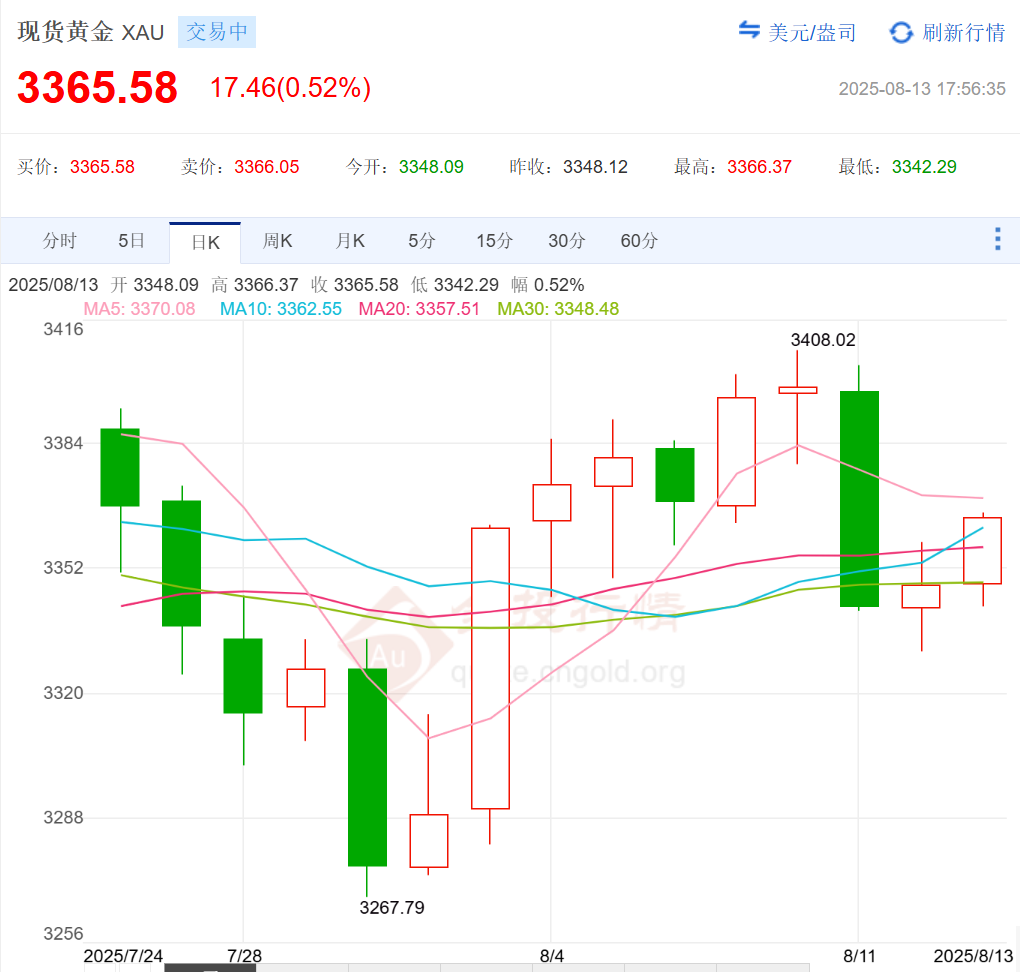
Group 1 - Recent fluctuations in gold prices have seen a significant increase followed by a decline, with prices dropping below the $3400 mark this week [1][2][3] - Last week, gold prices rose significantly, with the Shanghai gold futures price increasing by 2.22% to 787.80 CNY per gram and COMEX gold futures rising by 1.24% to $3458.20 per ounce [2] - The market is currently focused on potential interest rate cuts by the Federal Reserve, with a 95% probability of a rate cut expected in September, which may support gold prices [8] Group 2 - The recent U.S. inflation data has shown a mixed performance, with the core CPI rising to 3.1%, while the overall CPI remained stable at 2.7%, influencing market expectations for the Federal Reserve's monetary policy [6][8] - The upcoming U.S. Producer Price Index (PPI) and retail sales data are anticipated to impact gold prices, along with statements from key Federal Reserve officials [8] - Long-term outlook for precious metals remains positive due to ongoing geopolitical risks, trade tensions, and central bank gold purchases, despite short-term fluctuations [8]
美国6月PCE物价数据小幅反弹
Sou Hu Cai Jing· 2025-08-01 13:55
Group 1 - The core point of the article indicates that the U.S. June PCE price index year-on-year increased from 2.4% to 2.6%, suggesting a slight rebound in inflation, which may lead the Federal Reserve to be more cautious in its decision to restart interest rate cuts [2] - The June core PCE price index year-on-year remained stable at 2.8%, while the month-on-month index rose from 0.2% to 0.3%, indicating persistent inflationary pressures [2] - The article suggests that despite the inflation rebound, the U.S. economy is facing weak growth and potential further decline, which could lead to negative impacts if the Federal Reserve maintains high interest rates for an extended period [2] Group 2 - The author expresses skepticism about a significant rebound in U.S. inflation, emphasizing that the greater risk lies in economic downturns, which could render any accelerated interest rate cuts by the Federal Reserve ineffective [2] - A severe deterioration in the U.S. economy could lead to increased volatility in the stock market and have ripple effects on major global economies [2]

贵金属数据日报-20250619
Guo Mao Qi Huo· 2025-06-19 07:50
1. Report Industry Investment Rating - Not provided in the content 2. Core Viewpoints of the Report - In the short - term, the Israel - Iran conflict may support precious metal prices, but factors like potential trade improvement could suppress gold prices, so gold prices are expected to remain range - bound. Silver prices may continue to rise due to the conflict boosting inflation expectations and the improvement of commodity risk preferences, but the repair of the gold - silver ratio is relatively reasonable, and silver prices need to be cautious about the easing of the Middle East geopolitical situation [3]. - In the long - term, against the background of the trade war, the US economy faces a downward risk, the Fed may cut interest rates, and with global geopolitical uncertainties, great - power games, and the de - dollarization trend, central bank gold purchases continue, and the long - term upward trend of gold remains unchanged. The strategy is to allocate more on dips [3]. 3. Summary According to Related Catalogs Market Price Data - **Precious Metal Prices**: On June 18, 2025, compared with June 17, London gold spot decreased by 0.1%, London silver spot increased by 2.1%, COMEX gold decreased by 0.1%, COMEX silver increased by 2.1%, AU2508 remained unchanged, AG2508 increased by 0.0%, AU (T + D) remained unchanged, and AG (T + D) increased by 1.9% [3]. - **Price Spreads and Ratios**: The gold TD - SHFE active price spread changed by - 551.6%, the silver TD - SHFE active price spread changed by 99.1%, the gold internal - external price spread changed by 4.9%, the silver internal - external price spread changed by - 2.2%, the SHFE gold - silver ratio remained unchanged, the COMEX gold - silver ratio changed by - 9.7%, AU2512 - 2508 remained unchanged, and AG2512 - 2508 remained unchanged [3]. - **Position Data**: As of June 17, 2025, compared with June 16, the gold ETF - SPDR decreased by 0.27%, the silver ETF - SLV decreased by 0.95%, the COMEX gold non - commercial net long position decreased by 0.23%, the COMEX silver non - commercial long position increased by 3.92%, the COMEX silver non - commercial short position decreased by 12.58%, the COMEX silver non - commercial net long position increased by 0.43%, the COMEX silver non - commercial long - term position decreased by 0.40%, and the COMEX silver non - commercial short - term position increased by 9.68% [3]. - **Inventory Data**: On June 18, 2025, compared with June 17, SHFE gold inventory decreased by 0.05%, SHFE silver inventory increased by 1.15%, COMEX gold inventory decreased by 0.03%, and COMEX silver inventory decreased by 0.19% [3]. - **Other Market Data**: On June 18, 2025, compared with June 17, the dollar/yuan central parity rate increased by 0.02%, the dollar index increased by 0.69%, the US 2 - year Treasury yield decreased by 0.76%, the US 10 - year Treasury yield decreased by 1.57%, the VIX increased by 13.03%, the S&P 500 decreased by 0.84%, and NYWEX crude oil increased by 3.16% [3]. Market News and Events - On June 17, local time, Israel's war - reduction affairs minister Ron Dermer said that Israel had destroyed Iran's uranium enrichment facilities and would continue to act. Trump claimed to have full control of Iran's airspace and warned Iran to "unconditionally surrender." On June 18, Khamenei said that Iran would not surrender, and any US strike would have irreversible consequences. Also, at least three Iranian military aircraft landed in Oman, and Oman is mediating the nuclear - agreement consultations between Iran and the US [3]. - In the US, the number of initial jobless claims in the week ending June 14 was 245,000, a slight decline, remaining near an 8 - month high. The number of continued jobless claims in the week ending June 7 was 1.945 million, higher than expected but with a slight decline from the previous value [3]. Market Trends - **Short - term**: Gold prices are expected to remain range - bound, and silver prices may continue to rise but need to be cautious about the easing of the Middle East geopolitical situation [3]. - **Long - term**: The long - term upward trend of gold remains unchanged, and the strategy is to allocate more on dips [3].
市场风险偏好回升!美联储降息前景再生变
Xin Hua Cai Jing· 2025-05-13 07:25
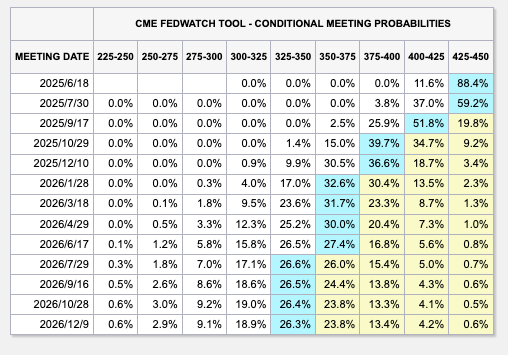
Core Viewpoint - The progress in US-China trade negotiations has led to a potential decline in the likelihood of a "stagflation" scenario in the US economy, resulting in a downward adjustment of market expectations regarding the Federal Reserve's interest rate cuts in 2025 [1] Summary by Relevant Sections Federal Reserve Interest Rate Expectations - The CME FedWatch Tool indicates that the expected interest rate cut by the Federal Reserve in 2025 has decreased from 75 basis points to 55 basis points, with the timing of the cut pushed from June to September [1] - Goldman Sachs has revised its forecast for the next rate cut from July to December, reflecting changes in the financial market environment [1] Inflation and Economic Growth - The inflationary effects from tariffs remain, with inflation expectations in the market not cooling down, complicating the Federal Reserve's ability to maintain a loose monetary policy [5] - The inflation rate is still above the Federal Reserve's target of 2%, with non-housing market service inflation at 3.4% in March, indicating upward pressure on inflation [5] - The latest tariff policies are expected to reduce US economic growth by 1-1.5 percentage points and may push core inflation up by 1-1.5 percentage points [5] Economic Downside Risks - Despite progress in trade negotiations, the risk of a downturn in the US economy persists, with Goldman Sachs estimating a 35% probability of recession in the next 12 months [7] - The effective tariff levels in the US remain significantly higher than in previous decades, which could negatively impact economic growth [7] - The average effective tariff rate in the US is currently at 17.8%, the highest level since 1934, indicating ongoing economic risks [7] Global Economic Context - The recent rebound of the US dollar index following trade negotiation progress does not change the underlying issues related to US dollar credibility and the trend of "de-dollarization" in global asset allocation [8] - A reduction in the US current account deficit could lead to decreased demand, impacting capital inflows into US assets and potentially putting long-term pressure on the dollar [8]