
美联储资产负债表缩减

Search documents
邦达亚洲:美元回落油价攀升 美元加元失守1.3600
Xin Lang Cai Jing· 2026-02-10 12:11
Group 1: Federal Reserve Insights - Federal Reserve Governor Stephen Milan stated that the Fed's balance sheet needs to be reduced, but this should not prevent large-scale asset purchases during economic crises [1][6] - Milan emphasized that reducing the balance sheet will decrease the Fed's presence in financial markets and provide policymakers with options for future crises [1][6] - He mentioned that while he supports a gradual reduction of the balance sheet, it cannot be implemented immediately due to regulatory hurdles [1][6] Group 2: Currency Market Analysis - Goldman Sachs analysts believe that Japan's more expansionary fiscal stance is likely to weaken the yen rather than support it, as increased government spending amplifies Japan's structural yield disadvantage [2][7] - The firm anticipates that the implied volatility of the USD/JPY exchange rate will rise again as investors refocus on the interplay between fiscal policy, yield differentials, and political risks [2][7] - Goldman Sachs suggests that the USD/JPY could move towards and potentially break the 160 level, with the risk of official intervention becoming a key consideration if the exchange rate remains in that range [2][8] Group 3: Gold Market Dynamics - Gold prices surged significantly, reaching a three-day high, with current trading around 5040, driven by renewed expectations of Fed rate cuts and heightened geopolitical tensions [3][9] - The ongoing accumulation of gold reserves by central banks also provides support for gold prices [3][9] - Market participants are advised to monitor resistance around 5100 and support near 4950 [3][9] Group 4: USD/JPY and USD/CAD Trends - The USD/JPY pair experienced a pullback after reaching a high, falling below the 156.00 mark and trading around 155.30, influenced by profit-taking and a weaker dollar index due to Fed rate cut expectations [4][10] - The USD/CAD pair declined, dropping below the 1.3600 level and trading around 1.3560, primarily due to the dollar index falling below 97.00 amid Fed rate cut expectations and rising oil prices due to geopolitical tensions [5][11]

宏观看客:凯文·沃什要缩减美联储资产负债表绝非易事
Xin Lang Cai Jing· 2026-02-04 19:01
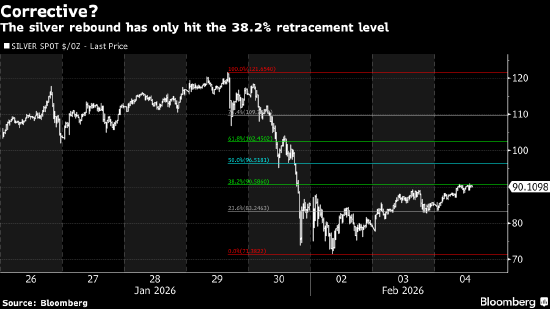
Group 1 - The recent volatility in precious metals and cryptocurrencies does not indicate a significant market dislocation, as retail buying remains strong despite fluctuations [1][6] - The S&P 500 index experienced a decline but recovered significantly by the close, suggesting resilience in the market [1][6] - Silver's remarkable rebound of 27% within two days appears to be a mere correction, with its future performance uncertain [1][6] Group 2 - The performance of cryptocurrencies indicates that speculative tools have not yet recovered, with retail buying still robust despite Bitcoin's decline [3][8] - Barclays' "retail favorites basket" index rose nearly 1.4%, while Goldman Sachs' similar index saw a smaller decline compared to the S&P 500 [3][8] - Observers attempting to link the decline in metals and other risk assets to political events lack substantial evidence, as the downturns predate these announcements [9] Group 3 - The potential new Federal Reserve chair, Kevin Warsh, may advocate for reducing the Fed's balance sheet, which could impact market dynamics [4][10] - Adjusting the composition of the Fed's balance sheet is seen as more feasible than reducing its size, which faces significant constraints [4][10] - If the Fed reduces its securities holdings while maintaining stable reserve demand, it may lead to a situation where other assets replace government bonds, keeping the balance sheet size relatively unchanged [5][11]

未知机构:JPMorgan亚太地区专业销售评论日期2026年2月1日的详细内容-20260203
未知机构· 2026-02-03 01:55
Summary of J.P. Morgan Asia Pacific Sales Commentary (February 1, 2026) Industry Overview - The document covers multiple commodity sectors including energy, mining, materials, and renewable energy [2][5] Core Insights and Arguments 1. **Macroeconomic and Policy Focus** - **Federal Reserve Chair Nomination (Kevin Warsh)**: - Market Reaction: His nomination triggered panic selling in the metals market on January 31, with silver down 27%, gold down 9%, and copper down 4% [7] - Concerns arose from his hawkish comments from 2006-2011, although recent statements have turned dovish [7] - Key Conclusion: J.P. Morgan's chief economist believes the Fed will likely remain unchanged throughout 2026 [7] 2. **Precious Metals (Gold and Silver)** - **Recent Plunge**: Attributed to severe gamma imbalance from bullish options in gold ETFs like GLD [8] - **Position Analysis**: Despite being smaller than in October 2025, traders still face a net short gamma, indicating market bubbles [8] - **Long-term View**: Structural bullish outlook on gold remains, driven by diversification and central bank purchases, with a target price of $6,000/oz by year-end [9] - **Silver Outlook**: More cautious due to industrial demand, preferring gold over silver currently [9] 3. **Base Metals (Copper)** - **Current Status**: Recent price disconnection from fundamentals, with unexpected contraction in China's manufacturing PMI and rising inventories [10] - **Market Sentiment**: Long-term investors are actively seeking buying opportunities despite short-term volatility [10] - **Support Levels**: Expected support at $12,000-$12,500/ton [11] 4. **Energy (Crude Oil)** - **Geopolitical Risks**: Reports indicate potential U.S. military action against Iran, with Brent crude prices nearing $70/barrel, including a $7 geopolitical risk premium [13] - **Market Impact**: J.P. Morgan estimates fair value for Brent at $61/barrel, expecting limited impact from any U.S. strikes on Iranian energy infrastructure [13] - **OPEC+ Outlook**: Anticipated to pause production adjustments, with Russia resuming gasoline exports, potentially pressuring gasoline crack spreads [13] 5. **China Policy (Energy Storage and Power)** - **National Capacity Pricing Policy**: New policy announced covering coal, gas, and energy storage projects, favoring storage development while negatively impacting traditional power generators [14][15] - **Impact Analysis**: Expected decline in thermal power prices by over 8% in 2026, with Longyang Electric viewed as having stable price prospects [15][17] - **Stock Recommendations**: Positive outlook on storage sector companies like Sungrow Power and CATL, with trading opportunities identified in Longyang Electric and Huaneng Power [18][19] 6. **Upcoming Key Earnings Reports (Asia Pacific)** - **Japan**: Focus on Nippon Steel, expected to raise earnings guidance due to rising U.S. hot-rolled coil prices [20] - **India**: Key companies like Tata Steel and Indian Oil Corporation will also report earnings [22] 7. **Other Market Dynamics and Data** - **China PMI**: January manufacturing PMI unexpectedly fell to 49.3, indicating contraction [22] - **Price Performance (February 1)**: - Best Performers: U.S. Natural Gas (+11.1%), Thermal Coal (+5.1%) - Worst Performers: Silver (-26.4%), Platinum (-16.9%), Gold (-8.9%) [23] Additional Important Insights - **Short-term Volatility**: Market fluctuations driven by Federal Reserve personnel changes and gold options imbalances [24] - **Long-term Logic**: J.P. Morgan maintains a bullish long-term outlook on gold and copper, viewing pullbacks as buying opportunities [24] - **Major Risks**: Potential U.S. military action against Iran poses significant geopolitical risks, contributing to oil price premiums [25] - **Policy Drivers**: China's energy storage pricing policy represents a pivotal industry event that will reshape profit dynamics in the power sector [26] - **Earnings Season Focus**: Earnings reports from Japanese (especially Nippon Steel) and Indian companies will serve as key market catalysts [27]
【经济学家:若美联储采用定期公开市场操作TOMOs,可进一步缩减资产负债表】银行业政策研究所(Bank Policy Institute, BPI)首席经济学家兼研究主管比尔·纳尔逊(Bill Nelson)认为,美联储不愿重启“定期公开市场操作”(TOMOs),阻碍了其资产负债表进一步缩...
Sou Hu Cai Jing· 2026-02-02 15:23
Core Viewpoint - The reluctance of the Federal Reserve to restart Term Open Market Operations (TOMOs) is hindering further reduction of its balance sheet, a stance based on misunderstanding [1] Group 1: Federal Reserve's Operations - The Federal Reserve cannot achieve meaningful balance sheet reduction without conducting regular open market operations [1] - To effectively reduce the balance sheet, the Federal Reserve must raise money market rates slightly above the Interest on Reserve Balances (IORB) to incentivize banks to shift funds from reserves to other liquid assets [1]
哈塞特:任命沃什是“正确的时间选了正确的人”,美联储资产负债表应““尽可能精简””
Hua Er Jie Jian Wen· 2026-02-02 01:27
Core Viewpoint - The article discusses the call from Trump's economic advisor, Hassett, for the Federal Reserve to reduce its balance sheet to the "most streamlined" level possible and supports Trump's nomination of Waller as Fed Chair, emphasizing the importance of maintaining financial stability and managing inflation and unemployment [1][2]. Group 1: Support for Waller's Nomination - Hassett strongly supports Trump's nomination of Waller for Fed Chair, describing him as a "data-driven, independent" candidate who will formulate monetary policy objectively, free from political influence [2]. - This endorsement is significant for alleviating market concerns regarding the independence of the Federal Reserve [2]. Group 2: Stance on Balance Sheet Reduction - Hassett explicitly states that the Federal Reserve should compress its balance sheet to the "most streamlined" level, aligning with the Trump administration's expectations for normalizing Fed policies [3]. - He emphasizes a return to traditional monetary policy operations, advocating for a low-key and pragmatic approach focused on statutory responsibilities [3]. Group 3: Interest Rate Outlook Warning - Hassett issues a cautious signal regarding future interest rate trends, indicating that if economic data changes significantly or inflation rises suddenly, there will be limited room to lower rates to ultra-low levels like 1% [4]. - This statement reflects the White House economic team's vigilance regarding inflation risks and aims to temper market expectations for substantial rate cuts [4].
特朗普钦点美联储新主席,几位落选热门候选人喊话:利率太高该降了
Sou Hu Cai Jing· 2026-01-30 22:17
Core Viewpoint - President Trump has nominated Kevin Warsh to be the next Chair of the Federal Reserve, replacing Jerome Powell, whose term ends in May 2026. This nomination has led to support from previously considered candidates who have criticized the current monetary policy [1]. Group 1: Support for Warsh and Criticism of Current Policy - White House National Economic Council Director Hassett expressed support for Warsh and criticized the Fed's decision to maintain interest rates in January, calling it a mistake [1][2]. - Hassett emphasized that the Trump administration aims to ease the Fed's work and believes that supply-side prosperity will provide the Fed with room to lower interest rates [2]. - Fed Governor Milan praised Warsh's innovative spirit and stated that he would continue in his role until a successor is confirmed, while also criticizing the current restrictive nature of interest rates [1][4]. Group 2: Concerns About Economic Conditions - Fed Governor Waller, who voted against maintaining interest rates, highlighted the need for further easing of monetary policy due to economic activity being constrained. He expressed concerns about the labor market's weakness, noting rising unemployment and slowing job growth [7]. - Waller indicated that upcoming data revisions might show no actual growth in wage employment last year, reflecting significant uncertainty in future job growth [7]. - He also mentioned that inflation, excluding the impact of Trump tariffs, is close to the Fed's 2% target [8].
Bessent: Goal of MBS buys is to match Fed run-off
Reuters· 2026-01-10 00:19
Core Viewpoint - The Trump administration aims to initiate mortgage-backed securities purchases to align with the rate at which these bonds are exiting the Federal Reserve's balance sheet [1] Group 1 - The U.S. Treasury Secretary Scott Bessent announced the strategy regarding mortgage-backed securities [1]

突遭“断供”!美联储,大消息!
券商中国· 2025-10-23 01:16
Core Viewpoint - The Federal Reserve faces a significant information gap as ADP Research has ceased providing employment data, which covers approximately 20% of the U.S. private sector workforce, amid a government shutdown that has already limited official economic data availability [2][4]. Group 1: Impact of ADP Data Suspension - ADP Research stopped supplying employment data to the Federal Reserve on August 28, which was previously referenced by Fed Governor Waller in a speech [4]. - The suspension of ADP data further complicates the Fed's ability to gauge the labor market in real-time, especially with the government shutdown halting most economic data releases [4][5]. - The Fed's data framework relies heavily on official data, third-party polls, and internal models, making the loss of ADP data particularly impactful [4]. Group 2: Interest Rate Expectations - Market expectations for a 25 basis point rate cut by the Federal Reserve on October 29 have risen significantly, with a 96.7% probability according to CME FedWatch [2][8]. - A survey of 117 economists indicated that 115 expect a 25 basis point cut, while some predict further cuts in December [8]. - The uncertainty surrounding future interest rates is heightened by speculation about the potential end of Fed Chair Powell's term in May 2024, leading to varied predictions for rates by the end of next year [8][9]. Group 3: Broader Economic Context - The ongoing pressure from President Trump for substantial rate cuts has raised concerns about the Fed's independence, with risks of over-lowering rates becoming more pronounced [10]. - Analysts suggest that the Fed may announce a halt to balance sheet reduction during the upcoming policy meeting, with potential for future bond purchases if year-end pressures escalate [8].

9月28日汇市晚评:美联储年内进一步降息预期降低 美元走强获得基本面支撑
Jin Tou Wang· 2025-09-28 09:30
Core Viewpoint - The foreign exchange market is experiencing fluctuations with the US dollar gaining strength due to supportive economic data and geopolitical concerns, while other currencies like the euro and pound are showing mixed trends [2][3]. Group 1: Currency Trends - The British pound against the US dollar showed a "bottoming rebound - range oscillation" pattern, while the euro against the dollar exhibited a similar "bottoming rebound - narrow oscillation" pattern [1]. - The US dollar against the Japanese yen is in a "strong trend with short-term consolidation" phase, indicating potential for further upward movement [1]. - The Australian dollar against the US dollar is in a "continuation of the downtrend + short-term support testing" stage, suggesting ongoing weakness [1]. Group 2: Economic Indicators and Central Bank Insights - Recent strong US economic data has bolstered the dollar's advantage, reducing expectations for further rate cuts by the Federal Reserve this year [2]. - Federal Reserve officials indicate that consumer spending remains healthy, but there are concerns about potential job losses affecting future spending [2]. - The European Central Bank is likely to maintain interest rates unchanged due to controlled inflation, as noted by Investec economists [2]. Group 3: Technical Analysis - For the euro/dollar pair, the MACD indicates a weak bearish structure, with potential resistance at 1.1845 and support levels at 1.1645 and 1.1573 [4]. - The pound/dollar pair has seen a significant drop, but it has not closed below the support level of 1.3332, suggesting a possible temporary halt in the downward trend [4]. - The dollar/yen pair has surpassed 149.04, indicating the end of bearish sentiment and the potential for bullish development, with resistance at 150.50 [5].
美联储威廉姆斯:美联储资产负债表缩减仍在平稳进行。
news flash· 2025-06-24 16:35
Core Viewpoint - The Federal Reserve's balance sheet reduction is proceeding smoothly, according to Williams [1] Group 1 - The Federal Reserve is actively managing its balance sheet, indicating a controlled approach to monetary policy [1] - Williams emphasized that the current pace of balance sheet reduction aligns with the Fed's overall economic strategy [1] - The ongoing process is seen as a necessary step to normalize monetary conditions after extensive quantitative easing [1]