长期利率

Search documents
银行投资观察20260308:风偏逐渐企稳,输入型通胀对长期利率影响加大
GF SECURITIES· 2026-03-08 14:28
Core Insights - The report indicates that the banking sector is showing signs of stabilization in risk appetite, with increasing input inflation impacting long-term interest rates [4][15] - The A-share banking sector has rebounded, outperforming H-shares, which have lagged behind [13][37] Section Summaries 1. Current Observation - During the observation period from March 2 to March 6, 2026, the banking sector (CITIC first-level industry) rose by 1.6%, ranking 6th among all industries and outperforming the Wind All A index, which fell by 2.3% [13] - The performance of state-owned banks, joint-stock banks, city commercial banks, and rural commercial banks varied, with changes of 3.30%, 0.98%, 1.17%, and 0.49% respectively [13] - H-shares of banks fell by 4.4%, underperforming the Hang Seng Composite Index, which dropped by 3.8% [13] 2. Investment Recommendations - The report emphasizes the importance of monitoring inflation recovery and its effects on long-term interest rates in the second quarter of 2026 [15] - It suggests that if inflation accelerates, the valuation of high-dividend and debt-like assets may be pressured, necessitating a downward adjustment of target returns for the banking sector [15] - Key recommended stocks include Ningbo Bank, China Merchants Bank, Qingdao Bank, and large state-owned banks [15] 3. Sector Performance - The banking sector's average price of convertible bonds increased by 0.11%, outperforming the China Securities Convertible Bond Index by 2.18 percentage points [14] - The report notes that the net profit growth rate and revenue growth rate expectations for A-share banks in 2025 have slightly decreased by 0.14 percentage points and 0.06 percentage points respectively compared to the previous period [14] 4. Individual Stock Performance - Among A-share banks, Chongqing Bank saw the highest increase at 12.46%, while Changsha Bank experienced the largest decline at 2.35% [13] - In H-shares, Chongqing Bank and Chongqing Rural Commercial Bank led the gains, while Zhengzhou Bank and Bank of China faced significant declines [13] 5. Valuation and Financial Analysis - As of March 6, 2026, the banking sector's latest price-to-earnings (P/E) ratio is 6.7x, and the price-to-book (P/B) ratio is 0.66x, indicating that valuations are at historical average levels [37] - The report highlights that the relative P/E and P/B ratios of the banking sector compared to the Wind All A index are 0.16 and 0.23 respectively, also aligning with historical averages [37]



美联储巴尔金:当前长期利率受美国国债供需情况驱动,随着赤字扩大,国债供应增加。
Sou Hu Cai Jing· 2026-01-06 14:38
Group 1 - The current long-term interest rates are driven by the supply and demand situation of U.S. Treasury bonds [1] - As the deficit expands, the supply of Treasury bonds is increasing [1]
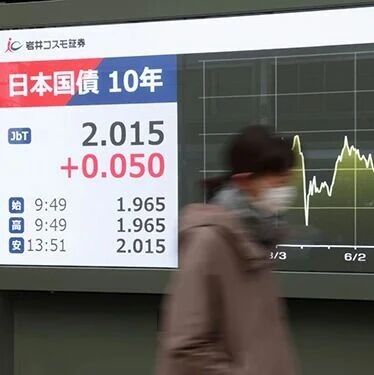
日本长期利率升至2.015%,26年来新高
日经中文网· 2025-12-19 08:00
Group 1 - Japan's long-term interest rate reached 2.015% on December 19, marking the first time it has surpassed 2% since August 1999, driven by concerns over fiscal deterioration and the Bank of Japan's interest rate hikes [2] - On December 17, the long-term interest rate hit 1.98%, the highest level since June 2007, reflecting a 0.91% increase compared to the end of 2024, influenced by fears of worsening fiscal conditions under the current government and expectations of further interest rate hikes [4] - The Bank of Japan raised its policy interest rate from 0.5% to 0.75% on December 19, the highest level in 30 years since the collapse of the bubble economy, amid ongoing inflation driven by yen depreciation [4] Group 2 - The last time long-term interest rates exceeded 2% in 2006, there were improvements in domestic economic and price outlooks, alongside heightened expectations for interest rate increases from the Bank of Japan [5] - The rise in Japan's domestic interest rates has also been influenced by increasing long-term rates in the United States [5]

谁做下一任美联储主席,摩根大通CEO戴蒙押注沃什,而非哈赛特
华尔街见闻· 2025-12-13 11:54
Core Viewpoint - Jamie Dimon, CEO of JPMorgan Chase, supports Kevin Warsh for the Federal Reserve chairmanship, believing he would be a "great chairman" and warning against Kevin Hassett's potential influence from the White House, which could undermine the Fed's independence [1][2]. Group 1: Dimon's Analysis - Dimon warns that if Hassett is appointed, he may quickly lower short-term interest rates to align with Trump's economic demands, but the Fed can only control short-term rates while long-term rates are determined by the market [2]. - Concerns arise that aggressive rate cuts under Hassett could ignite inflation expectations, leading to a rise in long-term rates, such as the 10-year Treasury yield, due to investor sell-offs [2][3]. Group 2: Market Reactions - Since reports of Hassett's candidacy emerged, the 10-year U.S. Treasury yield has increased from 4.0% to 4.2%, indicating market pricing for the associated risks [3]. - There is growing anxiety among bond market traders regarding inflation, as the 5-year forward inflation swap rate has recently risen by 0.06 percentage points, reaching a one-month high [3]. Group 3: Investor Concerns - Senior investors managing a $30 trillion U.S. Treasury market have expressed concerns to Treasury officials about Hassett's political ties to Trump, questioning the potential impact on the credibility of monetary policy [5]. Group 4: Selection Process - Trump has expressed dissatisfaction with current Fed Chair Jay Powell's policies and has indicated that loyalty and willingness to cut rates are key criteria for his selection of a new chair [7]. - The selection process, led by incoming Treasury Secretary Scott Bansen, continues, with Trump expected to interview more candidates soon [9].

下一任美联储主席候选人哈赛特生变?华尔街亮态度!摩根大通CEO戴蒙支持沃什,而非哈赛特
美股IPO· 2025-12-13 11:14
Core Viewpoint - Jamie Dimon, CEO of JPMorgan Chase, supports Kevin Warsh for the position of Federal Reserve Chair, warning that Kevin Hassett may be too compliant with the White House's interest rate reduction desires, potentially harming the Fed's independence and leading to increased long-term borrowing costs [2][3]. Group 1: Dimon's Analysis - Dimon argues that if Hassett is elected, he is likely to quickly lower short-term interest rates to align with President Trump's economic demands, but the Fed can only control short-term rates while long-term rates are determined by the market [4]. - Concerns arise that aggressive rate cuts under Hassett could ignite inflation expectations, causing long-term rates, such as the 10-year Treasury yield, to rise due to investor sell-offs [4]. Group 2: Market Reactions - Since media reports in late November indicated Hassett as a frontrunner, the 10-year U.S. Treasury yield has increased from 4.0% to 4.2%, reflecting market pricing of the associated risks [5]. - There is growing anxiety among bond market traders regarding inflation, as indicated by a rise in the 5-year forward inflation swap rate, which recently increased by 0.06 percentage points to a one-month high [5]. Group 3: Political Dynamics - Concerns about Hassett's political ties have been voiced by senior investors managing a $30 trillion U.S. Treasury market, questioning his close alignment with Trump and its potential impact on the credibility of monetary policy [7]. - President Trump has expressed dissatisfaction with current Fed Chair Jerome Powell's reluctance to implement significant rate cuts, emphasizing loyalty and willingness to lower rates as key criteria for his selection [8]. Group 4: Candidate Profiles - Kevin Hassett is viewed as a top contender, having publicly supported aggressive rate cuts and previously suggested that the reduction should be double the current level, although he claims to uphold central bank independence [10]. - Kevin Warsh, a former Fed governor and economist at the Hoover Institution, has received backing from Wall Street figures like Dimon, despite his past criticisms of the Fed and being perceived as overly hawkish before the 2008 financial crisis [10].
凌晨1:00,加速下跌,世界被骗了
Sou Hu Cai Jing· 2025-12-05 22:33
Group 1 - The market showed signs of a "silent retreat" despite a seemingly calm close, with Bitcoin testing critical support levels and institutional leverage quietly withdrawing [2] - The 10-year U.S. Treasury yield rose to 4.14%, marking the largest weekly increase since April, indicating a disconnect between long-term rates and market sentiment [2][3] - Gold prices fully retraced gains, with significant selling pressure observed before the weekend, suggesting institutional selling rather than retail activity [2] Group 2 - The S&P 500 index nearly retraced all gains, failing to reach new highs, reflecting a potential emotional peak in market sentiment [3] - A notable sell-off occurred during a low liquidity period, indicating active selling by large funds rather than passive market reactions [3] - Positive inflation indicators initially boosted market sentiment but failed to generate new buying interest, signaling a potential turning point for the market [3] Group 3 - A report titled "Global Market Strategy: 2026 Outlook" highlights the significance of the Federal Reserve's leadership change and its potential impact on the market and dollar [4] - The report includes a three-year outlook on the dollar, providing insights into potential turning points and a complete cycle roadmap [4] - Goldman Sachs' year-end stock selection letter identifies seven favored Chinese stocks and includes a list of preferred stocks in the Asia-Pacific and U.S. markets [5]
美联储官员沃勒:良好稳定的财政政策可确保长期利率稳定。
Sou Hu Cai Jing· 2025-10-16 13:56
Core Viewpoint - Federal Reserve official Waller stated that sound and stable fiscal policies can ensure long-term interest rate stability [1] Group 1 - Waller emphasized the importance of fiscal policy in maintaining stable long-term interest rates [1]
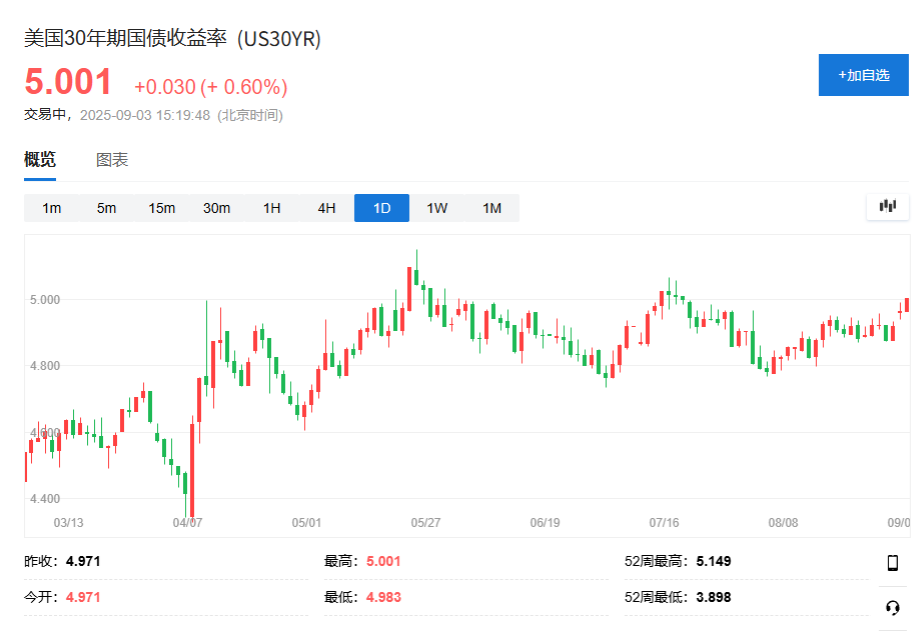
美联储决议前,美国长债收益率突破5%,释放什么信号?
Hua Er Jie Jian Wen· 2025-09-03 10:32
Core Viewpoint - The surge in long-term U.S. Treasury yields, surpassing 5%, is causing significant market volatility and raising concerns about inflation and government fiscal health, overshadowing expectations of a Federal Reserve rate cut later this month [1][4][6]. Group 1: Market Dynamics - The U.S. stock market faced pressure with the Nasdaq 100 index down 0.8% and the S&P 500 index down 0.7%, as all major tech stocks declined [1]. - The Cboe Volatility Index (VIX) has risen from its recent lows, indicating increased market risk aversion [1]. - The rise in 30-year Treasury yields is part of a broader global bond market sell-off, reflecting investor concerns over expanding budget deficits and increased bond issuance [4]. Group 2: Investor Sentiment - The 5% yield level is seen as a critical psychological threshold for investors, prompting a reassessment of high stock valuations, particularly for interest-sensitive growth stocks [1][5]. - Historical data shows that when the 30-year Treasury yield breached 5%, it led to significant market reactions, with the S&P 500 index dropping 2.3% in May after a similar rise [5]. Group 3: Economic Outlook - The current market environment is complicated by political factors, including criticism of the Federal Reserve and potential changes to tariff policies, which could impact inflation and government revenue [6]. - Rising interest rates are raising concerns about future economic growth and the implications for corporate and consumer capital costs, which could negatively affect earnings growth in an already expensive stock market [6].
美联储巴尔金:长期利率处于历史正常区间内。
Sou Hu Cai Jing· 2025-08-26 13:16
Core Viewpoint - The Federal Reserve's Barkin stated that long-term interest rates are within a historically normal range [1] Group 1 - Long-term interest rates are currently considered to be at a normal level compared to historical data [1]
专访瑞士百达美国高级经济学家崔晓:特朗普施压美联储相当于打开“潘多拉魔盒”
Di Yi Cai Jing· 2025-08-08 04:29
Core Viewpoint - The article discusses President Trump's pressure on the Federal Reserve to lower interest rates, highlighting the political dynamics and implications for monetary policy independence [1][2][10]. Group 1: Federal Reserve's Independence - Trump's attempts to influence the Federal Reserve, including the nomination of a "shadow chairman," face legal challenges due to the established independence of the Fed [4][5]. - Historical precedents show that past presidents have struggled to directly intervene in Fed policies without facing significant backlash [13][14]. Group 2: Political Pressure and Market Expectations - The political pressure from Trump may not successfully lead to immediate rate cuts, as the majority of the Federal Open Market Committee (FOMC) members remain cautious [8][9]. - Market expectations are shifting, with investors pricing in potential rate cuts after Powell's term ends, reflecting concerns over the Fed's independence [8][12]. Group 3: Potential Candidates for Fed Leadership - Several candidates for the "shadow chairman" position are discussed, with varying degrees of dovishness compared to Powell, but none are expected to fully comply with Trump's demands [6][7][8]. - The influence of these candidates on future monetary policy remains uncertain, as the ultimate decision-making power lies with Powell and the current FOMC [9][10]. Group 4: Economic Implications - Trump's strategy to lower long-term rates may backfire if it leads to increased inflation expectations, which could result in higher long-term rates instead [9][10]. - The potential for significant changes in the Fed's operational framework raises concerns about the long-term implications for monetary policy and economic stability [11][12]. Group 5: Investor Strategies - Investors are advised to consider the current environment where rate cuts are expected to be limited before Powell's departure, with more substantial cuts anticipated afterward [16][17]. - The divergence in monetary policy between the Fed and the European Central Bank (ECB) presents opportunities for investors to position themselves accordingly [16][17].