
高端定位

Search documents
大行评级丨里昂:下调海尔智家AH股目标价,维持“跑赢大市”评级
Ge Long Hui· 2026-03-30 03:23
Group 1 - The core viewpoint of the report indicates that Haier Smart Home's revenue in Q4 of last year decreased by 7% year-on-year to 68 billion yuan, while net profit fell by 39% to 2.2 billion yuan, missing the expectations of the firm [1] - Revenue in the Chinese market dropped by 15% year-on-year, primarily due to the old-for-new policy that led to demand being pulled forward in previous quarters [1] - Sales in the United States remained relatively stable, but the company was unable to pass on rising costs, including tariffs, to consumers, resulting in a significant decline in profit margins [1] Group 2 - Due to weakening demand in both China and the United States, the firm has revised its net profit forecasts for the company downwards by 25% and 21% for the next two years, respectively [1] - The target price for Haier's A-shares has been lowered from 34 yuan to 28 yuan, while the target price for H-shares has been reduced from 32 Hong Kong dollars to 25 Hong Kong dollars [1] - Despite the challenges, the firm remains optimistic about Haier's high-end positioning but believes the company needs to navigate through the cyclical downturn in these two countries to realize its value, maintaining an "outperform" rating [1]

里昂:降海尔智家(06690.HK)目标价至25港元 中国及美国市场表现双双转弱
Sou Hu Cai Jing· 2026-03-27 09:13
Core Viewpoint - The report from Citi indicates a downward revision of Haier Smart Home's net profit forecasts for the next two years by 25% and 21% due to weakening demand in China and the United States [1] Group 1: Financial Projections - Haier Smart Home's A-share target price has been reduced from 34 RMB to 28 RMB [1] - The H-share target price has been lowered from 32 HKD to 25 HKD [1] Group 2: Market Performance - As of March 27, 2026, Haier Smart Home's stock closed at 21.88 HKD, down 4.12%, with a trading volume of 59.7053 million shares and a turnover of 1.286 billion HKD [1] - The stock has not received any ratings from investment banks in the past 90 days, indicating low attention from analysts [1] Group 3: Company Positioning - Haier Smart Home holds a market capitalization of 65.119 billion HKD, ranking second in the white goods industry [1] - The company maintains a positive outlook on its high-end positioning but needs to navigate through the cyclical downturn in China and the U.S. to realize its value [1]


里昂:降海尔智家目标价至25港元 中国及美国市场表现双双转弱
Zhi Tong Cai Jing· 2026-03-27 08:39
Core Viewpoint - The report from Citi indicates a downward revision of Haier Smart Home's net profit forecasts for the next two years by 25% and 21% due to weakening demand in China and the United States, while maintaining a "outperform" rating on the stock [1] Financial Performance - Haier Smart Home's revenue in the fourth quarter of last year decreased by 7% year-on-year to 68 billion RMB [1] - The net profit for the same period fell by 39% to 2.2 billion RMB, which was below the bank's expectations [1] Market Analysis - Revenue from the Chinese market dropped by 15% year-on-year, primarily due to the early release of demand driven by the trade-in policy [1] - Sales in the United States remained relatively stable, but the company was unable to pass on rising costs, including tariffs, to consumers, resulting in a significant decline in profit margins [1] Target Price Adjustments - The target price for Haier Smart Home's A-shares was lowered from 34 RMB to 28 RMB [1] - The target price for its H-shares was reduced from 32 HKD to 25 HKD [1] Strategic Outlook - Despite the current challenges, the company is still viewed positively for its high-end positioning, but it needs to navigate through the cyclical downturn in the two major markets to realize its value [1]
老铺黄金(06181):26Q1业绩高增,品牌高端定位巩固
Guolian Minsheng Securities· 2026-03-25 14:46
Investment Rating - The report maintains a "Buy" rating for the company [2][8]. Core Insights - The company has demonstrated significant revenue growth, with a 2025 revenue of 27.30 billion RMB, reflecting a year-over-year increase of 221% [8]. - The adjusted net profit for 2025 reached 5.03 billion RMB, marking a year-over-year growth of 234.9% [8]. - The company is expanding its high-end brand positioning, with a notable increase in loyal membership, reaching 610,000 members by the end of 2025, up by 260,000 from the previous year [8]. - The company is actively expanding its store network and optimizing existing stores, contributing to revenue growth [8]. - The overseas market expansion has also shown substantial growth, with overseas revenue increasing by 361.02% in 2025 [8]. Financial Forecasts - Projected revenues for 2026, 2027, and 2028 are 38.24 billion RMB, 47.04 billion RMB, and 54.11 billion RMB, respectively, with growth rates of 40%, 23%, and 15% [2][8]. - The expected net profits for the same years are 7.06 billion RMB, 8.87 billion RMB, and 10.33 billion RMB, with growth rates of 45.1%, 25.6%, and 16.4% [2][8]. - The earnings per share (EPS) are forecasted to be 39.97 RMB, 50.18 RMB, and 58.42 RMB for 2026, 2027, and 2028, respectively [2][8]. - The price-to-earnings (P/E) ratio is projected to decrease from 21 in 2025 to 10 by 2028 [2][8].
Lululemon核心市场承压,品控失控是产能转移后遗症?
3 6 Ke· 2026-02-04 11:18
Core Viewpoint - Lululemon is facing significant challenges due to recurring product quality issues, particularly highlighted by the recent "GetLow" yoga pants controversy, which has raised concerns about the brand's quality control and market performance [1][2][4]. Product Quality Issues - The "GetLow" yoga pants, priced around 780 yuan, were found to have severe transparency issues during common movements, leading to consumer complaints and viral discussions on social media platforms [2][4]. - This incident marks the third major quality controversy for Lululemon in a decade, following similar issues in 2013 and 2024, indicating a pattern of quality control failures [4][5]. Financial Performance - Lululemon's financial results for Q3 2025 showed a net revenue increase of approximately 7% to about $2.6 billion, but net profit declined by about 12.8% to approximately $307 million, with a gross margin decrease of about 290 basis points to 55.6% [11][12]. - The Americas market, which is Lululemon's core region, experienced a 2% decline in net revenue, marking the first quarterly revenue drop since 2018 [9][11]. Market Dynamics - Despite a 46% revenue growth in mainland China, this region accounted for less than 20% of total revenue, indicating limited impact on overall performance [11][12]. - Increased competition from local brands in China, such as Li Ning and Anta, poses a significant threat to Lululemon's market share, particularly with products that offer better fit and value [12][13]. Strategic Challenges - Lululemon's reliance on a few core products, such as the Scuba hoodie, has led to stagnation in consumer interest, as noted by the CEO [12][13]. - The acquisition of the Mirror brand has not yielded expected synergies and has instead become a financial burden, contributing less than 3% to total revenue in 2025 [12][13]. Quality Control and Cost Management - The brand's shift of production to Southeast Asia, where labor costs are significantly lower, has raised concerns about quality control, as factories may prioritize output over material quality [5][7]. - The founder's criticism of management for lowering material standards highlights a disconnect between high profit margins and quality control investments [7][13].

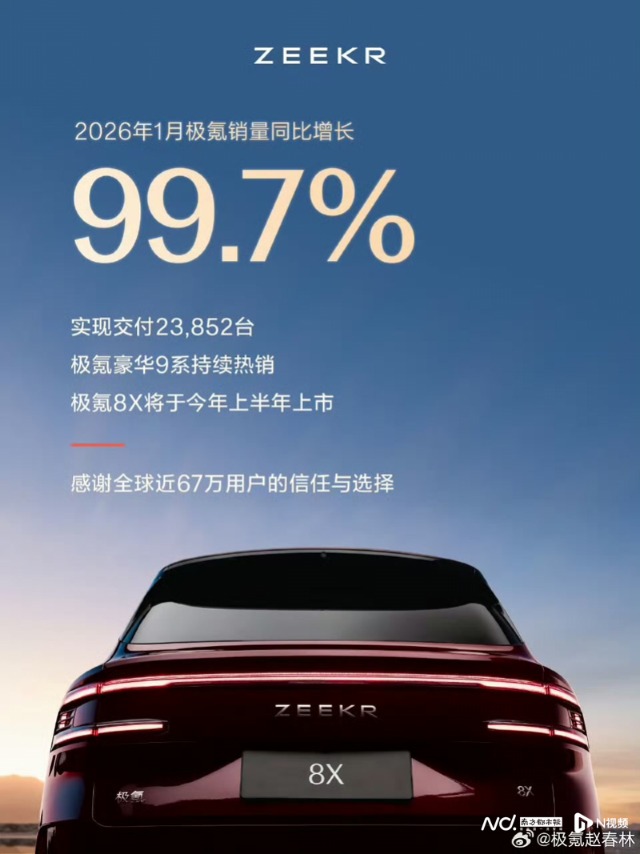
9X持续热销、8X上市在即 极氪1月销量同比增长99%
Nan Fang Du Shi Bao· 2026-02-01 13:38
Group 1 - The core point of the articles highlights the strong sales performance of the Zeekr brand in January, with a total delivery of 23,852 units, representing a year-on-year growth of 99.7% [2] - The flagship SUV Zeekr 9X has maintained high market interest since its launch in September 2022, achieving the sales champion in the 500,000-level large SUV category for two consecutive months in late 2025 [2] - The luxury MPV Zeekr 009 has been the number one in sales for MPVs priced above 400,000 for two consecutive years and has gained recognition in international markets, including Hong Kong and Southeast Asia [3] Group 2 - The upcoming model Zeekr 8X is set to launch in the first half of this year, targeting the 450,000-level high-performance hybrid SUV market, aiming to compete with major performance models from BMW, Mercedes-Benz, and Audi [3] - Zeekr has expanded its presence to over 50 countries and regions globally, with cumulative sales nearing 670,000 units, demonstrating its international delivery capabilities across five continents [3] - The brand has participated in global events like CES for four consecutive years, showcasing its commitment to "technology export" and "high-end positioning" in the global market [3]
调研速递|伟星新材接待摩根基金等3家机构调研 竞争优势多元 平均分红率70%-80%
Xin Lang Zheng Quan· 2025-12-28 15:23
Core Insights - Zhejiang Weixing New Materials Co., Ltd. (Weixing New Materials) held an investor relations activity on December 25, 2025, engaging with institutions such as Morgan Fund, Huaxia Fund, and Huayuan Securities to discuss key topics including manufacturing philosophy, competitive advantages, pricing strategies, industry demand outlook, and dividend policies [1][2][4] Group 1: Manufacturing and Competitive Advantages - The company attributes its advanced manufacturing automation to two main factors: a corporate culture focused on "long-term sustainable development" and a high demand for quality products driven by market competition [3] - Weixing New Materials has developed strong core competitiveness over more than 20 years, characterized by excellent brand operation, strong marketing capabilities, robust R&D strength, and a solid corporate culture with an outstanding management team [3] Group 2: Pricing Strategy and Sales Channels - The company employs a diversified retail strategy, selling through home decoration companies, project managers, and direct purchases by homeowners, with varying channel proportions across regions [3] - The pricing strategy is based on a "three high positioning" approach, emphasizing that price reductions are not the optimal choice for market expansion, and the company aims to maintain a difficult yet correct strategic path [3] Group 3: Financial Performance and Future Outlook - Sales expenses have increased due to intensified market competition and higher marketing and service investments, along with the impact of the acquisition of Zhejiang Keri, but the company plans to optimize its expense ratio in the medium to long term [3] - The company acknowledges weak market demand in Q4 and maintains a cautious outlook for industry demand in 2026, linking retail business demand to economic conditions and consumer confidence, while also noting potential positive impacts from policy changes in the new five-year plan [3] Group 4: Business Development and Dividend Policy - The company has over 1,000 first-level distributors and more than 30,000 terminal marketing outlets, indicating a stable channel network [3] - Weixing New Materials has consistently implemented cash dividends since its listing, with an average payout ratio of 70%-80%, and will continue to follow its profit distribution plan based on various factors [3] Group 5: Strategic Business Focus - The waterproof business model is mature, and the company plans to increase market expansion efforts, while the water purification business is still in the optimization phase [3] - The company has fully recognized goodwill impairment of 21.261 million yuan for Guangzhou Hexin in 2024 and has decided not to increase investment in Dongpeng Heli Fund, planning to exit once existing projects conclude [3]

一年关店超600家:重回高端的喜茶,艰难前行的加盟商
3 6 Ke· 2025-12-17 11:53
Core Insights - The core point of the article is that Heytea has experienced significant growth in store numbers but is now facing challenges with its franchise model, leading to a strategic shift towards maintaining quality and high-end positioning while managing franchisee pressures [1][9][29]. Expansion and Franchise Strategy - Heytea's store count increased from under 900 to over 3200, with more than 2300 being franchise stores, marking a successful phase in its franchise strategy [1]. - The franchise model was initiated in November 2022 to expand into more markets [2]. - However, the expansion faced difficulties, leading to a suspension of the franchise business in February 2023 and franchisees expressing the need for more support from the brand [3][19]. Store Closures and Challenges - Over the past year, Heytea closed more than 650 stores, indicating a high closure rate within the industry [4][6]. - The reasons for store closures include contract expirations and poor performance, with franchisees facing significant pressure due to high standards and a competitive market [6][10]. - Monitoring data shows a rapid shift from expansion to contraction, with a net closure of 680 stores projected by October 2025 [9][10]. Franchisee Experience and Pressure - Franchisees report high entry costs and operational pressures, with some considering not to renew contracts due to financial strains [12][19]. - The operational demands from Heytea, including strict adherence to quality standards, have led to high turnover rates among employees, further complicating franchisee operations [17][19]. Market Position and Competition - Heytea's market position has weakened compared to competitors, with other brands like Mixue and Gu Ming rapidly expanding their store counts [24][25]. - The company is exploring alternative expansion strategies, including smaller store formats and international markets, to maintain its brand quality while adapting to market conditions [26][28]. High-End Positioning and Product Strategy - Heytea aims to return to a high-end market position, focusing on product quality and customer experience, despite the challenges of competing in a price-sensitive market [29][33]. - The company has introduced new products with high-quality ingredients, but faces difficulties in maintaining premium pricing due to market competition [34][36]. - The brand's commitment to high standards is evident in its operational practices and product offerings, although achieving this in a competitive landscape remains challenging [39].

一副耳机卖5万!海菲曼过会北交所:高毛利神话下亦有隐忧
Nan Fang Du Shi Bao· 2025-12-11 09:40
Core Viewpoint - The company, Kunshan Haifiman Technology Group Co., Ltd., known as the "Hermès of headphones," is making a significant impact in the high-fidelity audio sector with impressive profitability as it prepares for its IPO on the Beijing Stock Exchange [1] Group 1: Financial Performance - The company reported comprehensive gross margins of 65.06%, 68.18%, and 70.10% for the years 2022 to 2024, outperforming competitors like Edifier and HiVi, and approaching the margins of Kweichow Moutai in certain years [1] - The company's overseas revenue consistently accounts for over 65% of its main business income, primarily from developed markets such as the US, Europe, Japan, and South Korea, where consumers exhibit a high willingness to pay for quality audio experiences [3] - In 2024, the company's overseas business gross margin reached 77.35%, significantly higher than the domestic margin of 55.81% [3] Group 2: Product Strategy - The company has established a product matrix covering mid to high-end markets, with headphone prices ranging from 1,329 yuan to 56,000 yuan [3] - The high-end headphones segment remains a cornerstone of the company's revenue, generating sales of 1.07 billion yuan, 1.35 billion yuan, 1.49 billion yuan, and 714.13 million yuan over the reporting periods [3] - The average selling price of the company's headphones has remained around 2,000 yuan, with sales of products priced above 2,000 yuan consistently accounting for over 60% of total sales [4] Group 3: Marketing and R&D Expenditure - The company's sales expense ratio was significantly higher than industry peers, at 19.75%, 18.85%, and 19.99% from 2022 to 2024, compared to an average of 10% to 12% for comparable companies [5][6] - In contrast, the company's R&D expense ratio has been declining, recorded at 5.66%, 5.20%, and 4.93%, which is below the industry average of approximately 6.7% [6] Group 4: Supply Chain and Production Challenges - The company employs a "self-production primarily, outsourcing secondarily" model, yet the outsourcing costs have consistently accounted for about 20% of the main business costs, surpassing labor and manufacturing costs combined in 2022 and 2023 [7] - There is a notable discrepancy between the increase in procurement costs from its main outsourcing partner, Dolphin Communications, and the decline in production volume of true wireless headphones, which fell by approximately 25.2% in 2024 [8] Group 5: Future Outlook and Challenges - The company plans to raise 243 million yuan through its IPO to enhance production capacity for advanced acoustic components and finished products, aiming to address supply chain concerns and reduce reliance on outsourcing [9] - Balancing marketing and R&D investments, finding equilibrium between niche and mass markets, and clarifying supply chain compliance will be critical challenges for the company post-IPO [9]
全球最大冰淇淋公司上市,对中国市场影响几何?丨消费参考
2 1 Shi Ji Jing Ji Bao Dao· 2025-12-09 03:09
Group 1 - The world's largest ice cream company, Dream, officially listed on December 8, trading on the Amsterdam Euronext, London Stock Exchange, and New York Stock Exchange [1] - After its spin-off from Unilever, Dream became an independent ice cream giant, owning well-known brands such as Dream, Cornetto, and Ben & Jerry's [1] - According to Unilever, Dream's ice cream business is projected to generate €7.9 billion (approximately ¥66.6 billion) in revenue and an adjusted EBITDA of €1.3 billion (approximately ¥11 billion) in 2024, holding a 21% market share in the global ice cream retail market [1] Group 2 - In China, Dream ranks as the second-largest ice cream company, with a market share of approximately 11%, while its brands, Cornetto and Dream, are positioned fourth and fifth in the market [3] - The Chinese ice cream market is highly competitive, with Dream focusing on a premium positioning strategy [4] - Despite the competitive pressure, the domestic market is recovering, with Dream's revenue in China expected to reach €317 million (approximately ¥2.6 billion) in 2024 and €270 million (approximately ¥2.2 billion) in the first half of 2025, indicating double-digit growth [5][6] Group 3 - Dream's CEO expressed the need to increase growth rates by 1% to 2% to meet market demands [5] - The company has increased its advertising and promotional expenses by €5 million to enhance its presence in China through social media and digital marketing [6] - The ongoing trend of cost-effectiveness in the domestic market poses growth challenges for Dream's premium positioning [7]