特朗普关税政策

Search documents
闫瑞祥:黄金狂飙屡创新高,欧美日线阻力对决
Sou Hu Cai Jing· 2025-04-01 03:17
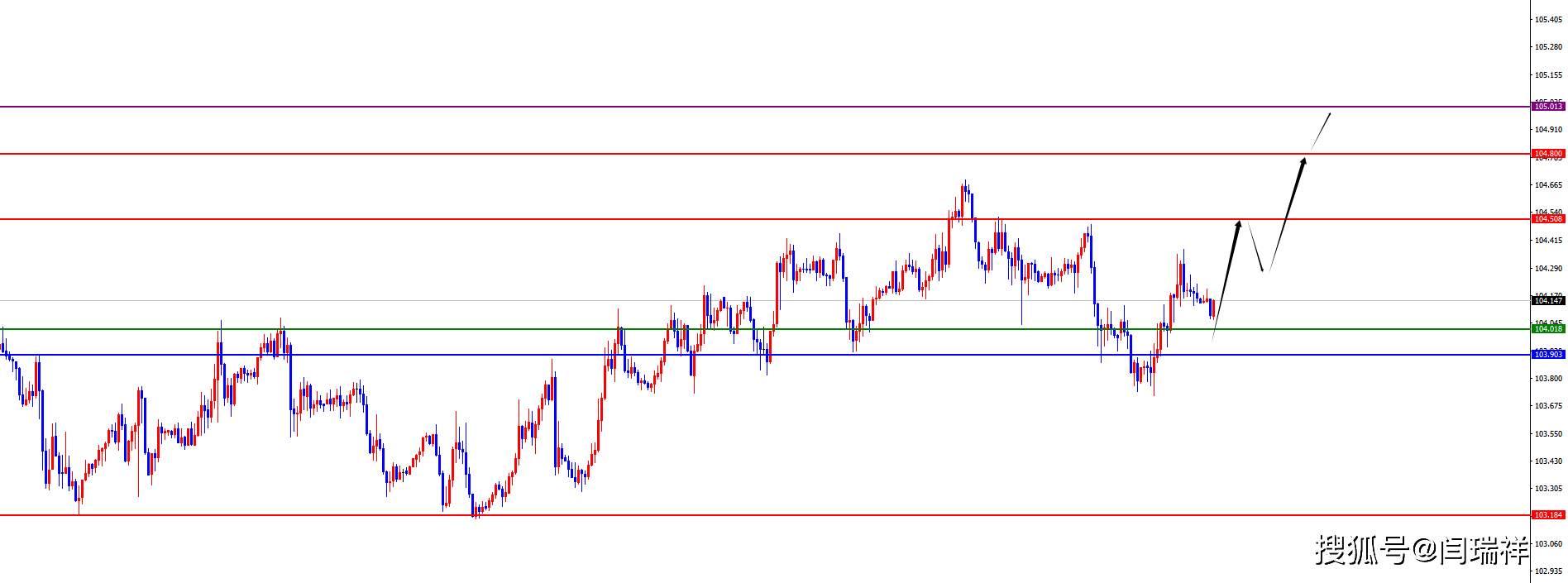
2025 年第一季度,特朗普关税政策的不确定性严重冲击美国股市。预计 4 月 2 日宣布对等关税,3 日汽车关税生效,引发全球贸易战担忧,扰乱股市。标普 500 指数、纳斯达克指数录得 2022 年以来最差季度表现,3 月大幅下跌,一季度分别急跌 4.6%、暴跌 10.5%,道琼斯工业指数下滑 1.3%。股市大跌促使黄 金避险买需增加,金价 2024 年涨超 27%,今年一季度又涨约 19%,还得益于有利货币政策、央行买盘及对交易基金的需求。纽约联储主席威廉姆斯认为货 币政策位置良好,里奇蒙联储主席巴尔金称降息看通胀。华尔街大行上调金价预期,高盛预计极端情况下未来 12 个月金价破 4500 美元。此外,投资者关注 美联储货币政策,本周非农报告、本交易日的 ISM 制造业 PMI 和 JOLTs 职位空缺等数据,将影响市场走势与投资者决策。 美元指数 美元指数方面,周一美元指数价格总体呈现上涨的状态。当日价格最高上涨至104.374位置,最低于103.722位置,收盘于104.157位置。回顾周一美指价格表 现,早间开盘后价格短线先承压下跌,随后欧盘再度发力突破早盘高点位置,之后美盘再度发力上行,最终看日线级 ...

纳斯达克一季度跌10.5%:特斯拉跌36%,英伟达跌20%
Guan Cha Zhe Wang· 2025-04-01 01:44
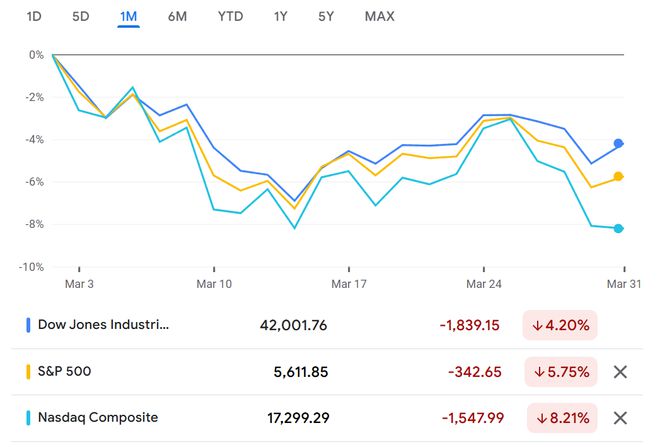
Group 1 - The U.S. stock market experienced significant declines in the first quarter, with the Nasdaq index dropping 10.5%, marking its worst quarterly performance since 2022 [1] - The S&P 500 index fell by 4.6%, while the Dow Jones Industrial Average decreased by 1.3% during the same period [1] - In March alone, the Nasdaq and S&P 500 indices suffered their largest monthly percentage declines since December 2022, with drops of 8.21% and 5.75% respectively [1] Group 2 - The sell-off in growth-oriented technology stocks heavily impacted the U.S. stock market, particularly affecting the "Big Seven" tech companies, with Tesla down nearly 36% and Nvidia down nearly 20% in the first quarter [3] - The information technology and consumer discretionary sectors within the S&P 500 saw double-digit declines, while the energy sector managed to rise by 9.3% during the same period [3] - Due to uncertainties surrounding Trump's tariff policies, Goldman Sachs raised the probability of a U.S. economic recession from 20% to 35% and lowered its year-end target for the S&P 500 index to 5700 [3]

冲上热搜!金价,涨爆了!网友:雷军能不能把价格打下来?
券商中国· 2025-03-31 06:27
Core Viewpoint - The article highlights the rising global risk aversion leading to a continuous increase in gold prices, with significant geopolitical tensions and trade policy uncertainties driving this trend [1][3][8]. Group 1: Gold Price Trends - As of March 31, the spot gold price reached a record high of $3120 per ounce, marking an increase of 1.1% on that day, while COMEX gold futures surpassed $3140 per ounce, also setting a new historical peak [3]. - Year-to-date, both spot gold and COMEX gold futures have seen an increase of over 18%, significantly outperforming major global stock indices [3]. Group 2: Geopolitical Influences - Recent statements from U.S. President Trump regarding threats to Russia and Iran have intensified market risk aversion, contributing to the surge in gold prices [3][4]. - Trump's comments included potential secondary tariffs on Russian oil and military threats against Iran, which have heightened geopolitical tensions [3]. Group 3: Economic Indicators and Market Reactions - The core PCE inflation rate for February rose by 2.8% year-on-year and 0.4% month-on-month, exceeding expectations, which has led to increased concerns about inflation and potential stagflation [4]. - Anticipation of upcoming tariffs and economic reports has caused global stock markets to decline, with fund managers reducing portfolio risks in response to the uncertain economic outlook [6][7]. Group 4: Future Outlook - Analysts expect that the combination of rising inflation and geopolitical tensions will maintain upward pressure on gold prices in the medium to long term [4][8]. - The potential for retaliatory measures from U.S. trade partners could further exacerbate market volatility, reinforcing the demand for safe-haven assets like gold [8].
昨夜,美股全线重挫!中概股也普跌
证券时报· 2025-03-29 00:21
在"特朗普关税"即将来临之际,美国股市遭遇重挫。 当地时间3月28日,美国三大股指全线收跌。道琼斯工业指数跌1.69%,报41583.90点;纳斯达克综合指数跌2.70%,报17322.99点;标普 500指数跌1.97%,报5580.94点。 | 名称 | 现价 | 涨跌 | 涨跌幅 | 年初至今 | | --- | --- | --- | --- | --- | | 道琼斯工业指数 | 41583.90 | -715.80 | -1.69% | -2.26% | | 纳斯达克指数 | 17322.99 | -481.04 | -2.70% | -10.29% | | 标普500 | 5580.94 | -112.37 | -1.97% | -5.11% | 银行股集体下跌,摩根大通、高盛、花旗、富国银行跌超2%,摩根士丹利、美国银行跌超3%。 能源股普遍下跌,西方石油跌超1%,埃克森美孚、雪佛龙、康菲石油、斯伦贝谢微跌。 航空股表现疲软,达美航空跌超5%,美联航跌逾4%,美国航空跌近4%,波音跌超3%,西南航空跌近1%。 对于美股市场的下跌,有分析人士指出,特朗普关税政策的不确定性、美国通胀依旧高涨、个人 ...
洪灝:当下市场的主要矛盾
2025-03-28 03:31
Summary of Key Points from the Conference Call Industry or Company Involved - The discussion primarily revolves around the U.S. stock market, particularly the S&P 500 index, and its recent performance trends. The focus is also on the implications of U.S. tariffs on copper prices and the broader economic landscape. Core Points and Arguments - The U.S. stock market experienced a strong rebound after four weeks of decline, with the S&P showing a slight increase last week despite daily fluctuations exceeding one percentage point [2][3] - A technical analysis indicated a "death cross" pattern in major indices, where the 50-day moving average fell below the 200-day moving average, raising concerns about market stability [2] - The rebound was largely driven by major technology stocks, with Tesla experiencing a significant 12% increase, marking its largest single-day gain since November [2] - There is a notable divergence between institutional investors ("smart money") and retail investors ("dumb money"), with retail investors significantly increasing their positions in index funds and Tesla, while institutional positions are being reduced [3] - Historical analysis suggests that understanding market cycles is crucial, with key points identified in February 2021 and October 2022, indicating potential future trends [5] - The copper market is highlighted as a critical indicator of economic health, with prices reaching historical highs, suggesting a recovery in the economy despite the downturn in U.S. stock prices [6][7] - The upcoming U.S. tariffs on copper imports are expected to increase domestic prices, leading to a potential supply shortage and impacting the broader market dynamics [7][8] - The market is currently facing uncertainty regarding economic growth, exacerbated by the potential impact of tariffs on inflation and monetary policy [6][8] - The concentration of market capitalization in the top ten U.S. stocks is at an all-time high, raising concerns about market valuation and the sustainability of the current rebound [9] - The next critical time node for market evaluation is projected around October, indicating a potential shift in market dynamics [9] Other Important but Possibly Overlooked Content - The discussion emphasizes the importance of historical context in market analysis, noting that while history may not repeat itself, it often rhymes, which is vital for understanding current market conditions [4] - The potential for a "stagflation" scenario, where inflation rises alongside stagnant economic growth, is highlighted as a significant risk for the capital markets [6][8] - The divergence in tariff expectations between U.S. markets and international markets could lead to significant volatility, particularly if the tariffs are less severe than anticipated [8]
特朗普关税政策推高黄金
Jin Tou Wang· 2025-03-28 02:21
Group 1 - The core viewpoint of the articles highlights the impact of Trump's tariff policies on gold prices, with gold trading at $3075.94 per ounce, reflecting a 0.64% increase [1] - The 25% tariff on automobiles is likened to a stone thrown into the global economic lake, creating ripples that affect various economic factors [1] - The Federal Reserve faces unprecedented policy dilemmas due to potential inflationary pressures from tariffs and the risk of economic growth slowdown [1] Group 2 - Gold prices have shown a rebound after a brief decline, with potential to reach resistance levels between $1348 and $2075 [2] - If gold fails to break through resistance, there is a risk of a pullback to trendline support, which could present a buying opportunity [2] - The short-term outlook for gold remains bullish, with key support levels identified at the 5-10 day moving averages [2]
美股史上最快暴跌之一!关税风暴下,如何抓住波动机遇?
RockFlow Universe· 2025-03-27 10:33
Core Viewpoint - The recent rapid decline in the US stock market, characterized as one of the fastest in history, is primarily driven by uncertainties surrounding Trump's tariff policies, weak economic data, and heightened market panic. The market has lost over $4 trillion in value, erasing gains made since Trump's election in November 2024 [2][3][24]. Group 1: Causes of the Market Decline - The S&P 500 index officially dropped over 10% as of March 13, marking a significant adjustment within just 16 trading days, one of the fastest declines recorded [7][24]. - Historical patterns indicate that extreme downturns are often triggered by policy shocks or systemic risks, with the current situation resembling the market turbulence seen during the 2018 trade war [24]. - Key factors contributing to the current market turmoil include: 1. Trump's frequent references to tariff policies, which have increased corporate costs and heightened trade uncertainties, threatening economic growth [8][9]. 2. Weak economic indicators since February, showing a slowdown in growth, rising inflation pressures, and declining consumer confidence [8][9]. 3. Deteriorating market sentiment, with the CNN Fear & Greed Index dropping to 21, indicating extreme fear among investors [9]. Group 2: Historical Context and Comparisons - Since 1950, there have been 40 instances where the S&P 500 index has corrected by more than 10%, with only six of these occurring within 20 days, highlighting the severity of the current situation [7][8]. - The article draws parallels between the current market conditions and previous downturns, such as the 2008 financial crisis and the 2020 COVID-19 pandemic, which were also marked by significant policy and economic uncertainties [8][9]. Group 3: Strategies for Navigating Market Volatility - The RockFlow research team suggests several strategies for investors to navigate the current volatility: 1. Implementing long-short strategies using inverse ETFs to capitalize on market reversals [17]. 2. Utilizing volatility strategies to take advantage of increased market fluctuations, particularly through VIX-related instruments [19]. 3. Employing "small bear insurance" by purchasing put options to hedge against short-term declines while maintaining long-term positions [21][23]. 4. Utilizing "bottom-fishing" tools to identify and invest in undervalued assets during market downturns [24].

晨报|对等关税/深海科技/MLF改革
中信证券研究· 2025-03-25 00:14
Group 1: Overseas Policy and Tariffs - The article suggests that April may be a critical time for the implementation of Trump's tariff policies, with key events such as the results of the "America First Trade Policy Memorandum" and the introduction of "reciprocal tariffs" [1] - It is noted that "reciprocal tariffs" should be viewed differently from tariffs on China, as their primary goal is to pressure trade partners to lower tariffs on U.S. goods rather than imposing universal tariffs globally [1] - The article indicates that the 20% tariffs imposed on China are more a reflection of U.S. domestic politics, and that negotiations between the U.S. and China may become more substantive after April [1] Group 2: Deep Sea Technology - Deep sea technology has been included in the government work report for the first time, highlighting its importance and potential for development [3] - The investment landscape for deep sea technology is expected to benefit from supportive local policies, with a focus on the entire industry chain from core components to operational services [3][4] - The article emphasizes that the deep sea technology sector is positioned similarly to low-altitude economy and commercial aerospace, suggesting significant growth potential [4] Group 3: Monetary Policy and Economic Cycles - The article discusses the shift in MLF operations to a multi-price bidding model, which may reduce funding costs for banks and stabilize market expectations [8][10] - It is anticipated that if economic momentum weakens due to tariffs and other factors, the central bank may consider further monetary easing measures [10] Group 4: Solid-State Battery Development - The Zhuhai government has released an action plan for solid-state battery development, setting clear timelines for industry growth and production targets [12][13] - The plan aims to establish a solid-state battery industry cluster by 2027 and achieve mass production by 2030, indicating strong governmental support for this sector [12] Group 5: Water Pricing Reform - Shenzhen is set to hold a hearing on water price reform, with proposed increases of 13%, which could alleviate cost pressures on local water supply companies [14] - The article suggests that successful price adjustments in major cities could catalyze similar reforms across the country, improving the long-term returns of the water supply industry [14] Group 6: Alcohol Industry Insights - The Spring Sugar Conference showed stable performance in the alcohol sector, with a narrowing decline in sales for major brands like Moutai and Wuliangye, indicating a potential bottoming out of the market [16] - The article recommends increasing investments in quality assets within the alcohol industry, considering the recovery potential and current valuations [16]


深夜,全线大涨!
券商中国· 2025-03-24 15:16
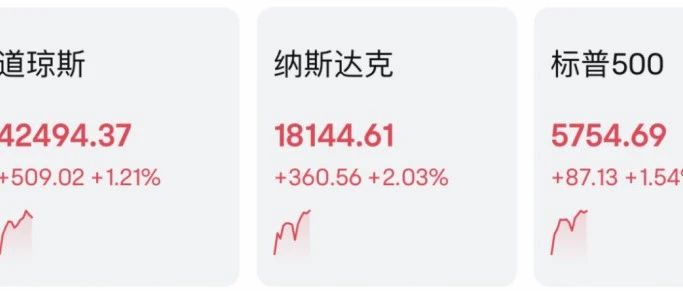
Core Viewpoint - The U.S. stock market staged a strong rebound, with major indices experiencing significant gains, driven by optimism surrounding potential changes in tariff policies announced by the Trump administration [2][5]. Group 1: Market Performance - The three major U.S. indices opened high and continued to rise, with the Dow Jones up 1.21%, Nasdaq up 2.03%, and S&P 500 up 1.54% [5]. - Major tech stocks saw substantial increases, with Tesla rising over 10%, Amazon up over 3%, and other companies like Nvidia, Google A, TSMC ADR, and Broadcom rising over 2% [6]. Group 2: Investment Trends - Investors are currently ignoring the risks posed by a potential full-scale trade war, as significant capital continues to flow into global equity markets. In the week ending last Wednesday, global equity funds saw an inflow of approximately $43.4 billion, the highest level this year [3][10]. - Retail investors in the U.S. have been actively buying Tesla shares, with a cumulative investment of $8 billion over 13 consecutive trading days, marking the largest inflow since 2015 [3][10]. - South Korean investors have also been heavily investing in U.S. stocks, with a net investment of $2.2 billion in Tesla shares this year, making it the most popular trade among them [11]. Group 3: Tariff Policy Insights - The Trump administration's upcoming tariff policy, set to be announced on April 2, is expected to be more targeted than previously suggested, which has contributed to market optimism [7][8]. - Officials have indicated that the new tariffs may exclude certain countries and will not simply be an addition to existing steel and aluminum tariffs, particularly regarding the automotive and semiconductor sectors [7][8].

刚刚!全线大反攻,A50飙涨!
券商中国· 2025-03-24 08:56
Core Viewpoint - Chinese assets are experiencing a broad-based rebound, with optimistic outlooks from various institutions regarding future performance [2][8]. Market Performance - A-shares and Hong Kong stocks saw a recovery, with major indices turning positive; the Hang Seng Tech Index rose over 2% at one point [2][4]. - A-shares closed with the Shanghai Composite Index up 0.15%, Shenzhen Component Index up 0.07%, and ChiNext Index up 0.01% [4]. - In the Hong Kong market, the Hang Seng Tech Index increased by 1.72%, the Hang Seng Index by 0.92%, and the Hang Seng China Enterprises Index by 1.27% [4]. Sector Highlights - Cyclical stocks, particularly in the non-ferrous metals sector, showed strong performance, with copper stocks leading the gains [4]. - Companies like Jiangxi Copper and Luoyang Molybdenum saw significant increases in their stock prices, driven by expectations of a long-term bull market in copper due to rising electrification demand [4]. Fiscal Policy Insights - The Ministry of Finance released a report indicating that fiscal policy in 2025 will be more proactive, focusing on increasing the fiscal deficit ratio and government bond issuance [5][6]. - Key areas of focus include optimizing expenditure structure, enhancing local financial support, and promoting domestic demand and consumption [5][6]. Future Outlook - Institutions like Huatai Securities maintain a positive outlook on Chinese assets, citing strong earnings from major tech companies and the potential for AI-driven investments to boost domestic demand [8]. - The report suggests that the market may see a rebalancing of styles, focusing on stable earnings and free cash flow, while technology remains a key theme [9]. - Concerns about increased volatility during the earnings season are noted, with a potential shift from valuation-driven to fundamentals-based pricing [9].