
可穿戴智能设备制造

Search documents
视涯科技(688781) - 视涯科技首次公开发行股票科创板上市公告书
2026-03-23 11:16
股票简称:视涯科技 股票代码:688781 视涯科技股份有限公司 SeeYA Technology Corp. (安徽省合肥市新站区合肥综合保税区内通淮中路 99 号) 首次公开发行股票科创板上市公告书 保荐人(联席主承销商) (中国(上海)自由贸易试验区商城路 618 号) 联席主承销商 (北京市朝阳区建国门外大街 1 号国贸大厦 2 座 27 层及 28 层) 二〇二六年三月二十四日 1 视涯科技股份有限公司 上市公告书 特别提示 视涯科技股份有限公司(以下简称"视涯科技"、"发行人"、"公司"、 "本公司")股票将于 2026 年 3 月 25 日在上海证券交易所科创板上市。 根据《上海证券交易所科创板上市公司自律监管指引第 5 号——科创成长 层》,上市时未盈利的科创板公司,自上市之日起纳入科创成长层。截至本公告 披露日,视涯科技尚未盈利,自上市之日起将纳入科创成长层。 普通投资者参与科创板成长层股票或者存托凭证交易的,应当符合科创板投 资者适当性管理的要求,并按照上海证券交易所有关规定,在首次参与交易前以 纸面或者电子形式签署《科创成长层风险揭示书》,由证券公司充分告知相关风 险。 视涯科技股份有限 ...
雷鸟供应商、苹果公司“小伙伴”等3只新股申购丨打新早知道
2 1 Shi Ji Jing Ji Bao Dao· 2026-03-15 23:05
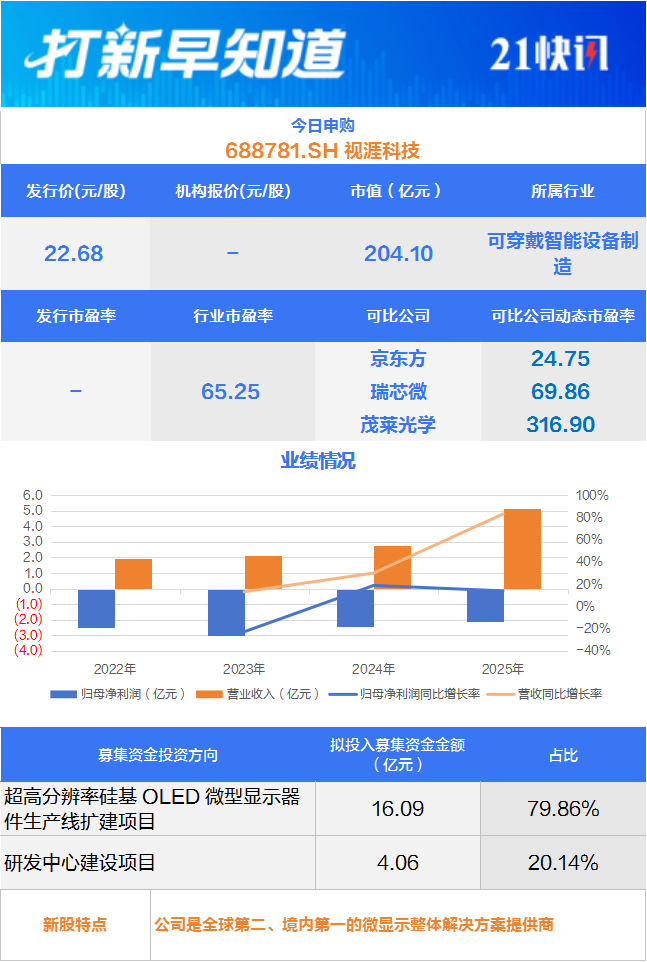
Core Viewpoint - The article discusses the IPOs of three companies: Vision Technology, Hongming Electronics, and Yuelong Technology, highlighting their market positions, financial metrics, and investment directions. Group 1: Vision Technology (688781.SH) - Vision Technology is a leading global provider of micro-display solutions, specializing in silicon-based OLED micro-displays and offering value-added services such as strategic product development and optical systems [1][6]. - The company has a market capitalization of 20.41 billion yuan and an issuance price of 22.68 yuan per share, with a projected issuance P/E ratio of 65.25 [3]. - Vision Technology plans to invest 16.09 billion yuan (79.86%) in expanding its ultra-high-resolution silicon-based OLED micro-display production line and 4.06 billion yuan (20.14%) in building a research and development center [5]. - The company is recognized as the second globally and the first domestically in micro-display solutions, having achieved significant market share in the XR device sector, with a 35.2% share of the global market [6][7]. Group 2: Hongming Electronics (301682.SZ) - Hongming Electronics focuses on the research, production, and sales of new electronic components, primarily resistive and capacitive components, with applications in various industries including aerospace and consumer electronics [8][12]. - The company has a market capitalization of 6.35 billion yuan and an issuance price of 69.66 yuan per share, with a projected issuance P/E ratio of 33.61 [8]. - Hongming Electronics plans to allocate 5.09 billion yuan (26.10%) for the industrialization of high-energy pulse capacitors and 3.94 billion yuan (20.19%) for new electronic components and integrated circuits production [10]. - The company has been recognized as a national high-tech enterprise and has a strong customer base, including major brands like Apple and Lenovo [11][12]. Group 3: Yuelong Technology (920188.BJ) - Yuelong Technology specializes in the research, production, and sales of flexible pipelines for fluid transport, including high-performance products for extreme conditions [13][15]. - The company plans to invest 1.42 billion yuan (48.72%) in a new self-floating rubber hose production project and 0.60 billion yuan (20.59%) in upgrading production facilities [15]. - Yuelong Technology has received numerous patents and awards, establishing itself as a leader in the oil and gas pipeline sector [15][16]. - The company has a diverse customer base, including major state-owned enterprises and has been involved in significant engineering projects [16][17].


2025年儿童智能手表行业词条报告
Tou Bao Yan Jiu Yuan· 2026-03-11 12:44
Investment Rating - The report does not explicitly state an investment rating for the children's smart watch industry Core Insights - The children's smart watch industry is driven by advancements in wearable technology and the growing demand for family safety, integrating features such as positioning, communication, health monitoring, and educational entertainment to meet parents' needs for child safety and health management [4][5] - The market is expected to continue expanding, supported by a large target demographic and increasing safety and educational demands, with significant growth potential in lower age groups [4][20][47] - Future growth will be primarily driven by technological research and functional innovation to meet diverse parental needs [4] Summary by Sections Industry Definition - The children's smart watch industry is a niche market driven by advancements in wearable technology and family safety needs, integrating real-time positioning, communication, health monitoring, and educational features [5][6] - The industry is supported by national standards and policies, forming a closed-loop solution centered on safety, health, and education [5] Industry Characteristics - The industry is characterized by supply expansion and a large target demographic, with production capacity and population supporting market growth [20][21] - The integration of precise positioning technology with health management is pushing children's smart watches into public health scenarios [22] - A clear price distribution exists, catering to various consumer needs and enhancing market penetration [23][24] Development History - The industry has evolved through three core stages: the nascent phase (2007-2014), the initiation phase (2015-2018), and the rapid development phase (2019-present), driven by technological innovation and policy support [25][28] - The current phase sees children's smart watches becoming essential tools for family safety and health management, with significant market growth [30][41] Market Size - The market size for children's smart watches is on a continuous upward trend, projected to reach approximately 160 billion yuan by 2026 and 238 billion yuan by 2029 [46] - The growth is driven by increasing parental demand for safety, education, and health management features [47][49] Consumer Insights - Consumers view children's smart watches as important safety tools, with a significant percentage recognizing their role in enhancing social interaction and reducing reliance on mobile phones [35][45] - However, concerns exist regarding the complexity of features and potential impacts on children's mental health [45] Industry Trends - The industry is witnessing a shift from basic safety tools to multifunctional smart parenting assistants, with features expanding to health monitoring, AI interaction, and social entertainment [41][42] - The competitive landscape is dominated by leading brands like Xiaotian and Huawei, which leverage strong brand influence and technological innovation [40][34]
前三季度核心CPI持续回升,PPI降幅有所收窄
Guo Jia Tong Ji Ju· 2025-10-20 02:18
Group 1: Consumer Price Trends - Consumer prices remained stable in the first three quarters, with CPI decreasing by 0.1% year-on-year, consistent with the first half and the first quarter [2] - Core CPI, excluding food and energy, has shown a continuous recovery since March, rising to 1% in September, the highest in nearly 19 months [4] - Food prices saw a year-on-year decline of 1.8%, with fresh vegetable prices averaging a drop of 7.9% and pork prices shifting from an increase of 3.8% in the first half to a decrease of 2.9% in the first three quarters [2] Group 2: Energy Price Trends - Energy prices decreased by 3.3% year-on-year in the first three quarters, with gasoline prices dropping by 7.3% due to international oil price fluctuations [3] Group 3: Producer Price Trends - PPI decreased by 2.8% year-on-year in the first three quarters, with a narrowing decline of 0.3 percentage points in the third quarter compared to the second quarter [5] - The domestic market's competitive order has improved, leading to a recovery in prices for certain industries, such as coal processing and black metal smelting, which saw a reduction in year-on-year price declines [5] Group 4: External Influences on Prices - International oil prices have generally trended downward, impacting domestic oil-related industry prices, with a 9.9% decline in the oil and gas extraction industry [6] - Conversely, international non-ferrous metal prices have risen, leading to a 5.6% year-on-year increase in domestic non-ferrous metal smelting and rolling industries [6] Group 5: High-Tech Industry Developments - The development of high-tech industries and effective macro policies have driven price increases in certain sectors, such as integrated circuit packaging and testing, which rose by 3.0% year-on-year [7] - Upgraded consumer demand has also contributed to price increases in sectors like arts and crafts manufacturing, which saw a 12.7% rise [7]
9月份核心CPI同比上涨1.0% 涨幅连续第5个月扩大
Zheng Quan Ri Bao· 2025-10-15 15:46
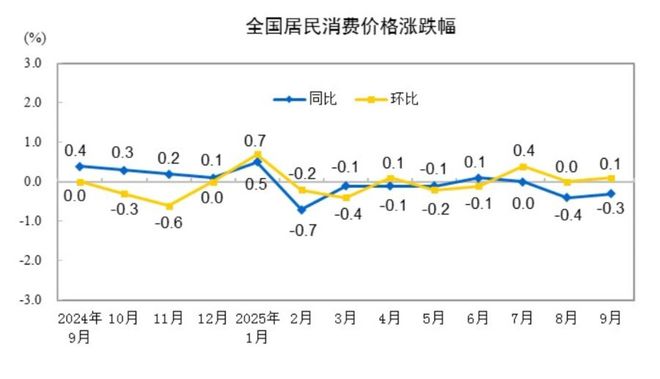
Core Insights - In September, the Consumer Price Index (CPI) increased by 0.1% month-on-month, while year-on-year it decreased by 0.3%. The core CPI, excluding food and energy, rose by 1.0%, marking the fifth consecutive month of growth and the first time in 19 months it returned to 1% [1][3] - The Producer Price Index (PPI) remained flat month-on-month and decreased by 2.3% year-on-year, with the decline narrowing by 0.6 percentage points compared to August [1][5] CPI Analysis - The month-on-month CPI increase was driven by a 0.7% rise in food prices, which contributed approximately 0.13 percentage points to the CPI increase. Industrial consumer goods prices, excluding energy, rose by 0.5%, contributing about 0.12 percentage points [2] - Year-on-year, the CPI decline of 0.3% was primarily influenced by a 4.4% drop in food prices and a 2.7% decrease in energy prices, which together accounted for a significant portion of the CPI decrease [2][3] Core CPI Insights - The core CPI's year-on-year increase of 1.0% reflects a sustained improvement, with industrial consumer goods prices, excluding energy, rising by 1.8%. Notably, gold and platinum jewelry prices surged by 42.1% and 33.6%, respectively [3] - The increase in core CPI is attributed to the effects of consumption promotion policies, with rising prices in home appliances and mobile phones contributing positively [3] PPI Insights - The PPI's year-on-year decline of 2.3% shows signs of stabilization in certain industries, with improved supply-demand dynamics leading to reduced price declines in sectors like coal processing and non-metallic mineral products [5] - The expected annual PPI decline is projected at 2.7%, influenced by ongoing market competition optimization and the effects of "anti-involution" policies [5]
2025年9月CPI和PPI数据解读:9月通胀:物价偏弱运行
ZHESHANG SECURITIES· 2025-10-15 14:01
Inflation Data Summary - September CPI decreased by 0.3% year-on-year, lower than the market expectation of -0.1% and previous value of -0.4%[2] - Month-on-month CPI growth was 0.1%, compared to 0% in the previous month[2] - September PPI recorded a year-on-year decline of 2.3%, an improvement from -2.9% previously and above the expected -2.4%[5] Price Movement Insights - Food prices increased by 0.7% month-on-month, contributing approximately 0.13 percentage points to the CPI increase[3] - Year-on-year, food prices fell by 4.4%, impacting CPI by about 0.83 percentage points[3] - Core CPI, excluding food and energy, rose by 1.0% year-on-year, marking the first return to 1% growth in 19 months[4] Market Outlook - The fourth quarter's asset performance will largely depend on risk appetite, with a potential shift from technology growth stocks to low-volatility dividend stocks[1] - A gradual decline in risk appetite is anticipated post-APEC, particularly after November[1] - Bond yields are expected to decrease in Q4 due to weakening fundamentals and potential monetary easing[1]
9月核心CPI,19个月来涨幅首次回到1%
21世纪经济报道· 2025-10-15 13:50
Core Insights - The article discusses the recent trends in China's Consumer Price Index (CPI) and Producer Price Index (PPI), highlighting a decrease in CPI and a narrowing decline in PPI, indicating potential economic recovery and price stabilization [1][10]. CPI Analysis - In September, the national CPI decreased by 0.3% year-on-year, with urban areas down 0.2% and rural areas down 0.5% [4][6]. - Food prices fell by 4.4%, while non-food prices increased by 0.7%, contributing to the overall CPI decline [4][7]. - The core CPI, excluding food and energy, rose by 1.0%, marking the first return to this level in 19 months and indicating a continuous expansion for five consecutive months [7][9]. - The month-on-month CPI increased by 0.1%, with urban prices stable and rural prices rising by 0.2% [8][10]. PPI Analysis - The PPI for September showed a year-on-year decline of 2.3%, but the rate of decline narrowed by 0.6 percentage points compared to the previous month [10][12]. - The industrial producer purchase price index decreased by 3.1% year-on-year, with a month-on-month increase of 0.1% [10][12]. - The decline in PPI is attributed to a low comparison base from the previous year and the positive effects of macroeconomic policies [12][13]. Sector-Specific Insights - Certain industries, such as coal processing and photovoltaic equipment manufacturing, experienced a reduction in price decline, contributing to the overall narrowing of PPI [13]. - The modernization of the industrial system and the release of consumer potential have led to price increases in sectors like aircraft manufacturing and electronic materials [13]. - The article anticipates that the PPI decline will first widen and then narrow in 2025, influenced by ongoing market competition improvements [14].

2025年9月通胀数据点评:反内卷政策下价格的止跌回稳
Tebon Securities· 2025-10-15 12:33
Price Trends - In September, gold and platinum jewelry prices increased by 42.1% and 33.6% year-on-year, respectively, driven by rising international gold prices and strong consumer demand[3] - Non-food prices rose by 0.7% year-on-year, with core CPI increasing by 1.0%, marking the first time in 19 months that it reached this level[4] - Food prices fell by 4.4% year-on-year, primarily due to a significant drop in pork prices, which decreased by 17.0%[4] Industrial Production - The Producer Price Index (PPI) decreased by 2.3% year-on-year in September, but the decline was less severe than the previous month's drop of 2.9%[4] - Prices for coal processing and black metal smelting saw a reduction in their year-on-year decline by 8.3 and 3.4 percentage points, respectively[3] Economic Outlook - The macroeconomic policy remains accommodative to support economic recovery, with expectations for continued low interest rates to stimulate credit and domestic demand[7] - The CPI is projected to rebound in October due to increased consumer activity during the "Golden Week" holiday, with expectations for a significant rise in travel and accommodation prices[9]
9月核心CPI重返1%,物价修复态势延续
2 1 Shi Ji Jing Ji Bao Dao· 2025-10-15 09:42
Group 1: Consumer Price Index (CPI) Insights - In September, the national Consumer Price Index (CPI) decreased by 0.3% year-on-year, while it increased by 0.1% month-on-month [1][2] - The core CPI, excluding food and energy prices, rose by 1.0% year-on-year, marking the first return to a 1% increase in nearly 19 months [1][4] - The decline in CPI was primarily attributed to the "carryover effect," with food prices dropping by 4.4%, significantly impacting the overall CPI [4][6] Group 2: Producer Price Index (PPI) Insights - The Producer Price Index (PPI) decreased by 2.3% year-on-year in September, with the month-on-month figure remaining flat [1][6] - The year-on-year decline in PPI has narrowed by 0.6 percentage points compared to the previous month, indicating a potential stabilization in producer prices [6][9] - The prices of production materials showed a year-on-year decline of 2.4%, but the decrease has lessened compared to previous months, suggesting some recovery in production material pricing [8][10] Group 3: Economic Factors and Market Trends - The improvement in price indices is attributed to the release of consumer potential, industrial structure upgrades, and the continuous optimization of market competition [1][10] - Various macroeconomic policies are showing positive effects, leading to a reduction in the year-on-year price decline in several industries, including coal processing and photovoltaic equipment manufacturing [10][11] - The overall market is expected to see a gradual recovery, with projections indicating that the PPI decline will narrow in the latter half of 2025 due to improved market conditions [11]
9月中国PPI同比降幅收窄 部分行业产能治理见效
Zhong Guo Xin Wen Wang· 2025-10-15 08:54
Core Insights - In September, China's Producer Price Index (PPI) decreased by 2.3% year-on-year, with the decline narrowing by 0.6 percentage points compared to the previous month [1] - The effects of macroeconomic policies are becoming evident, leading to positive price changes in certain industries [1] Industry Analysis - The price declines in several industries have narrowed, indicating effective capacity management and improved market competition. The following industries saw reduced year-on-year price declines: - Coal processing: down 8.3 percentage points - Black metal smelting and rolling: down 3.4 percentage points - Coal mining and washing: down 3.0 percentage points - Photovoltaic equipment and components manufacturing: down 2.4 percentage points - Battery manufacturing: down 0.5 percentage points - Non-metallic mineral products: down 0.4 percentage points - The combined downward impact on PPI from these six industries decreased by approximately 0.34 percentage points compared to the previous month [1] Price Trends - Structural upgrades and the release of consumer potential have led to price increases in related industries: - Aircraft manufacturing: up 1.4% year-on-year - Electronic special materials manufacturing: up 1.2% year-on-year - Wearable smart devices manufacturing: up 0.1% year-on-year - Policies aimed at boosting consumption are showing effects, with prices for arts and crafts and ceremonial goods rising by 14.7% year-on-year, and nutritional food manufacturing prices increasing by 1.8% year-on-year [1] Month-on-Month Analysis - The improvement in supply-demand structure has stabilized prices in certain industries: - Coal processing prices increased by 3.8% month-on-month - Coal mining and washing prices rose by 2.5% month-on-month - Black metal smelting and rolling prices increased by 0.2% month-on-month - Non-metallic mineral products and lithium-ion battery manufacturing prices decreased by 0.4% and 0.2% month-on-month, respectively, with declines narrowing by 0.6 and 0.3 percentage points compared to the previous month [2]