
器械

Search documents
大行评级丨交银国际:预期医药板块今年持续稳中向好,建议寻找估值被低估的股份
Ge Long Hui· 2026-02-06 02:33
Core Viewpoint - The report from交银国际 indicates a slight decrease in the proportion of domestic investors holding pharmaceutical stocks through the Hong Kong Stock Connect since the fourth quarter of last year, while foreign investment has increased, particularly in innovative drugs and leading CXO companies benefiting from demand recovery [1] Group 1: Investment Trends - Domestic investors' holdings in pharmaceutical stocks via Hong Kong Stock Connect have slightly decreased [1] - Foreign investors have increased their positions, particularly in innovative drug companies and leading CXO firms [1] Group 2: Investment Recommendations - The report suggests focusing on differentiated platforms such as small nucleic acids, long-acting formulations, invivo CAR-T, and new generation ADC/XDC, as well as disease areas like autoimmune, metabolic, and CNS [1] - The pharmaceutical sector is expected to maintain a stable upward trend this year, although short-term volatility may occur [1] Group 3: Stock Selection Criteria - Investors are advised to examine company fundamentals and valuations to identify undervalued stocks, such as 三生制药, 和黄医药, and 劲方医药, which have rich catalysts not yet reflected in their valuations [1] - CXO segment leaders, like 药明合联, are expected to benefit from a favorable downstream environment and improved financing conditions [1] - Sub-sectors such as hospitals, medical devices, and diagnostics are anticipated to see regulatory uncertainties gradually easing along with positive policy expectations [1]
交银国际:预计医药板块今年持续稳中向好 建议寻找被低估医药股
智通财经网· 2026-02-05 09:21
Core Viewpoint - The Hang Seng Healthcare Index has declined by 3.3% this week, underperforming the market, with a slight decrease in domestic investors' holdings of pharmaceutical stocks through the Hong Kong Stock Connect since the fourth quarter of last year, while foreign investment has increased [1] Group 1: Market Performance - The Hang Seng Healthcare Index has experienced a cumulative drop of 3.3% this week [1] - Domestic investors' holdings of pharmaceutical stocks via the Hong Kong Stock Connect have slightly decreased [1] - Foreign investment in the sector has increased, particularly in innovative drugs and leading CXO companies benefiting from demand recovery [1] Group 2: Investment Recommendations - The company suggests focusing on differentiated platforms such as small nucleic acids, long-acting formulations, invivo CAR-T, and new generation ADC/XDC in the pharmaceutical business development this year [1] - The sector is expected to maintain a stable upward trend this year, although short-term volatility may occur [1] - Investors are advised to examine company fundamentals and valuations to identify undervalued stocks, such as 3SBio (01530), Hutchison China MediTech (00013), and Genscript Biotech (02595) [1] - CXO segment leaders like WuXi AppTec (02268) may benefit from a favorable downstream environment and improved financing conditions [1] - Sub-sectors such as hospitals, medical devices, and diagnostics may see regulatory uncertainties easing along with positive policy expectations [1]
交银国际:中国医药1-8批国采接续规则或温和 短期催化剂充足
智通财经网· 2025-12-05 02:49
Core Viewpoint - The Hang Seng Healthcare Index increased by 0.5% this week, underperforming the broader market, with the biopharmaceutical, prescription drug, and medical device sectors showing better performance than others [1] Group 1: Market Trends - Domestic investors are leaning towards defensive strategies and profit-taking, primarily increasing positions in traditional and undervalued innovative pharmaceutical companies with stable internal growth [1] - Foreign investors are more active, focusing on leading companies and upstream segments in the innovation chain, including innovative drugs and CXO targets [1] Group 2: Regulatory Changes - The transition of the procurement rules for batches 1-8 to an inquiry-based model is expected to limit overall price reductions, with the impact on Hong Kong prescription drug manufacturers likely to be less than anticipated [1] Group 3: Future Catalysts - The industry has ample catalysts in December, including various academic conferences, the announcement of healthcare negotiation results, and potential interest rate cuts by the Federal Reserve, which may stabilize investment sentiment in the sector [1] Group 4: Recommended Focus Areas - The report recommends focusing on the following segments: 1) Innovative drugs: Companies like 3SBio (01530), Eucure Biopharma (06996), and BeiGene (06160) have rich short-term catalysts and their core product values are not yet reflected in their valuations; companies like Ascletis Pharma (02096), Hutchison China MediTech (00013), and Legend Biotech (LEGN.US) are significantly undervalued with clear long-term growth logic [1] 2) CXO: Leaders in this segment, such as WuXi AppTec (02268), are benefiting from high downstream demand and marginal recovery in financing [1] 3) Hospital, medical device, and diagnostics sub-sectors are showing opportunities for reversal as regulatory uncertainties gradually ease [1]

中信建投:CXO行业调整基本完成 重点关注出海能力强的CDMO企业及临床CRO龙头
智通财经网· 2025-11-23 23:45
Group 1 - The innovative pharmaceutical sector is experiencing three major trends: deepening internationalization 2.0, unprecedented policy support, and continuous technological breakthroughs [1] - By 2025, the number of license-out transactions is expected to reach 103, with upfront payments hitting a record high of $8.45 billion, benefiting companies that expand internationally [1] - The CXO industry adjustment is nearly complete, with stable overseas demand and a rebound in domestic investment and financing, focusing on CDMO companies with strong overseas capabilities and leading clinical CROs [1] Group 2 - The Chinese pharmaceutical industry is enhancing its competitiveness despite increasing external challenges, leveraging advantages in population, domestic demand, manufacturing, and supply chains [1] - The policy outlook indicates a shift towards high-quality growth, with a focus on optimizing drug and consumable procurement policies and diversifying payment and medical service pricing reforms by the second half of 2025 [2] - The industry is witnessing a transformation with an emphasis on supply chain security, innovation, and the integration of new technologies such as AI and brain-machine interfaces [2]

港股生物医药股集体拉升 康方生物涨超7% 医药板块三季度业绩有望逐渐回稳
Xin Lang Cai Jing· 2025-10-16 02:11
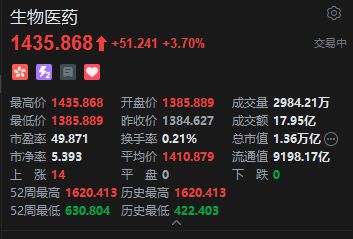
Group 1 - Hong Kong biopharmaceutical stocks experienced a collective surge, with companies like Kangfang Biopharma and Fuhong Hanlin rising over 7%, and Junshi Biosciences, Rongchang Biopharma, and Nuocheng Jianhua increasing over 4% [1] - WuXi Biologics and WuXi AppTec saw gains exceeding 3%, while Baijie Shenzhou rose over 2% [1] Group 2 - The biopharmaceutical sector index reached 1435.868, marking an increase of 51.241 or 3.70% from the previous day [2] - The highest price recorded was 1435.868, with an opening price of 1385.889 and a trading volume of 29.8421 million [2] - The total market capitalization of the sector stands at 1.36 trillion [2] - Zhongtai Securities predicts that by Q3 2025, the pharmaceutical sector's overall performance may continue to diverge, with some leading innovative drug companies expected to maintain rapid growth due to optimized product pipelines and international progress [2] - The CRO/CDMO industry is anticipated to stabilize gradually after a short-term adjustment, benefiting from the recovery of global orders and improved operational efficiency [2] - The medical device sector is showing steady performance, with certain segments like imaging equipment experiencing a rebound, while in vitro diagnostics may face temporary pressure due to external factors [2] - Overall, the pharmaceutical sector's performance is expected to gradually stabilize in Q3, with a recommendation to focus on high-certainty performance, strong growth momentum, and reasonably valued quality targets [2]


中泰证券:医药板块Q3业绩有望回稳 建议关注高确定性优质标的
智通财经网· 2025-10-14 23:41
Core Viewpoint - The market continues to focus on technology trends post-National Day holiday, with the pharmaceutical sector experiencing some capital outflow and relatively volatile performance, but the main logic of innovation remains intact [1] Group 1: Market Performance - After the National Day holiday, the overall market remains dominated by technology trends, while the pharmaceutical sector has seen a phase of capital outflow and is performing relatively weakly [1] - The Shanghai and Shenzhen 300 index fell by 0.51%, with the pharmaceutical and biological sector down by 1.20%, ranking 25th among 31 primary sub-industries [1] - The pharmaceutical sub-sectors showed mixed performance, with traditional Chinese medicine and pharmaceutical commerce rising by 1.51% and 0.64% respectively, while other sectors like medical devices and chemical pharmaceuticals saw declines [1] Group 2: Investment Recommendations - It is suggested to increase allocation to high-quality targets with key data readout catalysts, potential significant BD transaction expectations, and global potential during market dips [1] - In light of the long-term complexities of Sino-US relations, it is recommended to actively select low-valuation, well-structured, and fundamentally sound domestic demand sectors based on Q3 performance [1] Group 3: Q3 Performance Expectations - The pharmaceutical sector is expected to see continued performance differentiation in Q3 2025, with some leading innovative drug companies maintaining rapid growth due to optimized product pipelines and international progress [2] - The CRO/CDMO industry is anticipated to stabilize gradually, benefiting from global order recovery and improved operational efficiency [2] - The overall performance of the medical device sector is stable, with certain segments like imaging equipment showing signs of recovery, while some traditional Chinese medicine and medical service companies face short-term growth pressures [2] Group 4: Market Dynamics - Since the beginning of 2025, the pharmaceutical sector has achieved a return of 21.87%, outperforming the Shanghai and Shenzhen 300 index by 4.54 percentage points [4] - The current valuation of the pharmaceutical sector is 27.0 times PE, with a premium of 16.0% compared to the overall A-share market (excluding financials) [4] - The TTM valuation for the pharmaceutical sector stands at 30.9 times PE, which is below the historical average of 34.9 times PE, indicating a premium of 24.4% relative to the overall A-share market (excluding financials) [4]

华安基金:创新药是全年投资主线 港股优质龙头还有20%空间
Zhi Tong Cai Jing· 2025-09-10 11:45
Group 1: Core Insights - The main investment theme for the year is innovative drugs, while AI healthcare represents a trading opportunity [1] - In Q3 and Q4, sectors like CXO and medical devices are expected to show better structural alpha, potentially becoming significant investment directions next year [1][2] - The Hong Kong stock market has around 20% upside potential for quality innovative drug leaders, while A-shares have scarce expected difference targets [1] Group 2: Sector Analysis - The CXO and medical device sectors have shown a clear improvement since the end of last year, with future performance dependent on domestic demand and bidding conditions [2] - The investment rhythm includes three phases: data phase (March to June), business development phase (June to October), and post-IPO profit improvement phase [2] - AI healthcare is viewed as a trading theme, with CXO and medical devices expected to provide good structural alpha in the latter half of the year [2] Group 3: Technology and Robotics - The AI industry chain is currently in a phase of continuous fundamental growth, with hardware investments favored over software [3] - The robotics sector is highlighted as a key area of inflation within the AI industry, with strong demand anticipated for high-quality products [3] - Upcoming events, such as Tesla's shareholder meeting and new product launches from domestic brands, may create new investment opportunities in the robotics sector [3]
国泰海通|2025上海先导产业大会暨第14届医药CEO论坛+第5届人工智能大会
国泰海通证券研究· 2025-08-18 13:56
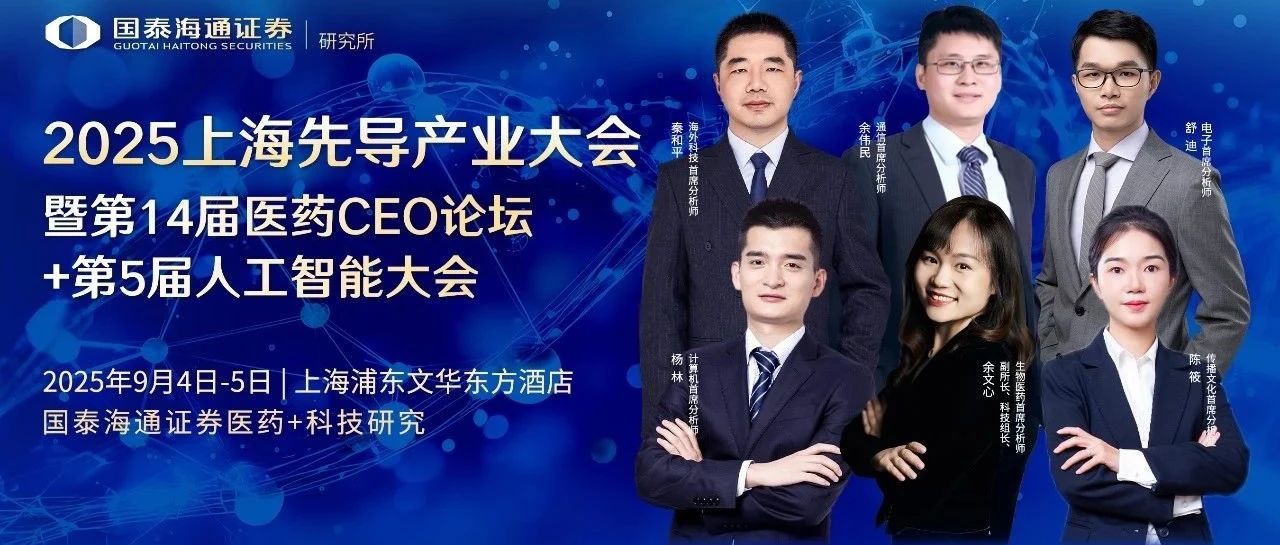
Core Viewpoint - The article discusses the upcoming 2025 Shanghai Leading Industries Forum, focusing on the pharmaceutical and technology sectors, highlighting the participation of key industry leaders and companies [2][4]. Group 1: Event Details - The forum will take place on September 4-5, 2025, at the Mandarin Oriental Hotel in Pudong, Shanghai [2]. - The event will feature over a hundred executives, including chairpersons and CEOs from listed companies, engaging in roundtable discussions and keynote speeches [4]. - The agenda includes dedicated sessions for the pharmaceutical and technology sectors, with specific time slots allocated for each [4]. Group 2: Participating Companies - A variety of pharmaceutical companies are expected to participate, including notable names such as: - Aier Pharmaceutical, Gilead Sciences, Junshi Biosciences, and more [6]. - The technology sector will also see participation from companies like: - Han's Laser, Kingsoft Office, and Hikvision, among others [7]. - The list of participating companies is continuously updated, indicating a dynamic and evolving event [5].
订单系统数字化转型方案
Sou Hu Cai Jing· 2025-08-07 03:46
Core Insights - The article emphasizes the necessity for companies to upgrade their order systems from manual processes to automated, intelligent systems by 2025 to remain competitive in the market [1][13] Group 1: Reasons for Upgrading Order Systems - Traditional order systems are inefficient, leading to errors and delays, particularly in B2B sectors where multiple departments are involved [1] - Companies lose millions annually due to data silos and miscommunication between sales, logistics, and finance [1] - By 2025, customer expectations for real-time order tracking and supplier demands for instant reconciliation will render outdated systems obsolete [1] Group 2: Technologies Enabling Automation - AI can replace human judgment in demand forecasting, significantly reducing error rates from 30% to 5% [3] - Blockchain technology enhances transparency in transactions, reducing order disputes by 70% in industries like food [4] - Robotic Process Automation (RPA) streamlines repetitive tasks, cutting order processing time from 2 hours to 10 minutes [5] - 5G and IoT technologies provide real-time monitoring of logistics, improving customer communication regarding order status [6] Group 3: Steps for Successful Transformation - Companies should first identify their pain points before investing in technology, ensuring they address the most critical issues [8] - Testing new technologies in small-scale pilot programs can validate effectiveness before broader implementation [9] - Employee training should focus on demonstrating the benefits of new systems to alleviate fears of job loss and encourage adoption [10] Group 4: Successful Case Studies - An automotive parts leader improved urgent order response times by 40% and increased customer retention by 15% through AI and automation [11] - An industrial wholesaler eliminated $80 million in excess inventory by using intelligent recommendation systems [14]
中信建投:医药行业下半年继续看好新增量及行业整合机会
智通财经网· 2025-06-22 11:05
Core Insights - The Chinese pharmaceutical industry possesses advantages in population and domestic demand, manufacturing and supply chain, and rapidly improving innovation capabilities, while the number of Chinese assets going abroad continues to rise [1][2] - In the face of external challenges, the industry needs to focus on domestic stability and external expansion, emphasizing supply chain autonomy, innovation, and integration domestically, while accelerating internationalization to seize global opportunities [1][2] Domestic Focus - Policy outlook indicates that reforms are entering a deep-water zone, with high-quality growth becoming the norm; key areas of focus include optimization of drug and consumable procurement policies, diversified payment methods, and medical service price reforms by the second half of 2025 [3] - The pharmaceutical supply chain is undergoing optimization and active innovation transformation, with a focus on supply chain security [3] - There are positive prospects for import substitution and merger integration opportunities in medical devices, with attention to new technology directions such as AI and brain-machine interfaces [3] - The industry is observing a recovery rhythm and long-term transformation in traditional Chinese medicine, pharmacies, distribution, medical services, and vaccines [3] External Expansion - Chinese innovations in pharmaceuticals are gaining recognition on the international stage, with ongoing strengthening of industry trends [4] - The pharmaceutical upstream and life sciences sectors are actively exploring overseas markets to seek a second growth curve [4] - Short-term tariff disruptions in raw materials are limited, with a focus on industry transformation opportunities [4] - The trend of internationalization in medical devices is firmly supported, with attention to opportunities for independent sales and business development of certain innovative devices [4] - The introduction of immunoglobulin provides opportunities for blood products to go abroad, with ongoing progress in overseas registration [4] - The export of vaccines is becoming more diversified, with an expected acceleration in progress [4] Investment Outlook for Second Half of 2025 - The focus on innovation will center around innovative drugs and pharmaceutical companies (e.g., bispecific antibodies, T-cell engagers, nuclear medicine) and medical devices (e.g., AI, brain-machine interfaces) [5] - The export focus will highlight representative segments such as innovative drugs and medical device companies [5] - Marginal changes will be driven by policy improvements (including pharmaceutical distribution and medical equipment updates) and supply-demand relationship improvements in sectors like CXO, life sciences, and upstream biopharmaceuticals [5] - The integration focus will recommend attention to medical devices and traditional Chinese medicine sub-sectors, certain pharmaceutical companies, and state-owned enterprises [5]