
科学研究和技术服务

Search documents
劲增1290户!连云港海州市场主体实现首月“开门红”
Yang Zi Wan Bao Wang· 2026-02-12 09:47
Group 1 - In January 2026, Lianyungang City's Haizhou District experienced a strong start in market entity development, with 519 new registered enterprises and 771 individual businesses, representing year-on-year growth of 7.01% and 19.9% respectively, indicating robust economic resilience and vitality [1] - The growth momentum is driven by "innovation" and "vitality," with a significant increase in new enterprises in scientific research and technical services, totaling 113, which is a substantial year-on-year growth of 63.77%, positioning these sectors as core engines for industrial upgrading [1] - The rapid growth of individual businesses in the wholesale, retail, accommodation, and catering sectors reflects the resilience of the economic internal circulation and the vigorous vitality of micro entities [1] Group 2 - The transformation of government services from "convenience" to "empowerment" has played a crucial role in enhancing market vitality, with the full process of enterprise establishment being compressed to within 0.5 working days [1] - The innovative "home-based registration" model has been successfully implemented in Banpu Town, allowing individual business registrations to be completed within one day without leaving the town, and this model is being promoted to more towns [1] - The district has effectively reduced burdens on enterprises by over 50 million yuan through inclusive and prudent regulation in 2025, significantly improving service efficiency [1] Group 3 - The development ecosystem is being optimized to provide a "inclusive" and "fair" environment for market entities, with a focus on creating a stable, transparent, and predictable development environment [2] - The district implements credit risk classification supervision, ensuring minimal disruption for trustworthy enterprises, while encouraging innovation and trial through an "observation period" for new business models [2] - Continuous focus on the concerns of market entities will be maintained, with efforts to deepen reform and innovation, optimizing the business environment to inject sustained momentum into regional economic high-quality development [2]

泉州2025年GDP公布!
Xin Lang Cai Jing· 2026-02-04 12:19
Economic Overview - In 2025, the GDP of Quanzhou reached 13778.34 billion yuan, growing by 5.3% year-on-year, with a three-industry structure of 2.0:50.5:47.5 [1][16][17] Agricultural Sector - The total output value of agriculture, forestry, animal husbandry, and fishery was 494.94 billion yuan, an increase of 3.6% from the previous year [2][18] - Agricultural output value rose to 210.48 billion yuan, up 5.5%, with grain production at 52.91 million tons, increasing by 2.5% [2][18] - The fishery sector saw a production value of 178.36 billion yuan, growing by 4.7%, with significant increases in abalone (23.2%) and shrimp (18.8%) production [4][20] Industrial Sector - The industrial added value for large-scale enterprises increased by 7.0%, with key industries showing strong growth, such as paper and printing (13.4%) and machinery (11.0%) [5][21] - Private industrial enterprises saw an added value growth of 7.8%, outpacing the average growth rate [5][21] - High-tech industries also experienced growth, with electronic information increasing by 6.7% and resource recycling by 18.7% [5][21] Tertiary Sector - The added value of the tertiary industry grew by 4.7%, accounting for 47.5% of GDP, a historical high [6][22] - The wholesale and retail sector contributed significantly, with a growth of 6.1%, boosting the tertiary sector's growth by 2.2 percentage points [6][22] - Tourism thrived, with total visitors reaching 112.28 million, an increase of 11.1%, and total tourism spending rising by 11.3% [7][22] Consumer Market - The total retail sales of consumer goods reached 6416.07 billion yuan, growing by 4.1% [8][24] - Online retail sales surged by 17.8%, with significant growth in essential goods and cultural products [8][24] Investment and Construction - Fixed asset investment grew by 1.1%, with a notable increase in government infrastructure investment by 10.2% [9][25] - Private investment also rose by 5.6%, contributing positively to overall investment growth [10][26] Foreign Trade - The total foreign trade volume decreased by 12.9% to 2363.79 billion yuan, with exports down by 16.9% [11][27] - The export of mechanical and electrical products reached 307.09 billion yuan, accounting for 18.6% of total exports [11][27] Fiscal and Financial Overview - The total public budget revenue was 991.60 billion yuan, increasing by 1.7%, with a focus on social welfare spending [13][28] - Financial institutions reported a growth in loans by 6.4%, with significant increases in sectors like leasing and business services [13][28] Income and Prices - The per capita disposable income reached 54858 yuan, growing by 5.1%, with rural income growth outpacing urban [14][29] - Consumer prices rose by 1.0%, with most categories experiencing price increases [15][30]
重点节点 ▏个人所得税经营所得汇算清缴如何操作操作步骤
蓝色柳林财税室· 2026-01-25 02:02
Group 1 - The article outlines the steps for individuals to file their income tax returns through the Natural Person Electronic Tax Bureau, emphasizing the importance of accurate data entry and submission [2][3][4][6] - It details the process of collecting and submitting taxpayer information, including income totals, costs, and tax adjustments, which are crucial for the annual tax return [2][5][6] - The article highlights the necessity of confirming the accuracy of tax information before submission and provides guidance on how to check the status of the tax return after submission [3][4] Group 2 - The article introduces the 7th announcement from the tax authority, effective from September 1, 2025, which allows eligible VAT taxpayers to apply for refunds of end-of-period tax credits [16][18] - It specifies the conditions under which taxpayers can apply for tax refunds, including credit rating requirements and previous compliance history [18][19] - The article outlines the calculation methods for determining the refundable amounts based on the increase in end-of-period tax credits over specified periods [24][30]


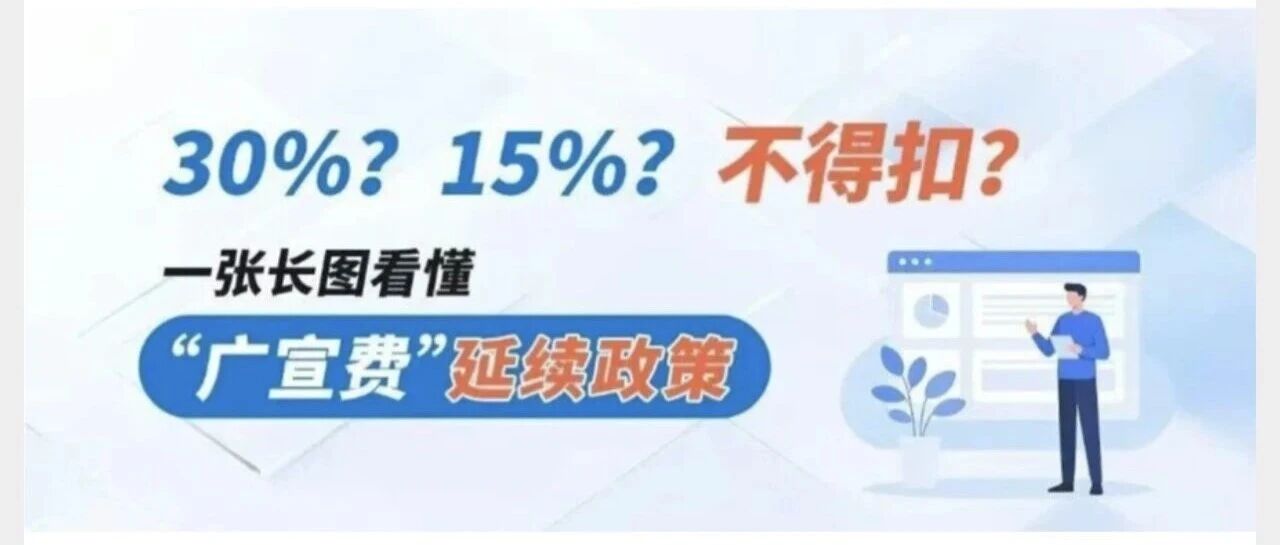
30%?15%?不得扣?一张长图看懂“广宣费”延续政策
蓝色柳林财税室· 2026-01-25 02:02
Core Viewpoint - The article discusses the implementation of Announcement No. 7 by the State Administration of Taxation, effective from September 1, 2025, which allows eligible VAT general taxpayers to apply for refunds of the ending retained tax credits under specific conditions [10]. Group 1: Eligibility Conditions - Taxpayers must have a credit rating of A or B [12]. - No instances of fraudulent tax refund claims or issuance of false VAT invoices in the past 36 months [12]. - No more than one tax evasion penalty from tax authorities in the past 36 months [12]. - Taxpayers must not have enjoyed VAT immediate refund or deferred refund policies since April 1, 2019, unless specified otherwise by Announcement No. 7 [12]. Group 2: Specific Industry Taxpayers - For manufacturing and three other industries, taxpayers must have over 50% of their VAT sales from these sectors based on the previous 12 months [15]. - Taxpayers in real estate development must have over 50% of their VAT sales and prepayments from real estate activities based on the previous 12 months [19]. - Other industry taxpayers must meet specific criteria regarding their retained tax credits to apply for refunds [23]. Group 3: Policy Highlights - Taxpayers can apply monthly to the tax authority for refunds of ending retained tax credits [17]. - For real estate developers, if the new retained tax credits in the sixth month exceed 500,000 yuan, they can apply for a refund of 60% of the new increase [20]. - Other taxpayers can receive a 60% refund on new retained tax credits up to 100 million yuan, and 30% on amounts exceeding that [24][26].
珠海印发行动方案 冲刺一季度经济“开门红” 企业增产最高奖70万
Nan Fang Ri Bao Wang Luo Ban· 2026-01-15 10:08
Group 1 - The "2026 Zhuhai Economic High-Quality Development Action Plan" was officially issued, introducing 22 policy measures aimed at boosting investment, consumption, enterprise expansion, and livelihood protection to achieve a strong economic start in Q1 [1] - In the industrial investment sector, the plan offers rewards for industrial enterprises completing investment progress exceeding 50 million, 100 million, 200 million, and 500 million yuan, with maximum rewards of 70,000, 150,000, 250,000, and 400,000 yuan respectively [1] - Differentiated production incentive policies are established for various industries, with manufacturing enterprises achieving year-on-year output growth receiving rewards ranging from 70,000 to 700,000 yuan based on different scales [1] Group 2 - Wholesale and retail enterprises will receive direct support, with rewards for wholesale sales growth of 200 million, 500 million, and over 1 billion yuan, and retail sales growth of 30 million, 50 million, and over 100 million yuan, with maximum support of 80,000, 200,000, and 400,000 yuan respectively [2] - The real estate market will focus on stimulating housing demand, with a subsidy of 1% on the net signing price for residents participating in housing exchanges, capped at 30,000 yuan per unit [2] - The "Yue Enjoy Warm Winter, Shop Guangdong" consumption season will provide special consumption subsidies for automobiles, home appliances, and local products, along with dining promotions offering up to 100 yuan in discounts [2]
70 万奖励 + 消费补贴!力拼经济开门红,珠海重磅发文
Nan Fang Du Shi Bao· 2026-01-13 11:30
Core Viewpoint - Zhuhai City has introduced a comprehensive policy package aimed at promoting high-quality economic development in the first quarter of 2026, with various financial incentives for industries, services, and consumer spending [1][3]. Group 1: Industrial Incentives - Industrial enterprises can receive rewards for increased production, with a maximum reward of 700,000 yuan for those achieving over 20 billion yuan in output [9]. - For industrial investment, companies can earn up to 400,000 yuan based on their investment progress, with additional rewards for new projects [4]. - The policy encourages a rapid investment process and aims to create a positive cycle of project funding and construction efficiency [4][5]. Group 2: Consumer Subsidies - Consumers can benefit from various subsidies, including 5,000 yuan for car purchases and 30,000 yuan for housing "trade-ins" [6][8]. - Retail and wholesale businesses can receive financial support based on sales growth, with rewards reaching up to 40,000 yuan for significant sales increases [7]. - The "Yue Enjoy Warm Winter" campaign will provide additional consumer incentives across various sectors [7]. Group 3: Service Industry Support - The support for the service industry has been expanded to include finance, leasing, and scientific research, with potential rewards of up to 600,000 yuan for qualifying companies [11][12]. - Financial institutions can receive funding support based on their revenue growth, with specific percentages allocated for different sectors [11]. - The policy aims to enhance the quality and capacity of the service sector, promoting digital transformation and innovation [12]. Group 4: Employment and Community Support - Zhuhai will implement recruitment services and support for workers returning to jobs, enhancing employment opportunities [13]. - Community activities and welfare programs will be organized to support local residents during the New Year, fostering a positive environment [13]. - The government will encourage businesses to engage in community events and provide benefits to employees during the festive season [13]. Group 5: Implementation and Duration - The measures will be effective from the date of issuance until March 31, 2026, with specific guidelines to be established by the end of January [14]. - Local governments are encouraged to develop their own measures based on the city-level policies, ensuring that benefits are accessible and efficiently distributed [14].
以提振消费激活经济发展潜能
Xin Lang Cai Jing· 2026-01-11 18:13
Core Insights - The article emphasizes the importance of boosting consumption as a key driver for economic growth and structural optimization in Inner Mongolia, aligning with national strategies to enhance domestic circulation and sustainable development [1][2][3] Group 1: Policy Direction and Economic Strategy - The 20th Central Committee of the Communist Party of China highlights the need to prioritize consumption as a strategic foundation for economic development, integrating consumer needs with supply-side reforms to stimulate domestic demand [2][4] - Inner Mongolia is encouraged to leverage its unique resources and ecological advantages to enhance market competitiveness and support national consumption initiatives, thereby facilitating a transition from resource dependency to market creation [4][5] Group 2: Consumption as a Growth Driver - Consumption is identified as the core force driving economic growth and supply transformation, particularly in resource-dependent regions like Inner Mongolia, which must cultivate internal growth dynamics through consumption [3][5] - The region aims to modernize its industrial system and promote new productive forces by aligning consumption with supply, thereby fostering a high-quality development path driven by consumer demand [3][6] Group 3: Market Dynamics and Consumer Behavior - The consumption market in Inner Mongolia is experiencing significant growth, with retail sales of consumer goods increasing by 7.2% in the first three quarters of 2025, driven by policy support for sectors like automotive and home appliances [6][7] - The increase in disposable income, particularly in rural areas, is expected to further stimulate consumption potential, contributing to a more balanced economic landscape [7][8] Group 4: Strategic Initiatives for Consumption Enhancement - The article outlines several strategic initiatives to enhance consumption, including improving the consumer environment, optimizing service supply, and creating diverse consumption scenarios to boost consumer confidence and spending [8][10] - Collaboration across various sectors is emphasized to create a supportive ecosystem for consumption, including financial incentives, infrastructure development, and regulatory improvements to ensure a safe and trustworthy market environment [9][10]
中小企业数量超6000万户,广东江苏山东占比近三成
第一财经· 2025-12-12 08:30
Core Viewpoint - The development of small and medium-sized enterprises (SMEs) in China has entered a new stage, with significant increases in quantity, efficiency, and quality during the 14th Five-Year Plan period, contributing over 60% of GDP, over 70% of technological innovation, and over 80% of urban employment [3][5]. Group 1: Growth and Contribution of SMEs - As of the end of 2024, the number of registered SMEs in China is expected to exceed 60 million, with an average annual increase of over 4 million since 2021 [5][3]. - In 2023, the employment from large-scale SMEs surpassed 128 million, with their value-added, operating income, and total profit growth rates averaging 6.4%, 7.4%, and 5.4% respectively, all exceeding those of large enterprises [5][3]. - By September 2025, the total number of registered SMEs is projected to reach 63.49 million, with micro-enterprises making up 79.4%, small enterprises 18.7%, and medium enterprises 1.9% [5][8]. Group 2: Regional and Sectoral Distribution - The top five provinces for SME numbers are Guangdong, Jiangsu, Shandong, Zhejiang, and Henan, collectively accounting for 40.9% of the total [6]. - The wholesale and retail, rental and business services, scientific research and technical services, manufacturing, and construction sectors represent the largest shares of SMEs, totaling 75.8% [6]. Group 3: Financing and Support for SMEs - The financing scale for SMEs in various sectors, particularly in wholesale and manufacturing, has shown an upward trend, with significant increases in investment amounts and events in Guangdong, Beijing, Shanghai, Jiangsu, and Zhejiang [15]. - Since 2014, the balance of loans to small and micro enterprises has increased over 30 times, reaching 65 trillion yuan by mid-2025, with their share of total enterprise loans rising from 30.4% to 38.2% [19][20]. - The government has implemented various policies to support the high-quality development of SMEs, including investments from the National SME Development Fund exceeding 69 billion yuan and initiatives for digital transformation [17][19].

2025年9月起,增值税期末留抵退税政策有新变化
蓝色柳林财税室· 2025-11-08 14:12
Core Viewpoint - The article discusses the new changes to the VAT end-of-period credit refund policy effective from September 2025, allowing eligible taxpayers to apply for refunds of their end-of-period VAT credits under specific conditions [3]. Group 1: Eligible Industries - Taxpayers in the manufacturing, scientific research and technical services, software and information technology services, and ecological protection and environmental governance sectors can apply for monthly refunds of their end-of-period VAT credits [5]. - The refund calculation formula for these industries is: Refundable VAT credit = End-of-period VAT credit × Input composition ratio × 100% [6]. Group 2: Real Estate Sector - Real estate developers can apply for a refund of 60% of the newly increased end-of-period VAT credits if the new credits are greater than zero for six consecutive months, with the sixth month’s new credits not less than 500,000 yuan [8]. - The refund calculation formula for real estate developers is: Refundable VAT credit = Newly increased end-of-period VAT credit compared to March 31, 2019, × Input composition ratio × 60% [9]. Group 3: Other Taxpayers - Other taxpayers can apply for a refund if they have positive end-of-period VAT credits for six consecutive months, and the newly increased credits in the sixth month compared to the previous year’s end-of-period credits are not less than 500,000 yuan [11]. - The refund calculation formula for these taxpayers is: Refundable VAT credit = Newly increased end-of-period VAT credit (up to 100 million yuan) × Input composition ratio × 60% + (amount exceeding 100 million yuan) × Input composition ratio × 30% [11]. Group 4: Eligibility Conditions - To qualify for the policy, taxpayers must have an A or B tax credit rating [12]. - Taxpayers must not have committed fraud related to VAT refunds or have been penalized for tax evasion in the past 36 months [13][14]. - Taxpayers must not have enjoyed VAT immediate refund policies since April 1, 2019, unless otherwise specified [15].

一揽子增量政策实施效果如何?税收数据揭示经济向好态势
Yang Shi Xin Wen· 2025-10-26 03:57
Core Insights - The implementation of a comprehensive set of incremental policies since September 26 last year has led to a steady recovery in both invoice sales and tax revenue, indicating a strengthening economic outlook in China [1][2] Group 1: Tax Revenue and Invoice Sales - The growth rate of national enterprise sales revenue has shown a steady increase, with quarterly growth rates from Q3 last year to Q3 this year recorded at 0.4%, 2.6%, 2.1%, 3.1%, and 4.4% respectively [2] - Tax revenue has turned positive after seven months of negative growth, with a cumulative increase in tax revenue since February this year, showing month-on-month growth of 2.6% and 6.9% in Q2 and Q3 respectively [2][6] Group 2: Capital Market Tax Revenue - Tax revenue related to the capital market has maintained a high growth rate, with a year-on-year increase of 56.8% in capital market service tax revenue, and a 110.5% increase in securities transaction stamp duty [3] - The total market value of A-share companies surpassed 100 trillion yuan in August, and the Shanghai Composite Index reached a ten-year high in September, with average daily stock trading volumes of 2.3 trillion yuan and 2.4 trillion yuan in August and September respectively [3] Group 3: Improvement in Business Conditions - The manufacturing sector has seen a year-on-year tax revenue growth of 5.4%, accounting for 31% of total tax revenue, with high-end manufacturing sectors like railway, shipbuilding, and aerospace experiencing a tax revenue increase of 31.5% [4] - In Dalian, the automotive manufacturing sector reported a sales revenue of 68.69 billion yuan, a year-on-year increase of 21%, while equipment and raw material purchases grew by 33.6% [5] Group 4: Emerging Industries and Consumption - The information transmission, software, and IT services sectors have seen tax revenue growth of 15.3%, while scientific research and technical services have grown by 13.2% [5] - Consumer goods sectors, particularly home appliances, have experienced significant sales growth, with retail sales of refrigerators and televisions increasing by 55.4% and 35.3% respectively [7]