国防军工

Search documents
洛克希德马丁股价创新高,业绩指引与国防订单成关键驱动力
Jing Ji Guan Cha Wang· 2026-02-13 22:45
Core Viewpoint - Lockheed Martin's stock price has reached a historical high, driven by strong earnings guidance, significant contract developments, and favorable industry policies [1]. Financial Performance - The company provided earnings guidance for 2026, expecting net sales between $77.5 billion and $80 billion, with earnings per share projected at $29.35 to $30.25, exceeding market expectations [2]. - In Q4 2025, net sales increased by 9% year-over-year to $20.3 billion, with earnings per share at $5.80 and net profit up by 155% [2]. Contract Developments - Lockheed Martin signed an agreement with the U.S. Department of Defense to increase the annual production of THAAD interceptors from 96 to 400 units and Patriot PAC-3 missiles from 600 to 2,000 units, supporting future revenue growth expectations [3]. Operational Status - As of the end of 2025, the company's backlog reached $194 billion, the highest level in history, providing visibility for long-term business [4]. Industry Policy and Environment - The U.S. defense strategy emphasizes strengthening the industrial base and deploying in the Asia-Pacific region, such as the plan to deploy nearly 300 F-35 aircraft by 2035, enhancing market expectations for the defense sector [5]. - The industrial sector has become a focal point for capital rotation, with institutions optimistic about valuation recovery opportunities [5]. Stock Performance - As of February 13, 2026, Lockheed Martin's stock closed at $652.00, up 2.29% for the day and 34.80% year-to-date, significantly outperforming the market [6]. - The trailing twelve months price-to-earnings ratio stands at 30.34, indicating a high market valuation [6].

东欧与苏联地区股票市场受地缘政治与政策影响
Jing Ji Guan Cha Wang· 2026-02-13 21:30
自2026年起,俄罗斯将增值税基本税率从20%提高至22%。经济学家预测此举可能加剧通胀风险,同时 该国投资增长已停滞,经济面临流动性下降挑战,或对当地企业盈利及股市情绪构成压力。 经济观察网近期东欧与苏联地区相关股票事件概览。截至2026年2月13日,东欧及苏联地区(如俄罗斯、 乌克兰)的股票市场主要受地缘政治、国际援助和经济政策调整影响。 近期事件 欧盟通过900亿欧元对乌贷款 欧洲议会于2026年2月11日批准总额900亿欧元的乌克兰援助贷款,其中300亿欧元用于宏观金融援助, 600亿欧元支持国防能力。首笔款项计划在2026年第二季度初发放,这可能间接影响与乌克兰相关的资 源类资产和国防产业链估值。 行业政策与环境 俄罗斯增值税率上调至22% 俄罗斯总统新闻秘书佩斯科夫在2026年2月12日重申,普京仅同意在莫斯科与乌克兰总统泽连斯基会 晤,而泽连斯基排除在俄、白俄会谈的可能。双方立场对立使谈判进展缓慢,地缘不确定性持续扰动东 欧资产风险溢价。 资金动向 欧洲资金流向东欧资产 截至2026年2月9日当周,欧洲股票基金吸引约140亿美元净流入,部分源于投资者减少对美股的依赖, 转向包括东欧的多元化市场。 ...
缩量调整,蛇年收官
Tebon Securities· 2026-02-13 12:41
Market Analysis - The A-share market experienced a volume contraction and adjustment on the last trading day before the Spring Festival, with the Shanghai Composite Index falling by 1.26% to 4082.07 points, below the 4100-point mark [4] - The Shenzhen Component Index decreased by 1.28% to 14100.19 points, while the ChiNext Index dropped by 1.57% to 3275.96 points, indicating a broad market decline with 3824 stocks falling and only 1537 rising [4] - For the entire year, the Shanghai Composite Index rose by 25.28%, the Shenzhen Component Index by 38.84%, and the ChiNext Index by 58.73% [4] Sector Performance - The defense and military sector was the only one to gain, up 0.46%, driven by advancements in commercial aerospace technology and geopolitical tensions [6] - Semiconductor equipment index rose by 1.65%, benefiting from increased demand for storage chips and AI computing power [6] - The non-ferrous metals sector saw a significant decline of 3.31%, influenced by fluctuations in international precious metal prices [6] Bond Market - The bond futures market showed mixed performance, with the 30-year main contract rising by 0.04% to 112.84 yuan, while the 10-year contract fell by 0.10% to 108.505 yuan [8] - The central bank conducted a net injection of 613.5 billion yuan, leading to a significant decline in short-term interest rates [8] - The market is expected to remain confident in the central bank's moderately loose monetary policy, which may support bond market recovery [8] Commodity Market - The commodity index fell by 1.69%, with industrial products leading the decline, particularly in precious metals and energy [8] - The main crude oil contract dropped by 4.22% to 456.3 yuan per barrel, amid concerns over supply surplus [8] - Soybean prices surged to a one-year high, driven by supply-demand factors and weather conditions in Brazil [8] Investment Opportunities - The report suggests a balanced allocation in technology and consumer sectors, with a focus on sectors like photovoltaic technology, commercial aerospace, and non-ferrous metals for future growth [8][12] - The report highlights several hot investment themes, including AI applications, commercial aerospace, nuclear fusion, quantum technology, brain-machine interfaces, and robotics, indicating strong future potential [10][12]
【13日资金路线图】两市主力资金净流出超340亿元,国防军工等行业实现净流入
证券时报· 2026-02-13 12:39
盘后数据出炉。 2月13日,A股蛇年收官日,上证指数收跌1.26%,深证成指跌1.28%,创业板指跌1.57%。A股全天成交2万亿元,上日成交2.16万亿元。市场逾3800股下 跌。 1.两市主力资金净流出超340亿元 今日沪深两市主力资金开盘净流出120.50亿元,尾盘净流出63.01亿元,两市全天主力资金净流出344.04亿元。 | | | 沪深两市最近五个交易日主力资金流向情况 (亿元) | | | | --- | --- | --- | --- | --- | | 日期 | 净流入金额 | 开盘净流入 | 尾盘净流入 | 超大单净买入 | | 2026-2-13 | -344.04 | -120.50 | -63.01 | -140.55 | | 2026-2-12 | -11.81 | -31.42 | -8.00 | 101.00 | | 2026-2-11 | -433.50 | -121.12 | -59.95 | -221.13 | | 2026-2-10 | -322.04 | -144.75 | -44.52 | -115.38 | | 2026-2-9 | 116.42 | 55.21 ...


蛇年收官日周期股全线回调,券商观点:牛市仍在,珍惜黄金坑【掘金日报2.13】
和讯· 2026-02-13 09:21
Core Viewpoint - The A-share market is set to experience a long holiday break of 9 days, combined with the regular market closure on February 14, leading to a total of 10 days off, impacting both stockholders and cash holders [1]. Market Overview - On February 13, the last trading day before the holiday, the A-share market saw a total transaction volume of 2 trillion yuan, with 46 stocks hitting the daily limit up. The market's performance showed a structure characterized by strong manufacturing, scattered cycles, and quiet consumption [3]. - The leading sectors included mechanical equipment and the automotive chain, with 7 and 5 stocks respectively hitting the limit up, indicating increased activity driven by exports and domestic substitution logic in the new energy vehicle industry [3]. Market Dynamics - The market exhibited a "strong high-end stocks remain strong, while mid-tier stocks show clear gaps" characteristic. The number of first-limit stocks decreased from 48 to 35, indicating a slight cooling of short-term market sentiment [7]. - Despite this, some funds continued to operate on independent logic, with ST Jinglan achieving 12 consecutive limit-ups and ST Songfa recording 3 limit-ups over 4 days, reflecting a high-risk appetite in the current market [8]. Sector Analysis - The main sectors attracting significant capital inflow included national defense and military, computer, and electronics, with the defense sector receiving the largest inflow of 7.317 billion yuan, indicating strong market interest in national security-related fields [10]. - The computer and electronics sectors followed with inflows of 4.784 billion yuan and 3.767 billion yuan respectively, showcasing ongoing optimism in the technology sector [10]. Stock Performance - Notable stocks with significant capital inflow included Deep Technology and Huasheng Tiancheng, with net inflows of 3.397 billion yuan and 3.255 billion yuan respectively, aligning with the overall sector trends [13]. - Conversely, stocks like Shuangliang Energy faced a trading halt after regulatory warnings regarding insufficient disclosure about a SpaceX order, highlighting the risks associated with speculative trading [16][17]. Market Sentiment - The overall market sentiment was weak, with the three major indices closing down: the Shanghai Composite Index fell by 1.26%, the Shenzhen Component Index by 1.28%, and the ChiNext Index by 1.57%, reflecting a broad retreat in cyclical stocks [19][20]. - Despite the downturn, there are expectations for a stronger market performance in February compared to late January, with potential capital rotation towards sectors with improving fundamentals [18].

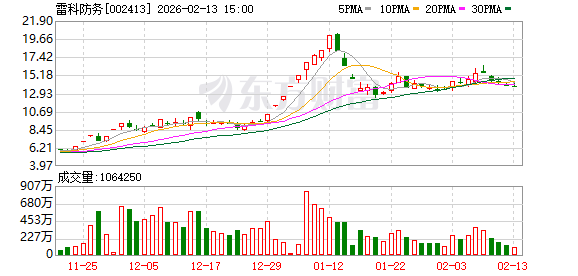
雷科防务:截至2026年2月10日公司股东人数为452206户
Zheng Quan Ri Bao· 2026-02-13 09:13
Core Insights - The company LeiKe Defense reported that as of February 10, 2026, the number of shareholders reached 452,206 [2] Company Summary - LeiKe Defense has a significant shareholder base, indicating strong investor interest and potential market confidence [2]

特朗普政策波动下,机构策略转向:看好非美股市与能源股等
智通财经网· 2026-02-13 08:13
Group 1: Global Economic Trends - The actions of President Trump are disrupting the previously maintained global order in economics, trade, and security, prompting allies to take action [1] - Financial markets are responding positively, with investors increasing investments in non-US stock markets and energy stocks, as well as showing optimism towards currencies like the Euro and Canadian Dollar [1] - The trend of "American exceptionalism" is fading, with major stock markets and emerging markets expected to achieve double-digit profit growth by 2026 [2] Group 2: European Market Developments - Over 73% of companies in the European Stoxx 600 index that reported Q4 earnings exceeded expectations, compared to 54% in the same period last year [2] - The FTSE 100 index in London has surpassed the 10,000-point mark, rising 5% this year, significantly outperforming the S&P 500's 1.4% increase [2] - A €600 million European strategic autonomy fund launched by BNP Paribas is focused on defense, industrial resilience, resource independence, and technology, driven by large-scale investment plans in Europe [2] Group 3: Defense and Energy Sector Insights - Defense stocks have surged by 200% since February 2022, highlighting their status as winners amid geopolitical tensions [5] - European energy stocks are nearing their highest levels since 2008, driven by increased focus on critical resources and infrastructure development [5] - The European Union is considering a "European manufacturing" strategy to protect domestic industries, although opinions among member states vary [8] Group 4: Currency Movements - The G10 currencies have shown significant appreciation against the US dollar since Trump announced tariffs, with the Swiss Franc up by 14.8% and the Euro by 9.6% [10]
日股2026开局杀疯了!高市早苗胜选点火 全球牛股榜日本霸屏前三
智通财经网· 2026-02-13 06:50
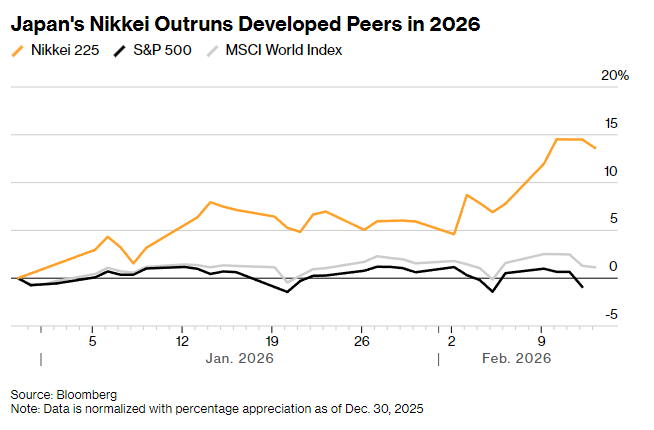
Group 1 - Japan's stock market has experienced a remarkable start to 2026, driven by Prime Minister Kishi's economic growth policies, with sectors like chips and defense leading the gains in developed markets [1] - The top three performing stocks in the MSCI global index this year are Japanese companies, with Kioxia Holdings leading at nearly 120% increase, followed by Kawasaki Heavy Industries and JX Advanced Metals, both exceeding 60% [1] - Following the historic election victory of Kishi's Liberal Democratic Party, the Tokyo Stock Exchange index and Nikkei 225 both reached all-time highs, with the Nikkei index rising over 5% post-election, significantly outperforming the S&P 500's 1.4% decline during the same period [1] Group 2 - Goldman Sachs has upgraded the rating of the Japanese stock market to overweight, anticipating benefits for sectors such as defense, key resources, shipbuilding, and energy due to a period of political stability [4] - Kawasaki Heavy Industries, a major stock in the MSCI index, surged 20% last week, benefiting from better-than-expected earnings and expectations that Kishi will relax constitutional restrictions on military capabilities [4] - Kioxia, which has already led the index in 2025, saw a 15% increase after raising its annual earnings forecast, driven by surging demand for storage chips in the AI industry, with its cumulative increase over the past 12 months exceeding 10 times [4] Group 3 - There are emerging concerns regarding the sustainability of the recent surge in Japan's stock market, with warnings that the positive news has largely been priced in and risks are accumulating [5] - The market's tolerance for underperformance is narrowing, and technical indicators suggest that the Nikkei 225 is currently in an overbought territory [5]
朝闻道 20260213:指数震荡偏强,控仓过节不慌
Orient Securities· 2026-02-13 00:58
Core Insights - The report indicates a cautiously optimistic outlook for February, with the index expected to remain stable and oscillate around the high and low points of January, suggesting a controlled approach to position management during the holiday season [3][8] - The mid-cap blue-chip style is expected to continue, with a focus on adjusting positions rather than passive defense, particularly in the livestock and chemical sectors [3][8] Market Strategy - The index is showing a slightly strong oscillation, with market sentiment indicating a lower risk appetite compared to the previous week, leading to rapid sector rotations [3][8] - Recommendations include controlling positions to avoid uncertainties during the holiday while being prepared for potential liquidity recovery post-holiday [3][8] Industry Strategy - In the agriculture sector, pig inventory is at a low point, with price bottoms being tested ahead of the holiday, indicating a potential recovery in market sentiment regarding pig prices [5][8] - The report highlights that the average weight of pigs post-slaughter has dropped to approximately 88.3 kg, suggesting limited downside for pig prices, with expectations for a price turning point in Q2 2026 [5][8] Thematic Strategy - The military industry is highlighted for its potential due to the resonance of domestic and international demand, with significant growth opportunities anticipated in unmanned and deep-sea technologies, as well as in military trade markets [6][8] - The report emphasizes the importance of the "14th Five-Year Plan" for the military sector, which is expected to clarify new equipment construction plans and enhance investment opportunities [6][8]


汽车业失血,军火单续命
汽车商业评论· 2026-02-12 23:06
Core Viewpoint - Renault has confirmed plans to produce up to 600 drones for the French Ministry of Defense at a factory in Le Mans, France, marking a significant shift towards defense manufacturing in response to heightened security concerns in Europe [5][8][22]. Group 1: Renault's Drone Production - The project will be a collaboration between Renault and defense contractor Thales, with a potential contract value of approximately €1 billion over a 10-year period [8]. - The drones produced will be similar to Iran's "Shahed" drones, intended for remote strikes, intelligence gathering, and reconnaissance, reflecting the capabilities seen in the ongoing Ukraine conflict [8][25]. - Renault emphasizes that this military production will not impact its existing automotive investment plans and does not intend to become a major defense player [9][10]. Group 2: Industry Trends in Defense - Other automotive suppliers in Europe, like Valeo and Schaeffler, are also pivoting towards defense, with Valeo participating in a "defense drone agreement" and Schaeffler collaborating with a drone startup [13][14]. - The shift towards defense is not universal; some companies, like ZF Friedrichshafen, are cautiously entering the defense sector, with defense-related revenue remaining a small fraction of their overall business [18]. Group 3: European Security Concerns - The ongoing Ukraine conflict and rising uncertainties in US-EU relations have heightened security awareness across Europe, leading to increased defense budgets and procurement [20][21]. - France's defense strategy has been rapidly adjusted, with President Macron announcing a significant increase in military spending, including a plan to boost defense spending by €36.5 billion by 2030 [27]. Group 4: Automotive Industry Challenges - The European automotive industry is facing significant challenges, including weak market demand and high costs associated with electric vehicle transitions, leading to substantial profit declines and job losses [30][31]. - The defense sector presents a unique opportunity for automotive companies, offering stable government contracts and less competition from Chinese firms, making it an attractive alternative [30][31]. Group 5: Economic Implications - Increased defense spending in Germany is expected to exceed €108 billion in 2026, providing a substantial boost to the defense industry and potentially offsetting declines in traditional sectors like automotive [32][34]. - Economists anticipate that this influx of funding could lead to technological advancements and a transformation in the defense sector, similar to the historical impact of defense spending in the US [36][37]. Group 6: Risks and Challenges - Transitioning to defense manufacturing carries risks, including limited export potential for European defense products and a weaker multiplier effect on the economy compared to civilian manufacturing [40][41][44]. - The defense industry currently employs about 120,000 people in Germany, significantly less than the 800,000 employed in the automotive sector, raising concerns about the ability to absorb job losses from the automotive industry's contraction [47][49].