新茶饮

Search documents
霸王茶姬“高娶”天合光能
Hu Xiu· 2025-12-14 15:53
Core Insights - The marriage between Zhang Junjie, CEO of Bawang Chaji, and Gao Haichun, co-chairman of Trina Solar, symbolizes a convergence of two distinct business models and generational paths in Chinese enterprises [4][6][7] - Bawang Chaji has seen significant growth, with revenue increasing from 1.9 billion RMB to 30 billion RMB in 2024, and the number of stores exceeding 6,200 globally [3][10] - Trina Solar, despite being a leading player in the photovoltaic industry, is currently facing challenges due to industry downturns, with a reported revenue decline of 20.87% year-on-year [18][40] Group 1: Company Profiles - Bawang Chaji, a rising star in the new tea beverage sector, has a market capitalization of approximately 25.05 billion USD (176 billion RMB) and has maintained profitability for 11 consecutive quarters [10][11] - Trina Solar, a veteran in the photovoltaic industry, has a market capitalization of 39.4 billion RMB and is experiencing significant financial strain, with a net profit loss of 4.2 billion RMB in the first three quarters of 2025 [8][18] - Bawang Chaji's financial metrics for the first half of 2025 include a revenue of 9.52 million USD and a net profit margin of 11.22%, while Trina Solar's metrics show a gross margin of 5.45% and a net margin of -9.16% [10][18] Group 2: Industry Context - The new tea beverage industry, represented by Bawang Chaji, is highly competitive, with many brands struggling to maintain growth amid price wars and market saturation [30][34] - The photovoltaic industry, where Trina Solar operates, is currently facing overcapacity and price wars, leading to a significant drop in component prices, which fell by 62% from 1.95 RMB/W to 0.74 RMB/W [15][18] - Trina Solar's strategic approach has focused on long-term sustainability, avoiding high leverage and aggressive expansion during market peaks, which has allowed it to survive industry downturns better than many competitors [22][24][42] Group 3: Future Outlook - Bawang Chaji is exploring international markets for growth, with 208 overseas stores as of the second quarter of 2025, although its overall scale remains small [35] - The photovoltaic industry is anticipated to reach a turning point, with efforts underway to consolidate and reduce excess capacity, which may lead to improved conditions for companies like Trina Solar [36][40] - The marriage between Bawang Chaji and Trina Solar may represent a strategic asset reorganization, potentially allowing both companies to leverage each other's strengths for future growth [7][44]



喜茶一年关店超650家,有加盟店亏损数十万离场
21世纪经济报道· 2025-12-12 14:32
Group 1 - The core viewpoint of the article highlights the challenges faced by Heytea, particularly its decision to temporarily halt franchise applications due to high competition and operational difficulties [1] - Heytea's previous franchisee reported significant losses, with some stores losing over 1 million yuan, attributed to an incomplete initial system and a 40% increase in material costs, which have pressured profit margins [1] - The number of Heytea stores is projected to decrease from 4,610 to 3,930 between October 2024 and October 2025, indicating a net reduction of 680 stores, with the current store count stabilizing around 3,946 as of November [1]

中国新茶饮(供应链)企业TOP50揭晓!“媒体+智库”视角勾勒产业双价值标杆
Nan Fang Nong Cun Bao· 2025-12-12 09:33
Core Insights - The 2025 "Zhu-Zun Cup" China New Tea Beverage (Supply Chain) Brand Value Top 50 list and special report were released, highlighting the industry's core competitiveness and development trends [3][4][5] - The new tea beverage sector is identified as a "billion-level" core category in consumer markets, significantly activating agricultural development and serving as a key consumption engine for rural revitalization [14][15] - The industry is transitioning from rapid growth to a critical transformation phase, shifting focus from brand marketing to supply chain efficiency and cost management [15][21] Industry Overview - The report categorizes the top companies into five dimensions: brand leadership, flavor sourcing, supply chain support, integration capabilities, and ecological collaboration [9][10] - The evaluation criteria have evolved from traditional metrics like store count and revenue to a multi-dimensional analysis of raw material quality, supply capacity, service depth, and ecological construction [10][11] Strategic Developments - Supply chain strategies are moving from "scale expansion" to "efficiency enhancement and cost precision" for refined operations [20][21] - The product strategy emphasizes direct sourcing from origin and "healthy industrialization" to ensure quality [21][22] - Technological advancements focus on smart equipment upgrades and digital logistics to overcome efficiency bottlenecks [22][23] Collaborative Efforts - The initiative is supported by a collaboration model involving government, research institutions, enterprises, and tea farmers, aiming to enhance the income of tea farmers in Zunyi [26][28] - The event aims to establish Zunyi as a "national new tea beverage supply chain center" and create a national supply chain alliance [28][29] - The event also emphasizes social responsibility and the value of empowering rural revitalization through concrete agricultural goals [30] Event Highlights - The Guangdong-Qian collaboration team was recognized as an innovative demonstration unit for rural revitalization and new tea beverage supply chain construction [32] - The event attracted over 600 exhibitors, more than a thousand key buyers, and over ten thousand professional visitors, showcasing the significance of the agricultural industry in the Greater Bay Area [35][36]

新消费派 | 3500亿元新茶饮市场“扫描” 存量博弈下的转型阵痛与未来机遇
Xin Hua Cai Jing· 2025-12-12 01:41
Core Insights - The Chinese new tea beverage market has grown to over 350 billion yuan, transitioning from rapid expansion to a critical transformation phase focused on quality and efficiency [1][2] - The industry is experiencing a slowdown in growth, with a projected market size of 354.7 billion yuan in 2024, reflecting a year-on-year growth rate of only 6.4%, significantly lower than the 24.9% compound annual growth rate from 2017 to 2022 [2] - Key future directions for the industry include health-oriented products, digital transformation, and increased market concentration among leading brands [1][4] Market Dynamics - The market is characterized by a "total increase, declining growth rate, and differentiated landscape," with the total number of tea beverage stores exceeding 415,000, but a net decrease of 39,000 stores in the past year due to closures [2] - Leading brands like Mixue Ice City and Bawang Chaji are expanding despite market challenges, with Mixue Ice City reaching 53,000 global stores and Bawang Chaji increasing its store count by over 40% [2][3] Financial Performance - Mixue Ice City went public in March 2025, achieving a market capitalization of 148.3 billion HKD and generating revenue of 14.875 billion yuan with a net profit of 2.718 billion yuan in the first half of 2025 [3] - In contrast, mid-tier brands like Heytea and Nayuki are facing revenue declines, with Heytea's revenue dropping by 1.9% and Nayuki's by 4.7% [3] Quality Improvement Focus - The industry is shifting from scale expansion to quality enhancement, with health, digitalization, globalization, and market differentiation as core features driving this transition [4] - The use of sugar substitutes in milk tea is projected to reach 61.3% by 2025, with a significant increase in the consumption of erythritol and plant-based ingredients [4] Digital Transformation - Digitalization is becoming essential, with leading brands enhancing their supply chain management and operational efficiency through technology [5][8] - The average capacity utilization rate of tea beverage raw material production has increased to 89.4%, and the application of blockchain technology in sourcing is on the rise [5] Global Expansion - Leading brands are accelerating their international expansion, with Bawang Chaji achieving an overseas GMV of over 300 million yuan, marking a 75.3% year-on-year growth [6] - Mixue Ice City has over 4,800 overseas stores, demonstrating the replicability of its business model in Southeast Asia [6] Challenges and Opportunities - The industry faces challenges such as raw material price volatility, severe product homogenization, and rising compliance costs [7] - To remain competitive, brands are diversifying their supply chains and leveraging technology to mitigate risks and enhance operational resilience [8] Future Outlook - The tea beverage industry is expected to enter a phase of category integration, digital empowerment, and initial globalization from 2026 to 2030, with a market size projected to exceed 1.05 trillion yuan, reflecting a 19% year-on-year growth [9] - The market is moving from a phase of "wild growth" to "refined cultivation," indicating a profound change in growth logic driven by health demands, digitalization, and globalization [9]
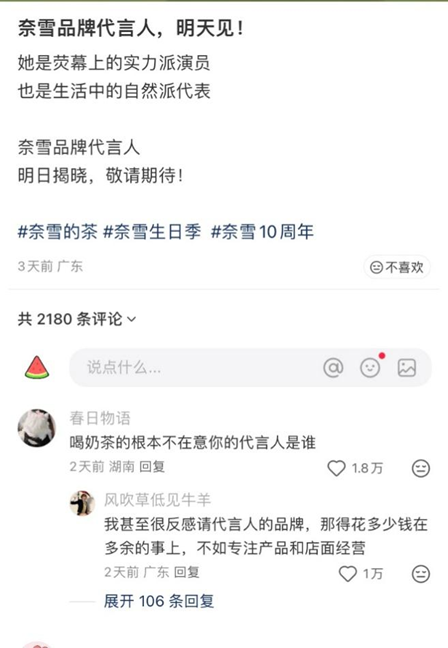
奈雪的茶累计市值缩水90% 明星代言营销模式遭质疑
Zhong Guo Jing Ji Wang· 2025-12-11 03:35
Core Viewpoint - Naixue Tea, once hailed as the "first stock of new tea drinks," is facing significant operational challenges, with its stock price plummeting over 90% since its IPO, leading to a market capitalization of less than 2 billion HKD [2][3]. Financial Performance - The company recorded a slight profit of 0.13 million in 2023, but is projected to incur a substantial loss of 9.17 billion in 2024, raising concerns about its ongoing profitability [2][3]. - Cumulative losses over the past five years have exceeded 6 billion, with a notable decline in the number of stores from 1798 to 1638, reflecting a net decrease of 160 stores [9][10]. Strategic Adjustments - Naixue has initiated several strategic adjustments, including reducing store sizes and modifying franchise policies to lower operational costs and expand into lower-tier cities [3][4]. - The average price per customer has decreased from 42 to 25.7, a nearly 40% reduction, aligning more closely with mainstream pricing [3]. Marketing and Brand Positioning - The company has faced criticism regarding its celebrity endorsement strategy, with consumers questioning the effectiveness of such marketing in a competitive landscape that increasingly values product quality and consumer experience over marketing noise [6][7]. - Despite launching new products and celebrity endorsements, the anticipated positive consumer response has not materialized, indicating a shift in market dynamics [6][7]. Operational Challenges - Naixue has encountered issues related to product quality, with over 2300 complaints reported, which undermine its efforts to establish a healthy brand image [8]. - The company has also experienced a significant turnover in its executive team, which poses additional challenges to stability and leadership [4][8]. Market Dynamics - The competitive landscape for new tea drinks has evolved, with successful brands focusing on product quality and value rather than high-profile marketing campaigns [7][8]. - Naixue's struggle to maintain a high-end positioning in a market that favors cost-effectiveness raises questions about its future viability [5][6].
业内人士:政策预期不断强化,大消费板块配置机遇浮现
Sou Hu Cai Jing· 2025-12-10 23:27
Group 1 - Recent policies aimed at promoting consumption and boosting domestic demand have been intensively introduced [1] - Experts believe that extending and expanding direct subsidies, as well as consumer loan interest subsidies, are expected to be effective short-term consumption promotion policies [1] - The consumption sector is showing signs of bottoming out, with fundamental recovery acting as a catalyst for stock price increases [1] Group 2 - Chain restaurants and new tea beverage companies with scale effects and significant earnings elasticity are highlighted as promising investment opportunities [1] - Sports companies involved in event operations and related services are also considered noteworthy [1] - Performing arts operators with scarce IP value that can continuously convert fan economy are identified as key segments to watch [1]
大消费迎“催化剂”!这些方向被看好
Zhong Guo Zheng Quan Bao· 2025-12-10 14:28
Core Viewpoint - Recent policies aimed at boosting consumption and domestic demand are expected to positively impact the consumer sector, with a focus on direct subsidies and consumption loan interest subsidies as short-term measures to stimulate spending [1] Group 1: Policy Initiatives - A series of policies have been released to enhance domestic demand and consumption, with expectations for increased fiscal spending and a focus on service consumption [2] - The Ministry of Industry and Information Technology and other departments have outlined a plan to create three trillion-level consumption sectors and ten hundred-billion-level consumption hotspots by 2027 [2] - The "old-for-new" policy is anticipated to continue, directing more resources towards service consumption and improving the overall consumption environment [3] Group 2: Investment Opportunities - The consumer industry is showing signs of bottoming out, with fundamental recovery acting as a catalyst for stock prices, particularly in sectors like chain restaurants, new tea drinks, and sports companies [1][4] - Service consumption is expected to enter a rapid growth phase, driven by personalized interactions and unique experiences, offering significant investment potential compared to traditional goods consumption [4] - Companies focusing on dividend distribution and share buybacks are improving the industry landscape, with a "dividend+" strategy recommended for stable short-term investments [4] Group 3: Strategic Focus Areas - Two main lines for investment in the consumer sector are suggested: one focusing on high replicability through efficient supply chains, and the other on high experience creation capabilities that offer unique consumer experiences [5] - Specific sectors to watch include chain restaurants, sports companies, entertainment operators with valuable IP, and platform companies with strong ecosystem capabilities [5]
纳斯达克上市半年承压:霸王茶姬遭谣言冲击,单店盈利下滑+品控问题持续发酵
Sou Hu Cai Jing· 2025-12-10 02:49
Core Viewpoint - The company BaWang Tea Ji, which made headlines as the first new tea beverage company to go public in the U.S., is facing multiple crises including rumors, stock price volatility, slowing growth, and quality control issues within just six months of its IPO [2] Group 1: Rumors and Legal Issues - A wedding invitation linked to the founder of BaWang Tea Ji has sparked widespread rumors about his personal life, including false claims about his marriage and business dealings [3][5] - The rumors have proliferated on social media, with fabricated stories about the founder's background and business success, leading to significant public confusion [6] - The company's stock price reacted negatively to the rumors, with a notable drop of 8.09% on November 20, 2025, resulting in a market value loss of approximately $2.1 billion [8] Group 2: Financial Performance and Challenges - BaWang Tea Ji has experienced a decline in single-store profitability, with the average monthly GMV for Q2 2025 at 404,350 yuan, representing a 23% year-over-year decrease [16] - The company has faced operational efficiency challenges, with single-store GMV declining for six consecutive quarters [16] - As of Q2 2025, the company had over 7,038 global stores and 200 million registered members, but rapid expansion has led to concerns about sustainability and profitability [14] Group 3: Quality Control Issues - The company has been criticized for quality control problems, including a recent incident where a customer found a foreign object in their drink, raising serious concerns about food safety [18][23] - Complaints on consumer platforms have reached 2,927, highlighting issues such as incorrect sugar levels and product cancellations [21] - Experts emphasize the importance of addressing food safety issues to maintain brand reputation and consumer trust, suggesting that the company must improve internal management and quality control measures [23]
蜜雪冰城早餐“前哨战”:5元平价策略背后的全时段野心与供应链大考
Xin Lang Cai Jing· 2025-12-10 02:40
Core Insights - The article discusses the strategic entry of Mixue Ice City into the breakfast market, targeting China's 1.35 trillion yuan breakfast sector with a new product line priced at 5 yuan [1][15][16] Group 1: Market Entry Strategy - Mixue Ice City has launched a breakfast series in several cities, including Hangzhou, Dalian, Xi'an, and Nanning, featuring four milk products priced uniformly at 5 yuan [1][14][15] - The company conducted a comprehensive breakfast survey through WeChat to gauge consumer preferences and price sensitivity before launching the breakfast products, indicating a cautious approach to market entry [2][16] - The breakfast initiative is currently in a testing phase, with no plans for large-scale promotion yet, reflecting a careful rollout strategy [2][16] Group 2: Operational Efficiency and Profitability - The introduction of breakfast items aims to optimize existing business models by utilizing idle morning hours in stores, thereby reducing fixed costs and enhancing overall profitability [3][18] - With over 53,000 stores, even a small increase in revenue from breakfast sales can lead to significant aggregated gains for the company [3][18] - The choice to offer dairy products for breakfast leverages existing supply chain capabilities, allowing for cost-effective product development and market testing [3][19] Group 3: Industry Trends and Competition - Mixue Ice City is part of a broader trend in the beverage industry, where brands like Gu Ming, Kudi, and Nayuki are also entering the breakfast market, indicating a shift towards all-day, multi-category operations [5][20][21] - The competitive landscape is characterized by increasing homogenization among tea brands, making it challenging to attract customers during limited afternoon tea hours [6][21] Group 4: Challenges in Localization and Standardization - The company faces significant challenges in catering to diverse regional breakfast preferences across China, which complicates the standardization of breakfast offerings [8][22][23] - Breakfast consumption behavior differs from tea consumption, emphasizing the need for quick service and efficient operations, which may require adjustments in store processes [9][24] - Balancing resource allocation between breakfast and core tea products poses an operational challenge for Mixue Ice City [9][24] Group 5: Supply Chain Considerations - Mixue Ice City's established supply chain, with five production bases and 29 warehouses, supports its distribution capabilities across over 300 cities [10][25][26] - The breakfast business will test the supply chain's adaptability, especially as many breakfast items require higher freshness and quicker turnaround than tea products [10][26] - The company's recent acquisition of a stake in a fresh beer brand indicates a strategy to diversify and create a full-day consumption experience [10][26]
大额亏损叠加高成本,市值缩水95%,明星代言能救奈雪吗?
Xin Lang Cai Jing· 2025-12-08 06:06
Core Viewpoint - The new tea beverage industry is transitioning from explosive growth to a phase of stock competition, where product quality and genuine consumer value are becoming more critical than mere marketing efforts [2][19]. Group 1: Company Overview - Naixue's Tea, a pioneer in the high-end market, announced actress Gao Yuanyuan as its brand ambassador on December 2, coinciding with its 10th anniversary [2]. - The company is facing significant operational challenges, with a reported revenue of 2.178 billion yuan for the first half of 2025, a substantial decline of approximately 40% year-on-year [2][8]. - Naixue's stock price has plummeted to around 1 HKD, a 95% drop from its initial listing price of about 19 HKD, resulting in a market value loss exceeding 30 billion yuan [2][34]. Group 2: Marketing Strategy - Naixue's recent marketing strategy includes a systematic approach to celebrity collaborations, aiming to enhance brand visibility [2]. - However, the effectiveness of this celebrity endorsement strategy has been questioned, with consumers expressing indifference towards the brand ambassadors [21][24]. - The shift in consumer sentiment indicates a market trend favoring product quality and consumer experience over celebrity endorsements [5][24]. Group 3: Financial Performance - Naixue's management expenses reached 1.37 billion yuan in the first half of 2025, surpassing its sales costs of 744 million yuan, highlighting a significant profit erosion factor [27]. - The company has accumulated losses exceeding 6 billion yuan, with a net loss of 117 million yuan reported for the first half of 2025 [30][34]. - Despite an increase in order volume by 11.43%, the average transaction value has decreased from over 40 yuan in 2021 to 25.7 yuan, indicating a dilution of the brand's premium positioning [28][30]. Group 4: Market Position and Strategy Challenges - Naixue's store network is predominantly concentrated in first- and second-tier cities, limiting its market expansion compared to competitors like Mixue Ice City, which have successfully penetrated lower-tier markets [34]. - The brand has undergone three significant name changes in the past decade, leading to perceptions of a lack of clear identity and strategic direction [34]. - High employee turnover and management instability have further complicated the execution of its strategic initiatives [34][35]. Group 5: Consumer Sentiment and Brand Image - Consumer feedback on Naixue's products has been mixed, with over 2,000 complaints reported, including issues related to product quality [5][24]. - The brand's focus on creating a "third space" experience has come under scrutiny as over 89% of orders are now from takeout and self-pickup, raising questions about the return on investment for physical store spaces [27][28].