
镍矿

Search documents
恒生指数早盘跌0.55% 有色资源板块逆市走高
Zhi Tong Cai Jing· 2026-01-15 04:06
Group 1 - The Hang Seng Index fell by 0.55%, down 149 points, closing at 26,850 points, while the Hang Seng Tech Index dropped by 1.83% [1] - Ctrip Group-S experienced a significant decline of over 19% due to an antitrust investigation initiated by the State Administration for Market Regulation [2] - Kaisa International Resources (03858) rose over 5% to reach a new high, with black tungsten concentrate prices surpassing 500,000 yuan, prompting several tungsten companies to raise long-term contract prices [1] Group 2 - Likin Resources (02245) surged over 10% and Zhongwei New Materials (02579) increased by over 9% amid disruptions in Indonesia's nickel ore quotas [1] - China Rare Earth Holdings (03788) saw a significant fluctuation, rising by 8% after the company's plan to spin off its gold business was terminated, and it intends to rename itself "Rare Earth Gold" [1] - Haichang Ocean Park (02255) increased by over 10%, with visitor numbers on the first day of the New Year holiday rising by 60% year-on-year [1] Group 3 - Zhihui (02513) rose over 4% after announcing a collaboration with Huawei to open-source a new generation image generation model [1] - China Heartland Fertilizer (01866) also increased by over 4%, as a global urea supply shortage may arise, and the company is actively repurchasing shares [1] - Woan Robotics (06600) saw a rise of over 7% following the release of its humanoid intelligent robot, Onero [1] Group 4 - Jiantao Laminates (01888) rose nearly 6% during intraday trading after announcing a price increase, which is expected to become a prevailing trend in the copper-clad laminate industry [1] - Q Technology (01478) retracted over 7% after Citigroup reported that the company's net profit last year fell below its expectations [1] - Kanglong Chemical (300759) (03759) dropped over 5% as it plans to conduct a placement at an 8.5% discount, raising nearly 1.32 billion HKD [1]
印尼镍矿配额扰动再起 力勤资源涨超11% 中伟新材涨超9%
Zhi Tong Cai Jing· 2026-01-15 02:17
Group 1 - Nickel stocks rose in early trading, with Liqin Resources (02245) up 11.22% at HKD 25.78, Zhongwei New Materials (02579) up 9.14% at HKD 39.16, and Xinjiang Xin Mining (03833) up 4.63% at HKD 2.94 [1] - The price of nickel on the London Metal Exchange closed at 18,785, an increase of 6.7%, while the Shanghai nickel futures closed at 148,930, up 5.6% [1] - Indonesia may approve a nickel ore production quota of approximately 260 million tons by 2026, according to local media citing mining officials [1] Group 2 - CITIC Futures anticipates that the theoretical demand for nickel ore in Indonesia will exceed the currently proposed quota of 260 million wet tons by approximately 15% in 2026, as it is a period of concentrated release of new capacity for Indonesian hydrometallurgical (HPAL) projects [1] - If this quota is implemented, it could lead to significant tightening expectations in the market [1]
港股异动|力勤资源大涨超13%,机构预计2026年镍矿短缺将成定局
Ge Long Hui· 2026-01-15 02:04
Core Viewpoint - Recent news regarding Indonesia's reduction of nickel ore quotas has led to a significant increase in nickel prices, with estimates suggesting a potential supply-demand reversal by 2026 due to a projected decrease in Indonesian nickel production by 200,000 to 300,000 tons [1] Group 1: Company Overview - Liqin Resources (2245.HK) experienced a surge of over 13%, reaching a peak of HKD 26.2 [1] - The company has established a comprehensive industrial chain covering nickel ore trading, smelting production, equipment manufacturing, and sales, positioning it to benefit from the anticipated market changes [1] Group 2: Industry Impact - Dongwu Securities forecasts that if Indonesia's actual approval quotas align with plans, a nickel ore shortage will be inevitable by 2026, leading to significant valuation recovery across the upstream and downstream sectors of the industry [1] - The increasing infrastructure budget in Indonesia and the expected rise in demand for HPAL smelting slag treatment will create new revenue streams and enhance the profitability of the group [1] Group 3: Strategic Developments - Liqin Resources announced the signing of a shareholder agreement for the establishment of a joint venture company, BJL, with its subsidiaries BBS and BMS, aimed at optimizing tax burdens related to wet slag treatment operations [1] - The formation of the BJL joint venture is intended to align with the company's business development needs and secure eligibility for tax incentives in Indonesia [1]
有色金属专场-2026年年度策略会议-恒中有变-观复顺时
2026-01-15 01:06
Summary of Key Points from Conference Call Industry Overview - The conference call primarily discusses the non-ferrous metals industry, focusing on lithium carbonate, nickel, copper, and aluminum markets. Lithium Carbonate Market - **Price Trends**: Lithium carbonate prices have risen significantly due to increased acceptable inventory, shifting market sentiment from pessimism to optimism. The price fluctuation range is expected to be between 100,000 to 180,000 RMB/ton in 2026, with a projected surplus of nearly 100,000 tons [1][10]. - **Supply and Demand Dynamics**: The lithium carbonate market is experiencing a notable increase in visible inventory, with total market inventory rising by 300 tons to 110,000 tons. Smelter inventory increased by 700 tons to 18,000 tons, while downstream inventory decreased by 2,400 tons to 17,000 tons [2]. - **Future Influences**: Key factors affecting lithium carbonate prices include policy changes, financial attributes, and annual supply-demand patterns. The market is currently in a state of excitement, with a significant focus on the impact of battery prices on economic viability [4][6]. Nickel Market - **Current Status**: The nickel market is characterized by a historical oversupply in stainless steel, nickel sulfate, and pure nickel supply chains, with inventories at multi-year highs. The demand from the stainless steel sector remains strong, but the battery sector is under pressure due to the rise of lithium iron phosphate [11]. - **Demand Growth**: Despite the oversupply, the stainless steel industry is expected to continue as the main growth driver, with a projected growth rate of 6.8% in stainless steel production for the first nine months of 2025 [11]. Copper Market - **Supply and Demand Outlook**: The copper market is expected to face a fragile supply situation with stable demand growth. The first quarter of 2026 is anticipated to be particularly tight, with a projected increase in refined copper production of 1.9% globally [12][19]. - **Price Predictions**: Copper prices are expected to remain strong, driven by strategic metal resource narratives and stable demand growth from traditional and emerging sectors [12][19]. - **Long-term Expectations**: Long-term forecasts suggest that copper prices may rise significantly post-2027 due to ongoing supply issues and investment challenges [16][17]. Aluminum Market - **Price Forecast**: Aluminum prices are expected to reach historical highs in 2026 but may not maintain the extreme levels seen at the beginning of the year. The market is anticipated to remain in a tight balance, with a focus on policy changes and emerging demand dynamics [22][30]. - **Demand Trends**: Overall aluminum demand is projected to grow at a rate of over 2%, although significant growth drivers are lacking. The construction sector's performance is expected to improve, but the photovoltaic sector may become a new drag on demand [30]. Additional Insights - **Investment Strategies**: The first quarter of 2026 is seen as a critical period for bullish strategies, with caution advised as the market approaches the Chinese New Year due to potential inventory accumulation [24]. - **Global Inventory Levels**: By the end of 2025, global visible inventory levels have risen to approximately 800,000 tons, indicating a recovery from pandemic-induced low inventory levels [21]. - **Emerging Technologies**: AI investments are expected to have a limited direct impact on copper consumption but may drive demand in the energy sector through increased electricity usage [20]. This summary encapsulates the key insights and projections discussed during the conference call, providing a comprehensive overview of the current state and future outlook of the non-ferrous metals industry.
新能源及有色金属日报:宏观情绪退潮,镍不锈钢震荡走弱-20260114
Hua Tai Qi Huo· 2026-01-14 03:11
Report Industry Investment Rating No information provided. Core View of the Report - Short - term nickel prices face multiple pressures such as high inventory, weak demand, and the ebb of macro - sentiment, and may continue to decline in a volatile manner. However, attention should be paid to the implementation of Indonesia's nickel quota adjustment policy. If the policy is tightened more than expected, it may support prices. - Short - term stainless steel may maintain a weak and volatile trend, mainly affected by high inventory, weak demand, and cost - side fluctuations. Attention should be paid to the implementation of Indonesia's nickel ore quota policy and the production and stocking rhythm of steel mills [1][3]. Summary According to Relevant Catalogs Nickel Variety Market Analysis Futures - On January 13, 2026, the main contract of Shanghai nickel 2602 opened at 145,000 yuan/ton and closed at 138,450 yuan/ton, a change of - 2.21% from the previous trading day's closing price. The trading volume was 1,277,690 (+194,488) lots, and the open interest was 119,485 (-4,663) lots. The main contract showed a "high - opening, low - running + volatile downward" trend, driven by the ebb of macro - sentiment, high inventory on the supply side, weak demand, and the fading of geopolitical risk premium [1]. Nickel Ore - Mysteel reported that there were transactions in the nickel ore market recently. The CIF price of domestic 1.3% nickel ore was 42 US dollars. The overall nickel ore resources in the market were limited, and the nickel ore price was running strongly. Philippine mines were eager to sell at higher prices. The downstream nickel - iron price reached 1,000 yuan/nickel (including tax at the hatch bottom) and above. In Indonesia, the domestic trade benchmark price in January 2026 (Phase II) was expected to rise by 2.8 - 4.9 US dollars/wet ton. The current mainstream premium was +25, and the premium range was mostly between +25 - 26. Factories may push down the premium due to cost pressure [1]. Spot - Jinchuan Group's sales price in the Shanghai market was 148,600 yuan/ton, an increase of 100 yuan/ton from the previous trading day. Spot trading was average, and the spot premiums of refined nickel brands were slowly falling. The premium of Jinchuan nickel changed - 100 yuan/ton to 8,900 yuan/ton, the premium of imported nickel changed 0 yuan/ton to 600 yuan/ton, and the premium of nickel beans was 2,450 yuan/ton. The previous trading day's Shanghai nickel warehouse receipt volume was 39,436 (-234) tons, and the LME nickel inventory was 284,148 (-414) tons [2]. Nickel Variety Strategy - Unilateral: Mainly operate within a range; Cross - period: None; Cross - variety: None; Spot - futures: None; Options: None [3]. Stainless Steel Variety Market Analysis Futures - On January 13, 2026, the main contract of stainless steel 2603 opened at 13,890 yuan/ton and closed at 13,790 yuan/ton. The trading volume was 256,128 (-551) lots, and the open interest was 130,200 (-4,171) lots. The contract opened higher due to the overnight rise of LME nickel but was dragged down by the rapid decline of Shanghai nickel, and the price fluctuated downward with weakening spot trading. In the afternoon, the continuous decline of Shanghai nickel triggered selling pressure, and the price fell below 13,800 yuan/ton, reaching a minimum of 13,705 yuan/ton and finally closing at 13,790 yuan/ton [3]. Spot - In the morning, the spot price rose slightly due to the increase in futures prices, but the market was afraid of high prices, and the inquiry and trading were poor. The stainless steel price in the Wuxi market was 13,900 (+0) yuan/ton, and in the Foshan market, it was 13,750 (-25) yuan/ton. The premium of 304/2B was between 175 - 375 yuan/ton. The ex - factory average price of high - nickel pig iron changed 8.50 yuan/nickel point to 980.5 yuan/nickel point [4]. Stainless Steel Variety Strategy - Unilateral: Neutral; Cross - period: None; Cross - variety: None; Spot - futures: None; Options: None [5].
国联民生证券:锂价步入上行通道 矿端或将短缺支撑镍价
智通财经网· 2026-01-14 02:31
Group 1: Lithium Market Insights - Lithium supply growth is slowing while energy storage demand is experiencing high growth, indicating an industry turning point with lithium prices entering an upward channel [1] - In H1 2025, lithium faced oversupply pressure leading to price declines, but strong demand from energy storage in H2 2025 has driven prices up [1][2] - The global lithium supply is projected to reach 215.9 million tons in 2026, with growth rates declining from 26% to 13% by 2028, while energy storage demand is expected to outpace supply growth [2] Group 2: Cobalt Market Dynamics - The Democratic Republic of Congo (DRC) is implementing a quota system that significantly reduces cobalt supply, with a projected 56% decrease in total quotas from 2024 levels by 2026-2027 [3] - Demand from consumer electronics is expected to exceed expectations, leading to a projected global cobalt shortage of 3.6 and 3.2 million tons in 2026 and 2027, respectively [3] - The domestic inventory is being continuously consumed, leading to a tight supply situation before new raw materials from the DRC arrive [3] Group 3: Nickel Market Overview - Indonesia's regulatory measures aim to control nickel supply and support prices, with a focus on high-grade nickel resources and restrictions on new pyrometallurgical capacity [4] - Nickel supply remains tight due to slow approval processes for mining quotas and external factors affecting mining and transportation capabilities [4] - The nickel market is expected to face potential reductions in mining quotas in 2026, necessitating close monitoring of Indonesia's policy changes [4]

印尼镍矿拟减产引发市场震荡 产能优势难挡库存高压
2 1 Shi Ji Jing Ji Bao Dao· 2026-01-13 02:11
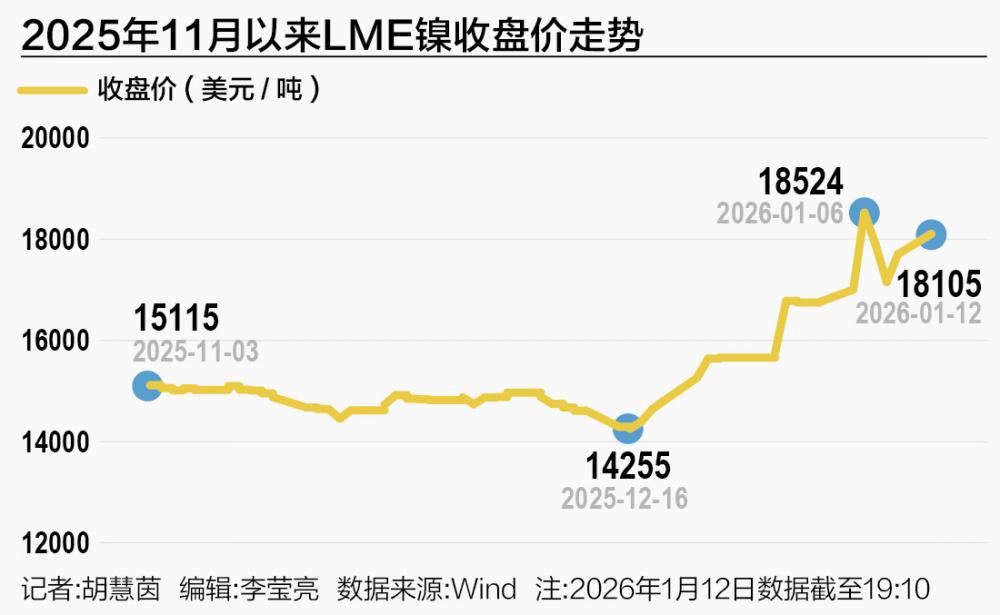
Core Viewpoint - Nickel prices have surged significantly since mid-December 2022, driven by supply concerns from Indonesia and increased investment in China's metal market, although signs of a cooling trend are emerging [1][3][4]. Group 1: Price Movements - On January 6, 2023, nickel futures prices rose by 10.5%, nearing $18,800 per ton, marking the largest single-day increase since late 2022 [1]. - As of January 12, 2023, nickel futures prices fell to $17,703 per ton, reflecting a cumulative increase of 5.6% since the beginning of the year [1]. - The recent nickel price surge has been accompanied by a decline in prices, with LME nickel dropping to $18,059 per ton and Shanghai nickel at ¥143,760 per ton by January 12, 2023 [3]. Group 2: Supply Dynamics - Indonesia controls nearly 70% of global nickel production and plans to cut production quotas by approximately 34% to 250 million tons by 2026 [4][8]. - The Indonesian government is also adjusting the pricing formula for nickel and imposing taxes on cobalt, which is expected to increase production costs [4][9]. - Analysts suggest that Indonesia's shift from production expansion to active regulation aims to stabilize prices and address supply concerns [4][9]. Group 3: Market Sentiment and Future Outlook - The current market sentiment indicates limited downside potential for nickel prices, with predictions suggesting an average price of $15,250 per ton by 2026 if no significant production cuts are implemented [1][11]. - Despite the recent price volatility, analysts believe that the oversupply situation in the nickel market has not been resolved, with expectations of a surplus of 350,000 to 400,000 tons by 2026 [11]. - The demand side remains weak, particularly in the stainless steel sector, which has been a significant consumer of nickel [10][11]. Group 4: Strategic Considerations - Indonesia's nickel industry policies are evolving, focusing on maximizing resource value and stabilizing prices rather than merely expanding production [7][9]. - The country aims to enhance its influence in the global nickel market through coordinated policies among nickel-exporting nations, akin to an "OPEC for nickel" [8]. - The long-term strategy includes developing downstream industries, particularly in electric vehicle production, to increase the added value of nickel resources [8][9].

镍价飙涨创近三年高位
2 1 Shi Ji Jing Ji Bao Dao· 2026-01-12 23:42
Core Viewpoint - Nickel prices have surged since mid-December 2022, driven by supply concerns from Indonesia and a large-scale investment boom in China's metal market. However, signs of a cooling trend have emerged, with prices dropping from a peak of nearly $18,800 per ton to $17,703 per ton by January 12, 2023, reflecting a 5.6% increase since the beginning of the year [1][2][3]. Group 1: Price Movements and Market Dynamics - On January 6, 2023, nickel futures prices on the London Metal Exchange (LME) rose by 10.5%, marking the largest single-day increase since late 2022 [1][2]. - As of January 12, 2023, LME nickel was priced at $18,059 per ton, while Shanghai nickel futures were at 143,760 yuan per ton, showing a nearly 7.7% increase since the start of the year [2][3]. - The recent surge in nickel prices contrasts with the performance of other metals like copper and aluminum, which have reached new highs, indicating a divergence in market trends [1][3]. Group 2: Supply Concerns and Indonesian Policy - Indonesia controls approximately 70% of global nickel production and has announced plans to reduce production quotas by 34% to about 250 million tons by 2026 to better match supply and demand [2][3][4]. - The Indonesian government is also adjusting the pricing formula for nickel and imposing taxes on by-products like cobalt, which could increase production costs and tighten supply [3][4]. - Analysts suggest that Indonesia's shift from expansion to active regulation and price support is a strategic move to address concerns about future supply shortages [3][4]. Group 3: Investment Trends and Market Sentiment - The recent volatility in nickel prices has been fueled by a comprehensive investment boom in the Chinese metal market, with significant trading volumes observed in nickel and other metals [4][5]. - Investor behavior in the precious metals market has shifted towards a "buying the dip" strategy, although recent declines in nickel prices may indicate a potential retreat from this trend [4][5]. - The overall sentiment in the market remains cautious, with expectations of a potential oversupply of nickel persisting, despite temporary price increases [22][23]. Group 4: Future Outlook and Challenges - Analysts predict that unless Indonesia implements strict production controls and demand experiences a significant rebound, nickel prices may struggle to maintain high levels, with forecasts suggesting an average price of $15,250 per ton by 2026 [1][3][22]. - The demand for nickel is primarily driven by the stainless steel and battery sectors, but current market conditions indicate a weakening demand, particularly in the stainless steel industry [21][22]. - The potential for structural changes in nickel demand exists, but large-scale substitutions are unlikely due to fixed nickel content in stainless steel and the established preferences for battery technologies [23][24].
政策惊雷破仓海,镍途跌宕问来年 ——2025 复盘与 2026 掘金指南
Xin Lang Cai Jing· 2026-01-12 09:46
Core Viewpoint - The nickel market in 2025 experienced a "wide fluctuation" characterized by an "N-shaped" price trend, driven by the interplay between "Indonesian policy expectations" and "global high inventory realities" [4][10]. Price Trend Summary - In the first quarter, optimistic market sentiment was fueled by Indonesia's tightening policy signals and China's "expanding domestic demand" strategy, pushing prices from 128,000 CNY/ton to a peak of 135,000 CNY/ton by mid-March [5]. - The second quarter saw a decline in prices due to high inventory and weak demand, with prices dropping from around 130,000 CNY/ton to approximately 122,000 CNY/ton by the end of June [5]. - The third quarter was marked by a narrow price range of 120,000 to 124,000 CNY/ton, with market sentiment remaining pessimistic due to high inventory and weak demand [5]. - In the fourth quarter, prices surged to 138,000 CNY/ton, driven by expectations of a significant reduction in Indonesia's nickel mining quotas and global liquidity easing [5][10]. Supply Side Overview - The global nickel supply market in 2025 exhibited an overall surplus, with significant production growth driven primarily by Indonesia's capacity expansion [8]. - The supply dynamics evolved through three phases: initial expectations of loosened supply due to increased mining quotas, mid-year cost pressures from resource tax hikes, and a late-year shift in expectations towards potential quota reductions [8]. - Indonesia's quota management significantly influenced global supply, with a dual model of domestic production and imports from the Philippines [8]. Demand Side Overview - The global nickel consumption market in 2025 showed moderate growth, with demand expected to reach 3.53 to 3.6 million tons, reflecting a year-on-year increase of about 5% [9]. - Demand dynamics shifted, with traditional stainless steel applications experiencing weak growth, while high-end alloys and special steels became the main drivers of demand growth [9]. - High-purity nickel plate demand remained resilient, particularly in high-nickel battery applications, despite challenges from competing technologies [9]. Market Dynamics Summary - The nickel market's volatility in 2025 highlighted the critical role of policy expectations and financial attributes, with prices reflecting not only current supply-demand conditions but also future narratives [7][10]. - The end-of-year price surge was primarily driven by fears of supply contraction, supported by macro liquidity conditions [6][10].

长江有色:12日镍价上涨 现货挺价明显电池企业观望
Xin Lang Cai Jing· 2026-01-12 09:46
Core Viewpoint - Nickel prices have strengthened due to a combination of macroeconomic factors, industry trends, and geopolitical disturbances, reflecting a complex interplay of liquidity expectations, supply constraints, and geopolitical uncertainties [2] Supply Side - Indonesia's policy changes are the biggest variable affecting the supply landscape, with rumors suggesting a potential 34% reduction in nickel ore production quotas by 2026, which could significantly alter the global nickel supply-demand balance [2] - Indonesia's proposed revision of mining taxes to classify by-product cobalt as a separate taxable item may increase nickel smelting production costs, providing price support from the cost side [2] - Although LME nickel inventories are high, the availability of specific brands and grades for delivery is relatively tight, leading to higher spot premiums and indicating that immediate supply is not as loose as the absolute inventory figures suggest [2] Demand Side - Nickel demand is driven by two core areas: stainless steel, which accounts for over 60% of global nickel consumption, and the rapidly growing demand from the new energy battery sector, particularly high-nickel ternary batteries [3] - The aerospace and military sectors also contribute to demand through the use of nickel-based superalloys, adding a high-value growth segment to the market [3] - The nickel industry chain is characterized by high upstream concentration, technology-driven midstream, and diversified downstream demand, with Indonesia controlling about 70% of global supply [3] Market Outlook - Short-term nickel price trends will be primarily influenced by expectations surrounding Indonesia's production reduction policies, alongside geopolitical factors and resilient demand, suggesting prices may remain strong but volatile [4] - High global visible inventories will impose substantial constraints on the upward price potential, with future market focus on the implementation and effectiveness of Indonesia's policies and the path for inventory digestion [4]