证券业

Search documents
美联储降息在即 美债一举夺魁! 年内跑赢全球主权债
智通财经网· 2025-09-16 02:37
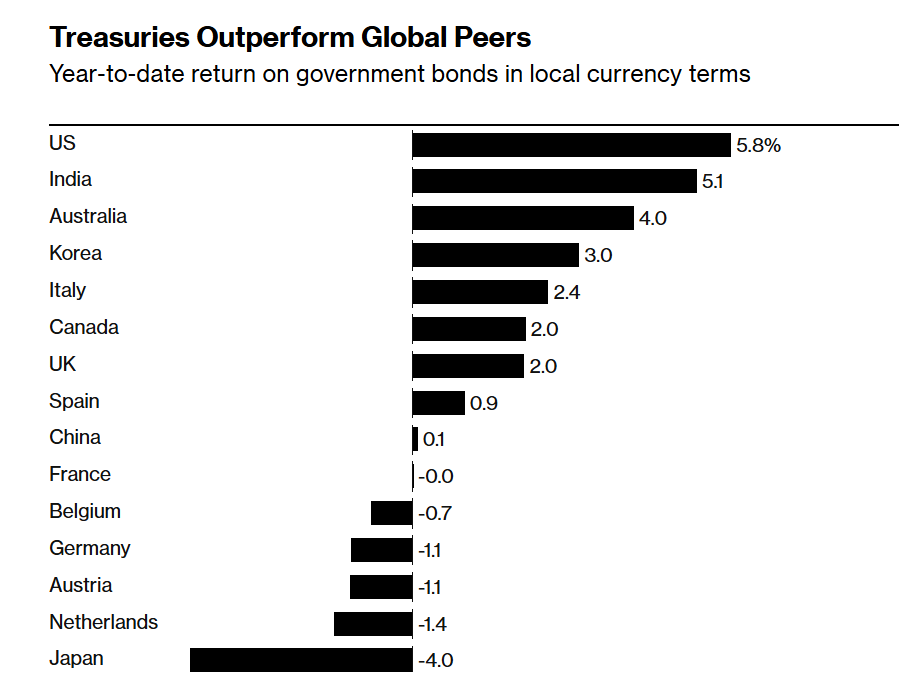
Group 1 - The core viewpoint is that the recent rise in expectations for Federal Reserve interest rate cuts has shifted the outlook for U.S. Treasury bonds, making them the top-performing sovereign debt market globally [1][4] - According to Bloomberg's statistics, the return on U.S. government securities is projected to be 5.8% by 2025, outperforming 15 other major bond markets [1][4] - The excess return of U.S. Treasury assets compared to global peers has decreased to its lowest point in three years, despite still being significantly higher than developed markets [1][4] Group 2 - Analysts suggest that the Federal Reserve's anticipated rate cuts are based on a weakening economy rather than a strong one, which could support U.S. Treasury performance [2][4] - Market focus is shifting towards the specifics of the Federal Reserve's easing policy, with expectations of three 25 basis point cuts by the end of the year [4][5] - The yield on the U.S. 10-year Treasury has decreased by approximately 50 basis points this year, indicating rising bond prices [5] Group 3 - The ongoing weak U.S. dollar has led international investors to seek returns in non-dollar assets, impacting the relative performance of U.S. Treasuries [8][11] - Despite strong performance in local currency terms, U.S. Treasuries have lagged behind other sovereign bonds when measured in U.S. dollars due to currency fluctuations [11] - Major investment firms are currently favoring European and UK bonds over U.S. Treasuries, reflecting a shift in investment strategy [11]

上海市金融运行报告(2025)
Zhong Guo Ren Min Yin Hang· 2025-09-16 02:35
Economic Performance - Shanghai's GDP reached 5.4 trillion yuan in 2024, with a year-on-year growth of 5.0%[2] - Fixed asset investment grew by 4.8%, with industrial investment showing a strong increase of 11.1%[3] - Total retail sales of consumer goods decreased by 3.1% year-on-year, amounting to 17,940 billion yuan[3] Trade and Employment - The total import and export volume reached 4.3 trillion yuan, a year-on-year increase of 1.3%[3] - The urban unemployment rate averaged 4.2%, down by 0.3 percentage points from the previous year[3] - Per capita disposable income in Shanghai increased by 4.2%, reaching 88,366 yuan[43] Financial Sector Development - The balance of deposits and loans reached 22.0 trillion yuan and 12.3 trillion yuan respectively, with year-on-year growth of 7.7% and 9.8%[4] - New loans for small and micro enterprises had a weighted average interest rate of 3.25%, down by 0.37 percentage points year-on-year[5] - The social financing scale increased by 10,612 billion yuan, exceeding the previous year by 3,201 billion yuan[5] Industrial Growth - The total industrial output value was 39 trillion yuan, with a year-on-year growth of 0.7%[3] - The added value of strategic emerging industries reached 17,201 billion yuan, growing by 1.8%[3] - The three leading industries (integrated circuits, biomedicine, and artificial intelligence) achieved a combined output value of 4,618 billion yuan, with a growth rate of 10.8%[3]
9.16犀牛财经早报:上半年非货币基金保有规模首破10万亿 部分民营银行大额存单利率超2%
Xi Niu Cai Jing· 2025-09-16 01:51
Group 1: Fund Distribution and Sales Fee Reform - The China Securities Regulatory Commission has solicited opinions on the draft regulations for managing sales fees of publicly offered securities investment funds, which may impact commercial banks' role in fund distribution [1] - Banks are expected to prefer large fund managers and equity funds that demonstrate stable performance and sound management due to the focus on personal customer service and encouragement of long-term investment in the draft [1] - The reform aims to enhance banks' professional service capabilities and promote the healthy development of the public fund industry [1] Group 2: Fund Sales Performance - In the first half of 2025, the total scale of non-monetary funds held by the top 100 fund distribution institutions exceeded 10 trillion yuan, reaching 10.2 trillion yuan, a 6.95% increase from the previous half [1] - The combined scale of equity funds held by these institutions was 5.14 trillion yuan, reflecting a 5.89% quarter-on-quarter growth [1] - Ant Group continues to lead in equity fund holdings, with significant growth in non-monetary funds and stock index funds, while major brokerages dominate the index product sector [1] Group 3: Interest Rates on Large Deposits - Several private banks have launched large-denomination certificates of deposit with interest rates exceeding 2%, contrasting with state-owned and joint-stock banks where rates are generally in the "1" range [2] - These high-rate products are often limited in availability and sell out quickly, indicating a strategy for customer acquisition by private banks [2] - Industry insiders suggest that this approach is a temporary measure and may not be sustainable in the long term [2] Group 4: New Energy Vehicle Insurance - The high growth and high claims phenomenon in new energy vehicle insurance is changing, with leading insurers moving towards profitability while improving the claims ratio [2] - The new energy vehicle insurance market is expected to remain a key growth area for the auto insurance sector, although achieving overall profitability will take time [2] Group 5: AI Chip Market Dynamics - Domestic chip manufacturers are seizing the market opportunity created by the instability of Nvidia's chip supply, with significant investments from companies like Alibaba and Baidu [2] - The development prospects for domestic AI inference chips are considered promising, although ongoing efforts in ecosystem development are necessary [2] Group 6: Cloud Infrastructure and AI Demand - Oracle's recent performance, highlighted by a 359% year-on-year increase in remaining performance obligations (RPO) to $455 billion, signals strong demand for AI inference computing [3] - Nearly 60% of this growth is attributed to a $300 billion contract with OpenAI, indicating a clear signal of the industry's need for computing power [3] - The substantial order enhances confidence across the industry to invest in AI and cloud sectors [3] Group 7: Construction Industry Performance - The construction sector experienced a decline in revenue and net profit in the first half of 2025, with revenues down 5.66% and net profits down 8.89% year-on-year [4] - Despite the downturn, many institutions are optimistic about potential recovery opportunities in the second half of the year [4] Group 8: Tencent's Bond Issuance - Tencent is promoting its first bond issuance in four years, seeking to issue offshore RMB-denominated notes with maturities of 5, 10, and 30 years at initial guidance rates of 2.6%, 3%, and 3.6% respectively [4] Group 9: AI Chip Efficiency - A new optical chip developed by American scientists can perform AI tasks with energy efficiency improvements of 10 to 100 times compared to traditional chips, potentially alleviating the high energy demands of AI applications [4] Group 10: Financial Transactions and Corporate Actions - Yunfeng Financial plans to issue 1.91 billion new shares at a price of HKD 6.1 per share, aiming to raise approximately HKD 11.7 billion [5] - Dongcheng Pharmaceutical is planning to spin off its subsidiary for a public listing in Hong Kong, with no substantial legal obstacles identified [6] - The company Biyuan Quantum has initiated IPO counseling for its A-share listing, focusing on quantum computing technology [7] - United Precision intends to acquire a 51% stake in Chengdu Mite Aviation Manufacturing for no more than 380 million yuan, aiming to expand its presence in the aerospace defense sector [8]

每日债市速递 | 特朗普预计美联储将 “大幅降息”
Wind万得· 2025-09-15 23:32
1. 公开市场操作 央行公告称,9月15日以固定利率、数量招标方式开展了2800亿元7天期逆回购操作,操作利率1.40%,投标量2800亿元,中标量2800亿元。Wind数据显 示,当日1915亿元逆回购到期,据此计算,单日净投放885亿元。 (*数据来源:Wind-央行动态PBOC) 2. 资金面 资金面方面,税期之际,银行间市场周一资金面略显收敛,存款类机构隔夜回购加权利率上行近5个bp至1.41%上方;匿名点击(X-repo)系统隔夜报价亦 升至1.40%上方,且供给偏少;非银机构以存单和信用债为抵押拆借隔夜资金,报价在1.46%-1.48%左右,较上个交易日走高。 海外方面,最新美国隔夜融资担保利率为4.41%。 (IMM) // 债市综述 // 3. 同业存单 全国和主要股份制银行一年期同业存单最新成交在1.68%附近,较上日基本持平。 6. 国债期货收盘 集体上涨 30年期主力合约涨0.21% 10年期主力合约涨0.12% 5年期主力合约涨0.07% 2年期主力合约涨0.01% (*数据来源:Wind-同业存单-发行结果) 4. 银行间主要利率债收益率 涨跌不一 (*数据来源:Wind-国际货币资 ...

美联储降息预期攀升,发达经济体趋向谨慎,全球市场迈入“超级央行周”
Huan Qiu Shi Bao· 2025-09-15 22:55
在维持关键利率稳定9个月后,市场普遍预期美联储将在9月为期两天的议息会议后宣布降息。美国《财 富》杂志网站称,尽管特朗普持续向美联储施压,甚至试图解雇美联储理事库克,但迄今美联储基本上 顶住了压力,不过就业市场的突然恶化使降息大概率成为美联储的选择。报道称,美联储将于本周二和 周三召开会议,目前华尔街的关注点是:利率将从当前的4.25%—4.5%区间下调25个基点,还是50个基 点? 在美联储之外,本周全球市场将经历36小时"利率决策潮"。从加拿大央行和美联储周三的决策开始,次 日转向英国央行,最后以日本央行收尾,各国央行可能调整借贷成本,为投资者预示年内最后一季政策 意图。 【环球时报报道 记者 倪浩】全球市场迎来"超级央行周",美国、英国、日本以及加拿大等多个主要经 济体央行将在本周陆续公布最新利率决议,"这周将决定全球十大交易货币中半数货币的政策走向。至 本周结束时,全球2/5经济体的利率政策将被调整或重新确认",彭博社14日报道称。其中,美联储是否 降息成为重头戏,目前市场普遍预计美联储将降息,不过围绕降息幅度仍有争议。美国总统特朗普14日 表示,他认为会出现"大幅降息"。但无论降息与否,近期美国疲软 ...
全球央行超级周再来袭 美联储料领衔降息
Sou Hu Cai Jing· 2025-09-15 17:14
Group 1 - The core inflation in the US remains sticky, with the Consumer Price Index (CPI) rising by 0.4% in August compared to 0.2% in July, indicating persistent inflationary pressures [1][2] - Weekly jobless claims have increased to 263,000, the highest level in nearly four years, suggesting a weakening labor market [1][2] - The market anticipates that the Federal Reserve will initiate a new round of interest rate cuts, with a 25 basis point reduction expected, bringing the federal funds rate to a range of 4.00% to 4.25% [1][2][3] Group 2 - The CME FedWatch tool indicates a 76% probability that the Federal Reserve will implement three rate cuts this year due to the deteriorating labor market conditions [2][3] - Economic experts suggest that the Federal Reserve's focus is shifting from inflation to employment and economic weakness, with expectations of a 25 basis point cut in September [3][4] - The political pressure on the Federal Reserve is increasing, complicating its policy decisions amid strong inflation and weak employment data [4] Group 3 - The Bank of Japan is expected to maintain its current interest rate of 0.5%, despite recent trade agreements with the US, which have alleviated some economic concerns [5][6] - The Canadian central bank is anticipated to restart rate cuts, with a 90% probability of a 25 basis point reduction to 2.5% due to rising unemployment and GDP contraction [8][9] - The UK central bank faces complexities in its monetary policy due to mixed economic signals, with recent inflation data complicating the outlook for further rate cuts [7][8]
流动性和基本面的双重视角
2025-09-15 14:57
Summary of Key Points from Conference Call Records Industry Overview - The financial data for August 2025 indicates a year-on-year growth rate of social financing at 8.8%, with a continuous decline in loan growth. The cumulative new loans from January to August decreased by approximately 1 trillion yuan compared to the previous year, with significant reductions in household credit [1][4] - The upstream resource and real estate chain industries continue to decline, while the consumer and infrastructure sectors show positive signals. The midstream manufacturing and TMT (Technology, Media, and Telecommunications) sectors perform strongly, and the financial industry releases favorable signals [2][11] Core Insights and Arguments - The central bank's monetary policy remains multi-targeted, requiring a balance between internal and external factors. It is crucial to monitor the impact of fiscal policy on social financing and maintain a moderately loose monetary policy to support reasonable growth in money supply [6][7] - The A-share market has experienced a rebound after a period of volatility, particularly in the technology growth sector. The market is expected to focus on performance and policy in September and October, with the upcoming 20th Central Committee's Fourth Plenary Session influencing market expectations [8][9] - In the first half of 2025, the overall revenue growth rate of A-shares turned positive, with a year-on-year increase of 0.03%. However, the revenue growth rate of non-financial sectors declined, while the net profit growth rate remained positive at 2.44% [9][10] Important but Potentially Overlooked Content - The phenomenon of "residential deposit migration" began to show signs from July, with household deposits declining for two consecutive months and the growth rate falling below M2. This trend indicates a shift of funds towards non-bank sectors, such as stocks and other equity assets [5][11] - The financial sector shows signs of recovery, with banks, securities, and insurance industries reporting positive net profit growth. The TMT sector continues to exhibit high levels of prosperity, particularly in the semiconductor and consumer electronics segments [16] - The infrastructure sector displays a mixed performance, with certain sub-sectors like airports experiencing high growth, while logistics shows signs of recovery due to policy changes [17] - Future investment opportunities should be analyzed based on growth potential (net profit growth), stability (ROE), and valuation matching. Key sectors to watch include precious metals, cement, and TMT, particularly in gaming software development [18][19]
宏观金融数据日报-20250915
Guo Mao Qi Huo· 2025-09-15 12:35
Group 1: Market and Liquidity - Interest Rates - DRO01 closed at 1.36 with a -0.60 bp change, DR007 at 1.46 with a -2.38 bp change [4] - GC001 closed at 1.37 with a 28.50 bp change, GC007 at 1.46 with a 4.50 bp change [4] - SHBOR 3M closed at 1.55 with no change, LPR 5 - year at 3.50 with no change [4] - 1 - year treasury closed at 1.40 with a 0.07 bp change, 5 - year at 1.61 with a -1.32 bp change [4] - 10 - year treasury closed at 1.86 with a -1.01 bp change, 10 - year US treasury at 4.06 with a 5.00 bp change [4] - Last week, the central bank conducted 1.2645 trillion yuan in reverse repurchase operations, with 1.0684 trillion yuan maturing, resulting in a net injection of 196.1 billion yuan [4] - This week, 1.2645 trillion yuan of reverse repurchases will mature, and 120 billion yuan of treasury cash fixed - deposits will mature on Monday [5] Group 2: Market and Liquidity - Stock Indexes - CSI 300 closed at 4522 with a -0.57% change, IF current month at 4523 with a -0.9% change [6] - SSE 50 closed at 2969 with a -0.49% change, IH current month at 2969 with a -0.7% change [6] - CSI 500 closed at 7148 with a 0.35% change, IC current month at 7140 with a 0.2% change [6] - CSI 1000 closed at 7423 with a 0.31% change, IM current month at 7393 with a 0.1% change [6] - Last week, CSI 300 rose 1.38% to 4522, SSE 50 rose 0.89% to 2968.5, CSI 500 rose 3.38% to 7147.7, and CSI 1000 rose 2.45% to 7422.9 [6] - Last week, in the Shenwan primary industry index, electronics (6.1%), real estate (6%), agriculture, forestry, animal husbandry and fishery (4.8%), media (4.3%), and non - ferrous metals (3.8%) led the gains, while only comprehensive (-1.4%), banking (-0.7%), pharmaceutical biology (-0.4%), and social services (-0.3%) declined [6] - Last week's A - share daily trading volumes were 2.2215 trillion yuan, 1.9424 trillion yuan, 1.8096 trillion yuan, 2.1904 trillion yuan, and 2.2681 trillion yuan, with the average daily trading volume decreasing by 247.39 billion yuan compared to the previous week [6] Group 3: Market and Liquidity - Futures Volume and Open Interest - IF trading volume was 148,623 with a -12.4% change, and open interest was 278,489 with a -1.3% change [6] - IH trading volume was 65,282 with a -8.0% change, and open interest was 100,041 with a -4.2% change [6] - IC trading volume was 175,859 with a -10.2% change, and open interest was 267,758 with a 0.5% change [6] - IM trading volume was 240,836 with a -24.3% change, and open interest was 372,165 with a -4.2% change [6] Group 4: Market and Liquidity - Futures Basis - IF basis for current month was -1.94%, next month was 1.22%, current quarter was 2.10%, and next quarter was 1.90% [8] - IH basis for current month was -0.15%, next month was -0.17%, current quarter was -0.11%, and next quarter was -0.23% [8] - IC basis for current month was 7.91%, next month was 9.06%, current quarter was 8.45%, and next quarter was 8.40% [8] - IM basis for current month was 29.59%, next month was 14.44%, current quarter was 12.77%, and next quarter was 11.82% [8] Group 5: Economic Data and Market Outlook - In August, the new social financing was 2.57 trillion yuan, a year - on - year decrease of 463 billion yuan, and the stock growth rate of social financing dropped to 8.8% [7] - Government bond net financing decreased by 251.9 billion yuan year - on - year, and corporate short - term loans increased by 260 billion yuan year - on - year [7] - Resident short - term loans only increased by 1.05 billion yuan, and M1 year - on - year growth rate rose slightly to 6% [7] - In the coming week, there will be many domestic and international macro events. The Fed will announce its September interest rate decision, and China - US leaders will have talks [7] - Last week, the stock index rose further, with CSI 500 leading the rise in index futures. Market trading volume decreased last week [7] - The strategy is to control risks in index futures positions and mainly adjust for long positions next week [7]
华为融海计划:打造合作新范式,共驱金融数智化转型向新而行
Jin Rong Shi Bao· 2025-09-15 12:21
Core Insights - The global financial industry is undergoing a rapid digital transformation, requiring collaboration between financial institutions and technology companies to enhance data application capabilities and innovative solutions [1][3] - Huawei's "Ronghai Plan" was launched at the 2024 Global Connectivity Conference, aiming to drive the digital transformation of the financial sector through a collaborative ecosystem [1][2] Group 1: Trends in the Financial Industry - Customer demands are shifting from standardized services to personalized offerings, necessitating customized financial solutions [3] - Regulatory requirements are becoming more stringent, with increased expectations for compliance and risk management from financial institutions [3] - The pace of technological advancement is accelerating, requiring continuous investment from financial institutions to keep up with new technologies [3] Group 2: Components of the Ronghai Plan - The Ronghai Plan consists of three sub-plans: Solution Precision Building, Smart Innovation, and Partner Global Expansion, aimed at creating a comprehensive ecosystem for digital transformation [4] - The Solution Precision Building plan focuses on developing competitive joint solutions for key scenarios such as distributed core banking and rapid trading in securities [4][5] - The Smart Innovation plan emphasizes the development of AI models and innovative applications in financial scenarios, enhancing efficiency and customer satisfaction [6] Group 3: Global Expansion and Collaboration - The Partner Global Expansion plan aims to facilitate the international deployment of Chinese financial technology solutions, with successful implementations in over 20 countries [7][8] - Huawei's collaborations have led to rapid project completions, such as the Union Digital Bank loan core system in the Philippines, showcasing the speed of Chinese digital finance solutions [7] - The Ronghai Plan promotes a model of "global technology + local adaptation," ensuring that advanced solutions meet regional regulatory requirements [9] Group 4: Future Outlook - Huawei plans to continue expanding its partnerships and technological innovations to support the digital transformation of the global financial industry [11] - The upcoming 2025 Huawei Global Connectivity Conference will feature discussions on accelerating the implementation of intelligent solutions in the financial sector [11]
8月金融数据解析:数据结构中的玄机
雪球· 2025-09-15 07:49
Core Viewpoint - The financial data for August indicates a weak demand for financing in the real economy, with signs of improvement in corporate long-term investments, while consumer confidence remains low, leading to a "deposit migration" phenomenon influenced by the performance of the capital market [12][13]. Group 1: Social Financing and Loan Data - The total social financing scale increased by 2.57 trillion yuan, slightly above market expectations, but decreased by 463 billion yuan year-on-year, marking the first decline in the year [3][5]. - New RMB loans amounted to 590 billion yuan, a year-on-year decrease of 310 billion yuan, remaining at a low level compared to previous years [3][5]. - Government bond net financing was 1.37 trillion yuan, becoming a drag on social financing for the first time in ten months due to a high base effect from last year [5][12]. Group 2: Credit Structure and Consumer Behavior - Resident loans increased by 30.3 billion yuan, a year-on-year decrease of 159.7 billion yuan, reflecting a cautious attitude towards debt amid an unstable job market [6][8]. - Consumer confidence index is low, and the employment outlook index has hit a new low since March 2020, limiting residents' willingness to leverage [6][8]. - The consumer loan interest subsidy policy started in September, and its effects are yet to be observed [8]. Group 3: Corporate Loan Trends - Non-financial corporate loans increased by 590 billion yuan, a year-on-year decrease of 250 billion yuan, with short-term loans showing a seasonal improvement for the first time in five years [8][12]. - The increase in short-term loans may be related to a recovery in production sentiment, while the decline in medium to long-term loan growth is slowing down [8][12]. Group 4: Monetary Supply and Deposit Trends - M2 grew by 8.8% year-on-year, remaining stable, while M1's growth rate increased by 0.4 percentage points to 6.0%, narrowing the gap between M2 and M1 to a 51-month low [11][12]. - In August, RMB deposits increased by 2.06 trillion yuan, a year-on-year decrease of 160 billion yuan, indicating a trend of "deposit migration" from residents to non-bank deposits [11][12]. Group 5: Future Outlook - The pace of government bond issuance will continue to impact social financing growth, with a projected decrease in net issuance in the fourth quarter compared to the previous year [12][13]. - The key factor for a rebound in private sector credit demand hinges on the stabilization of the real estate market and improvements in income expectations [13]. - The central bank's continued support and liquidity remain strong, suggesting that structural market trends may persist [13].