
银行业

Search documents
国家金融监管总局:商业银行信贷资产质量总体稳定
Jin Rong Jie· 2026-02-12 11:14
Core Insights - The National Financial Regulatory Administration released data on key regulatory indicators for the banking and insurance sectors for Q4 2025 [1] Banking Sector - As of the end of Q4 2025, the balance of non-performing loans (NPLs) in commercial banks was 3.5 trillion yuan, a decrease of 24.1 billion yuan compared to the previous quarter [1] - The non-performing loan ratio for commercial banks stood at 1.50%, down by 0.02 percentage points from the previous quarter [1] - The balance of normal loans in commercial banks reached 230.2 trillion yuan, with normal loans accounting for 225.1 trillion yuan and attention loans totaling 5.1 trillion yuan [1]
【招银研究|固收产品月报】债市明显修复,固收+迎布局窗口(2026年2月)
招商银行研究· 2026-02-12 11:13
Core Viewpoint - The bond market has shown signs of recovery over the past month, with various fixed-income products achieving positive returns, particularly those with embedded options, while the stock market remains volatile and weak [2][3][9]. Group 1: Fixed Income Product Performance - In the past month, all types of fixed-income products have generated positive returns, with option-embedded bond funds leading at 0.74%, followed by medium to long-term bond funds at 0.37%, short bond funds at 0.20%, high-grade interbank certificates of deposit at 0.15%, and cash management products at 0.10% [3][9]. - The recovery in the bond market is attributed to increased demand for safe-haven assets due to stock and commodity market volatility, as well as a more favorable liquidity environment [9][19]. Group 2: Market Review - The bond market has experienced a recovery, with interest rates declining, supported by factors such as increased investor demand for bonds during the holiday season and a more abundant liquidity environment [9][19]. - The 10-year government bond yield has dropped below the critical level of 1.8%, but further downward movement is expected to be limited in the short term [9][22]. Group 3: Future Outlook - In the short term, the bond market's recovery may be nearing its end, with potential upward pressure on interest rates due to various factors, including stock market performance and inflation expectations [22][28]. - The strategy for investors includes maintaining positions in short to medium-term pure bond products while waiting for better entry points for long-duration bonds as yields rise [34][35]. Group 4: Credit Bond Market - The credit bond market is expected to remain stable, with limited risks of widening credit spreads, and short to medium-duration products are favored [23][34]. - Investors are advised to continue holding medium to short-duration products to capture coupon payments, while being cautious with long-duration credit bonds due to increased volatility [23][34]. Group 5: Regulatory Updates - On January 23, the China Securities Regulatory Commission released guidelines for the performance comparison benchmarks of publicly offered securities investment funds, which aim to simplify compliance requirements and enhance transparency in the fixed-income market [29][30].


10000亿元!央行明日将开展买断式逆回购操作
证券时报· 2026-02-12 11:10
Core Viewpoint - The People's Bank of China (PBOC) is set to conduct a 1 trillion yuan reverse repo operation on February 13, 2023, as part of its ongoing liquidity management strategy [2]. Group 1: Reverse Repo Operations - On February 12, the PBOC announced a 1 trillion yuan buyout reverse repo operation with a term of 6 months (182 days) [2]. - This operation marks the continuation of the PBOC's strategy, with a net injection of liquidity through reverse repos for the ninth consecutive month [2]. - In February, the PBOC has conducted a total of 1.8 trillion yuan in reverse repo operations, with a net injection of 600 billion yuan after accounting for 1.2 trillion yuan in maturing operations [5]. Group 2: Market Analysis - Analysts suggest that the increase in reverse repo operations is a response to potential liquidity tightening in February, particularly due to the upcoming Spring Festival and government bond issuances [5]. - The market expects that the PBOC will utilize various tools, including medium-term lending facilities (MLF) and structural instruments, to maintain liquidity in the banking system [6]. - The MLF is anticipated to be maintained or slightly increased in February, providing stable liquidity expectations for financial institutions [6].
中方持续大规模抛售美债,贝森特:不希望与中国脱钩
Sou Hu Cai Jing· 2026-02-12 11:07
Group 1 - China has significantly reduced its holdings of U.S. Treasury bonds, dropping to $682.6 billion, the lowest level since the 2008 financial crisis [1][3] - The reduction in U.S. Treasury holdings reflects China's strategic judgment regarding international order and wealth security, indicating a shift in capital allocation [3][5] - The U.S. Treasury Secretary's comments about not wanting to decouple from China highlight the tension in U.S.-China relations, as the U.S. seeks to maintain stability amid China's withdrawal from U.S. debt [1][14] Group 2 - China's strategy includes increasing gold reserves and promoting the use of its currency in international markets, signaling a clear stance against U.S. financial dominance [5][20] - The continuous reduction of U.S. Treasury holdings over nine months is a strategic arrangement rather than a temporary reaction, indicating a long-term shift in investment strategy [7][9] - The U.S. faces rising Treasury yields and increasing interest payments, which could lead to a larger fiscal bubble and undermine confidence in U.S. debt [16][22] Group 3 - The geopolitical landscape has changed, with China diversifying its foreign reserves to mitigate risks associated with U.S. financial policies and potential asset freezes [12][16] - The U.S. government's attempts to attract investments back from allies may face challenges, as global economic interdependence complicates the reallocation of capital [18][20] - China's focus on expanding its influence in global finance through initiatives like the Belt and Road and enhancing currency swap mechanisms reflects a strategic move to establish a new financial order [20][22]

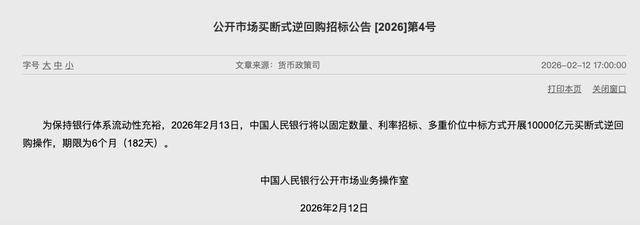
央行:2月13日将开展1万亿元买断式逆回购操作,期限6个月
Sou Hu Cai Jing· 2026-02-12 11:02
Core Viewpoint - The People's Bank of China (PBOC) is conducting a reverse repurchase operation of 1 trillion yuan to maintain liquidity in the banking system, with a maturity of 6 months [1][2]. Group 1 - On February 13, 2026, the PBOC will implement a fixed quantity, interest rate tender, multi-price bidding method for the reverse repurchase operation [1][2]. - This operation will result in a net injection of 500 billion yuan, considering that 500 billion yuan of the same maturity tools are maturing this month [2]. - Combined with an earlier operation on February 4, which injected a net 100 billion yuan, the total net liquidity injection for the month through reverse repos alone will be 600 billion yuan [2].
适度宽松的货币政策效果逐步显现
Mei Ri Jing Ji Xin Wen· 2026-02-12 10:57
Group 1 - The central bank's monetary policy report indicates that the effects of moderately loose monetary policy in 2025 are gradually becoming evident, with social financing scale and broad money supply (M2) growing by 8.3% and 8.5% year-on-year, respectively, significantly outpacing nominal GDP growth [1] - The report highlights a strong credit support, with the growth rate of RMB loans around 7% after adjusting for local government debt impacts, and the interest rates for new corporate and personal housing loans remaining around 3.1% [1] - Key areas of loan growth include technology loans (up 11.5%), green loans (up 20.2%), and loans for the elderly care industry (up 50.5%), indicating a continuous optimization of credit structure [1] Group 2 - Direct financing has accelerated, with significant increases in government bonds, corporate bonds, and non-financial corporate domestic stock financing, particularly through the newly launched "Technology Board" for bond issuance, which exceeded 1.5 trillion yuan [2] - The shift in economic structure from traditional investment-driven growth to technology innovation and consumption-driven growth is emphasized, with direct financing models becoming more aligned with high-growth sectors [2] - The report states that the national economy maintained a steady growth trend in 2025, with GDP increasing by 5% year-on-year, achieving major development goals [2] Group 3 - The report notes that the Consumer Price Index (CPI) remained flat year-on-year, while the core CPI rose by 0.7%, indicating structural characteristics in price movements, with some sectors reflecting price increases due to high-quality economic development [4] - The government has introduced a package of policies to support domestic demand growth, which is expected to positively impact the economy and lead to a moderate recovery in prices [4] - The report highlights the importance of financial services adapting to the requirements of high-quality economic development, with a focus on supporting key areas such as expanding domestic demand and technological innovation [4] Group 4 - The report discusses the enhanced coordination between fiscal and monetary policies, with measures such as the implementation of interest subsidies for small and micro enterprises and the establishment of risk-sharing tools for private enterprises [7] - Three models of policy coordination are outlined: creating a favorable environment for government bond issuance, combining re-lending tools with fiscal subsidy policies, and sharing financing risks between fiscal and monetary policies [9] - The collaboration between fiscal and monetary policies aims to alleviate financing difficulties for small and micro enterprises, thereby promoting private investment [7][9] Group 5 - Recent trends show a slowdown in the growth of household and corporate deposits, while the scale of wealth management and asset management products has increased significantly, indicating a shift in asset allocation [10] - The report suggests that despite some deposits moving towards wealth management products, most will eventually return to the banking system, reflecting a change in deposit structure rather than a decrease in overall liquidity [12] - The central bank's flexible use of various tools has effectively met the liquidity needs of the banking system, with a net injection of 6 trillion yuan through open market operations in 2025 [10]
央行:明日开展10000亿元买断式逆回购操作
新华网财经· 2026-02-12 10:34
Group 1 - The People's Bank of China announced a reverse repurchase operation of 1 trillion yuan to maintain liquidity in the banking system, with a term of 6 months (182 days) [1] - The operation will be conducted through a fixed quantity, interest rate bidding, and multiple price winning method [1] Group 2 - Several banks have raised deposit interest rates [4]
美国经济:就业企稳,经济维持“金发姑娘”状态
Zhao Yin Guo Ji· 2026-02-12 10:34
Employment Data - In January, the U.S. added 130,000 non-farm jobs, significantly exceeding the market expectation of 65,000[4] - Private sector job additions rose from 64,000 in December to 172,000 in January[4] - The unemployment rate decreased from 4.4% in December to 4.3% in January, better than the expected 4.4%[4] Structural Weakness - Job growth was primarily concentrated in public sectors like healthcare and education, while layoffs reached the highest level for January since 2009[4] - Job vacancies fell to a nearly five-year low, indicating weak labor demand[4] - The government sector saw a reduction of 42,000 jobs, with federal employment down by 34,000 since 2025, totaling a cumulative loss of 323,000 jobs[4] Wage Growth and Inflation - Monthly wage growth increased from 0.1% in December to 0.4% in January, with a year-on-year growth rate of 3.7%[4] - The QCEW benchmark revision reduced the projected job additions for April 2024 to March 2025 by 860,000, aligning with market expectations[4] Economic Outlook - The labor market is expected to stabilize with potential structural weaknesses due to AI integration replacing basic jobs[4] - Expansionary fiscal policies may support demand recovery, but the job market's recovery will be uneven[4] - Market anticipates two rate cuts in 2026, with the first cut now expected in July instead of June[4]
10000亿元,央行明日操作
财联社· 2026-02-12 10:22
Group 1 - The People's Bank of China announced a fixed amount reverse repurchase operation of 1 trillion yuan (10000 billion) to maintain liquidity in the banking system [1] - The operation will be conducted with a term of 6 months (182 days) [1]
人民银行将于2月13日开展10000亿元买断式逆回购操作
Bei Jing Shang Bao· 2026-02-12 10:16
Group 1 - The People's Bank of China (PBOC) announced a reverse repurchase operation of 1 trillion yuan to maintain ample liquidity in the banking system [1] - The operation will be conducted on February 13, 2026, with a term of 6 months (182 days) [1] - The reverse repurchase will utilize a fixed quantity, interest rate bidding, and multiple price level bidding method [1]