零售业

Search documents
陈茂波最新发声!
证券时报· 2025-08-03 09:17
Core Viewpoint - The Hong Kong economy shows sustained growth momentum, driven by exports, local consumption, and fixed investment, with GDP increasing by 3.1% year-on-year in Q2 2023, marking the tenth consecutive quarter of positive growth [1][2]. Economic Performance - In Q2 2023, Hong Kong's GDP grew by 3.1% year-on-year, with a 0.4% increase compared to Q1 2023 [1]. - Private consumption expenditure rose by 1.9% year-on-year, while government consumption expenditure increased by 2.5% [1]. - Fixed capital formation grew by 2.9% year-on-year, with merchandise exports up by 11.5% and imports up by 12.7% [1]. - Service output increased by 7.5% year-on-year, and service input rose by 7% [1]. Real Estate and Retail Market - The retail sales value recorded a slight year-on-year growth of 0.3% in Q2 2023, with expectations of mild growth in the restaurant sector [2]. - Residential property prices remained stable, with rental performance strong and transaction volume significantly increasing by approximately 37% quarter-on-quarter [2]. - The number of negative equity cases decreased by 7% to over 37,000 as property prices stabilized [2]. Stock Market and Investment - The total market capitalization of Hong Kong stocks reached HKD 42.7 trillion in the first half of the year, a year-on-year increase of 33% [2]. - Hong Kong led the global IPO market with 52 IPOs raising HKD 124 billion, a 590% increase year-on-year [2]. Government Initiatives and Events - The Hong Kong government is actively promoting investment and talent attraction, which has increased demand for office space [2]. - Upcoming major events, such as the National Games and the Wine and Dine Festival, are expected to boost tourism and economic activity [3]. - The government aims to leverage high-value tourism and various events to enhance local consumption and market sentiment [3].


高瑞东 周欣平:为什么美国非农就业大幅下修?
Sou Hu Cai Jing· 2025-08-03 06:06
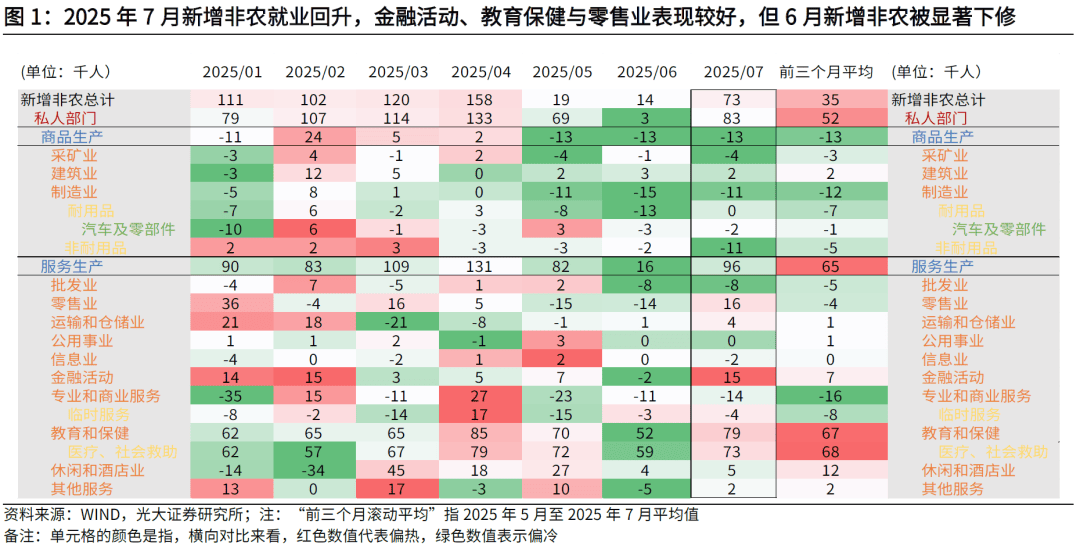
Group 1 - The core viewpoint indicates that the significant downward revision of June non-farm data reflects substantial disruptions to the U.S. economy due to tariffs, suggesting that the resilience of the U.S. economy should not be overestimated, and the direction of interest rate cuts remains highly certain [2][4][17] - In July, non-farm employment increased by 73,000, which is below the expected 110,000, and the previous value was revised down from 147,000 to 14,000, indicating pressure on the U.S. job market [6][11][22] - The unemployment rate in July rose to 4.2%, up from 4.1% in the previous month, while the average hourly wage increased by 3.9% year-on-year, exceeding the expected 3.8% [1][6][31] Group 2 - In July, the financial activities, healthcare, and retail sectors added 15,000, 79,000, and 16,000 jobs respectively, showing a stable demand in the service sector [3][22] - The manufacturing sector has seen negative job growth for three consecutive months, indicating insufficient production willingness among enterprises [3][22] - The labor force participation rate decreased to 62.2% in July, down from 62.3% in the previous month, with a notable decline in employment willingness among younger demographics [26][31] Group 3 - The downward revision of June non-farm data was primarily due to significant adjustments in government, leisure, and hotel employment, which collectively accounted for a 90,000 downward revision, representing nearly 70% of the total revision [12][17] - The cumulative downward revision for May and June non-farm data reached 258,000, while the July employment figure of 73,000 is a significant drop compared to the average monthly increase of over 100,000 in the first quarter [4][17] - The market anticipates that the Federal Reserve will cut interest rates three times in 2025, with an 80% probability for the first cut in September [4][21][37] Group 4 - The average hourly wage growth has shown an upward trend, with a month-on-month increase of 0.3% in July, higher than the previous 0.2% [37][39] - The service sector's job growth in July rebounded to 96,000, compared to a previous value of 16,000, indicating a relatively stable demand in the service industry [22][31] - The overall economic environment remains challenging, with second-quarter GDP growth at 3.0%, driven by a "import rush" effect, while core GDP growth has declined [18][22]
伯克希尔哈撒韦Q2财报:巴菲特继续减持股票,现金储备仍近历史高位
Huan Qiu Wang· 2025-08-03 01:56
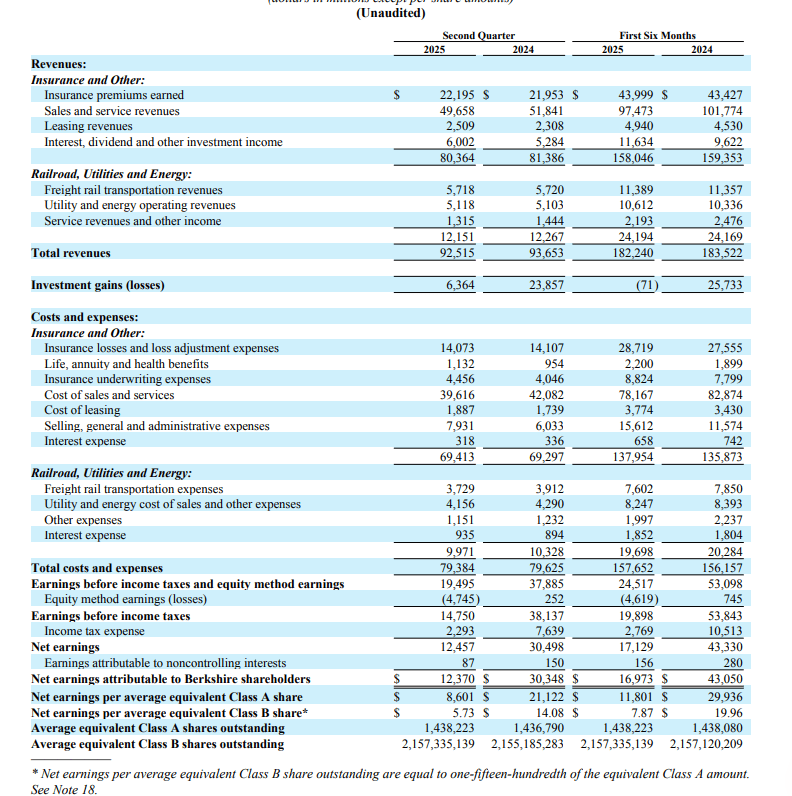
Core Viewpoint - Berkshire Hathaway warns that international trade policy tensions and U.S. tariff policies pose significant threats to its diversified business and may substantially impact future performance [1][3] Group 1: Financial Performance - In the first half of 2025, Berkshire's overall operating profit decreased by 4% year-on-year to $11.16 billion [1] - The company reported a net sale of $4.5 billion in stocks, marking the 11th consecutive quarter of stock reduction [3] - Cash reserves slightly decreased to $344.1 billion, remaining close to historical highs [3] Group 2: Business Segments - Insurance underwriting business showed weak performance, while profits increased in railroads, energy, manufacturing, and retail sectors [1] - The company recognized a $3.8 billion impairment loss on its investment in Kraft Heinz, reflecting the long-term underperformance of the consumer goods giant [3] Group 3: Management and Strategy - Warren Buffett announced plans to step down as CEO by the end of the year, with Greg Abel, the vice chairman of non-insurance operations, set to take over [3] - Market observers are closely watching for potential changes in investment strategy under the new management [3]

光大证券:为什么美国非农就业大幅下修?
智通财经网· 2025-08-03 01:29
Core Viewpoint - The U.S. non-farm employment data shows a significant decline, with July's job additions at 73,000, down from an expected 110,000, indicating a weakening labor market and increasing likelihood of the Federal Reserve restarting interest rate cuts in the second half of the year [1][2][6]. Employment Data Summary - The U.S. Labor Department reported that July's non-farm employment increased by 73,000, significantly lower than the expected 110,000, and the previous value was revised down from 147,000 to 14,000 [2]. - The unemployment rate for July was reported at 4.2%, matching expectations but up from the previous value of 4.1% [2]. - Average hourly earnings increased by 3.9% year-over-year, slightly above the expected 3.8% [2]. Non-Farm Data Revision Analysis - The downward revision of June's non-farm data by 258,000 jobs was primarily due to adjustments in government, leisure and hospitality, and construction sectors, which accounted for 90,000 of the total revision [3]. - The significant revision reflects the impact of tariffs on the U.S. economy, suggesting that the resilience of the economy may have been overestimated [3][6]. Sector Performance - In July, the financial activities sector added 15,000 jobs, education and health services added 79,000 jobs, and retail added 16,000 jobs, indicating stable demand in these service sectors [4]. - The manufacturing sector has seen negative job additions for three consecutive months, indicating a lack of production willingness among companies [4]. Labor Market Dynamics - The labor force participation rate decreased to 62.2% in July from 62.3% in the previous month, with a notable decline in employment willingness among younger demographics [5]. - The number of unemployed individuals increased by 221,000 in July, contributing to the rise in the U3 unemployment rate to 4.2% [5]. - Temporary unemployment increased by 80,000, while permanent unemployment remained unchanged, suggesting a rise in layoffs by companies [5].

伯克希尔Q2净利润暴跌59%,现金储备接近历史高位,警告关税将打击业绩 | 财报见闻
Sou Hu Cai Jing· 2025-08-02 23:32
Core Insights - Berkshire Hathaway reported mixed results for Q2, with operating profit declining by 3.8% year-over-year to $11.16 billion, while net profit plummeted by 59% to $12.37 billion, largely due to changes in investment portfolio valuations [1][2] - The company warned that international trade policy tensions, particularly tariffs, pose a significant threat to its diversified business operations, potentially impacting future performance [1][2] - Cash reserves reached $344 billion, marking the first decline in three years, as the company adopted a more cautious stance in the stock market [1][10] Financial Performance - Q2 revenue was $92.515 billion, slightly above market expectations of $91.963 billion but down from $93.653 billion in the same period last year [2][3] - Investment income for Q2 was $4.97 billion, a significant drop from $18.75 billion year-over-year [2][5] - Earnings per share (EPS) for Q2 was $8,601, exceeding market expectations of $7,443 but down from $21,122 in the previous year [2][3] Business Segment Analysis - BNSF Railway reported a strong performance with operating income of $1.47 billion, up 19% year-over-year, reflecting improved demand for goods transportation [5][11] - Insurance underwriting showed mixed results, with underwriting profit of $2.5 billion impacted by $1.2 billion in losses from wildfires in Southern California [6][8] - The manufacturing, service, and retail sectors saw operating profit increase by 6.5% to $3.6 billion, although performance varied significantly across sub-sectors [11][12] Investment Portfolio Changes - The company experienced a significant decline in investment gains, reporting $6.4 billion in Q2 compared to $23.86 billion in the same period last year [9] - Berkshire recognized a $3.8 billion impairment loss on its investment in Kraft Heinz, attributing it to ongoing declines in fair value and economic uncertainties [9][10] - The company has been a net seller of stocks for 11 consecutive quarters, selling approximately $3 billion worth of stocks in Q2 [10] Trade Policy Impact - The company's consumer brands faced notable declines, with Fruit of the Loom's revenue down 11.7%, Garan down 10.1%, and Jazwares down 38.5%, attributed to uncertainties from international trade policies and tariffs [13]
伯克希尔二季度净利润同比下滑59%!巴菲特连续11季度净卖股票
Sou Hu Cai Jing· 2025-08-02 15:39
Core Insights - Berkshire Hathaway's Q2 2025 financial report shows significant changes in key metrics, with revenue at $92.515 billion, slightly above market expectations but down from $93.653 billion year-over-year. Net profit fell 59% to $12.37 billion, exceeding market expectations of $10.703 billion [1][3]. Financial Performance - The operating profit for Q2 was $11.16 billion, a 3.8% decrease from $11.6 billion in the same period last year. The performance across business segments varied, with BNSF Railway showing strong growth, achieving operating income of $1.47 billion, up 19% year-over-year, reflecting a recovery in U.S. goods transportation demand [3]. - The energy sector also performed well, contributing an operating profit of $702 million, a 7.2% increase year-over-year. Manufacturing, service, and retail sectors reported operating profits of $3.6 billion, up 6.5% [3]. - The insurance underwriting business faced challenges, with underwriting profit at $2.5 billion impacted by approximately $1.2 billion in losses from Southern California wildfires. Insurance underwriting revenue decreased by 12% to $1.99 billion, while insurance investment income slightly increased by 1.4% to $3.37 billion. The float remained at $174 billion, providing low-cost investment capital [3]. Investment Strategy - The company maintained a cautious approach to stock investments, selling approximately $3 billion in stocks during Q2, marking the 11th consecutive quarter of net stock sales. No stock buybacks were conducted during this period [4]. - As of the end of Q2, the top five holdings included American Express, Apple, Bank of America, Coca-Cola, and Chevron, accounting for 67% of the fair value of the portfolio [4]. - Cash and cash equivalents stood at $344.1 billion, a slight decrease from $347 billion at the end of Q1, marking the first decline in cash reserves in three years, yet remaining near historical highs [4]. - The company recognized a $3.8 billion impairment loss on its investment in Kraft Heinz, attributing it to a continuous decline in fair value and current economic uncertainties. The book value of its Kraft Heinz holdings was reduced to $8.4 billion, with the company still holding a 27.4% stake [4].

2025年7月美国非农数据点评:为什么美国非农就业大幅下修?
EBSCN· 2025-08-02 12:01
Employment Data Summary - In July 2025, the U.S. non-farm payrolls increased by 73,000, significantly below the expected 110,000, and the previous value was revised down from 147,000 to 14,000[1][11]. - The unemployment rate in July 2025 was 4.2%, matching expectations but up from the previous 4.1%[1][14]. - Average hourly earnings rose by 3.9% year-on-year, exceeding the expected 3.8% and revised from a previous increase of 3.7%[1][14]. Data Revision Insights - The June non-farm payrolls were revised down by a total of 258,000, with significant downward adjustments in government, leisure, and construction sectors, accounting for 90,000 of the total revision[2][12]. - The downward revision reflects the impact of tariffs on the U.S. economy, indicating a decline in the accuracy of the "birth-death model" used for employment predictions[2][5]. Sector Performance - In July, the financial activities, education, and healthcare sectors added 15,000, 79,000, and 16,000 jobs respectively, showing stability in service sector demand[3][27]. - The goods-producing sector continued to show negative job growth for three consecutive months, indicating weak production intentions among businesses[3][28]. Labor Market Dynamics - The labor force participation rate fell to 62.2% in July, down from 62.3% in June, with a notable decline in employment willingness among younger demographics[4][35]. - The number of unemployed individuals increased by 221,000 in July, contributing to the rise in the U3 unemployment rate to 4.2%[4][35]. Economic Outlook - The Federal Reserve is expected to initiate rate cuts, with market predictions indicating three rate cuts in 2025, starting in September with an 83.4% probability[5][26]. - The overall economic environment remains challenging, with the second quarter GDP growth at 3.0%, driven by a "import rush" effect, but core GDP growth showing signs of decline[5][23].
离境退税服务升级,“即买即退”提速消费体验
Sou Hu Cai Jing· 2025-08-02 06:02
Core Viewpoint - The announcement by the State Taxation Administration to promote the "immediate refund" service for outbound travelers aims to enhance the shopping experience for international tourists and boost the economic impact of events like the Chengdu World Games [1] Group 1: Policy Implementation - The "immediate refund" service is being expanded from pilot locations to nationwide, enhancing the efficiency and convenience of tax refunds for international visitors [1] - The minimum purchase amount for tax refund eligibility has been reduced from 500 RMB to 200 RMB, while the cash refund limit has increased from 10,000 RMB to 20,000 RMB [4][7] Group 2: Retail and Consumer Experience - The retail store at Xinglong Lake Metro Station is strategically located to attract visitors to the World Games, offering a variety of official merchandise and facilitating the "immediate refund" process [9] - The "immediate refund" system allows tourists to receive tax refunds on-site after spending 200 RMB, transforming the traditional refund process into an instant benefit [7][13] Group 3: Economic Impact - The introduction of the "immediate refund" service has significantly stimulated consumer spending among international tourists, with Chengdu's tax refund stores increasing by 34% year-on-year, totaling 429 stores [15] - In 2024, the total tax refund amount in Chengdu reached nearly 30 million RMB, with sales exceeding 250 million RMB, reflecting a growth of over 400% [15]

政府就业被高估——7月美国非农数据解读【陈兴团队•财通宏观】
陈兴宏观研究· 2025-08-02 05:56
Core Viewpoint - The July non-farm employment data shows a significant downward revision in previous months, indicating an overestimation of employment levels, particularly in government sectors. The overall labor market is cooling down, with rising unemployment rates and declining labor participation rates [2][3][5]. Employment Data Revision - The July non-farm employment recorded an increase of 73,000 jobs, but previous months' data were heavily revised downwards. June's employment was adjusted from 147,000 to 14,000, and May's from 144,000 to 19,000, totaling a downward revision of 258,000 jobs [3][2]. Unemployment Rate Trends - The unemployment rate rose slightly by 0.1 percentage points to 4.2% in July, while the U6 unemployment rate increased by 0.2 percentage points to 7.9%. This indicates a broad cooling of the job market, with a decrease in labor participation rate to 62.2%, the lowest since the beginning of 2023 [5][6]. Sector-Specific Employment Changes - Job growth in July was concentrated in the education and healthcare sectors, with retail, education, and financial activities seeing the most significant increases. However, government employment decreased by 10,000 jobs, marking the third negative month this year, with substantial downward revisions in previous months [6][2]. Labor Market Supply and Demand - As of June, job vacancies in the U.S. fell to 7.44 million, with a vacancy rate of 4.4%. The labor supply-demand gap recorded 422,000, indicating a return to pre-pandemic levels and suggesting a balance in the labor market [8]. Wage Growth Trends - Average hourly earnings in July increased by 0.3% month-over-month, with a year-over-year growth of 3.9%. However, long-term trends show a slowdown in wage growth since November 2024 [9][10]. Real Wage Growth - The real wage growth, adjusted for inflation, showed a year-over-year increase of 1% in June, down by 0.4 percentage points from the previous month. This indicates stable wage income growth [10]. Sectoral Wage Changes - In July, the highest year-over-year wage growth was observed in the retail and business services sectors, at 5.2% and 5.1%, respectively. Conversely, the slowest growth was in public utilities and construction, with declines of approximately 0.7 and 0.2 percentage points [12]. Interest Rate Expectations - Following the release of weak employment data, expectations for interest rate cuts in September have increased, with the probability rising from 40% to 80%. The anticipated number of rate cuts for the year has also increased from 1.3 to 2.2 [16].

不出中国所料:特朗普对全球征税后,高兴不到一天,噩耗就来了
Sou Hu Cai Jing· 2025-08-02 05:42
Group 1 - The implementation of "reciprocal tariffs" by the Trump administration, with rates ranging from 10% to 41% on key goods such as automobiles, machinery, electronics, and textiles, aims to retaliate against countries imposing tariffs on U.S. products [1] - The immediate market reaction was negative, with major U.S. stock indices experiencing significant declines: Dow Jones down 1.6%, Nasdaq down over 2.3%, and S&P 500 down 1.8%, resulting in a loss of over a trillion dollars in market value for companies like Amazon [1][3] - The policy has sparked widespread criticism from economists, including Nobel laureate Paul Krugman, who labeled it as a foolish approach that ultimately harms American citizens [3][6] Group 2 - The automotive industry is facing severe challenges due to rising costs of steel and aluminum, leading to profit declines for major companies like General Motors and Ford, which may resort to layoffs and production cuts [8] - Retail giants such as Walmart and Target are considering price increases to cope with rising input costs and inflation, which will ultimately burden American consumers [8] - The overall economic environment is deteriorating, with rising living costs exacerbating existing issues like high rents and inflation, contradicting the intended goal of economic recovery [8][15] Group 3 - China has prepared for potential repercussions from the U.S. tariff policy, emphasizing that trade wars yield no winners and are detrimental to the populace [10] - The Chinese government is actively reducing reliance on the U.S. market while enhancing trade relations with ASEAN, Africa, and the Middle East, indicating a strategic pivot in its economic partnerships [10] - The U.S. is facing increasing isolation as traditional allies express concerns over the unilateral tariff actions, with countries like Germany and France warning of potential retaliatory measures [12][13] Group 4 - The overarching sentiment is that the tariff policy is not a sustainable solution for economic issues, as it leads to market chaos rather than recovery, with consumers ultimately bearing the costs of increased tariffs [15] - The approach of using tariffs as a tool for economic negotiation is criticized as short-sighted and detrimental to long-term economic stability [15]