
装备制造业

Search documents
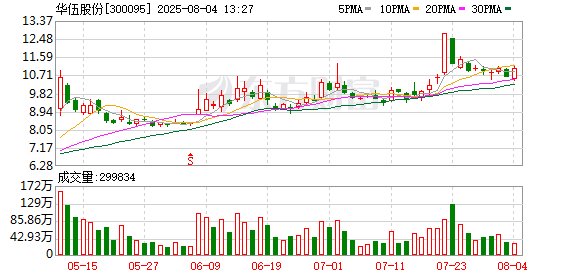
华伍股份:董事、高级管理人员曹明生辞职
Mei Ri Jing Ji Xin Wen· 2025-08-04 05:26
华伍股份(SZ 300095,最新价:11.06元)8月1日晚间发布公告称,江西华伍制动器股份有限公司董事 会于2025年8月1日收到公司董事、常务副总经理曹明生先生提交的书面辞职报告,曹明生先生因个人原 因,申请辞去公司董事、常务副总经理职务,并相应辞去董事会战略委员会委员职务。曹明生先生离任 公司董事、常务副总经理职务后,将不再担任公司其他职务,其辞职不会影响公司相关工作的正常开 展。 (文章来源:每日经济新闻) 2024年1至12月份,华伍股份的营业收入构成为:装备制造业占比98.39%,其他业务占比1.24%,劳务 收入占比0.37%。 ...


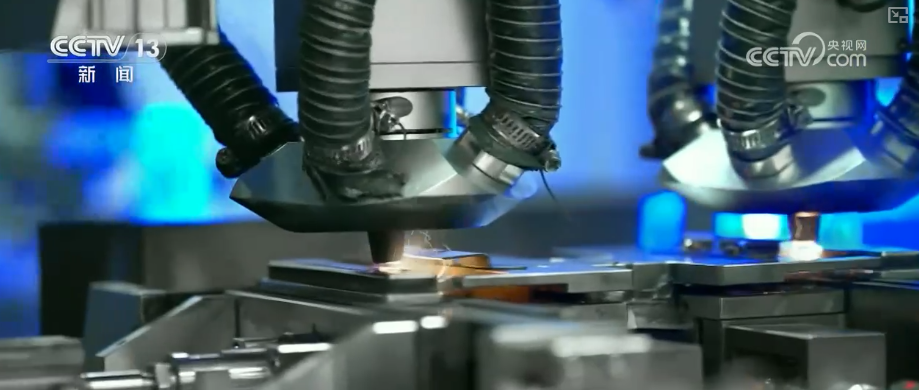
8.9%、11.9%、45.3%,增长!“数”览“两新”成效 制造业“高端化”稳步推进
Yang Shi Wang· 2025-08-04 04:46
Group 1 - The core viewpoint indicates that in the first half of 2025, national enterprise sales revenue is experiencing steady growth, with the manufacturing sector improving in quality and efficiency, and the "two new" policies showing significant results [1] - Manufacturing sales revenue growth rate is 1.5 percentage points faster than the overall national enterprise growth rate, highlighting its role as a key support for economic stability [3] - The high-end manufacturing sector is progressing steadily, with sales revenue in equipment manufacturing and high-tech manufacturing increasing by 8.9% and 11.9% year-on-year, respectively [6] Group 2 - The innovation industry is expanding, with high-tech industry sales revenue growing by 14.3% year-on-year, indicating rapid growth [8] - The procurement of machinery and equipment by enterprises increased by 11.1% year-on-year, continuing the strong growth trend observed since 2024, driven by large-scale equipment renewal policies [11] - Consumer demand is being continuously released due to the old-for-new policy, with retail sales of home audio-visual equipment and daily household appliances increasing by 45.3% and 56.6% year-on-year, respectively [15] Group 3 - Inter-provincial sales accounted for 40.7% of national enterprise sales revenue, an increase of 0.6 percentage points compared to the same period last year, reflecting deepening inter-provincial trade connections and steady progress in building a unified national market [17]
今年上半年全国企业销售收入平稳增长
news flash· 2025-08-03 14:05
Core Insights - The latest data from the National Taxation Administration indicates that in the first half of this year, national enterprise sales revenue has maintained steady growth, with the manufacturing sector showing quality improvements under the "Two New" policies [1] Manufacturing Sector - Manufacturing sales revenue growth rate is 1.5 percentage points faster than the overall national enterprise growth rate, making it a crucial support for stable economic growth [1] - The high-end transformation of the manufacturing sector is progressing steadily, with sales revenue in equipment manufacturing and high-tech manufacturing increasing by 8.9% and 11.9% year-on-year, respectively [1] High-Tech Industry - The innovative industry continues to expand, with high-tech industry sales revenue growing by 14.3% year-on-year in the first half of the year, indicating rapid growth [1] Digital Economy - Sales revenue from core digital economy industries and the amount of national enterprise procurement of digital technologies both saw a year-on-year increase of around 10%, reflecting the ongoing acceleration of digital industrialization and industrial digitalization processes [1]
上半年我国中小企业质效稳步提升
Yang Shi Wang· 2025-08-03 12:20
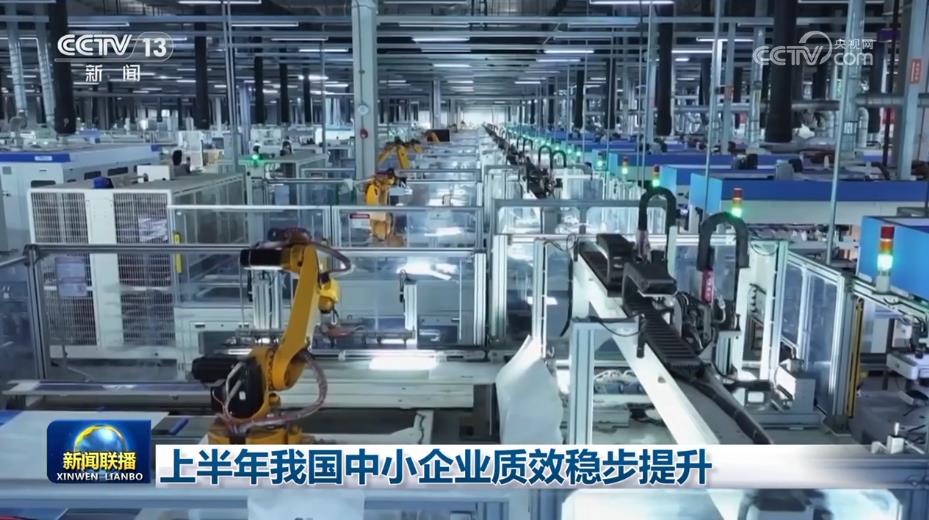
Group 1 - The overall economic operation of small and medium-sized enterprises (SMEs) in China remained stable in the first half of the year, with key economic indicators showing growth [1] - Among 31 major manufacturing sectors, 19 sectors saw an increase in total profits for SMEs, with rapid growth in sectors such as computer and communication electronic equipment and electrical machinery [3] - The export momentum of SMEs remained strong, with the export index for SMEs at 52.1% in June, marking 15 consecutive months in the expansion zone [3] Group 2 - The added value of industrial SMEs above designated size grew by 8.0% year-on-year in the first half of the year, with specialized and innovative SMEs ("little giants") achieving an 8.6% increase [4] - The innovation capability of SMEs is improving, with R&D expenses of specialized and innovative "little giants" accounting for 5.3% of operating income, surpassing the average level of all industrial enterprises by 3.1 percentage points [6] - The government plans to enhance the cultivation system for quality enterprises, explore mechanisms for proactive identification of quality enterprises, and improve the public service system for SMEs [6]
中经评论:减税降费精准发力,要提质更要持续
Sou Hu Cai Jing· 2025-08-03 00:07
Group 1 - The cumulative tax cuts and fee reductions in China from 2021 to the first half of this year reached 9.9 trillion yuan, expected to reach 10.5 trillion yuan by the end of this year, averaging over 2 trillion yuan annually [1] - Tax cuts and fee reductions are crucial for reducing the burden on enterprises and stimulating market vitality, allowing more funds for reinvestment and enhancing the multiplier effect of investments [1][2] - Structural tax cuts aim to allocate more resources to critical areas for national development, supporting the construction of a modern industrial system, with significant tax incentives for R&D expenditures [1] Group 2 - The manufacturing sector is a key focus of structural tax cuts, with measures like lowering VAT rates and increasing VAT refunds, contributing to the growth of manufacturing enterprises [2] - From 2021 to 2024, the sales revenue of manufacturing enterprises is expected to maintain around 29% of total enterprise sales, with high-end and high-tech manufacturing sectors showing annual growth rates of 9.6% and 10.4% respectively [2] - Tax cuts not only expand production and exchange but also enhance resource allocation efficiency and support the construction of a unified national market [2] Group 3 - The emphasis on improving the quality and efficiency of tax policies is essential, with a focus on utilizing tax data to better implement policies and support innovation and manufacturing [3] - Future tax policies should be refined to support foundational R&D and the transformation of technological achievements, particularly in emerging sectors like new energy and robotics [3] - The approach of using tax reductions to enhance enterprise efficiency and market vitality is a vital pathway for promoting high-quality economic development in China [3]
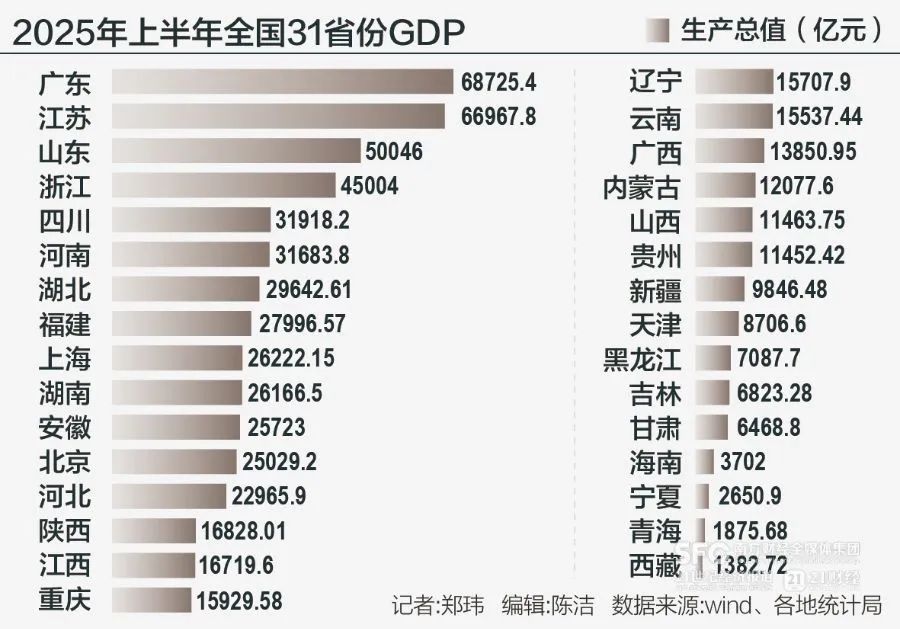
31省份半年报:粤苏鲁总量领跑 新兴产业成增长“新势力”
2 1 Shi Ji Jing Ji Bao Dao· 2025-08-02 04:37
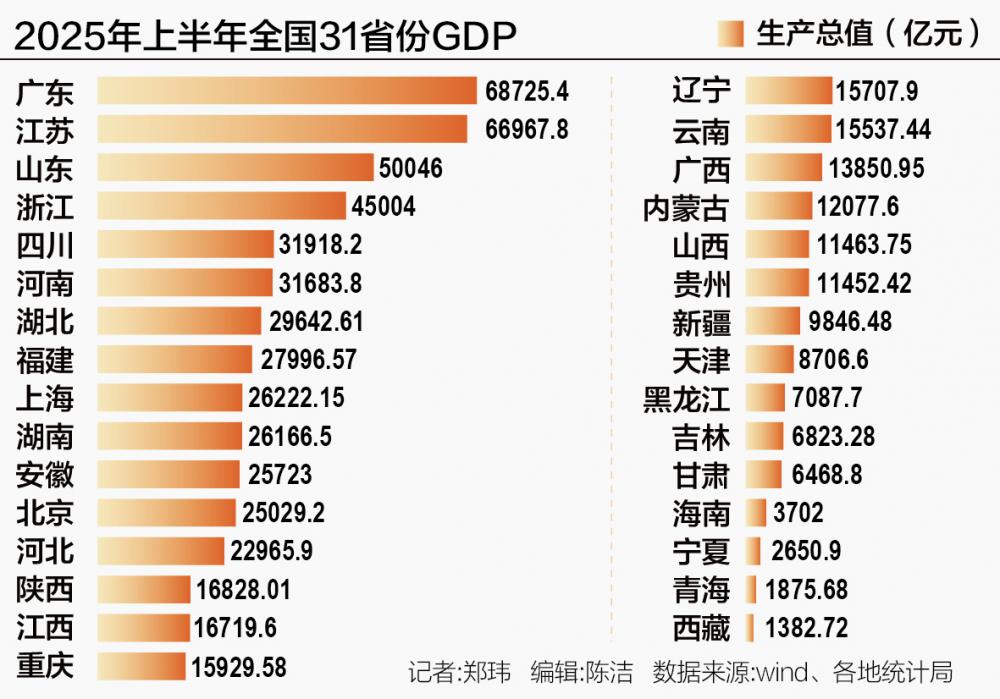
Economic Overview - The economic performance of various provinces in China during the first half of 2025 shows a clear distinction between traditional economic powerhouses leveraging innovation and emerging provinces igniting growth through new industries and unique consumption points [1][2] - The GDP totals for the top three provinces are Guangdong at 68,725.4 billion, Jiangsu at 66,967.8 billion, and Shandong at 50,046 billion, maintaining their positions as the leading economic regions [3][4] Regional Performance - Eastern provinces continue to lead in overall economic output, while central provinces like Hubei show impressive growth rates, with Hubei's GDP reaching 29,642.61 billion, growing by 6.2% [6][4] - The industrial sector has been a significant driver of economic growth across many provinces, with 27 provinces reporting industrial value-added growth rates surpassing regional GDP growth [7][4] Industrial Growth - The equipment manufacturing sector, particularly in automotive and electronics, has shown strong performance, with high-tech products in Guangdong and Hubei experiencing double-digit growth [7][9] - In the first half of 2025, the industrial value-added in Fujian grew by 8.7%, with the equipment manufacturing sector increasing by 15.2% [8][9] Investment and Consumption - Beijing's economic growth is supported by a 14.1% increase in fixed asset investment, with equipment purchase investments soaring by 99.0% [5][4] - Hubei's consumption and investment growth rates exceeded GDP growth, with retail sales increasing by 6.9% and exports rising by 38.5% [6][4] Emerging Industries - New industries are becoming a significant force for economic growth, with provinces focusing on robotics, drones, and other high-tech sectors to drive development [11][10] - Guangdong's production of high-tech products, including lithium-ion batteries and industrial robots, saw substantial increases, with lithium-ion battery production up by 42.2% [9][10]
31省份半年报全部出炉,广东、江苏、山东GDP位列前三
2 1 Shi Ji Jing Ji Bao Dao· 2025-08-02 04:24
Economic Overview - As of mid-2025, all 31 provinces in China have released their economic reports, showing a stable economic landscape with no changes in the top 10 GDP provinces compared to the first quarter [2][5] - The eastern provinces continue to lead in overall economic output, with Guangdong, Jiangsu, and Shandong maintaining the top three positions in GDP, achieving 68,725.4 billion yuan, 66,967.8 billion yuan, and 50,046 billion yuan respectively [2][5] Regional Performance - The eastern provinces exhibit stable growth, while central provinces show impressive economic growth rates, with Hubei's GDP growing by 6.2%, surpassing the national average of 5.3% [7] - In the first half of 2025, Hubei's fixed asset investment increased by 6.5%, and its total retail sales of consumer goods rose by 6.9%, with exports growing significantly by 38.5% [7] Industrial Growth - Industrial growth has been a key driver for many provinces, with 27 provinces reporting industrial value-added growth rates exceeding regional GDP growth [3][9] - The equipment manufacturing sector, particularly in automotive and electronics, has shown strong performance, with high-tech products like lithium-ion batteries and industrial robots in Guangdong and Hubei experiencing double-digit growth [3][9][11] Emerging Industries - New industries are emerging as significant contributors to economic growth, with provinces like Guangdong and Hubei focusing on high-tech manufacturing, including substantial increases in the production of lithium-ion batteries and robotics [12][13] - The industrial robot sector is entering a crucial development phase, with Guangdong becoming a major hub for smart robotics, aiming to enhance overall economic efficiency [12][13] Investment and Consumption - In Beijing, fixed asset investment grew by 14.1%, with equipment purchase investments skyrocketing by 99%, indicating strong industrial expansion [6] - In Fujian, social retail sales reached 12,560.88 billion yuan, growing by 6.0%, supported by an 8.7% increase in industrial value-added [6][10]
经济新方位|稳经济促改革,不断完善政策工具箱
Ren Min Ri Bao· 2025-08-02 03:35
Economic Overview - China's GDP grew by 5.3% year-on-year in the first half of the year, exceeding initial market expectations and improving by 0.3 percentage points compared to the same period last year [2] - The production and business activity expectation index for July was 52.6%, indicating stable and optimistic market confidence among manufacturing enterprises [2] - The urban unemployment rate averaged 5.2%, a decrease of 0.1 percentage points from the first quarter, with 6.95 million new urban jobs created, achieving 58% of the annual target [2] Domestic Demand and Resilience - Domestic demand contributed 68.8% to economic growth, highlighting its role as the main driver [2] - The total import and export scale reached 20 trillion yuan, with exports increasing by 7.2% [2] - High-tech manufacturing value added grew by 9.5%, outpacing overall industrial growth by 3.1 percentage points [3] Policy and Strategic Focus - The National Development and Reform Commission (NDRC) plans to implement policies to expand domestic demand and promote high-level technological self-reliance [3] - Emphasis on strengthening the domestic circulation to mitigate external shocks and uncertainties [4] - The NDRC aims to enhance the effectiveness of domestic circulation by optimizing supply structures and increasing investment returns [6][7] Market and Investment Environment - The proportion of inter-provincial trade sales to total sales increased to 40.4%, up 0.6 percentage points year-on-year [7] - Logistics costs as a percentage of GDP decreased, saving over 130 billion yuan in logistics expenses [7] - The NDRC is focused on improving the market environment for new industries and enhancing the competitiveness of state-owned enterprises [9][11] Reform Initiatives - The NDRC is set to deepen reforms to stimulate consumption and expand effective investment [9] - Plans to standardize government investment behaviors and address issues of disorderly competition in various sectors [10] - The NDRC will promote policies to facilitate market access for new business models and enhance the flow and allocation of production factors [11]
稳经济促改革,不断完善政策工具箱
Ren Min Ri Bao· 2025-08-02 00:20
Core Viewpoint - The Chinese economy showed resilience in the first half of the year, with a GDP growth of 5.3%, exceeding initial market expectations, and demonstrating strong internal demand as the main driver of growth [3][4]. Economic Performance - Major macroeconomic indicators performed well, with GDP growth of 5.3% year-on-year, which is 0.3 percentage points higher than the same period last year [3]. - The production and business activity expectation index for July was 52.6, indicating stable optimism among manufacturing enterprises [3]. - The urban unemployment rate averaged 5.2%, a decrease of 0.1 percentage points from the first quarter, with 6.95 million new urban jobs created, achieving 58% of the annual target [3]. Internal Demand and Trade - Internal demand contributed 68.8% to economic growth, showcasing its role as the main growth driver [3]. - The total import and export volume reached 20 trillion yuan, with exports growing by 7.2% [3]. - The value added of the equipment manufacturing industry increased by 10.2%, indicating its continued importance [3]. New Growth Drivers - High-tech manufacturing value added grew by 9.5%, outpacing overall industrial growth by 3.1 percentage points [4]. - Emerging industries such as artificial intelligence and smart manufacturing are rapidly developing [4]. Policy Measures - The National Development and Reform Commission (NDRC) plans to implement policies to expand domestic demand and promote high-level technological self-reliance [4][10]. - There will be a focus on enhancing economic monitoring and timely policy adjustments to stabilize employment, businesses, and market expectations [4]. Market Integration - The construction of a unified national market is emphasized, with inter-provincial trade sales accounting for 40.4% of total sales, an increase of 0.6 percentage points year-on-year [8]. - The ratio of social logistics costs to GDP has decreased, indicating improved efficiency in logistics [8]. Reform Initiatives - The NDRC aims to deepen reforms to stimulate consumption and investment, including measures to enhance the competitiveness of state-owned enterprises and promote private investment in key sectors [10][11]. - There is a focus on addressing issues of disorderly competition and market disarray through regulatory measures [11][12].
地区经济发展稳中有进
Jing Ji Ri Bao· 2025-08-01 21:58
Economic Performance Overview - All 31 provinces in China have reported their economic data for the first half of the year, showing resilience and steady growth despite a complex environment, with 22 provinces achieving growth rates at or above the national average of 5.3% [1][2] - Tibet led the growth with a rate of 7.2%, while several provinces such as Gansu (6.3%), Hubei (6.2%), and Zhejiang (5.8%) also showed strong performance [2] Regional Economic Contributions - The top ten provinces by GDP in the first half of the year included Guangdong (68,725.4 billion), Jiangsu (66,967.8 billion), and Shandong (50,046 billion), with Guangdong maintaining its position as the largest economy [3] - The total import and export value of Guangdong, Jiangsu, Zhejiang, Shanghai, and Shandong accounted for 64.1% of the national total, reflecting a year-on-year growth of 4.8% [3] Policy and Investment Trends - Policies aimed at boosting domestic demand and technological upgrades have been implemented, with significant increases in equipment investment in Beijing (99% growth) and retail sales in Zhejiang showing over 60% growth in certain categories [4][5] - The manufacturing sector has seen robust growth, with provinces like Anhui and Hunan reporting increases in industrial output and profits exceeding national averages [4][5] Emerging Industries and Innovations - In the eastern region, industries such as artificial intelligence and high-tech manufacturing in provinces like Zhejiang and Fujian have shown double-digit growth [5] - The western provinces are also advancing, with Sichuan reporting substantial increases in the production of new energy vehicles and solar batteries [5] Future Economic Strategies - Provinces are focusing on expanding domestic demand, enhancing new productivity, and deepening reforms to ensure sustainable economic growth in the second half of the year [7][8] - Specific strategies include Guangdong's emphasis on consumption, investment, and exports, while Jiangsu aims to enhance its market and innovation capabilities [8][9]