半导体

Search documents
【太平洋科技-每日观点&资讯】(2026-03-12)
远峰电子· 2026-03-11 12:08
Market Overview - Major indices showed mixed performance with ChiNext Index up by 1.31%, Shenzhen Component Index up by 0.78%, and Shanghai Composite Index up by 0.25, while the STAR Market 50 Index fell by 1.37% [1] - TMT sector led the gains with SW Communication Cables and Accessories up by 2.42%, SW LED up by 2.17%, and SW Panels up by 0.83% [1] - TMT sector faced declines with SW Marketing Agency down by 2.76%, SW Digital Chip Design down by 2.06%, and SW Passive Components down by 1.42% [1] Domestic News - Tiancheng Semiconductor successfully developed 14-inch silicon carbide single crystal material with an effective thickness of 30mm, which is primarily used in silicon carbide components [2] - Demand for small and medium-sized panels is expected to remain supported due to pre-stock for the domestic 618 promotion, while large-sized panel prices may stabilize [2] - Qiangyi Co. plans to invest 1 billion yuan in a semiconductor probe card manufacturing base in Hefei, which aims to alleviate capacity bottlenecks and enhance delivery efficiency [2] - Changjiang Electronics Technology's new factory focuses on packaging capabilities for core chips used in electric vehicles and robotics, enhancing synergy between automotive electronics and robotics technology [2] Overseas News - SK Hynix announced the successful development of 16Gb LPDDR6 DRAM based on 10nm process technology, with mass production expected in the second half of the year [3] - Meta acquired the AI social network Moltbook, aiming to enhance AI services for individuals and businesses [3] - Applied Materials and Micron, along with SK Hynix, are collaborating to develop next-generation DRAM and NAND solutions to improve AI system efficiency [3] - TrendForce predicts that the penetration rate of CPO (Co-Packaged Optics) in AI data center optical communication modules will grow to 35% by 2030 [3] AI Insights - Hume AI released its first open-source voice model TADA, which synchronizes text and audio generation to reduce content loss [4] - Google launched its first native multimodal vector model, Gemini Embedding 2, enabling cross-modal applications [4] - OpenAI plans to integrate Sora into ChatGPT, allowing users to generate videos directly in the chat interface [4] - Huawei introduced the Xiaoyi Claw based on HarmonyOS, currently in beta, to assist users with document editing and email responses [4] Industry Tracking - Shenyang Duwi Technology delivered China's first large-size reusable liquid rocket thrust chamber made from 3D-printed copper alloy, enhancing engine reliability [5] - Xanadu demonstrated advanced aerospace simulation using a hybrid quantum-classical environment, showcasing the potential of quantum computing in complex calculations [5] - Figure launched the Helix 02 humanoid robot capable of performing household tasks autonomously [5] - Nanda Optoelectronics' project for producing specialty gases for semiconductor manufacturing has entered trial production, with a total investment of 100 million yuan [5] High-Frequency Data Updates - DRAM prices showed slight increases, with DDR5 16G average price at $39.75, reflecting a 0.17% rise [6] - Semiconductor material prices remained stable, with 4N zinc oxide powder priced at 1,635 yuan per kilogram [7]

“浓眉大眼”的 NXP 汽车芯片大厂,也要涨价了!
是说芯语· 2026-03-11 11:21
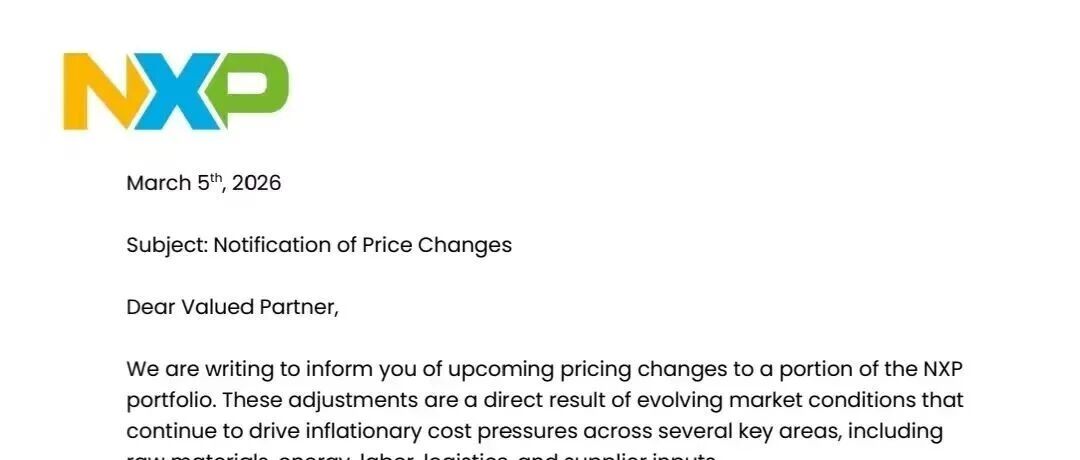
Core Viewpoint - NXP Semiconductors is implementing a price adjustment on selected products due to rising costs in raw materials, energy, labor, logistics, and supplier inputs, effective from April 1, 2026 [3]. Group 1: Price Adjustment Announcement - The price adjustment is a response to the ongoing changes in the market environment that have put pressure on multiple core cost areas [3]. - NXP will provide advance notice of the specific products affected, including updated distributor costs, to ensure clear communication and smooth execution [3]. - The adjustment of distributor pricing will follow the regular schedule starting March 30, 2026 [3]. Group 2: Company Background - NXP Semiconductors, headquartered in Eindhoven, Netherlands, is a leading global provider of embedded semiconductor solutions, having been established as an independent entity from Philips Semiconductor in 2006 and listed on NASDAQ in 2010 [5]. - The company focuses on key areas such as automotive electronics, industrial IoT, secure identification, and communication infrastructure, holding a leading position in automotive-grade microcontrollers (MCUs), in-vehicle networking, and security chips [5]. - NXP serves major automotive manufacturers like Tesla and BYD, as well as industries such as financial payments and smart home solutions, leveraging its extensive security technology patents and global presence [5].
HBM,不吃香了?
半导体芯闻· 2026-03-11 11:05
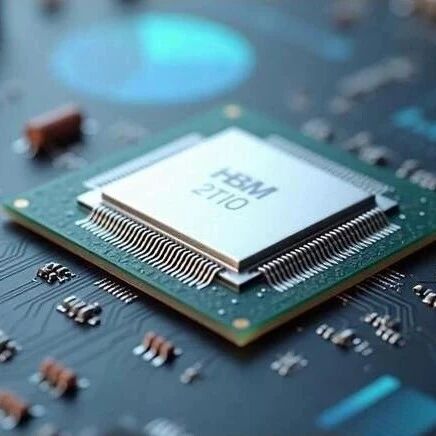
Core Viewpoint - The competition in the artificial intelligence semiconductor market is shifting from high bandwidth memory (HBM) to low-power dynamic random-access memory (DRAM) modules known as Socamm2, with a focus on 256GB capacity [1]. Group 1: Socamm Overview - Socamm is a modular low-power DRAM designed for servers, featuring four low-power DRAM chips per module, offering more data transfer channels, faster speeds, and higher energy efficiency compared to traditional server memory [3]. - The modular nature of Socamm allows for easy upgrades without replacing entire servers, which is highly valued by data center operators [3]. Group 2: Micron's Strategic Move - Micron has announced the shipment of the world's first 256GB Socamm2 module samples, which is approximately 33% higher in capacity than the flagship 192GB Socamm2 products from Samsung and SK Hynix [5]. - This higher capacity enables significant advantages in processing large amounts of data for complex tasks such as large model inference, and is crucial for Micron's strategy to regain its technological leadership [5]. - According to Omdia, as of Q4 last year, the global DRAM market shares were 36.6% for Samsung, 32.9% for SK Hynix, and 22.9% for Micron [5]. Group 3: Samsung and SK Hynix's Market Position - Samsung has taken the lead in the Socamm2 market by mass-producing the 192GB module, ensuring supply chain stability and is expected to supply around 10 billion Gb to Nvidia, covering about 50% of Nvidia's total Socamm2 demand [7]. - SK Hynix is also expanding its Socamm2 product line and plans to leverage its technology reputation from the HBM market to enhance its position in the Socamm sector [7]. Group 4: Market Trends and Future Outlook - The key turning point for market adoption is anticipated in the second half of this year following the launch of Nvidia's AI accelerator, Vera Rubin, which will utilize Socamm [8]. - Market Research Intellect predicts that the low-power DRAM market, including Socamm, will grow at an annual rate of 8.1%, reaching a size of $25.8 billion by 2033 [8]. - The competition among the three companies is currently close, but future success will depend on yield rates, pricing, and optimization details [8].

美股上演教科书级 V 型反转,这轮 Taco 行情藏着哪些超额 Alpha?
RockFlow Universe· 2026-03-11 10:41
Core Insights - The traditional energy crisis has shifted from "physical scarcity" to "expectation management," with the half-life of premiums triggered by events like the blockade of the Strait of Hormuz reducing to 12 hours by 2026 [3][5] - Trump's "peace narrative" serves as a substitute for interest rate cuts, injecting certainty into liquidity and causing rapid capital shifts from oil and gold to long-duration assets, reflecting extreme anxiety over "missing the reversal" [3][5] - The RockFlow research team believes that the market in 2026 will focus not on the events themselves but on the "reaction functions" of decision-makers, suggesting investors should overweight high-quality growth stocks and use energy hedges to capture pricing discrepancies arising from panic [3][5] Group 1: Market Dynamics - The market's response to the blockade of the Strait of Hormuz, which typically would indicate a prolonged energy crisis, showed that the war premium collapsed in less than 12 hours [9][10] - The G7's coordinated response to potential oil price spikes signals a zero tolerance for high oil prices, establishing a "political ceiling" for oil prices in the $90-95 range [11][13] - The market's volatility reflects a lack of confidence in long-term holdings, characterized by high-frequency and emotional trading, with funds rapidly shifting between assets based on fear and anxiety [16][19] Group 2: Sector Analysis - Energy giants like ExxonMobil (XOM) and Chevron (CVX) have transitioned from being viewed as speculative assets to reliable dividend-paying stocks, as long as oil prices remain in a healthy range of $70-80 [19] - High-duration technology and SaaS sectors have seen a resurgence, as the decline in oil prices helps stabilize inflation expectations, allowing for a recovery in valuations of previously pressured stocks [20] - The market's core resilience in 2026 is expected to come from high-quality growth stocks that were previously undervalued due to high interest rate expectations [20][25] Group 3: Investment Strategy - Investors are advised to embrace "certainty" and "flexibility" in the face of market volatility, focusing on high-quality AI infrastructure and SaaS sectors while using the energy sector as a hedge [21][25] - The market's reaction to geopolitical events will increasingly depend on the narratives constructed by political leaders, necessitating a shift in investment strategies to account for these influences [23][24]

2月环球经济与大类资产配置观察:“沃什交易”、AI担忧、中东局势叠加扰动市场
工银亚洲· 2026-03-11 10:36
Market Overview - In February 2026, major asset classes experienced declines due to concerns over the new Fed chair's "balance sheet reduction" policy, geopolitical tensions, and AI-related worries, particularly affecting precious metals[4] - The South Korean stock market outperformed with a gain of 19.5%, followed by Japan's Nikkei 225 at +10.4% and European indices such as the FTSE 100 (+6.7%) and CAC40 (+5.6%) [5] Fund Flows - Global stock and bond markets saw increased net inflows, with emerging markets attracting more capital than developed markets; passive funds were a significant driver of this trend[6] - In February, U.S. stock markets had a net inflow of $13.38 billion, while European stocks saw a substantial increase in net inflows to $36.9 billion, up from $23.06 billion the previous month[12] Economic Indicators - The U.S. economy showed signs of "stagflation" with a Q4 2025 GDP growth rate of 1.4%, significantly below the expected 2.8%[14] - Eurozone manufacturing PMI rose to 50.8 in February, indicating a recovery, while inflation rates showed a decrease to 1.7%[14] Policy Developments - The U.S. Supreme Court ruled against certain tariffs, leading to a temporary 10% global import tariff imposed by the Trump administration, which may affect trade agreements[15] - The European Central Bank maintained its interest rates, while Japan's monetary policy is expected to remain accommodative despite rising inflation concerns[18] Commodity Trends - Gold prices fluctuated significantly, reaching over $5,300 per ounce due to geopolitical tensions and changes in U.S. monetary policy expectations[23] - Brent crude oil prices rose to nearly $80 per barrel amid ongoing geopolitical conflicts, particularly between the U.S. and Iran[23]
博通(AVGO US):AI芯片收入指引强劲
HTSC· 2026-03-11 10:35
Investment Rating - The investment rating for the company is "Buy" with a target price of $380.73 [1][5] Core Insights - The company reported FY26Q1 revenue of $19.311 billion, exceeding previous guidance of $19 billion, with a year-over-year increase of 29% and a quarter-over-quarter increase of 7%, primarily driven by rapid growth in AI business revenue [1] - The semiconductor solutions segment achieved revenue of $12.5 billion, a year-over-year increase of 52% and a quarter-over-quarter increase of 13%, with AI-related revenue reaching $8.4 billion, up 106% year-over-year [2] - The company expects AI chip revenue to exceed $100 billion in 2027, having secured capacity for key components [2] - The ASIC business continues to grow significantly, with a 140% year-over-year increase in revenue for FY26Q1, and strong demand from major clients like Google and OpenAI [3] - The infrastructure software segment maintained stability, with FY26Q1 revenue of $6.797 billion, showing a slight year-over-year increase of 1.4% [4] - Adjusted net profit forecasts for FY26-28 have been raised to $50.3 billion, $73.5 billion, and $107.1 billion respectively, reflecting an 8%, 15%, and 17% increase [5] Summary by Sections Financial Performance - FY26Q1 revenue was $19.311 billion, with a net profit of $7.349 billion, and an EPS of $1.50 [1] - Adjusted EBITDA for FY26Q1 was $13.128 billion, corresponding to an EBITDA margin of approximately 68% [1] Semiconductor Solutions - The semiconductor solutions business generated $12.5 billion in revenue, with AI-related revenue contributing $8.4 billion [2] - The company has locked in advanced process wafer capacity and key components for future growth [2] AI Business Outlook - The ASIC business is expected to continue its high growth trajectory, with significant demand from clients projected to reach nearly 10GW by 2027 [3] - AI network revenue grew by 60% year-over-year, with expectations for further growth as AI cluster sizes expand [3] Infrastructure Software - The infrastructure software segment's revenue was $6.797 billion, with VMware Cloud Foundation playing a critical role in AI data center architecture [4] Profit Forecast and Valuation - The company is projected to have a PE ratio of 37x for FY26, with a target price of $380.73 based on competitive advantages in ASIC and network businesses [5]

独角戏 | 谈股论金
水皮More· 2026-03-11 10:33
Market Overview - The A-share market saw all three major indices rise today, with the Shanghai Composite Index up 0.25% to close at 4133.43 points, the Shenzhen Component Index up 0.78% to 14465.41 points, and the ChiNext Index up 1.31% to 3349.53 points. The total trading volume in the Shanghai and Shenzhen markets reached 25.285 billion, an increase of 1.114 billion from the previous day [1][2]. Index Performance - Despite the rise in indices, the majority of individual stocks experienced declines, with a median drop of 0.50%. A total of 1955 stocks rose while 3157 stocks fell. The strong index performance was primarily driven by heavyweight stocks, particularly in the Shenzhen market, where "Ning Wang" (Ningde Times) surged 5.45%, positively impacting BYD and Sunshine Power [2][3]. Sector Analysis - The oil and gas sector rebounded today, while sectors such as aerospace equipment and semiconductor technology stocks faced adjustments. The performance of heavyweight stocks, including major banks and state-owned enterprises, provided support to the indices, but did not lead to a broad market rally [2][3]. International Market Context - Internationally, U.S. indices showed a pattern of rising and then retreating, with moderate declines. In the Asia-Pacific region, the Nikkei Index rose 1.43% and the Korean Index rose 1.40%, while the Hang Seng Index opened high but closed down 0.24% due to a cooling off of the "shrimp farming" concept related to AI tools [3][4]. Conclusion - The market dynamics reflect a scenario where heavyweight stocks are influencing index performance, while the majority of individual stocks are underperforming. The contrasting movements of key stocks, referred to as "Wang Bu Jian Wang" (King does not see King), highlight the divergence in market behavior [4].

几千亿美元远远不够!黄仁勋亲笔长文:AI 是人类历史上最大的基建浪潮
机器之心· 2026-03-11 09:39
机器之心编辑部 在「龙虾热」蔓延全国的此刻,大家把越来越多的工作交给 AI。从写代码到数据分析,很多人开始尝试让 AI 接管完整流程。 人工智能能力的跃升似乎正逼迫着人们直面「自我价值」的拷问: 「AI 会不会替代我的岗位?」「如果越来越多的工作被接管,人类又该做什么?」 往回看,也许可以窥见答案一角,技术史研究在回顾工业革命时提出过一个经典观察: 技术不会消灭劳动,而是重新配置、隐藏或外包劳动。 而就在刚刚,英伟达 CEO 黄仁勋发布长文,从人工智能产业结构的角度给出这个理论的当代版本: AI 并不是飘渺的软件,它依赖真实世界的投入 —— 能源、基 础设施,以及背后的大量人力。 博客链接:https://blogs.nvidia.com/blog/ai-5-layer-cake/ 文章原文翻译如下: 人工智能是当今塑造世界最强大的力量之一。它不是一个应用,也不是单一模型,而是如同电力和互联网一般的 关键基础设施 。 人工智能的运行依托于切实的 硬件、能源与经济规律 。它消耗原材料,并将其大规模转化为智能产出。每一家企业都将应用它,每一个国家都将构建它。 若要理解人工智能为何以此种态势演进,我们需要回归「第一 ...


黄仁勋罕见发文:AI是这个重塑世界的重要力量,是电力、互联网一样的基础设施
硬AI· 2026-03-11 09:11
Core Viewpoint - AI is not merely a model or application but a foundational infrastructure akin to electricity and the internet, requiring significant investment for future development [5][6][20]. Group 1: AI Industry Structure - The AI industry is structured as a "five-layer cake" consisting of energy, chips, infrastructure, models, and applications, with strong interdependencies among these layers [7][9][26]. - The foundational layer is energy, which is essential for real-time intelligence generation, as every generated token relies on energy conversion into computational power [9][24]. - Above energy is the chip layer, which efficiently transforms energy into computational power, crucial for AI workloads that demand high parallel computing capabilities [9][24]. - The infrastructure layer includes systems like land, power delivery, cooling systems, and networks that enable thousands of processors to work together, forming "AI factories" designed to produce intelligence [9][24]. - The model layer encompasses AI models that can understand various types of information, with significant advancements occurring in fields like protein AI and robotics [10][24]. - The application layer is where economic value is created, with examples including drug discovery platforms and autonomous vehicles, all utilizing the same underlying technology stack [10][25]. Group 2: Current State and Future Needs - Currently, global investment in AI infrastructure is in the thousands of billions, but future needs are projected to require investments in the tens of trillions [6][13][27]. - The construction of chip factories, server assembly plants, and AI data centers is accelerating, potentially becoming one of the largest infrastructure projects in human history [13][27]. - There is a growing demand for skilled labor in AI data center construction, including electricians and network engineers, highlighting the need for a diverse workforce [13][27]. Group 3: Role of Open Source Models - Open source models play a critical role in the AI ecosystem, with many organizations relying on them to drive AI development [15][29]. - The advancement of open source models can stimulate demand across the entire technology stack, as seen with the example of DeepSeek-R1, which increased the need for training power and infrastructure [15][30]. Group 4: Broader Impacts of AI - AI is expected to transform not only the software industry but also sectors like energy, manufacturing, and labor structures, indicating a significant industrial-level transformation [18][31]. - The ongoing development of AI is anticipated to enhance productivity across various fields, such as radiology, where AI assists in image analysis while increasing the demand for radiologists [27][28].

科创板成长层首批“退层”企业出炉!百济神州、寒武纪等在列
Shang Hai Zheng Quan Bao· 2026-03-11 08:44
Group 1 - The core viewpoint of the news is that the Sci-Tech Innovation Board (STAR Market) is witnessing the first batch of companies transitioning out of the growth tier, with significant revenue and profit growth expected for 2025 [2][3] - As of March 11, all companies on the STAR Market have disclosed their 2025 performance, projecting total revenue of 1.59 trillion yuan, a year-on-year increase of 10.3%, and net profit of 59.1 billion yuan, a year-on-year increase of 28.2% [2] - Six companies, including Cambricon and BeiGene, are expected to successfully turn profitable, with net profits ranging from 80 million yuan to 2.1 billion yuan, and are anticipated to remove the special "U" designation after the 2025 annual report [2][3] Group 2 - Among the six companies, BeiGene leads in revenue, expecting 2025 revenue of 38.205 billion yuan, a 40.4% increase, and a net profit of 1.422 billion yuan, driven by strong sales of its key products [3] - Cambricon achieved a revenue of 6.497 billion yuan in 2025, a substantial increase of 453.21%, marking its first annual profit since its IPO in 2020 [6][8] - Other companies like Orbbec and NIO also reported significant growth, with Orbbec's revenue reaching 941 million yuan (up 66.66%) and NIO's revenue at 2.726 billion yuan (up 108.93%) [8] Group 3 - The STAR Market's growth tier was established to support technology companies with significant breakthroughs and broad commercial prospects, particularly those that are not yet profitable at the time of listing [10] - Since the introduction of the "1+6" policy measures by the China Securities Regulatory Commission, several cutting-edge technology companies have accelerated their listing processes, with 39 companies now included in the growth tier [10] - The establishment of the growth tier enhances the market's inclusivity and attractiveness, catering to different risk preferences among investors [11]