茶饮

Search documents
新茶饮半年业绩分化,奈雪的茶掉队
21世纪经济报道· 2025-08-29 00:20
Core Viewpoint - The tea beverage industry is experiencing significant performance differentiation among brands, with Mixue and Guming leading in growth while Nayuki continues to struggle with losses [1][2]. Group 1: Financial Performance - Mixue Group reported a revenue of 14.875 billion and a net profit of 2.718 billion, both achieving approximately 40% growth [1]. - Guming achieved a net profit of 1.626 billion, a remarkable increase of 119.8%, with revenue growing by 41.2% to 5.663 billion [1]. - Nayuki's revenue declined by 14.4% to 2.178 billion, with an adjusted net loss reduced by 73.1% to 117 million [1][6]. Group 2: Market Dynamics - The "takeaway war" has significantly influenced revenue growth, but the sustainability of this growth is uncertain as competition returns to rationality [2][8]. - Guming's CEO expressed concerns that long-term reliance on takeaway subsidies is detrimental to franchise operations and industry health [2]. Group 3: Store Expansion - Guming opened 1,570 new stores in the first half of 2025, more than double the 765 opened in the same period last year, reaching a total of 11,179 stores [4]. - Mixue also expanded its store count to 53,014, adding 9,796 stores in the same timeframe [4]. - In contrast, Shàngshàng Auntie saw a slower growth rate, with a net increase of only 260 stores [6]. Group 4: Revenue Sources - Guming's revenue breakdown shows that 79.4% comes from product and equipment sales, while franchise management services contribute 20.5% [5]. - Mixue's product and equipment sales reached 14.495 billion, accounting for over 97% of total revenue [5]. Group 5: Cost and Profitability - Nayuki faces high cost pressures, with material costs at 34.1% and employee costs at 29.8% of revenue, leading to profitability challenges [6]. - Mixue aims to maintain a long-term gross margin target of around 30% as it scales operations [6]. Group 6: Future Growth Strategies - Brands are exploring coffee as a growth avenue, with Mixue's subsidiary Luckin Coffee seeing a 164% increase in new store openings [10]. - Guming has introduced coffee products in over 8,000 stores, with coffee sales accounting for about 15% of some franchisees' revenue [10]. - The competitive landscape in the coffee market raises questions about the ability of new tea beverage brands to capture market share [10].

新茶饮半年报明显分化
2 1 Shi Ji Jing Ji Bao Dao· 2025-08-28 23:15
Core Insights - The tea beverage industry is experiencing significant revenue growth, with brands like Mixue and Guming leading the way, while Nayuki is lagging behind [1][2] - The "takeaway war" has played a crucial role in driving sales, but its sustainability is in question as competition normalizes [2][7] Group 1: Financial Performance - Mixue Group reported a revenue of 14.875 billion yuan and a net profit of 2.718 billion yuan, both achieving approximately 40% growth [1] - Guming's net profit surged by 119.8% to 1.626 billion yuan, with revenue increasing by 41.2% to 5.663 billion yuan [1] - Nayuki's revenue declined by 14.4% to 2.178 billion yuan, with an adjusted net loss reduced by 73.1% to 117 million yuan [1][4] Group 2: Store Expansion - Guming opened 1,570 new stores in the first half of 2025, doubling the 765 stores opened in the same period last year, reaching a total of 11,179 stores [3] - Mixue Group also expanded significantly, increasing its global store count to 53,014, with 9,796 new stores opened in the first half of the year [3] - Nayuki closed 132 self-operated stores, attributing revenue decline to the closure of underperforming locations [4] Group 3: Revenue Sources - The majority of revenue for leading tea brands comes from selling raw materials and equipment to franchisees, with Guming's sales from goods and equipment contributing 79.4% of its revenue [4] - Mixue's sales from goods and equipment reached 14.495 billion yuan, accounting for over 97% of total revenue [4] Group 4: Cost and Profitability - The tea beverage companies have seen improvements in costs and profits, with Mixue aiming to maintain a long-term gross margin of around 30% [5] - Nayuki faces high cost pressures, with material costs accounting for 34.1% of revenue and employee costs at 29.8% [6] Group 5: Market Dynamics - The competitive landscape in the takeaway market has led to increased sales but may not be sustainable in the long term as subsidies decrease [7][8] - The industry is witnessing a shift towards coffee offerings, with brands like Mixue and Guming expanding their coffee product lines [8][9]
从单打独斗到集体出海,新消费品牌掀起一场"中国潮流"风暴
Sou Hu Cai Jing· 2025-08-28 18:07
Core Insights - A new wave of Chinese brands is rapidly expanding in Southeast Asia, driven by a collective approach to market entry, contrasting with the previous individualistic strategies [3][4][9] - The success of brands like KKV and Mixue Ice City highlights the effectiveness of this "group army" strategy, allowing for shared resources and reduced entry barriers [4][10][16] Group 1: Market Dynamics - Southeast Asia is experiencing a "new consumption boom," with Chinese brands redefining market rules through collective efforts [3][4] - The region's young population, with a median age below 30, presents significant consumer potential, as these individuals are more open to new brands and products [21][23] - Cultural similarities, particularly in areas with large Chinese communities, lower the adaptation costs for Chinese brands entering these markets [23][24] Group 2: Brand Success Stories - Mixue Ice City has opened nearly 5,000 stores in Southeast Asia within two years, showcasing a rapid expansion strategy that resonates with local consumers [4][6] - Bubble Mart's LABUBU character has gained popularity in Thailand, indicating a shift in local consumer habits towards Chinese trendy products [6][8] - Brands like KKV are facilitating the entry of over 100 Chinese brands into Southeast Asia, significantly increasing their market presence and sales [9][10] Group 3: Innovative Business Models - KKV's model includes zero entry fees and comprehensive support for product certification and logistics, making it easier for brands to enter the market [10][16] - The establishment of a unified certification service and shared marketing strategies among brands enhances operational efficiency and reduces costs [16][17] - Data-driven decision-making through KKV's retail management system allows brands to quickly adapt to consumer preferences and optimize their offerings [17] Group 4: Strategic Advantages - The RCEP agreement has facilitated trade by reducing tariffs and improving logistics, further benefiting Chinese brands in Southeast Asia [25][26] - The ongoing infrastructure development in Southeast Asia provides ample opportunities for retail brands to establish a strong presence [27] - The rise of social media and e-commerce platforms has created new marketing channels, allowing brands to engage with consumers effectively [27][28] Group 5: Future Outlook - The success of Chinese brands in Southeast Asia is seen as a stepping stone for global expansion, with plans to replicate successful models in other regions [28][36] - The anticipated growth of KKV and its associated brands could lead to a significant increase in their international market share by 2027-2028 [32] - The overall trend indicates a shift from "Made in China" to "Created in China," emphasizing cultural influence alongside commercial success [36]

古茗(01364.HK):2025H1经调净利润同增42% 门店扩张环比大幅提速
Ge Long Hui· 2025-08-28 14:04
Core Viewpoint - The company has demonstrated significant growth in revenue and profit in the first half of 2025, driven by store expansion and improved operational efficiency [1][2][3] Financial Performance - In H1 2025, the company achieved a revenue of 5.66 billion yuan, representing a year-on-year increase of 41.2% [1] - The net profit attributable to shareholders reached 1.63 billion yuan, up 121.5% year-on-year [1] - Adjusted profit for the same period was 1.09 billion yuan, reflecting a growth of 42.4% [1] Business Segmentation - Revenue from sales of goods and equipment was 4.50 billion yuan, accounting for 79.4% of total revenue, with a year-on-year increase of 41.8% [2] - Franchise management service revenue was 1.16 billion yuan, making up 20.5% of total revenue, with a growth of 39.2% [2] - Direct store sales revenue was 7.84 million yuan, representing 0.1% of total revenue [2] Store Expansion - The company added a net of 1,265 stores in H1 2025, significantly accelerating its expansion pace compared to the previous year [2] - Total store count reached 11,179 by the end of H1 2025, with a revised annual net store addition target increased from 2,100 to 2,500 [2] - The proportion of stores in lower-tier cities reached 80.9%, with town stores accounting for 43% of the total [2] Operational Efficiency - Average GMV per store was 1.371 million yuan, reflecting a year-on-year increase of 20.6% [2] - The number of cups sold per store was 79,400, up 16.6% year-on-year, with an estimated average price per cup increasing by approximately 4% [2] Profitability Metrics - Gross margin stood at 31.5%, with a slight decrease of 0.1 percentage points [3] - Operating profit margin improved by 1.6 percentage points to 23.7% [3] - Adjusted net profit margin increased by 0.2 percentage points to 19.2% [3] Future Outlook - The company has revised its adjusted net profit forecasts for 2025-2027 to 2.22 billion, 2.74 billion, and 3.31 billion yuan, respectively, reflecting increases of 10%, 9%, and 7% [3] - The company is expected to continue benefiting from product innovation and expansion in lower-tier markets, potentially leading to sustained valuation premiums [3]
古茗(1364.HK):营收利润双高增 拓品类强化成长动能
Ge Long Hui· 2025-08-28 14:04
Core Viewpoint - Company reported strong performance in 1H25 with significant growth in GMV, revenue, and net profit, driven by effective strategies and market conditions [1][2][3] Financial Performance - 1H25 GMV reached 14.1 billion yuan, up 34.4% year-on-year, with revenue of 5.663 billion yuan, up 41.2% year-on-year, and net profit of 1.625 billion yuan, up 121.5% year-on-year [1] - Adjusted core profit was 1.136 billion yuan, reflecting a 49% year-on-year increase, with an adjusted core profit margin of 20.1%, up 1.0 percentage points year-on-year [1][3] Store Expansion and Product Development - As of the end of 1H25, the company operated 11,179 stores, marking a significant milestone in store count [1][3] - The company introduced 16 new coffee products and implemented a new franchise policy to ease financial burdens on franchisees, with over 8,000 stores equipped with coffee machines [2][3] Revenue Structure and Contribution - Revenue from sales of goods and equipment, franchise management services, and direct store sales reached 4.496 billion yuan, 1.159 billion yuan, and 78 million yuan respectively, with year-on-year growth rates of 41.8%, 39.2%, and 14.0% [2] - The annualized revenue per franchise store from goods and equipment is approximately 804,000 yuan, up 20.7% year-on-year, while franchise management service revenue is about 207,000 yuan, up 18.5% year-on-year [3] Profitability and User Engagement - The company maintained a gross margin of 31.5% in 1H25, with stable sales and management expense ratios [3] - The number of registered users on the company's mini-program reached 178 million, with 50 million active users in the latest quarter, reflecting a 36.9% year-on-year increase [3] Future Outlook and Valuation - The company adjusted its net profit forecasts for 2025-2027, with expected profits of 2.163 billion yuan, 2.517 billion yuan, and 3.058 billion yuan respectively, corresponding to adjusted EPS of 0.91, 1.06, and 1.29 yuan [4] - The target price was adjusted to 34.57 HKD, based on a 30x PE for 2026, considering the company's growth potential and profitability [4]
新茶饮半年业绩分化显著,“外卖大战”后急需寻找新增量
2 1 Shi Ji Jing Ji Bao Dao· 2025-08-28 13:33
Core Insights - The tea beverage industry is experiencing significant revenue growth, with major brands like Mixue and Guming leading the way, while Nayuki is lagging behind [1][2] - The "takeaway war" has played a crucial role in driving sales, but its sustainability is in question as competition normalizes [2][7] Financial Performance - Mixue Group reported a revenue of 14.875 billion yuan and a net profit of 2.718 billion yuan, both achieving approximately 40% growth [1] - Guming's net profit surged by 119.8% to 1.626 billion yuan, with revenue increasing by 41.2% to 5.663 billion yuan [1] - Nayuki's revenue declined by 14.4% to 2.178 billion yuan, with an adjusted net loss reduced by 73.1% to 117 million yuan [1] Store Expansion - Guming opened 1,570 new stores in the first half of 2025, doubling the 765 stores opened in the same period last year, reaching a total of 11,179 stores [3] - Mixue Group also expanded its store count to 53,014, adding 9,796 stores in the same timeframe [3] - Nayuki closed 132 self-operated stores, attributing revenue decline to the closure of underperforming locations [4] Revenue Sources - A significant portion of revenue for leading tea brands comes from selling raw materials and equipment to franchisees, with Guming's sales from goods and equipment contributing 79.4% of its revenue [4] - Mixue's sales from goods and equipment reached 14.495 billion yuan, accounting for over 97% of total revenue [4] Cost and Profitability - The tea beverage companies have seen improvements in costs and profits, with Mixue aiming to maintain a long-term gross margin of around 30% [5] - Nayuki faces high cost pressures, with material costs making up 34.1% of revenue and employee costs at 29.8% [6] Market Dynamics - The competitive landscape in the takeaway market has led to increased sales but raises concerns about long-term growth sustainability [7] - The "takeaway war" has temporarily boosted sales, but as competition stabilizes, brands may face challenges in maintaining growth [7][8] Strategic Initiatives - Brands are exploring coffee as a growth avenue, with Mixue's coffee brand Lucky Coffee seeing a 164% increase in new store openings [8][9] - Guming has introduced coffee products in over 8,000 stores, with coffee sales accounting for about 15% of some franchisees' revenue [9]
蜜雪冰城的选择题:幸运咖快一点,出海慢一点
36氪未来消费· 2025-08-28 12:50
Core Financial Performance - In the first half of 2025, the company achieved a revenue of 14.87 billion yuan, representing a year-on-year growth of 39.3% [5] - The net profit for the same period was 2.72 billion yuan, with a year-on-year increase of 44.1% [5] - The total number of global stores reached 53,014, with an addition of 9,796 stores compared to the same period last year, primarily driven by growth in mainland China [5] Store Expansion and Market Penetration - The growth rate of new stores in mainland China accelerated significantly, with a quarter-on-quarter increase of approximately 16% in H1 2025, compared to only 7% in H2 2024 [5] - Most new stores are located in third-tier cities and below, with 5,707 new stores in these areas, accounting for nearly 60% of the total new openings [5] - The company aims to penetrate approximately 30,000 town markets across the country for future store growth [5] Same-Store Sales and External Factors - Although same-store sales growth data was not disclosed, it is estimated that same-store growth approached 9% in H1 2025 [5] - The rise in delivery services has positively impacted sales performance across the tea beverage sector [5] Cost Management and Profitability - Despite rising costs for coffee beans and lemons, the overall gross margin for H1 2025 was 31.6%, only a slight decrease of 0.3% from the previous year [6] - The company attributes the stable gross margin to the decline in sugar and milk prices, as well as improved supply chain efficiency [6] Lucky Coffee's Growth Potential - Lucky Coffee has seen significant expansion, with over 7,000 signed stores as of July 2025, compared to approximately 4,000 at the end of 2024, indicating a growth rate of 150% if the target of 10,000 stores is met by the end of 2025 [7] - The focus of expansion has shifted to first- and second-tier cities, with a validated profitability model for single stores in first-tier cities [7] Product Strategy and Market Positioning - Lucky Coffee differentiates itself from the company's other brand, Mixue Ice City, by focusing on freshly brewed coffee using a semi-automatic coffee machine and factory-roasted beans [9] - The introduction of the "fruit coffee" series aims to leverage the company's existing supply chain advantages, utilizing frozen fruit purees from Mixue [9] International Expansion and Operational Efficiency - The number of overseas stores grew to 4,733 in H1 2025, a net increase of 128 stores year-on-year, but a decrease from 4,895 in H2 2024 due to optimization efforts in Indonesia and Vietnam [12] - The company is focusing on improving operational efficiency in overseas markets, with daily sales per relocated store increasing by over 50% [12] - Plans for global expansion continue, with new stores opening in Kazakhstan and Malaysia, and a production base in Hainan aimed at supporting Southeast Asian markets [13]

喜茶回应被测反式脂肪酸含量最高是因添加更多真奶 天然乳制品也有反式脂肪酸吗
Yang Zi Wan Bao Wang· 2025-08-28 12:34
Core Viewpoint - The recent evaluation by NetEase Finance revealed that several popular tea brands, including Heytea and Naixue's Tea, contain trans fatty acids and cholesterol, sparking public concern and discussion on social media [1][3]. Group 1: Product Evaluation - The product "Baked Brown Sugar Bubble Milk Tea" from Heytea was found to have the highest trans fatty acid content at 0.113g/100g [3]. - Trans fatty acids are known to significantly increase the risk of cardiovascular diseases by raising low-density lipoprotein levels and lowering high-density lipoprotein levels [3]. Group 2: Health Implications - Natural dairy products inherently contain trans fatty acids, primarily sourced from ruminant animals like cows and sheep [3]. - According to the National Food Safety Risk Assessment Expert Committee, the average trans fatty acid content in natural dairy products is 0.83g/100g, while liquid milk and fermented milk contain less than 0.08g/100g [4]. Group 3: Regulatory Standards - The food safety national standard (GB28050-2011) states that products can be labeled as "zero trans fatty acids" if they contain less than 0.3g/100g [4]. - The nutritional labeling guidelines specify that products with ≤0.3g/100g (solid) or 100ml (liquid) can claim to be free of trans fatty acids [5]. Group 4: Consumer Awareness and Industry Response - With rising health awareness, the ready-to-drink tea industry is responding to consumer demands for healthier options, including a new nutritional grading system being implemented in Shanghai in 2024 [6]. - The grading system categorizes beverages from A to D based on their content of non-dairy sugars, saturated fats, trans fats, and non-sugar sweeteners, aiding consumers in making healthier choices [6]. Group 5: Broader Health Considerations - Besides trans fatty acids, the fat, calories, and sugar content in milk tea pose potential health risks, with some milk teas containing over 15 grams of sugar even when labeled as "no added sugar" [7]. - Ingredients like creamers and common toppings can significantly increase the overall caloric content of milk tea [7].

8.28犀牛财经晚报:多家银行宣布下调存款利率 国泰君安国际在香港推出加密货币交易服务
Xi Niu Cai Jing· 2025-08-28 10:28
Group 1: Banking Sector - Several small and medium-sized banks have announced a reduction in RMB deposit rates, with declines ranging from 10 to 20 basis points [1] - Three banks in Sichuan Province plan to jointly establish a wealth management company, expressing confidence in obtaining the necessary license [1] Group 2: Technology and Innovation - A new adaptive, full-bandwidth, high-speed wireless communication chip has been developed by Chinese scientists, capable of achieving over 120 Gbps transmission rates, meeting 6G communication requirements [2] - Guotai Junan International has officially launched cryptocurrency trading services in Hong Kong, allowing clients to trade various cryptocurrencies [2] Group 3: Consumer Goods - The sales of matcha beverages have surged, with new products selling over 10,000 cups in their first week, indicating a growing trend among young consumers [2] Group 4: Financial Performance Reports - Zhujiang Beer reported a net profit of 612 million yuan for the first half of 2025, a year-on-year increase of 22.51% [6] - Baolong Technology's net profit decreased by 9.15% year-on-year, despite a revenue increase of 24.06% [7] - Nanshan Aluminum achieved a net profit of 2.625 billion yuan, up 19.95% year-on-year [8] - Jindi Co. reported a net profit increase of 32.86% year-on-year, with revenue growth of 40.57% [10] - Caitong Securities reported a net profit of 1.083 billion yuan, a year-on-year increase of 16.85% [11] - Yili Co. reported a net profit of 7.2 billion yuan, a year-on-year decrease of 4.39% [12] - China Galaxy reported a net profit increase of 47.86% year-on-year, with revenue growth of 37.71% [15] Group 5: Market Trends - The ChiNext 50 Index surged by 7.23%, with significant gains in semiconductor and computing power sectors, while the overall market saw over 2,800 stocks rise [16]




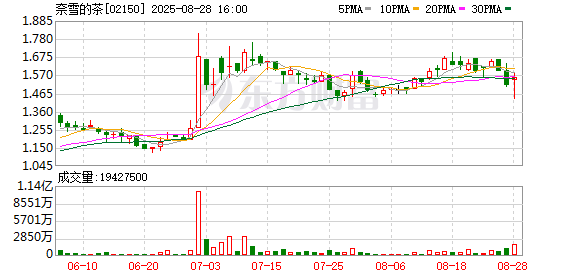
奈雪的茶2025年上半年营收21.8亿元 日均订单量同比提升11.4%
Zheng Quan Ri Bao· 2025-08-28 08:13
Core Viewpoint - Naixue Tea's mid-year performance report for 2025 shows significant improvement in multiple core indicators, confirming the effectiveness of its health strategy [2][3] Financial Performance - Revenue reached 2.18 billion yuan, with adjusted net loss narrowing by 73.1% from 438 million yuan to 117 million yuan year-on-year [2][3] - Operating cash flow increased by 33.1% to 138 million yuan, indicating improved financial health [3] - Cash on hand as of June 30 was 2.79 billion yuan, providing strong financial stability and risk resistance [3] Operational Metrics - Average daily sales per store increased by 4.1% compared to the same period in 2024, with daily order volume rising from 265.9 to 296.3, a year-on-year increase of 11.4% [3] - Directly operated same-store sales grew by 2.3% to 1.76 billion yuan, with positive growth across all city tiers, particularly in new first-tier cities where average daily sales per store increased by over 9% [3] Membership and Customer Engagement - Registered membership reached 111 million, with 8.3 million new members, predominantly from younger demographics [3] - The consumption scenario has shifted from "immediate thirst quenching" to "daily light nutrition" [3] Product Strategy - The "No Sugar Natural Nutrition+" initiative was launched in collaboration with various organizations, marking a shift in the industry towards natural nutrition [4] - The "Little Purple Bottle" series achieved over 500,000 cups sold within three days of launch, with a single product topping sales on the day of the autumn equinox [4] - The new product "Sunshine Golden Pineapple Turmeric Yogurt" received special recommendations from registered nutritionists and health managers [4] Growth Strategy - The company plans to optimize the "Naixue Green" store model and explore full-time "light drink and light food" composite formats in new emerging scenarios [6] - More health-focused products utilizing "Chinese superfoods" will be launched in the second half of the year [6] - The company aims to enhance its digital membership system for more precise member operations and accelerate its overseas market expansion [6] Market Positioning - In a highly competitive tea beverage market, Naixue Tea is establishing a differentiated advantage by focusing on health trends, aligning with consumer preferences for "natural and light nutrition" [7] - The mid-year performance underscores the initial success of the brand's transition from "scale expansion" to "value cultivation" [6][7]