
服务业

Search documents
夏季达沃斯热议中国经济:AI创新是驱动增长的核心力量
2 1 Shi Ji Jing Ji Bao Dao· 2025-06-26 09:35
Group 1 - China's economy remains a crucial engine for global economic growth despite dynamic changes and external complexities [1] - Experts at the World Economic Forum discussed how China can respond to macroeconomic headwinds and transition to a more resilient, consumption-driven, and innovation-led economy [1] - Pragmatism is still dominant in China's approach, with deep interdependence in trade despite perceptions of decoupling [1] Group 2 - Technological innovation, particularly in artificial intelligence (AI), is a core driver shaping China's growth trajectory [2] - New open models and digital tools are promoting cost-effective innovations based on China's unique advantages in advanced R&D, large-scale production, and integrated supply chains [2] - The role of consumption in China's economic growth is increasing, with consumers becoming more discerning and seeking quality alternatives without increasing spending [2] Group 3 - Transitioning from an investment and export-driven model to one focused on domestic demand and services is essential for China's economic future [2] - Increasing domestic consumption requires measures to expand employment opportunities and enhance social spending in healthcare and education [2]
全球经济和大类资产半年报:全球经济进入冲顶期
Ge Lin Qi Huo· 2025-06-26 07:48
Report Information - Report Title: Global Economic and Major Asset Semi-Annual Report [1] - Date: June 26, 2025 [2] - Analyst: Yujunli [3] - Contact Email: yujunli@greendh.com [3] Key Points Global Economic Landscape - Global manufacturing PMI contracted in April and May due to reciprocal tariff impacts [7] - On May 12, China and the US reached an agreement in Switzerland to significantly reduce reciprocal tariffs, with tariffs lowered to 10%, and an additional 24% of reciprocal tariffs to be discussed after 90 days. The 20% tariff imposed by the US on China over fentanyl will be negotiated separately. The first meeting of the China-US economic and trade consultation mechanism in London (June 9 - 10) reached a principled framework agreement [11] Capital Flows - According to a Citi report on May 28, large global funds are collectively "de-Americanizing", reducing allocations in US stocks, bonds, and the US dollar, and increasing allocations in European and Asian stocks, gold, and non-US currencies. Institutions' overall allocation of US stocks has dropped to a neutral level, making it the least favored market globally. There is a consensus among large global funds to "buy Asia and Europe". European and Japanese stocks have been upgraded, and emerging market stocks remain overweight [12] - Institutions generally reduced holdings of US and Japanese bonds and shifted to increasing positions in UK, German, Italian government bonds, and emerging market local bonds [13] - In the foreign exchange market, selling of the US is more evident. The US dollar continues to be under-allocated, while the euro and yen continue to be added to portfolios [14] - According to a report from Bank of America on June 16, global central banks have sold $48 billion worth of US Treasury bonds since the end of March, and foreign investors' holdings in the Fed's reverse repurchase facility have also decreased by approximately $15 billion [15] US Economic Indicators - In May, US manufacturing prices continued to rise rapidly, and service prices accelerated their increase [23] - US retail and food sales reached $715.4 billion, remaining at a high level, with a year-on-year increase of 3.3% in the current month, indicating strong consumer demand [26] - In April, the monthly value of US goods imports recovered to normal at $277.9 billion, mainly affected by reciprocal tariffs [29] - In April, the monthly value of US consumer goods imports recovered to normal at $69.8 billion, with a year-on-year growth rate of 5.2%. US retailers stocked up on a large scale before the implementation of reciprocal tariffs, and imports decreased significantly after the tariffs were imposed in April [32] - In April, the monthly value of US intermediate goods imports was $51.9 billion, showing a significant month-on-month decline due to tariff impacts. Manufacturers stocked up on a large scale before the tariffs [35] - In April, the monthly value of US capital goods imports was $90.5 billion, second only to March, with a year-on-year growth rate of 18.2%, indicating an acceleration in the reshoring of US manufacturing and the "re-industrialization" of the US [38] - In April, the monthly value of the US goods trade deficit decreased significantly to $87.4 billion due to reciprocal tariff impacts [41] - In April, the monthly value of US service exports reached a new high for the year at $98.8 billion, indicating the continued strength of the US service industry [44] - In May, the year-on-year growth rate of the US core CPI was 2.8%, the same as the previous value, with a month-on-month increase of 0.2%. The market expects the Fed to start cutting interest rates in September [47] - In May, the US PPI was 2.6% year-on-year and 0.1% month-on-month [50] - In April, the number of job openings in the US increased to 7.39 million, and the number of hires reached a one-year high, indicating a tightening labor market [53] - In May, the hourly wage of US non-farm enterprises was $36.24, with a year-on-year growth rate of 3.9% [56] - In April, the year-on-year growth rate of US wholesalers' inventories was 2.3%, and that of manufacturers' inventories was 0.9%, indicating an active inventory replenishment phase [59] Other Regions' Economic Indicators - In May, the monthly value of China's manufacturing fixed investment was 2.93 trillion yuan, with a year-on-year growth rate of 7.8%. China continues to make large-scale investments in emerging and future industries [62][65][68] - The ceasefire between Israel and Iran boosted global risk appetite [71] - The China-US reached a phased framework agreement, stabilizing global economic expectations. The final value of the US Markit Manufacturing PMI in June was 52.0, continuing to expand. The manufacturing material procurement price index rose significantly by 5.4 points to 70, the largest increase in four years [72] - The Swiss National Bank cut interest rates by 25 basis points to 0% [73] - China carried out comprehensive rectification of involutionary competition. The European Central Bank has cut interest rates eight times. Germany significantly expanded its military by 30%, driving the recovery of European manufacturing [74] - Elon Musk's Robotaxi was put into operation [75] Major Asset Strategies - The rebound of US stocks after April was mainly driven by retail investors, while institutions withdrew one after another, and short positions of hedge funds reached a new high [78] - The US "Great Beauty" tax cut plan passed in the House of Representatives, and the yield of 30-year US Treasury bonds once exceeded 5% [80] - Inflation in Japan rose, and the yields of 40-year and 30-year Japanese government bonds increased significantly [83] - As a representative of China's offshore assets, the Hang Seng Tech ETF is expected to benefit from the reallocation of global financial assets [86] - Driven by the continuous inflow of various funds, the A-share market is expected to shift from a volatile recovery to a trending upward market. There is a bullish view on Chinese equity assets [89] - The savings of the household sector continue to shift to high-dividend sectors, and the Bank ETF has continuously reached new highs [91] - In May, the issuance of China's 50-year Treasury bonds was oversubscribed, and long-term Treasury bonds are under pressure. The flattening of the domestic yield curve is unsustainable [93] - The ceasefire between Israel and Iran is only a temporary respite, and peace is short-lived. Iran is likely to face a situation similar to Gaza. The pulse increase in crude oil prices in June is likely to be just the first wave [96] - Gold is still in a technical adjustment phase, mainly fluctuating within a range [99] - The RMB is expected to achieve a double surplus in trade and capital accounts, and there is continued optimism about the RMB [102]
金融促消费路线明晰:政策重心转向服务消费和供给端
Xin Lang Cai Jing· 2025-06-26 02:40
Core Viewpoint - The recent issuance of the "Guiding Opinions on Financial Support to Boost and Expand Consumption" marks a shift in policy focus from goods consumption to service consumption, emphasizing the cultivation of supply rather than merely stimulating demand [1] Group 1: Policy Changes - The "Opinions" outline 19 specific measures across six areas to enhance consumer capacity, cultivate demand, and improve the specialized service capabilities of financial institutions [1] - Service consumption is highlighted as a key area, mentioned 13 times in the document, while goods consumption is referenced only twice [1] Group 2: Economic Context - In May, retail sales of goods increased by 6.5% year-on-year, showing a 2.6 percentage point improvement from December of the previous year, while service sector growth was more subdued at 6.2%, down 0.3 percentage points from December [1] - Analysts suggest that the marginal effects of the old-for-new consumption policy will weaken, indicating limited growth potential for goods consumption, whereas service consumption still holds significant potential [2] Group 3: Supply-Side Focus - The "Opinions" emphasize the importance of optimizing supply alongside expanding demand, aiming for a virtuous cycle in production, distribution, and consumption [2] - Future policies may focus on increasing financing support for consumer enterprises and investing in service consumption infrastructure, including facilities for culture, sports, healthcare, and community services [3] Group 4: Consumer Confidence - The primary constraint on consumer growth is not financial access but rather macroeconomic pressures and cautious consumer sentiment regarding employment and income [4] - The "Opinions" propose measures to support employment and income growth, enhance consumer confidence, and improve financial services for small and micro enterprises [4]
路透社:受关税政策影响 美国6月份商业活动放缓通胀压力加剧
Sou Hu Cai Jing· 2025-06-24 12:57
Group 1 - The core viewpoint indicates that U.S. business activity has slightly slowed down in June due to significant tariffs imposed by the White House on imported goods, leading to increased costs and prices, which may accelerate inflation in the second half of the year [1] - The S&P Global reported that the U.S. Composite PMI output index fell from 53.0 in May to 52.8 in June, suggesting a slowdown in economic output from the private sector [1] - The Services PMI preliminary value decreased from 53.7 in May to 53.1, and the new orders index dropped from 53.0 to 52.3, indicating weakened market demand growth [1] Group 2 - Inflationary pressures have intensified, with manufacturers' input cost pressures rising sharply, as the price index surged to 70.0, the highest since July 2022, up from 64.6 in May [1] - Nearly two-thirds of manufacturers reported rising costs attributed to tariffs, which are being passed on to consumers, keeping the price indicators for goods and services elevated [1] - The manufacturers' price index jumped from 59.7 in May to 64.5, marking the highest level since July 2022 [1] Group 3 - Economists widely expect U.S. inflation rates to soar starting in June, with tariff policy uncertainties exacerbating the risks of rising inflation and sluggish economic growth, potentially leading to stagflation [2] - The rise in inflation expectations has led the Federal Reserve to pause its interest rate cut cycle, maintaining the benchmark overnight rate at 4.25%-4.50% [2] - Federal Reserve Chairman Powell indicated that future inflation is expected to be "notable" [2]

湖北推动精准招商 至2027年年引千个10亿级项目
Chang Jiang Shang Bao· 2025-06-24 06:40
Core Viewpoint - The Hubei Provincial Government has released guidelines aimed at enhancing investment attraction and promoting entrepreneurship, targeting the introduction of over 1,000 industrial projects each year with investments exceeding 1 billion yuan by 2027 [1][2]. Investment Attraction Goals - Hubei aims to achieve a total import and export volume exceeding 700 billion yuan in 2024, with a year-on-year growth of 9.6% [2]. - The province plans to establish a mature investment attraction framework by 2027, focusing on high-tech industries and advanced manufacturing projects, with a target of increasing the proportion of advanced manufacturing projects [2]. Strategic Focus Areas - The guidelines emphasize targeting key projects, industries, and regions, particularly focusing on the "51020" advanced manufacturing clusters and five modern service industry clusters [2]. - Hubei will leverage both domestic and international markets, concentrating on regions such as Beijing-Tianjin-Hebei, Yangtze River Delta, and Greater Bay Area, as well as overseas markets in Europe, East Asia, and the Middle East [2]. Service and Environment Optimization - Hubei will enhance its investment environment by optimizing administrative services, reducing costs for enterprises, and ensuring compliance with investment commitments [3]. - The province plans to utilize national-level exhibition platforms to promote the "Invest in China? Choose Hubei" brand [3]. Chain-driven Investment Strategy - The guidelines propose a targeted approach to investment attraction through industry chain, cluster, and ecosystem strategies, focusing on leveraging local "chain master" enterprises [4]. - Hubei will establish a directory of supporting enterprises and promote vertical integration and horizontal expansion within industry chains [4]. Resource Utilization and Entrepreneurship Promotion - The province will efficiently utilize existing factory and land resources while promoting venture capital and industrial investment enterprises [5]. - Hubei aims to support entrepreneurship through various initiatives, including encouraging alumni and faculty to return for innovation and entrepreneurship, and providing financing support for startups [5].
制造业与服务业增速双降 美国经济在第二季度末遭遇内外挑战
Xin Hua Cai Jing· 2025-06-24 02:37
短期内,关税进一步推高了通胀,压缩了居民的实际收入;从中长期来看,如果找不到新的增长动力, 美国经济可能会陷入滞胀的风险——即低增长伴随高通胀。政策制定者需要在抑制通胀的同时避免过度 紧缩,并且白宫的贸易政策也将直接影响未来的经济前景。 标普全球市场情报首席商业经济学家Chris Williamson指出:"6月份的PMI初值显示美国经济在第二季度 末依然保持增长,但前景充满了不确定性。"随着过去两个月通胀压力显著增加,企业不得不通过提价 来应对关税带来的成本上涨,而这将逐渐传导至消费者层面。 总之,美国经济目前正处于"增长放缓加通胀升温"的复杂局面中,PMI数据既体现了经济的韧性,也暴 露了潜在风险。美联储选择观望,等待更清晰的信号以指导下一步行动,而贸易战和政策的不确定性仍 是决定未来走向的关键因素。 (文章来源:新华财经) 新华财经北京6月24日电标普全球最新发布的6月采购经理人指数(PMI)显示,尽管制造业和服务业仍 处于扩张区间,但增速有所减缓,反映出美国经济在面对内外挑战时的脆弱性。 制造业PMI为52,略高于市场预期的51,但与上月持平,表明制造业的增长势头勉强维持。服务业PMI 为53.1,虽 ...
美国6月Markit制造业和制造业保持扩张 价格指数创四年来最大涨幅
Hua Er Jie Jian Wen· 2025-06-23 16:06
美国制造业6月继续保持稳定扩张步伐,但价格压力显著上升,两项关键通胀指标攀升至2022年7月以来最高水 平,反映出企业正将包括进口关税在内的更高成本转嫁给消费者。 周一,美国最新公布的PMI数据显示(调查数据收集的时间是6月12日至20日): 美国6月Markit制造业PMI初值52,与5月持平,高于预期的51,为2月以来最高水平。该指数高于50表明制造业活 动扩张。 美国6月Markit服务业PMI初值53.1,低于前值53.7,高于预期的52.9,创两个月新低。 美国6月Markit综合PMI初值52.8,低于前值53,高于预期52.1,创两个月新低。 通胀压力加剧,尤其是在制造业 通胀方面,制造业和服务业都面临显著的价格上涨,其中制造业尤为明显。 "虽然6月的商业活动和新订单继续增长,但在商品和服务出口下降的背景下,增长已显得疲弱。" 由于关税因素,材料采购价格指数大幅上升5.4点至70。销售价格指数上升至64.5,均达到2022年7月以来的最高 水平,显示制造商正在将成本上涨压力传导至下游。 约三分之二的制造商将原材料成本上涨归因于关税,而超过一半的制造商则将销售价格上涨归因于关税。 然而,服务业价格 ...

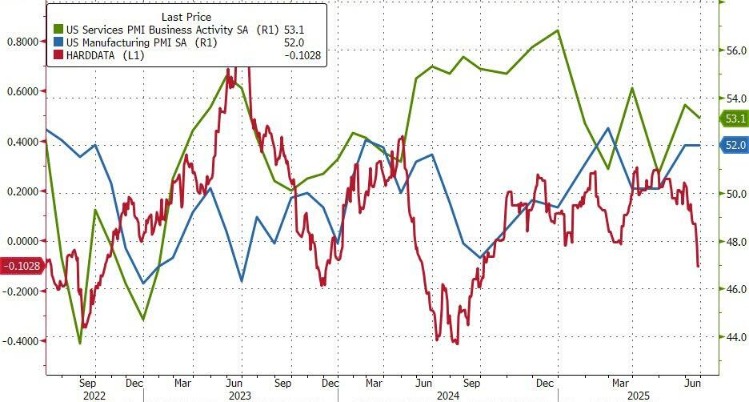
美国6月标普全球服务业PMI初值录得53.1,综合PMI初值录得52.8,均为两个月低位。
news flash· 2025-06-23 13:51
Core Insights - The preliminary S&P Global Services PMI for June in the U.S. recorded at 53.1, indicating a slowdown in the services sector [1] - The composite PMI preliminary value stood at 52.8, marking a two-month low for both indices [1] Summary by Category - **Economic Indicators** - The services PMI reflects a deceleration in growth, with a reading of 53.1 [1] - The composite PMI, which includes both services and manufacturing, is at 52.8, also a two-month low [1]
德法拖后腿,欧元区6月服务业PMI创今年新低,制造业PMI深陷收缩
Hua Er Jie Jian Wen· 2025-06-23 09:38
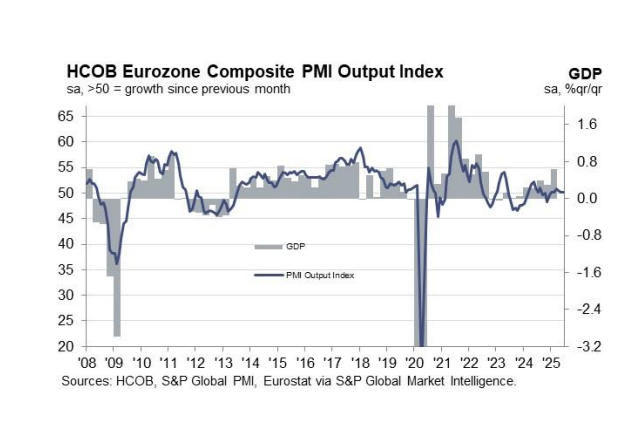
Core Viewpoint - The Eurozone's composite PMI fell to 50.8 in June from 52.2 in May, marking a five-month low and below analysts' expectations of 50.5, indicating a challenging economic environment [1][4]. Economic Performance - The services PMI dropped to 51.3 in June, the lowest level this year, down from 53.1 in May, reflecting a slowdown in new orders and business confidence [5]. - The manufacturing PMI remained in contraction at 46.5, slightly improving from 46.1 in May, but still well below the 50 mark, indicating ongoing demand weakness [8]. Country-Specific Insights - Germany's composite PMI fell to 49.8 in June from 52.4 in May, indicating significant economic challenges, with both services and manufacturing sectors showing weakness [9]. - France's economic performance deteriorated further, with a composite PMI of 45.7 in June, down from 48.9 in May, indicating deep recessions in both services and manufacturing sectors [10]. Economic Outlook - Analysts suggest that the Eurozone economy may face greater pressure in the latter part of the year due to weak consumer confidence and inflation remaining above the ECB's 2% target [12]. - The ECB's recent rate cuts may limit further monetary easing, as inflation has recently dropped below the target, and the central bank is expected to pause further rate reductions [12].
受制造业复苏推动 德国6月商业活动恢复增长
news flash· 2025-06-23 07:38
Core Insights - Germany's business activity has shown signs of recovery in June, driven by a resurgence in the manufacturing sector, with new orders increasing at the highest rate in over three years [1] - Four German economic research institutes have revised their forecasts for 2025, now expecting economic growth after two consecutive years of contraction [1] - Despite the overall recovery, the service sector continues to experience a slowdown, although at a reduced pace compared to previous months [1]