
电商

Search documents
京东成立“变色龙业务部”
第一财经· 2026-01-10 02:23
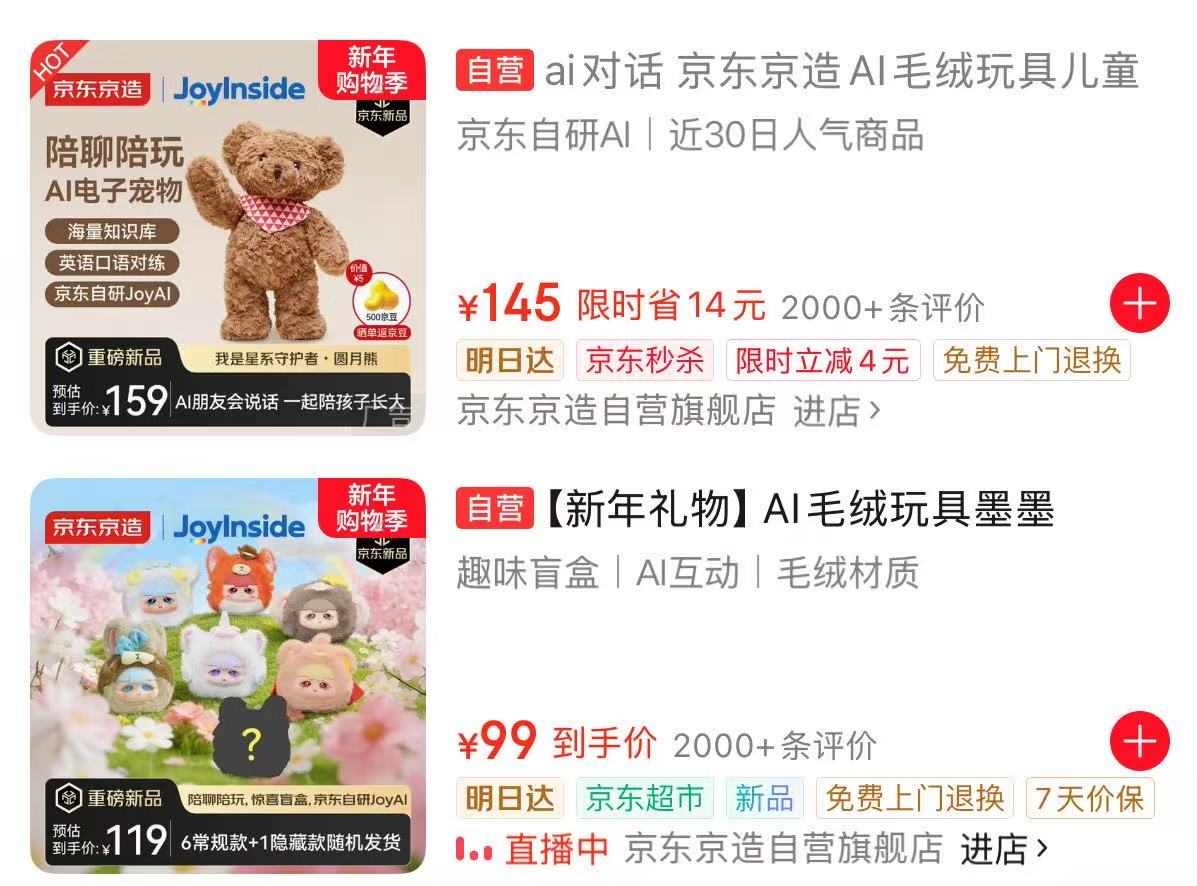
Core Viewpoint - JD.com has established the "Chameleon Business Unit" to enhance the development and commercialization of AI products, marking a significant shift in its AI strategy from research to business application [3][5]. Group 1: AI Strategy and Business Development - The establishment of the Chameleon Business Unit signals JD.com's transition of its AI strategy from technical capability to a commercial business, focusing on digital humans, JoyAI, and JoyInside [5]. - JD.com plans to leverage its own brand to connect directly with manufacturing, aiming to reduce costs and gain pricing advantages through efficient resource allocation [3][5]. - The company has increased its R&D spending, with a 28.4% year-on-year growth to 5.6 billion yuan, representing 1.9% of its revenue in Q3 2025 [5]. Group 2: AI Applications and Digital Humans - AI toys and digital humans are identified as key commercial scenarios for JD.com's AI capabilities [6]. - The cost of producing a digital human has decreased by over 90%, from tens of thousands of yuan to double digits, thanks to advancements in model training [6][7]. - During the Double 11 shopping festival, the number of merchants using digital human live streaming increased nearly sixfold, contributing hundreds of billions in GMV since 2025 [7]. Group 3: AI Toys Market - JD.com has launched a series of AI toy products since November 2022, with significant sales figures, including over 4,000 units of a toy series and 8,000 units of the JoyInside chess robot [9][11]. - The AI toy market is projected to grow rapidly, with sales of AI robots, trendy toys, and educational toys expected to increase by 124.6%, 798.7%, and 473.7% respectively from 2024 to 2025 [12]. - JD.com aims to differentiate itself in the AI toy market by addressing challenges such as product homogeneity and high return rates, leveraging cost-effectiveness and rapid product iteration [11][12].


京东升级“变色龙”,发出AI落地信号
Di Yi Cai Jing· 2026-01-10 01:54
Core Insights - JD.com has established the "Chameleon Business Unit" to enhance the development and commercialization of AI products, including JoyAI App and digital humans, indicating a strategic shift towards AI integration in its business model [1][2] - The formation of the Chameleon Business Unit signals that JD.com's AI strategy is transitioning from research and development to commercial application, focusing on multimodal AI tools and digital human technologies [2][3] Group 1: AI Product Development - The Chameleon Business Unit aims to accelerate the development of AI products, leveraging self-developed products for rapid iteration and user data accumulation to optimize large models [1][2] - JD.com has seen a significant increase in R&D spending, with a 28.4% year-on-year growth to 5.6 billion yuan, reflecting its commitment to AI technology [2] Group 2: Digital Human Applications - JD.com's digital humans are being utilized across various scenarios, including live streaming, customer service, and brand endorsements, with production costs significantly reduced by over 90% compared to traditional methods [5][6] - The number of merchants using digital humans for live streaming has increased nearly sixfold during the Double 11 shopping festival, contributing hundreds of billions in GMV [6] Group 3: AI Toy Market - JD.com has entered the AI toy market, launching several AI toy products since November, with notable sales figures, including over 4,000 units of a toy series and 8,000 units of the JoyInside chess robot [7][10] - The AI toy sector is projected to experience substantial growth, with sales of AI robots, trendy toys, and educational toys expected to increase significantly in the coming years [10][11] Group 4: Competitive Landscape and Challenges - The AI toy market faces challenges such as product homogeneity and high return rates, necessitating innovation and differentiation for companies entering this space [11] - JD.com aims to leverage cost advantages and rapid product iteration to establish a competitive edge in the AI toy market, collaborating with over 40 leading brands to enhance its technology platform [11]
深夜英特尔狂飙超8% 中概股下挫 油价、白银拉升
2 1 Shi Ji Jing Ji Bao Dao· 2026-01-09 16:11
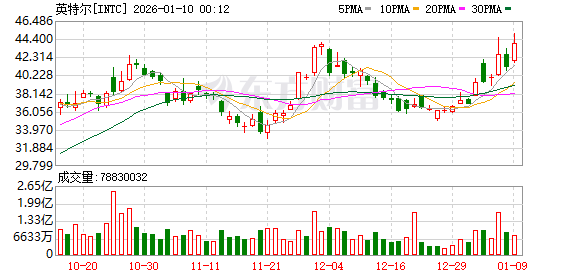
Market Overview - The US stock market opened higher on January 9, with the Dow Jones up 0.35%, S&P 500 up 0.52%, and Nasdaq up 0.65% [2] - Major technology stocks showed mixed performance, with Intel rising over 8%, reaching a new intraday high since April 2024 [4] Technology Sector - Intel's stock price increased by 8.29%, reaching $44.52 [5] - Other tech stocks included Google (up 0.99%), Tesla (up 0.54%), and Facebook (up 0.01%), while Apple, Nvidia, Microsoft, and Amazon saw slight declines [5] - Chinese stocks listed in the US faced declines, with the Nasdaq Golden Dragon China Index dropping nearly 1.4%, and companies like Alibaba and XPeng Motors falling over 3% [5] Commodity Market - International gold prices saw a short-term increase, with spot gold rising by 0.4% to $4,495.7 per ounce, and silver increasing by 2.97% to $79.18 per ounce [6] - The overall trend for silver remains bullish despite short-term volatility, influenced by global market instability and expectations of Federal Reserve rate cuts [6] Oil Market - International oil prices rose, with WTI crude oil increasing by 2.41% to $59.15 per barrel, and Brent crude oil up by 2.02% to $63.24 per barrel [8] Employment Data - In December, the US non-farm payrolls increased by 50,000, below the expected 70,000, with the unemployment rate at 4.4% [10] - The total employment increase for 2025 was only 584,000, marking the weakest annual growth since 2020 [10] - Following the employment report, traders are betting that the Federal Reserve will pause interest rate cuts, with expectations of a cumulative reduction of about 50 basis points by 2026 [10] Geopolitical Developments - The US Southern Command confirmed a joint operation with the Department of Homeland Security to seize the "Olina" oil tanker in the Caribbean, marking the fifth interception of Venezuelan oil transport vessels in recent weeks [10] - The US Energy Secretary announced plans to adjust policies to allow US oil companies to operate in Venezuela [10]

亚马逊药房将销售诺和诺德口服减重药
Xin Lang Cai Jing· 2026-01-09 14:34
亚马逊1月9日公告称,亚马逊药房(Amazon Pharmacy)作为一家提供全流程服务的数字药房,可将药 品直接配送至客户家中。现已通过多项保险计划及现金支付选项,提供诺和诺德公司的Wegovy®口服 药,这是美国食品药品监督管理局(FDA)批准的首款且唯一用于体重管理的口服GLP-1药物。符合条 件的商业保险客户每月支付25美元即可获得一个月用量,而无保险客户可通过现金支付方案获取 Wegovy®,每月起价149美元。 ...
阿里Q4财报前瞻:AI云保持强劲增长,淘闪大幅减亏
Hua Er Jie Jian Wen· 2026-01-09 12:00
Core Insights - The consensus on Wall Street is clear: despite macro headwinds facing its core e-commerce business, Alibaba is undergoing a profound transformation driven by accelerated cloud business and AI capital expenditures [1] - Analysts expect Alibaba Cloud to experience explosive revenue growth driven by AI demand, solidifying its position as China's leading AI enabler [1][2] - The "Quick Commerce" business under the "Taotian" group is making significant progress in loss control, indicating a balance between market share and profitability [1] Cloud Intelligence and AI Business - Alibaba Cloud is expected to be the highlight in the upcoming financial report, with revenue growth projected to exceed 35%, up from 34% in the previous quarter, and potentially accelerating to 40% by FY2027 [2] - Continuous investment in AI and the rollout of consumer applications are driving this growth, with significant upgrades to products like Qwen APP and Quark [2] - Analysts believe this will mark the ninth consecutive quarter of revenue growth acceleration for Alibaba Cloud, with current forecasts possibly being conservative [2] Profitability Analysis - Alibaba Cloud is expected to maintain a stable EBITA margin of around 9%, indicating effective cost control alongside rapid revenue expansion [3] - The overall adjusted EBITA is projected to decline by 45% to 30 billion RMB, but this reflects a strategy of "exchanging short-term profits for long-term barriers" [5] - The losses in the instant retail segment are expected to narrow significantly, from 35 billion RMB in the previous quarter to 23 billion RMB, showing management's commitment to efficiency [5] Core E-commerce Business - Concerns about the slowdown in the core e-commerce business are attributed to short-term macroeconomic fluctuations rather than a loss of competitiveness [4] - The growth of the core e-commerce business is expected to slow to 3% due to a high base effect from the software service fee introduced last year [4] - Despite a challenging environment, Alibaba's market share in the core e-commerce sector remains relatively stable, indicating resilience [4] Valuation and Outlook - Morgan Stanley has lowered its adjusted EBITA expectations for FY2026 and FY2027 by 7% and 15%, respectively, and reduced the target price from $200 to $180, but maintains a bullish outlook [7] - Barclays retains a target price of $195, emphasizing Alibaba's attractiveness as a leading AI story in China [7] - The current stock price reflects expectations of consumer weakness but does not fully account for the acceleration in cloud business and improvements in loss-making segments [7]

每周回顾 沪指16连阳突破4100点;2025年公募基金自购5600亿元
Sou Hu Cai Jing· 2026-01-09 08:40
Economic Indicators - In December, the Consumer Price Index (CPI) increased by 0.2% month-on-month and 0.8% year-on-year, with the core CPI (excluding food and energy) rising by 1.2% year-on-year [1] - The Producer Price Index (PPI) rose by 0.2% month-on-month but decreased by 1.9% year-on-year [1] Stock Market Performance - The Shanghai Composite Index (SSE) experienced a 16-day consecutive rise, closing at 4120.43 points, marking a ten-year high, with total trading volume exceeding 3 trillion yuan [1] - Several brokerage firms expressed optimistic expectations for the stock market in 2026, with CITIC Securities predicting a 5%-10% increase in the full-year performance of the market [1] Commodity Market Regulation - The Shanghai Futures Exchange implemented a series of regulatory measures to cool down the overheating silver futures market, including risk warnings, trading limit adjustments, and margin changes [1] Semiconductor Market Trends - The price of memory chips has surged, with some DDR5 server memory modules priced at over 40,000 yuan each, leading to comparisons with real estate prices in Shanghai [2] - The global demand for AI computing power has created a severe supply-demand imbalance in the memory semiconductor market, prompting significant price increases [2] Corporate Developments - Vanke A announced the retirement of its executive vice president, Yu Liang, who will no longer hold any position within the company [3] - Alibaba plans to increase investment in Taobao Flash Sale in 2026, aiming to become the market leader [4] Fund Industry Insights - Public funds in China engaged in a large-scale self-investment action in 2025, with total self-purchase transactions reaching 562.66 billion yuan, a 51.8% increase from 2024 [5] - Non-monetary public fund self-purchases amounted to 9.34 billion yuan, a 130% increase from the previous year, with bond funds being the primary focus [5][6] IPO Activity - Unigroup Guoxin has entered the counseling phase for its IPO, reflecting a new wave of interest in storage chips driven by AI [6] - MiniMax, an AI model company, successfully listed on the Hong Kong Stock Exchange, achieving a market capitalization exceeding 80 billion HKD [7] - The snack brand "Mingming Hen Mang" is planning to raise 400-500 million USD through an IPO, with significant growth in transaction volume and profit reported [8]
别低估了,淘宝闪购这一战的决心
Feng Huang Wang· 2026-01-09 08:35
Core Viewpoint - Alibaba is determined to lead the next retail revolution by significantly increasing its investment in instant retail, with a goal of market share growth by 2026 [2][4][18] Group 1: Strategic Importance of Instant Retail - The battle for instant retail is not just a business competition but a critical fight for Alibaba's future business model [5][9] - Instant retail is seen as a necessary response to the saturation of traditional e-commerce growth, with consumer demand for immediacy rapidly increasing [6] - Failure in this sector could result in Alibaba losing not just a business segment but also its influence in the evolving consumer landscape [9] Group 2: Investment Strategy - Alibaba plans to invest in three key dimensions to enhance its competitive edge: improving user and order value, expanding product categories, and optimizing fulfillment experiences [10][11] - The focus is on elevating the perception of instant retail from low-value delivery services to high-quality consumer experiences [11] - By integrating its extensive supply chain from Tmall and Hema, Alibaba aims to create a differentiated advantage in instant retail [15][17] Group 3: Efficiency and Long-term Vision - Despite a reported loss of approximately 20 billion yuan in the fourth quarter, Alibaba's loss reduction is outpacing competitors, indicating a strategic approach to spending [8][14] - The company is leveraging data and technology to ensure that every subsidy is effectively directed towards improving business fundamentals [8][14] - Alibaba's long-term strategy involves transforming instant retail into a service-oriented model, which is seen as a calculated investment for future growth [8][14][18] Group 4: Competitive Advantages - Alibaba's unique supply chain integration provides a significant barrier to entry for competitors, making it difficult for them to replicate its model [15][17] - The synergy between its physical retail networks and instant delivery capabilities enhances operational efficiency and product variety [17] - The shared consumer data across platforms allows for precise inventory management and targeted marketing, creating a more responsive retail environment [17]

小摩:对阿里巴巴-W(09988)未来6至12个月交易前景持建设性看法 建议增持股票
智通财经网· 2026-01-09 07:05
Group 1 - Morgan Stanley maintains an optimistic outlook on Alibaba's (09988) trading prospects for the next 6 to 12 months, recommending to overweight the stock as it is expected to overcome short-term profit pressures [1] - The target price for Alibaba's US stock is lowered from $230 to $215, based on a 16x price-to-earnings ratio for the fiscal year 2028, while the Hong Kong target price is adjusted from HKD 225 to HKD 210 [1] - Despite short-term profit margin pressures due to increased investments in food delivery, instant retail, and generative AI applications, these negative factors are gradually being understood by the market, with investment pace largely dependent on management's self-regulation [1] Group 2 - Earnings per share forecasts for Alibaba for 2027 and 2028 are reduced by 15% and 7% respectively, reflecting increased investment in user acquisition for food delivery, instant retail, and generative AI applications, alongside weakened monetization capabilities in the domestic e-commerce sector due to soft consumer demand [2] - It is anticipated that profit margins may have further downside potential in the coming quarters as these adverse factors continue to unfold, leading to a more differentiated and potentially volatile trading style [2]
全球品牌大事记(2025年12月)
Sou Hu Cai Jing· 2026-01-09 04:22
Group 1: Amazon's Rapid Delivery Service - Amazon launched the AmazonNow ultra-fast delivery service in Seattle and Philadelphia, promising delivery within 30 minutes for Prime members at a fee of $3.99, significantly lower than the previous $15 order threshold [4] - This service aims to reshape urban commercial geography by accelerating the online transition of convenience stores and pharmacies, leveraging Amazon's logistics network to enhance delivery speed and consolidate its brand goal of "everything fast" [4] Group 2: TikTok's Investment in Latin America - TikTok announced a $37.7 billion investment to build a large-scale data center in Brazil, supported by local renewable energy, establishing a dual hub with an operational center in Mexico [5] - This investment aims to create a regional brand barrier and ecosystem control, leveraging user engagement metrics to potentially increase cloud service revenue [5] Group 3: Google's AI Search Engine - Google integrated the Gemini 3 model into its search engine, offering free AI search services to nearly 120 countries, with a monthly active user base exceeding 650 million [6] - The company is building a monopoly triangle of "search entry - cloud services - hardware," aiming to transform from an "information indexing tool" to a "task-executing intelligent agent" [6] Group 4: Elon Musk's Wealth and Business Empire - Elon Musk's net worth reached $684.3 billion, with SpaceX's valuation doubling to $800 billion, making it a core wealth engine alongside Tesla and xAI [7] - Musk's wealth growth reflects a paradigm shift in capital logic, with SpaceX, AI, and energy sectors creating a unique competitive moat that traditional industries struggle to replicate [7] Group 5: Apple's Foldable Phone Strategy - Apple plans to release at least seven new models by 2027, including its first foldable iPhone, priced around $2,500, to combat stagnation in growth [8] - The success of the foldable iPhone is critical, as it faces challenges such as high pricing and unresolved hinge reliability issues, which could dilute brand value if not executed successfully [8] Group 6: NASA's Lunar Mission Challenges - NASA's Artemis program faces significant delays, with key components lagging behind schedule, increasing reliance on SpaceX for lunar landing capabilities [9] - This situation enhances SpaceX's strategic value and bargaining power, marking a shift in commercial space branding from supplementary to core roles [9] Group 7: Mercedes-Benz Emission Scandal - Mercedes-Benz reached a settlement of $149.6 million over emissions cheating allegations, highlighting systemic compliance issues within German automakers [10] - The scandal threatens to damage the brand's reputation and could impact the collective brand equity of German automotive engineering, especially against electric vehicle competitors [10] Group 8: Meta's Shift from Metaverse to AI - Meta plans to cut its metaverse project budget by up to 30%, redirecting focus towards AI hardware and applications [11] - This strategic pivot reflects a response to market pressures and competition, aiming to create AI-driven immersive experiences while still maintaining some metaverse elements [11] Group 9: LG's New Gallery TV - LG is set to launch the Gallery TV, featuring a wall-mounted design and customizable frames, targeting the high-end home decor market [12] - The success of this product will depend on partnerships with museums and digital art platforms, as well as consumer willingness to pay for non-standardized designs [12] Group 10: BYD Surpassing Tesla in EV Sales - BYD's sales surpassed Tesla's for the first time, with Tesla reporting a 15.6% decline in Q4 2025 deliveries [13] - Tesla's reliance on a universal product strategy is being challenged by local competitors like BYD, which are leveraging localized supply chains and digital services to gain market advantages [13]




中国互联网广告营销趋势报告:AI正在彻底重构消费者决策路径
Cai Jing Wang· 2026-01-09 03:48
Core Insights - AI is fundamentally reshaping consumer decision-making paths, leading to a significant shift in marketing focus [1] - The report highlights that the deepening development and mature application of AI technology is a critical breakthrough for "data-driven" advertising marketing [1] Group 1: Consumer Decision Logic - Consumer decision logic is being fundamentally restructured from "passive search" to "active trust in AI recommendations" [1] - Marketing competition is shifting from keyword ranking to optimizing structured information that AI can recognize and assess as high value [1] Group 2: Content Production - Content production is undergoing a revolution, transitioning from "labor-intensive creativity" to "AI-driven large-scale creation and real-time optimization" [2] - AI can analyze user characteristics, scenarios, intentions, and even real-time emotions to select or generate personalized creative variations, achieving a significant increase in creative output [2] Group 3: Consumer Insights and Measurement - Consumer insights and measurement are evolving from "fuzzy attribution" to "full-link visualization and emotional computation" [2] - AI enables real-time analysis of user dynamic needs, preferences, and search intentions, facilitating a coherent and personalized experience across fragmented scenarios [2] Group 4: Short Video and E-commerce - The "short video+" model is rapidly evolving, restructuring the competitive landscape of the e-commerce industry [3] - Video information flow advertising has seen an 18.85% year-on-year growth, becoming the fastest-growing advertising format [3] Group 5: Market Growth Projections - The Chinese internet advertising market is projected to grow steadily at a rate of 11.5%, reaching a scale of 725.7 billion yuan by 2025 [3] - E-commerce advertising continues to lead with a market share of 38.55%, with interest-based e-commerce growing by 18.9% year-on-year [3] - The report predicts that the Chinese internet advertising market could exceed 900 billion yuan by 2026, driven by "agent-based AI" and "full-scene integration" [3]