即时零售

Search documents
美团宣布暂停“团好货”,此前曾多年尝试用外卖导流电商
第一财经· 2025-12-15 12:46
Core Viewpoint - Meituan's "Tuan Hao Huo" business has been suspended to focus on exploring new retail formats, reflecting a strategic shift in response to market changes [3][7]. Group 1: Business Strategy - Meituan's e-commerce strategy is evolving towards instant retail while downplaying traditional express e-commerce [7]. - The company aims to adapt to trends and actively seek changes in its business model [7]. - The suspension of "Tuan Hao Huo" will involve internal communication regarding the future plans for affected personnel [7]. Group 2: Financial Performance - Meituan's new business segments, including grocery retail, reported strong growth with revenues reaching 28 billion yuan, a year-on-year increase of 15.9% [7]. - Instant retail saw a peak of over 150 million daily orders in July, with more low-frequency users transitioning to high-frequency usage [7]. Group 3: Market Trends - Instant retail is gaining traction, with sales during this year's Double 11 shopping festival reaching 67 billion yuan, a 138.4% year-on-year increase [8]. - The growth in instant retail is driven by high-frequency purchases that stimulate lower-frequency buying, breaking through growth bottlenecks [8]. - Major brands are increasingly entering instant retail platforms, as evidenced by the participation of over ten thousand stores during the recent Double 11 event [8]. Group 4: Industry Insights - The rise of instant retail signifies a new phase in e-commerce competition, blending "far-field + near-field" strategies [9]. - Traditional e-commerce must enhance last-mile delivery capabilities, while local businesses leverage instant retail to challenge traditional e-commerce supply chain resilience [9].


美团暂停「团好货」业务,外卖员揽不动快递的活?
Tai Mei Ti A P P· 2025-12-15 11:45
Core Insights - Meituan has announced the suspension of its group buying business, Tuan Haohuo, shifting its strategic focus towards exploring new retail formats [1][9] - The decision reflects a recognition of the challenges faced in the fast-evolving grocery retail sector, where existing delivery models fail to meet the demand for instant retail [1][6] Business Overview - Tuan Haohuo was launched in August 2020 to compete with Pinduoduo, aiming to leverage Meituan's extensive user base and low-cost offerings to penetrate the lower-tier market [2][3] - Initially, Tuan Haohuo showed promising growth, with its GMV nearly tripling year-on-year in the first half of 2021, but later struggled to maintain its competitive edge [3][4] Strategic Challenges - The business faced strategic ambiguity, transitioning from a low-price model to a quality-focused approach, which resulted in a confusing market position [3][4] - Tuan Haohuo's average order value was only 17.5 yuan, indicating a reliance on low-cost, private-label products, which did not differentiate it from competitors like Pinduoduo [4][5] Market Dynamics - Meituan's core business model is built on local services and instant delivery, which contrasts sharply with Tuan Haohuo's logistics model that relied on a national express network [6][7] - The mismatch between user expectations for immediate delivery and Tuan Haohuo's slower fulfillment process led to a decline in user engagement [7][8] Strategic Refocus - The suspension of Tuan Haohuo is seen as a strategic pivot for Meituan, allowing the company to concentrate resources on its core strengths in instant retail, exemplified by Meituan Flash Purchase and Xiaoxiang Supermarket [9][10] - Meituan aims to leverage its existing logistics network and partnerships to enhance its position in the rapidly growing instant retail market, which is projected to capture significant market share [10][11] Competitive Landscape - The decision to exit Tuan Haohuo aligns with Meituan's strategy to avoid inefficient competition in the long-distance e-commerce space dominated by Alibaba, focusing instead on its strengths in local retail [11][12] - The company is positioning itself to build a robust ecosystem by integrating local merchants into its supply chain, enhancing its competitive advantage in the "30-minute economy" [11][12]
从“只送吃的”到“什么都能送”:淘宝闪购背后的消费新趋势
Sou Hu Cai Jing· 2025-12-15 09:13
Core Insights - The rebranding of "Ele.me" to "Taobao Flash Purchase" signifies a shift in consumer expectations and habits towards instant retail, moving beyond just food delivery [5][12] - Instant retail has become a habit for consumers, as they increasingly rely on delivery services for various everyday needs, not just meals [2][4] Group 1: Changes in Consumer Behavior - Consumers now use instant delivery for a variety of products, such as stationery, cleaning supplies, and even medications, indicating a broader acceptance of delivery services [2][3][4] - The name change reflects a transition from a focus solely on food to a more comprehensive service that addresses immediate consumer needs [5][7] Group 2: Implications for Users - The rebranding centralizes the entry point for consumers, making it easier to remember and access the service for various products [9] - There is a shift in consumer expectations regarding delivery times, with an increasing emphasis on same-day delivery and quick service [9] Group 3: Challenges for Businesses and Platforms - The expansion of delivery categories from food to a wide range of products presents new challenges for businesses, including managing inventory, pricing, and delivery logistics [11] - Companies must adapt to a new competitive landscape where reliability and speed are critical, moving from a focus on speed to maintaining service quality [11] Group 4: Industry Reflection - The rebranding prompts a reevaluation of what instant delivery services can offer, pushing platforms to consider which products are suitable for immediate delivery and how to handle potential issues [12] - This change marks a significant shift in the industry, positioning instant delivery as a primary option for various consumer needs beyond just meal delivery [12]
美团宣布暂停“团好货”
第一财经· 2025-12-15 08:43
Core Viewpoint - Meituan has decided to suspend its "Tuan Hao Huo" business to focus on exploring new retail formats, reflecting a strategic shift in its e-commerce approach towards instant retail and away from traditional delivery e-commerce [3][7]. Group 1: Business Strategy - Tuan Hao Huo, a B2C e-commerce initiative launched by Meituan in August 2020, has been rebranded as Meituan E-commerce and is being phased out as the company pivots towards instant retail [7]. - The decision to suspend Tuan Hao Huo is part of Meituan's broader strategy to adapt to the evolving grocery retail landscape, which has seen significant innovation and growth [7]. - Meituan's third-quarter financial report indicates strong growth in new business segments, with revenue reaching 28 billion yuan, a year-on-year increase of 15.9% [7]. Group 2: Market Trends - The instant retail sector is gaining traction, with data showing that sales during this year's Double 11 shopping festival reached 67 billion yuan, marking a 138.4% increase year-on-year [8]. - Meituan's flash purchase platform has seen record highs in transaction volume and user engagement during the Double 11 period, with average consumer spending increasing by nearly 30% [8]. - The entry of numerous brands into instant retail platforms signifies a shift in the e-commerce landscape, where traditional e-commerce must enhance last-mile delivery capabilities to remain competitive [9].
美团暂停“团好货” 曾尝试用外卖导流电商
Bei Jing Shang Bao· 2025-12-15 05:10
Core Insights - Meituan has decided to suspend its "Tuan Hao Huo" business to focus on exploring new retail formats, indicating a strategic shift in its operations [2] Group 1: Business Overview - "Tuan Hao Huo" was launched in August 2020 as a B2C e-commerce initiative and was later integrated into the Meituan app as a primary entry point [2] - The business aimed to accumulate experience in product retail but faced challenges in meeting the demands of instant retail users in the evolving grocery retail sector [2] Group 2: Strategic Shift - Since 2025, Meituan has been intensifying its exploration of new retail formats, aiming for a strategic transformation in retail [2] - In June, Meituan announced plans to expand its instant retail offerings, including the continued diversification of its flash purchase business and the gradual expansion of "Xiang Supermarket" to all first- and second-tier cities [2] - Currently, "Xiang Supermarket" has established a service network covering over 30 cities, including major urban centers like Beijing, Shanghai, Guangzhou, and Shenzhen [2]
饿了么的“橙色”新生:阿里的即时零售新棋局
Sou Hu Cai Jing· 2025-12-13 03:52
Core Insights - Alibaba is integrating Ele.me with Taobao Flash Purchase, marking a significant move in the instant retail sector, showcasing strong organizational synergy and combat effectiveness [2] - Taobao Flash Purchase achieved a peak of 120 million daily orders in August, with 300 million monthly active buyers, indicating a shift from quantity to quality [2] - Morgan Stanley reports that Alibaba's market share in China's food delivery market has risen to 42%, reflecting the strategic value of the Ele.me and Taobao combination [2] Group 1: Strategic Moves - The upgrade of Ele.me to Taobao Flash Purchase signifies a transition from single-point competition in food delivery to a comprehensive instant service model under Alibaba's consumer platform strategy [2][11] - The integration is seen as a necessary evolution in the instant retail industry, aligning with the shift from "single-point delivery" to "full-domain instant service" [2][11] - The strategic investment from Alibaba aims to break the previous growth constraints faced by Ele.me, allowing for a more robust competitive stance against rivals [7][10] Group 2: Technological Advancements - Ele.me has adopted AI technology to enhance operational efficiency, transitioning from traditional methods to a tech-driven model, which includes the development of the "Holo Shield" system for compliance and the AI assistant "Xiao E" for delivery optimization [5] - The platform's service capabilities have expanded beyond food delivery to include a wide range of products, indicating readiness for a seamless integration with Taobao Flash Purchase [6] Group 3: Market Positioning - The rebranding to Taobao Flash Purchase is viewed as a strategic move to capture consumer mindshare in the instant retail space, leveraging Alibaba's financial resources for user acquisition and retention [7][8] - The collaboration between Ele.me and Taobao is expected to enhance the service chain, transforming traditional e-commerce delivery from next-day to hourly delivery [8][10] Group 4: Future Directions - The upgrade is not merely a rebranding but a strategic alignment with Alibaba's broader consumer ecosystem, positioning Ele.me as a critical infrastructure component for the company's future growth [13][14] - The focus on high-frequency consumer categories, such as pharmaceuticals and convenience goods, is essential for driving growth in the instant retail sector [11][12]

即时零售迎“奇点”,巨头激战正酣
Zhong Guo Ji Jin Bao· 2025-12-11 08:32
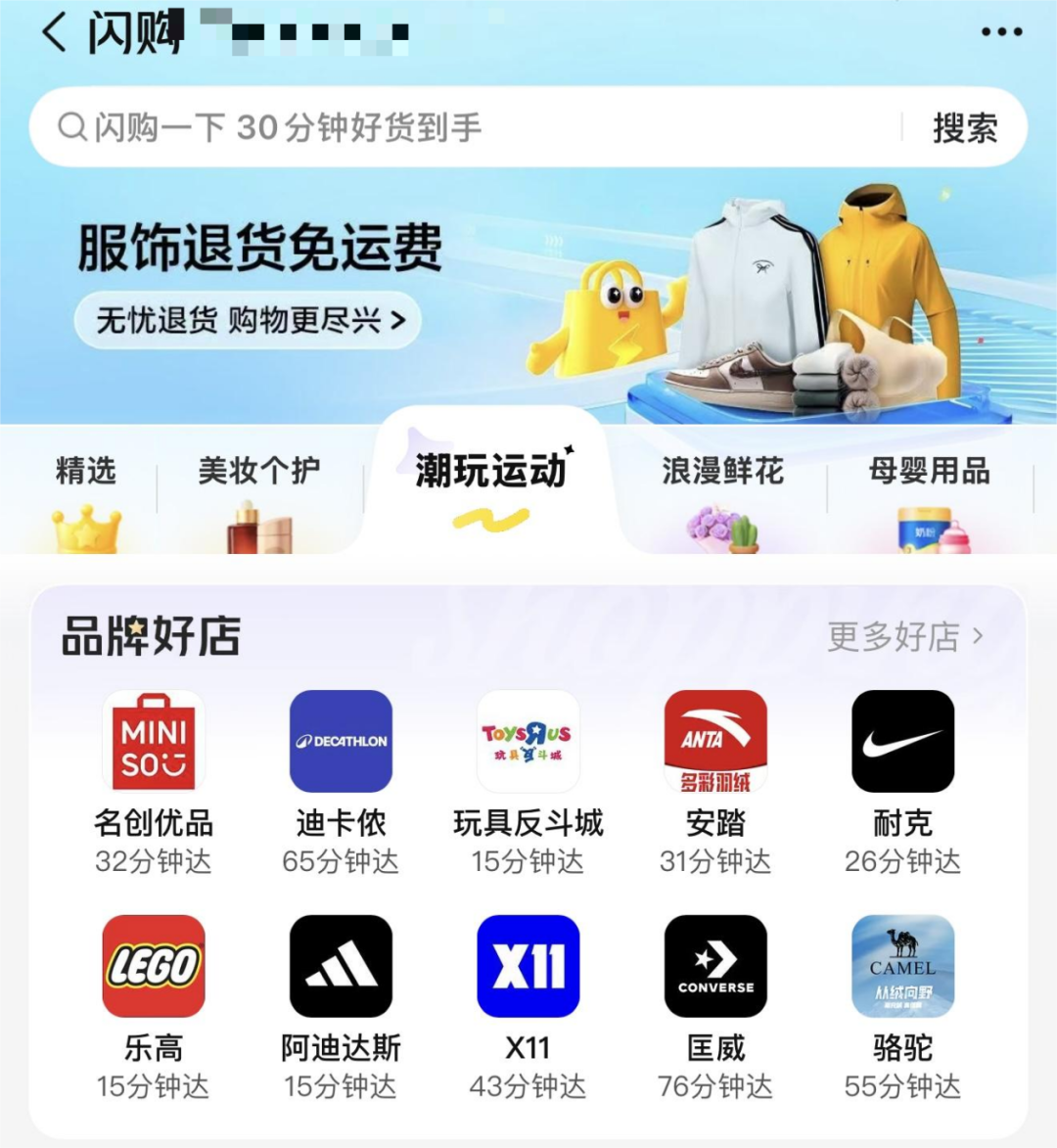
Core Insights - The instant retail market is projected to reach 971.4 billion yuan by 2025, with a year-on-year growth of 24.4%, nearing the trillion yuan mark [1][3] - Major e-commerce platforms are heavily investing in instant retail, with Alibaba, JD, and Meituan collectively spending nearly 60 billion yuan in Q3 this year [3] - Instant retail is evolving from a decade-long journey of O2O and community group buying to a more robust business model that emphasizes speed and convenience [3][4] Market Expansion - The instant retail industry is experiencing rapid growth, with expectations to hit 2 trillion yuan by 2030, maintaining a compound annual growth rate of 25% [3] - The shift towards instant retail is reshaping investment values in sectors like beauty, apparel, and food and beverage [2][3] Consumer Behavior - The "post-95" generation prioritizes delivery speed, with over 50% wanting same-day or even half-day delivery, indicating a strong demand for instant retail services [3][4] - Instant retail aligns with the consumer desire for immediate gratification, enhancing the shopping experience for younger demographics [4] Channel Transformation - The beauty and personal care sector is rapidly adopting instant retail due to its product characteristics, such as high price points and urgent demand scenarios [5] - Sportswear brands like Li Ning and Anta are also entering the instant retail space, leveraging local store networks for quick delivery [5][7] Operational Innovations - Qingdao Beer has successfully integrated instant retail, achieving a tenfold increase in GMV from 2 billion yuan to nearly 20 billion yuan in five years, with a compound annual growth rate exceeding 50% [8] - Instant retail is enabling traditional retail businesses to transition from a "goods and venue" mindset to an "instant service" model [9] Competitive Landscape - The instant retail market is currently characterized by intense competition, with major players engaged in a subsidy war that has led to significant cash flow challenges [11][12] - Despite increased sales through instant retail channels, many companies are struggling with profitability due to high platform fees and operational costs [12] Strategic Recommendations - Retail brands need to explore business models that are more compatible with instant retail and enhance their supply chain capabilities to thrive in this evolving landscape [12]

价值研究所|即时零售迎“奇点”,巨头激战正酣
Zhong Guo Ji Jin Bao· 2025-12-11 08:31
Core Insights - The instant retail market in China is projected to reach 971.4 billion yuan by 2025, with a year-on-year growth of 24.4%, nearing the trillion yuan mark [2][3] - Major e-commerce platforms are heavily investing in instant retail, with Alibaba, JD, and Meituan collectively spending nearly 60 billion yuan in the third quarter of this year [3] - The business model of instant retail, which focuses on rapid delivery from local warehouses, has evolved over the past decade and is now gaining traction among consumers, particularly the younger demographic [4][5] Market Expansion - The instant retail sector is expanding rapidly, with expectations to reach 2 trillion yuan by 2030, maintaining a compound annual growth rate of 25% [3] - Instant retail has transitioned from a focus on fresh produce to a broader range of products, including beauty and apparel, which are well-suited for quick delivery due to their high demand for timeliness [5][7] Consumer Behavior - The younger generation, particularly those born after 1995, prioritize delivery speed, with over 50% expecting same-day or even half-day delivery [3][4] - Instant retail aligns with the "immediate purchase and delivery" mindset of younger consumers, enhancing their shopping experience and brand loyalty [4] Channel Transformation - The shift towards instant retail is prompting a re-evaluation of market shares, with brands that embrace new channels likely to stand out [5] - Beauty products are among the fastest-growing categories in instant retail due to their high price points and urgent demand scenarios [5][7] Operational Innovations - Companies like Qingdao Beer have adapted their operations to leverage instant retail, achieving a nearly tenfold increase in gross merchandise volume (GMV) from 2 billion yuan to approximately 20 billion yuan over five years [8] - Instant retail is also enabling traditional retail businesses to transition from a "goods and venue" mindset to an "instant service" model, opening new growth avenues [8][10] Competitive Landscape - Despite the rapid growth, the instant retail sector is still in its early stages, with major players engaged in a subsidy war that raises questions about long-term profitability [10][11] - Retail brands face challenges from high platform fees and competition from e-commerce platforms that are also developing their own private label products, which can undermine traditional brands [11] Future Outlook - The future of retail is expected to be multi-faceted, with no single model completely replacing the others, as companies strive to find business models that fit the instant retail paradigm [11] - Companies that can enhance their supply chain responsiveness through digital transformation are likely to thrive in the instant retail era [11]

饿了么升级变橙:阿里锚定长期投入,淘宝闪购奔向即时零售王座
创业邦· 2025-12-11 04:50
Core Insights - The article discusses the significant transformation of Ele.me into Taobao Flash Purchase, highlighting the strategic shift in the instant retail sector driven by Alibaba's commitment and resources [3][10][19] - It emphasizes the impressive performance metrics of Taobao Flash Purchase, including a peak daily order volume of 120 million and a monthly active buyer count of 300 million in August, indicating a transition from quantity to quality [2][11] Group 1: Strategic Shift and Market Position - The upgrade of Ele.me to Taobao Flash Purchase signifies a strategic alignment with Alibaba's broader consumer platform strategy, moving from a standalone delivery service to a key component of a comprehensive instant retail ecosystem [3][10] - This transition is seen as a response to the competitive landscape, where Ele.me aims to leverage its delivery capabilities to enhance Alibaba's overall service offerings [9][15] - The integration of Ele.me into Alibaba's ecosystem allows for improved resource allocation and operational efficiency, breaking the previous cycle of limited growth due to resource constraints [13][19] Group 2: Technological Advancements - Ele.me's evolution is supported by the implementation of AI technologies, which have transformed traditional operational models into data-driven systems, enhancing delivery efficiency and reducing costs [7][8] - The introduction of AI tools, such as the "Holo Shield" system and the AI assistant "Xiao E," has improved compliance and operational effectiveness, positioning Ele.me at the forefront of innovation in the delivery sector [7][8] Group 3: Market Dynamics and Consumer Engagement - The article notes that the shift to Taobao Flash Purchase is not merely a rebranding but a strategic move to capture consumer mindshare in the instant retail space, where the term "flash purchase" has been popularized by competitors [10][18] - The focus on high-frequency consumer categories, such as pharmaceuticals and convenience goods, aligns with the evolving demands of the market, allowing for a more comprehensive service offering [16][18] - The integration of Ele.me's delivery network with Taobao's extensive merchant resources enhances the overall consumer experience, facilitating faster and more diverse delivery options [11][19]

从“应急”到“全场景”,可口可乐、李锦记正在即时零售 3.0 时代掘金新增长
Sou Hu Cai Jing· 2025-12-10 05:15
Core Insights - The instant retail industry in China is undergoing a significant "scene revolution," transitioning from a speed-driven model to a comprehensive scene-based approach, with the market expected to exceed 1 trillion yuan by 2025 [2][11] - Taobao Flash Purchase is leveraging innovative IP marketing and cross-ecosystem collaboration to create a new consumption paradigm that integrates content, scene, and instant fulfillment, providing brands with a new growth path [2][11] Industry Development Stages - Instant retail has evolved through three key phases: - Phase 1 (2014-2018): Focused on food delivery, addressing basic dining needs [4] - Phase 2 (2019-2024): Expanded to include a wide range of products, with "urgent purchases" becoming a core consumer pain point [4] - Phase 3 (2025 and beyond): Aims for "one-stop lifestyle services," extending beyond home delivery to include travel and outdoor needs, with a focus on emotional and situational satisfaction [4][10] User Engagement and Market Growth - Over 55% of users prefer instant retail due to its convenience and variety, with consumption habits evolving towards all-time, all-category, and all-scene engagement [3] - The monthly active users of instant retail apps have reached 551 million, with the market projected to surpass 1 trillion yuan by 2025 [2] Policy Support - The Chinese government has introduced policies to support the innovation of instant retail models, providing a favorable environment for high-quality industry development [2] Consumption Trends - The demand for instant retail is growing across various time frames, with significant increases in late-night orders during events like the UEFA European Championship [5] - Non-food categories are showing substantial growth, with single-use items and outdoor products seeing year-on-year increases of over 120% and 140%, respectively [5] Content-Driven Marketing - The "Flash Purchase Theater" IP connects video content with instant retail transactions, allowing users to order products while engaging with content, achieving delivery within 30 minutes [5][10] - Collaborative marketing efforts with brands like Coca-Cola and Lee Kum Kee have resulted in significant sales growth, with some campaigns achieving over 300% year-on-year increases in business [10][12] New Service Offerings - Taobao Flash Purchase has introduced tailored "Flash Packs" for different consumer needs, such as family outings and casual drinking, enhancing the convenience of on-the-go purchases [8][10] - The "24h Random Order" IP extends instant retail services beyond home to include hotels and parks, addressing the fragmented needs of consumers [10][11] Future Outlook - The future of instant retail will focus on scene insight rather than just product variety, with a shift towards comprehensive service ecosystems that meet users' immediate and fragmented needs [10][11] - The integration of instant retail with various external ecosystems will enhance emotional and situational value in transactions, positioning instant retail as a central service hub in daily life [11]