粮食

Search documents
Q2公募基金持仓解密:聪明钱已悄悄布局这些机会,你跟上了吗?
申万宏源证券上海北京西路营业部· 2025-08-12 02:00
Core Insights - The article highlights the investment strategies of fund managers in Q2, indicating a clear trend in their portfolio adjustments and signaling strong directional moves in certain sectors [1][2]. Group 1: Sector Focus - The technology sector continues to lead, with significant investments in areas such as 5G infrastructure and AI computing power, reflecting a robust demand and growth potential [3][4]. - The media sector shows a holding of 1.9%, with gaming and advertising segments attracting capital due to accelerated AI application deployment, leading to a performance explosion in the industry [4]. - The agricultural sector has a holding ratio of 1.6%, with a configuration coefficient of 1.36 times, indicating a positive outlook on the fundamentals of livestock and grain sectors [6]. Group 2: Defensive and Cyclical Sectors - The defense and military sector holds a 4.2% share, with geopolitical tensions enhancing the long-term investment logic in areas like aviation and ground equipment [6]. - The financial sector is experiencing a valuation recovery, with bank holdings increasing to 4.9%, driven by low valuations and high dividend yields, making it a leading performer in the market [7]. Group 3: ETF Trends - Passive funds, particularly ETFs, have seen significant inflows, with the CSI 300 and CSI 1000 ETFs increasing by 24.1 billion and 11.5 billion shares respectively, indicating a strong appetite for broad market exposure [8]. Group 4: Cautionary Signals - The electronics sector maintains a high holding of 18.8%, with over half in semiconductors, suggesting a crowded investment space that may face short-term adjustment risks [9]. - The wine sector shows a declining configuration coefficient of 0.54 times, indicating a potential exit signal from investors, necessitating caution against blind bottom-fishing [11]. - Significant reductions in holdings have been observed in the automotive, food and beverage, and power equipment sectors, with food and beverage holdings decreasing by 2.1 percentage points, highlighting fundamental pressures [13].

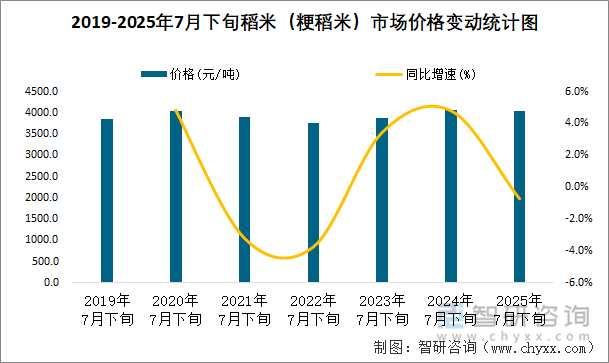
2019-2025年7月下旬稻米(粳稻米)市场价格变动统计分析
Chan Ye Xin Xi Wang· 2025-08-11 03:26
Group 1 - The core point of the article indicates that the market price of rice (specifically japonica rice) for processing purposes is projected to be 4042.3 yuan per ton in late July 2025, reflecting a year-on-year decrease of 0.73% and a month-on-month decrease of 0.04% [1] - The highest price recorded in the past five years for the same period was in late July 2024, reaching 4072 yuan per ton [1]
真相诡异,谁拿捏了韩国人的五花肉自由?
Hu Xiu· 2025-08-06 03:12
Core Insights - The term "Korean hot inflation" emerged in July 2025, indicating a significant rise in prices in South Korea, particularly affecting food items [1] - The video discusses the food crisis in South Korea, highlighting issues such as the inability of Koreans to afford pork belly and the theft of rice from Shandong, as well as the trend of raising pigs in Vietnam [1] Group 1 - The rise in food prices has led to a crisis where basic food items are becoming unaffordable for the average Korean [1] - The situation has prompted discussions about food security and agricultural practices in South Korea [1] - The video aims to provide a comprehensive understanding of the ongoing food crisis and its implications for the Korean economy [1]
第七届北京粮食行业职业技能竞赛收官
Xin Jing Bao· 2025-07-31 22:54
粮食安全是"国之大者",技能人才是保障粮食安全的坚实根基。北京市粮食和物资储备局局长柯永果表 示,举办行业技能竞赛是落实"人才兴粮"战略的重要举措,更是激励广大粮食行业从业者精进技能、担 当使命的生动实践。通过举办技能竞赛,激发全行业学技术、练本领的热情,培养更多懂技术、精业 务、能担当的粮食技能人才,为首都粮食安全筑牢人才屏障。 新京报讯 近日,2025年第七届北京粮食行业职业技能竞赛落幕,经过激烈角逐,竞赛评选出22个个 人、9个团体奖项,一批技艺精湛、表现突出的选手崭露头角。 本次竞赛由北京市粮食和物资储备局、北京市人力资源和社会保障局、北京首农食品集团有限公司联合 主办。大赛吸引了全市粮食行业多支代表队、近百名选手参赛。比赛紧扣粮食行业实际需求,设置(粮 油)仓储管理员、农产品食品检验员等关键岗位竞赛项目,全面考察选手的专业素养和实践能力。 作为北京粮食行业的重要赛事,北京粮食行业职业技能竞赛已成功举办七届。后续,北京将选拔出优秀 选手参加第七届全国粮食行业职业技能竞赛,并持续加大粮食行业技能人才培养力度,通过以赛促学、 以赛促练,推动更多"粮工巧匠"成长成才。 ...
巴西要求美国将粮食产品排除在特朗普威胁的50%关税之外。
news flash· 2025-07-29 19:23
Core Viewpoint - Brazil is requesting the United States to exempt agricultural products from the 50% tariffs threatened by Trump [1] Group 1 - Brazil's government is actively seeking to protect its agricultural exports from potential tariffs imposed by the U.S. [1] - The request highlights the ongoing trade tensions between Brazil and the United States, particularly in the agricultural sector [1] - The outcome of this request could significantly impact the pricing and availability of agricultural products in both countries [1]
实干争先年,向新而行:裕民县市监局开展粮食领域计量器具检查工作
Zhong Guo Shi Pin Wang· 2025-07-29 03:00
Group 1 - The core viewpoint of the news is the joint initiative by the Yumin County Market Supervision Administration and the Development and Reform Commission to conduct a special inspection of measuring instruments in the grain sector, aiming to enhance the fairness and quality of the grain market [1] - The special inspection covered key locations including grain purchasing points, storage facilities, flour processing plants, grain and oil wholesale markets, and large supermarkets, employing a collaborative model of "technical support + law enforcement + industry guidance" [1] - The inspection involved 5 law enforcement personnel, checked 5 grain operating entities, and verified 10 measuring instruments, effectively regulating the measurement order in the grain market [1] Group 2 - The Yumin County Market Supervision Administration plans to establish a long-term mechanism of "double random + key supervision," and will conduct follow-up inspections during the peak grain purchasing season while encouraging public supervision through the 12315 complaint reporting channel [2] - The Development and Reform Commission will enhance industry regulation in the grain circulation sector, promote the establishment of measurement credit files, and incorporate measurement violations into the enterprise credit evaluation system to create a punitive effect of "one violation, restrictions everywhere" [2]
全球动作!中国狂囤万吨黄金石油,西方秘密会议曝光
Sou Hu Cai Jing· 2025-07-25 01:34
Group 1 - China's gold reserves have increased for eight consecutive months, indicating a strong demand for gold despite high international prices [3][9] - In 2023, China imported over 540 million tons of crude oil, marking an 11% increase from the previous year, with significant purchases from Middle Eastern and Russian suppliers [3][9] - China's summer grain production exceeded 146 million tons, ensuring food security amid global market instability [5][12] Group 2 - Western countries are concerned about China's aggressive accumulation of commodities, which they believe could disrupt global market stability [7][11] - The U.S. is particularly wary of China's resource reserve strategy, viewing it as a systemic challenge to its economic dominance [9][11] - China's foreign exchange reserves exceed $3 trillion, with a significant portion being invested in gold, oil, and food supplies, contrasting with the U.S. gold reserve strategy [9][11]

舟山市围绕大宗商品资源配置枢纽建设作出最新部署
Qi Huo Ri Bao· 2025-07-20 23:17
Core Viewpoint - Zhoushan is emerging as a significant hub for the commodity trading industry, leveraging national strategies to enhance its oil and gas industry and expand into various commodities, marking a historic opportunity for open development [1][2]. Group 1: Development of Commodity Trading Center - The establishment of the "Zhejiang International Commodity Trading Center" aims to expand the oil and gas industry experience into other commodities such as iron ore, non-ferrous metals, and agricultural products [1]. - The Zhoushan government has outlined a clear action plan to support the construction of the commodity trading center, focusing on enhancing trading platform capabilities and price influence [1][4]. - The integration of various trading platforms under the Zhejiang International Commodity Trading Center is a crucial step towards building a modern commodity circulation system in Zhejiang Province [2]. Group 2: Price Index and Market Influence - "Zhoushan Price" has become a significant price index for low-sulfur fuel oil, breaking the monopoly of overseas markets and enhancing its global market presence [3]. - The Zhejiang International Oil and Gas Trading Center has launched several price guidance products and indices to improve the influence of the Zhoushan Price, including the "Zhoushan Biodiesel Storage Comprehensive Price" [3]. - The trading center has facilitated transactions worth approximately 88.3 million yuan through its price window system, indicating a growing market activity [3]. Group 3: Policy Support and Future Plans - The Zhoushan government has been actively developing policies to support the integration of commodity trading and has proposed various measures to enhance the trading center's capabilities [4]. - Future plans include further integration of trading platforms, enhancing trading varieties, and optimizing trading models to increase transaction scale and price influence [4]. - The government aims to create a better business environment to attract various market participants and promote trade aggregation [4].
减持5484亿美债,中方开始囤粮油,人民币逆增涨,盖茨预言恐成真
Sou Hu Cai Jing· 2025-07-18 12:01
Group 1 - The core viewpoint of the article suggests that China's strategic moves, including reducing U.S. Treasury holdings and increasing reserves, are part of a larger plan to create a more independent and secure economic system [3][19][27] - As of March 2025, China's holdings of U.S. Treasury bonds have decreased to $765.4 billion, with the UK surpassing China as the second-largest holder [3][5] - Since 2022, China has consistently reduced its U.S. Treasury holdings, with reductions of $173.2 billion in 2022, $50.8 billion in 2023, and $57.3 billion in 2024 [5] Group 2 - The U.S. government debt has surged from $900 billion in 1980 to $34 trillion in 2025, raising concerns about sustainability [8] - Internal divisions within the U.S. Federal Reserve regarding debt policy are becoming more pronounced, with a clear distinction between hawkish and dovish members [10] - China's grain procurement for 2023 has remained stable, exceeding 400 million tons, indicating a robust food reserve strategy [10] Group 3 - China plans to increase its strategic oil reserves by 8 million tons by March 2025, reflecting a proactive approach to energy security [12] - The article emphasizes that China's reserve strategy is more focused on long-term and systematic approaches compared to the U.S. [15] - China's efforts to enhance its financial infrastructure through digital currency and cross-border payment systems support its goal of reducing reliance on the U.S. dollar [23] Group 4 - The article highlights that China's technological advancements, particularly in renewable energy, are reducing dependence on traditional energy sources [21] - China's combination of reducing U.S. debt holdings, accumulating resources, and strengthening the yuan is a well-designed strategic approach to enhance economic security [27] - The shift in China's economic structure is influencing the global economic landscape, leading to a diversification of international reserve systems [25]
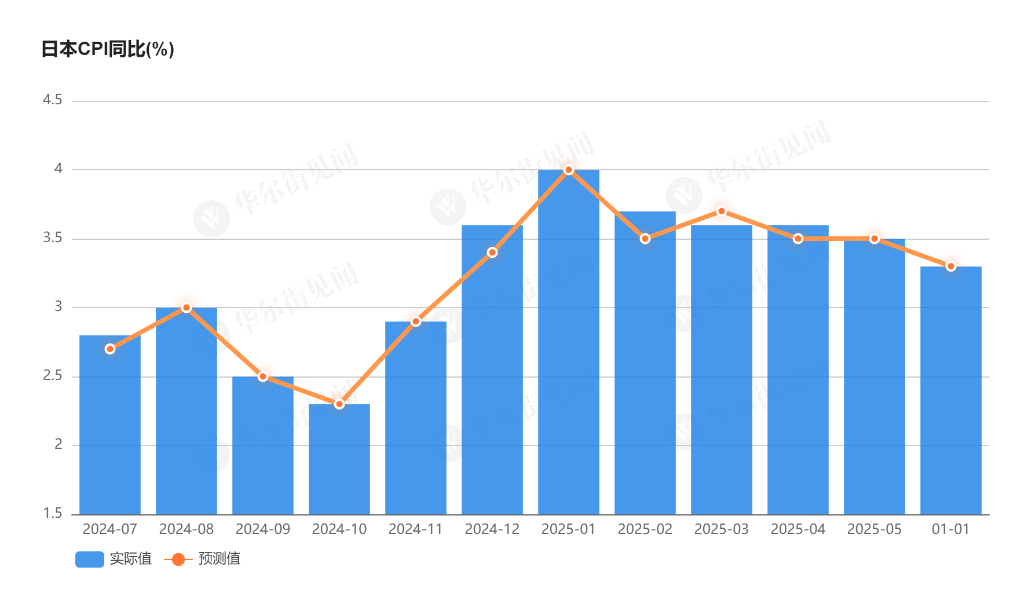
大米危机缓解,日本6月通胀降温,核心CPI回落至3.3%
Hua Er Jie Jian Wen· 2025-07-18 07:26
Core Insights - Japan's inflation has cooled down, with June CPI falling to 3.3%, primarily driven by a slowdown in rice price increases, marking the 39th consecutive month above the central bank's 2% target [1][4] - The core CPI, excluding volatile fresh food prices, also decreased from 3.7% in May to 3.3% in June, indicating some relief in inflationary pressures [4] - However, the "core-core" CPI, which excludes fresh food and energy prices, rose from 3.3% to 3.4%, suggesting persistent underlying inflationary pressures [4][9] Inflation Dynamics - The main factor contributing to the cooling inflation is the significant easing of rice price pressures, with June rice prices increasing by 100.2% year-on-year, down from 101.7% in May [8] - Despite the recent decline, rice prices remain at their highest growth rate in over half a century, indicating ongoing challenges in the agricultural sector [8] Economic Outlook - Market sentiment is cautiously optimistic regarding inflation prospects, with expectations that government rice stock releases and summer energy price controls will support further inflation decline [7] - However, risks such as yen depreciation, potential U.S. tariff threats, and uncertainties surrounding the upcoming Senate elections add complexity to the economic outlook [7][10] Trade and Tariff Concerns - Japan's economy faces potential growth challenges due to higher tariffs, particularly a proposed 25% tariff on Japanese imports by the U.S., which could impact key export sectors like automobiles [10] - The first quarter of 2023 saw Japan's GDP contract by 0.2%, marking the first decline in a year, primarily due to a significant drop in exports [10] Political Uncertainty - The upcoming Senate elections on July 20 pose a risk to policy stability, with the ruling coalition potentially losing its majority, which could lead to increased market volatility [10]