新能源车

Search documents
反内卷信号明确,市场有望加速出清 | 投研报告
Zhong Guo Neng Yuan Wang· 2025-07-09 01:06
Group 1 - The core viewpoint of the news highlights that the photovoltaic industry is undergoing a "de-involution" movement that has reached the highest strategic level of the country, focusing on capacity integration in the silicon material segment and strengthening price regulation across the industry chain [1][4] - The current state of the photovoltaic industry is at the bottom of the cycle, with future policy strength being a key variable affecting industry trends [1][4] - In the medium to long term, the photovoltaic industry is expected to enter a phase of high-quality development, where technological upgrades and market structure optimization will become core competitive factors for companies [1][4] Group 2 - Weekly market review indicates that from June 29 to July 4, the Shanghai Composite Index rose by 1.40%, the Shenzhen Component Index by 1.25%, and the ChiNext Index by 1.50%, with the Shenwan Electric Equipment Index increasing by 1.99%, outperforming the CSI 300 by 0.45 percentage points [2] - In the sub-sectors, the Shenwan photovoltaic equipment increased by 5.76%, while wind power equipment decreased by 0.86%, battery by 1.63%, and grid equipment by 0.82% [2] Group 3 - The report tracks key sectors, noting that EVE Energy has submitted an IPO application to the Hong Kong Stock Exchange, with funds primarily allocated for projects in Hungary and Malaysia, as well as working capital and general corporate purposes [3] - The Hungarian project is already under construction and is expected to be operational by 2027, with a planned capacity of 30GWh, focusing on producing power batteries, particularly the 46 series cylindrical batteries [3] Group 4 - Investment suggestions for the photovoltaic sector emphasize the importance of focusing on silicon materials, glass, and battery segments that have undergone sufficient corrections, as well as new technologies and leading manufacturers [4][5] - For the wind power sector, the domestic industry chain has a localization rate exceeding 90%, with strong global competitiveness in upstream materials and core components [4] - The report suggests focusing on companies like Goldwind Technology, Dongfang Cable, and others in the wind power sector, while in the new energy vehicle sector, it recommends companies benefiting from low upstream material prices and stable profitability [5]

股价大跌27%,特斯拉痛失护城河,马斯克还没玩够?
Sou Hu Cai Jing· 2025-07-08 11:26
Group 1 - Tesla's stock price closed down 6.8% at $293.94, marking a 27% decline year-to-date [2] - The company has lost its competitive advantages, previously held by strong political connections and a positive brand image [4][5] - The relationship between Elon Musk and Donald Trump has deteriorated, impacting Tesla's political support [5][8] Group 2 - The recent "Inflation Reduction Act" has negatively affected Tesla by increasing government debt and eliminating a $7,500 subsidy for electric vehicles [7][10] - Tesla's global deliveries fell to 336,700 units in Q1 2025, a 13% year-over-year decline, with significant drops in key markets like Germany (down 59.5%) and France (down 63%) [17] - The company is facing increased competition from Chinese electric vehicle manufacturers, which are gaining market share in Europe and China [24][28] Group 3 - Analysts have downgraded Tesla's earnings expectations, with Wells Fargo setting a target price of $130, nearly halving the current stock price [29] - The departure of Tesla's North America and Europe operations head, Omid Afshar, is linked to declining sales in those regions [19] - Tesla's future prospects, including autonomous driving and new low-cost models, remain uncertain and are not expected to offset the current downturn [20][29]

【Tesla每日快訊】 川普新政策對Tesla有何影響?$7,500稅收優惠還能搶多久?🔥中國單踏板制動新標準(2025/7/8-2)
大鱼聊电动· 2025-07-08 11:09
Regulatory & Policy Impacts - China's new regulation on single-pedal driving mode, effective January 1, 2026, prohibits stopping a vehicle solely by releasing the accelerator pedal, requiring brake pedal use, impacting Tesla's vehicle control logic and user experience [1] - The US federal tax credit of $7,500 is set to expire on September 30, 2025, prompting Tesla to alert customers [1] - A US manufacturing auto loan interest tax deduction policy proposed by Trump allows consumers to deduct up to $10,000 in interest on loans for US-assembled vehicles between 2025 and 2028, benefiting Tesla [1] Market Trends & Sales Performance - China's new energy vehicle sales account for over 60% of global sales, with over 30 million vehicles in use by early 2024, holding the largest global share [1] - Tesla's China insurance registrations for the week of June 30 to July 6, 2025, fell 75.8% week-over-week to 5,010 units and 22.9% year-over-year, indicating sales pressure [1] - Year-to-date, Tesla's China insurance registrations are down 5.3% compared to last year, reflecting market competition or economic factors affecting consumer confidence [1] - Statista forecasts the global electric vehicle market revenue to reach $784.2 billion in 2025, with China contributing $377.9 billion, nearly half of the total [1] Industry Challenges & Adjustments - China's electric vehicle market faces overcapacity, intense competition among hundreds of manufacturers, leading to price wars and reduced profits [1] - Porsche's IT subsidiary is cutting hundreds of jobs as part of a digital transformation and cost control strategy [2] - Honda has canceled the development of a large electric SUV, originally planned for 2027, and lowered its 2030 electric vehicle sales target from 30% to 20% due to slowing demand in the US market [2] - Other automakers like Ford, Jaguar Land Rover, and Nissan are also slowing down or canceling electric vehicle projects [2]


乘联分会:6月新能源车厂商批发渗透率49.8%,较2024年6月提升4.6个百分点
news flash· 2025-07-08 08:19
Group 1 - The core viewpoint of the article highlights that the wholesale penetration rate of new energy vehicles (NEVs) reached 49.8% in June, marking an increase of 4.6 percentage points compared to June 2024 [1] - Domestic brand NEVs achieved a penetration rate of 66.7% in June [1] - The penetration rate of NEVs in the luxury vehicle segment was 33% [1] - Mainstream joint venture brands had a significantly lower NEV penetration rate of only 6.6% [1]
乘联分会:6月新能源车在国内总体乘用车的零售渗透率53.3%
news flash· 2025-07-08 08:16
Group 1 - The core viewpoint of the article highlights that in June, the retail penetration rate of new energy vehicles (NEVs) in the overall passenger car market in China reached 53.3%, an increase of 4.8 percentage points compared to the same period last year [1] Group 2 - In June, the penetration rate of NEVs among domestic independent brands was 75.4% [1] - The penetration rate of NEVs in the luxury car segment was 30.3% [1] - The penetration rate of NEVs among mainstream joint venture brands was only 5.3% [1]
中国乘联分会:6月新能源车市场零售111.1万辆,同比增29.7%。
news flash· 2025-07-08 08:10
中国乘联分会:6月新能源车市场零售111.1万辆,同比增29.7%。 ...
新能源概念爆发,科创板新能源 ETF(588960)盘中涨幅达3.92%
Mei Ri Jing Ji Xin Wen· 2025-07-08 06:36
Core Insights - The new energy sector, including lithium batteries, photovoltaics, and wind power, is experiencing significant activity on the STAR Market, with the New Energy ETF (588960) rising by 3.92% and the Lithium Battery ETF (561160) increasing by 2.64% [1] - Major companies in the New Energy ETF, such as Daqo Energy and Trina Solar, have seen substantial gains, with Daqo Energy rising over 10% and Trina Solar increasing more than 6% [1] - The central government is intensifying efforts to regulate disorderly competition, focusing on improving product quality and facilitating the orderly exit of outdated production capacity [1] Industry Developments - A joint notice from the National Development and Reform Commission and other departments emphasizes the scientific planning and construction of high-power charging facilities, aiming for over 100,000 such facilities nationwide by the end of 2027 [1] - The focus will be on local economic development, the promotion of new energy vehicles, and the distribution of electric power resources, with an emphasis on "instant charge and go" scenarios [1] - Analysts indicate that semi-solid-state batteries are beginning to scale up, while solid-state batteries are expected to see small-scale deployment by 2027 and larger applications in energy storage post-2030 [1] ETF Information - The New Energy ETF (588960) closely tracks the STAR Market New Energy Index (000692.SH), with daily price fluctuations potentially reaching 20% [2] - The index comprises 50 large-cap stocks from the solar, wind, and new energy vehicle sectors, reflecting the overall performance of representative companies in the new energy industry on the STAR Market [2]
港股科技ETF(513020)上一交易日净流入1.36亿,市场关注反内卷政策与AI产业景气传导
Mei Ri Jing Ji Xin Wen· 2025-07-07 01:53
Group 1 - The core viewpoint indicates that anti-involution policies will primarily focus on industries such as new energy vehicles and photovoltaics, leading to accelerated mergers, restructuring, and integration rather than administrative capacity reduction [1] - The recent sentiment in the Hong Kong stock market has declined, with the Hang Seng Technology Index experiencing a pullback after reaching the upper range, influenced by strong U.S. economic data, delayed interest rate cuts, a depreciating RMB, and rising long-term interest rates, which have increased pressure on the liabilities of Hong Kong stocks [1] - Looking ahead, high long-term U.S. interest rates may continue to suppress the economy, but the AI capital expenditure wave is expected to support the performance of leading technology stocks in Hong Kong, with high demand in upstream AI computing power and servers likely to persist into the second half of the year, providing a favorable long-term value proposition for the Hang Seng Technology sector [1] Group 2 - The Hong Kong Technology ETF tracks the Hong Kong Stock Connect Technology Index, which is compiled by Guozheng Index Co., Ltd., aiming to reflect the performance of technology industry stocks that can be traded through the Stock Connect mechanism [1] - The index constituents mainly cover high-tech fields such as information technology and healthcare, selecting innovative companies with high growth potential as samples, thereby reflecting the overall trend of the technology sector in the Hong Kong stock market [1] - The industry allocation focuses on technological innovation areas, including cloud computing and biomedicine, providing investors with an efficient tool to invest in leading technology stocks in Hong Kong [1]
广发证券:“大美丽”法案将使得美国财政进一步宽松 美股短期上行 美元有反弹需求
智通财经网· 2025-07-06 23:43
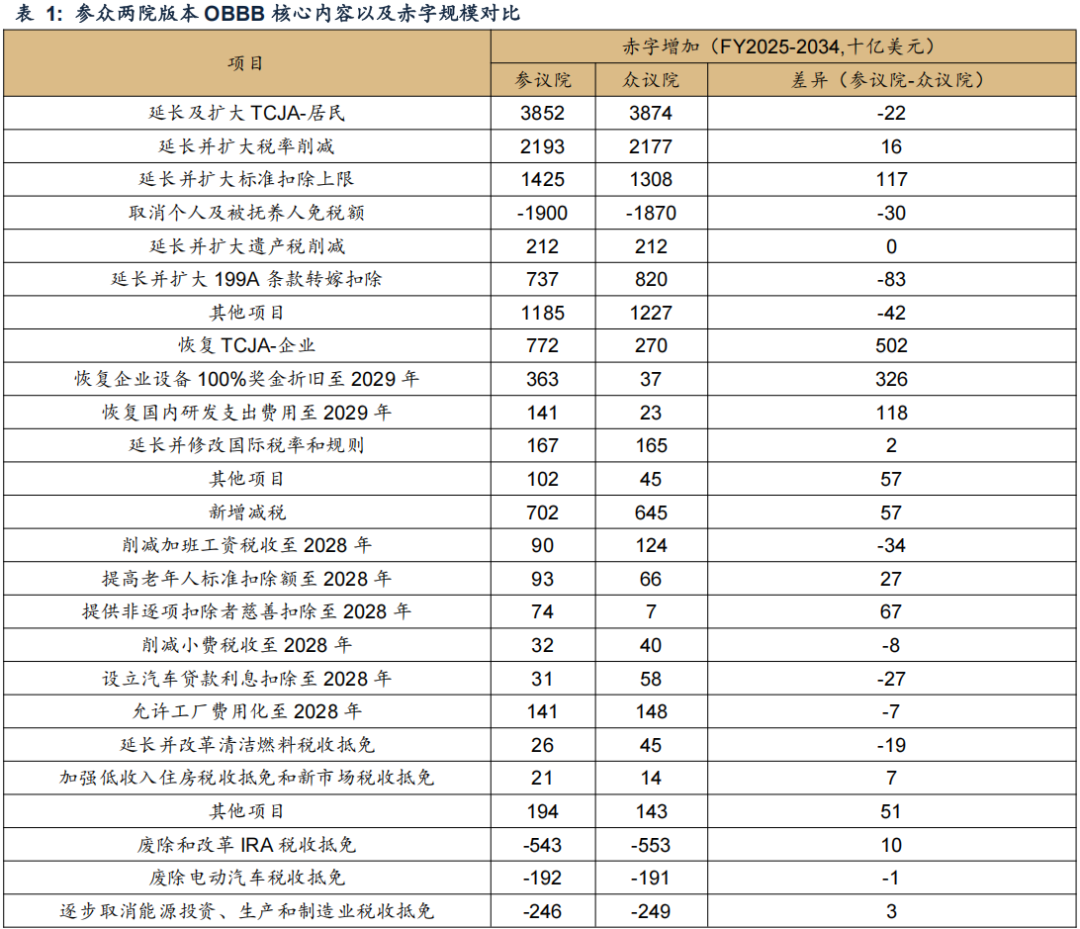
Group 1 - The "Great Beauty" Act, signed by Trump on July 4, 2023, will lead to further fiscal easing in the U.S., providing short-term support for economic growth but potentially causing secondary inflation risks and delaying Fed rate cuts, raising concerns about U.S. fiscal sustainability [1][10][12] - The final version of the "Great Beauty" Act has a larger deficit compared to the House version, with changes including the removal of Clause 899, an increase in the federal debt ceiling, and tightened conditions for Medicaid eligibility [1][10] - The Act is expected to have significant long-term effects across various industries, providing tax and subsidy advantages to traditional energy, manufacturing, real estate, military, and agriculture sectors while cutting benefits for clean energy, electric vehicles, healthcare, and food sectors [10][11] Group 2 - The Act will allow for the resumption of oil and gas leasing auctions on public lands and waters, and it maintains policies for real estate companies to fully deduct property improvement costs [11] - A budget of approximately $150 billion will be allocated over the next five years for large military projects, including shipbuilding and missile defense systems [11] - The semiconductor industry will see an increase in tax credits from 25% to 35% for new factories built in the U.S., with projects needing to commence by the end of 2026 [11] Group 3 - The "Great Beauty" Act represents a significant expansion of U.S. fiscal policy, which may require rate cuts to support this expansion amid high deficits and debt concerns [12][15] - The current fiscal expansion differs from previous cycles due to unexpected fiscal growth, changes in economic fundamentals, tariff uncertainties, and cracks in dollar credit [12][15] - The narrative around major asset classes is expected to fluctuate between "economic weakness," "data resilience," and "fiscal risk," impacting pricing for U.S. Treasuries, equities, the dollar, gold, and oil [15]

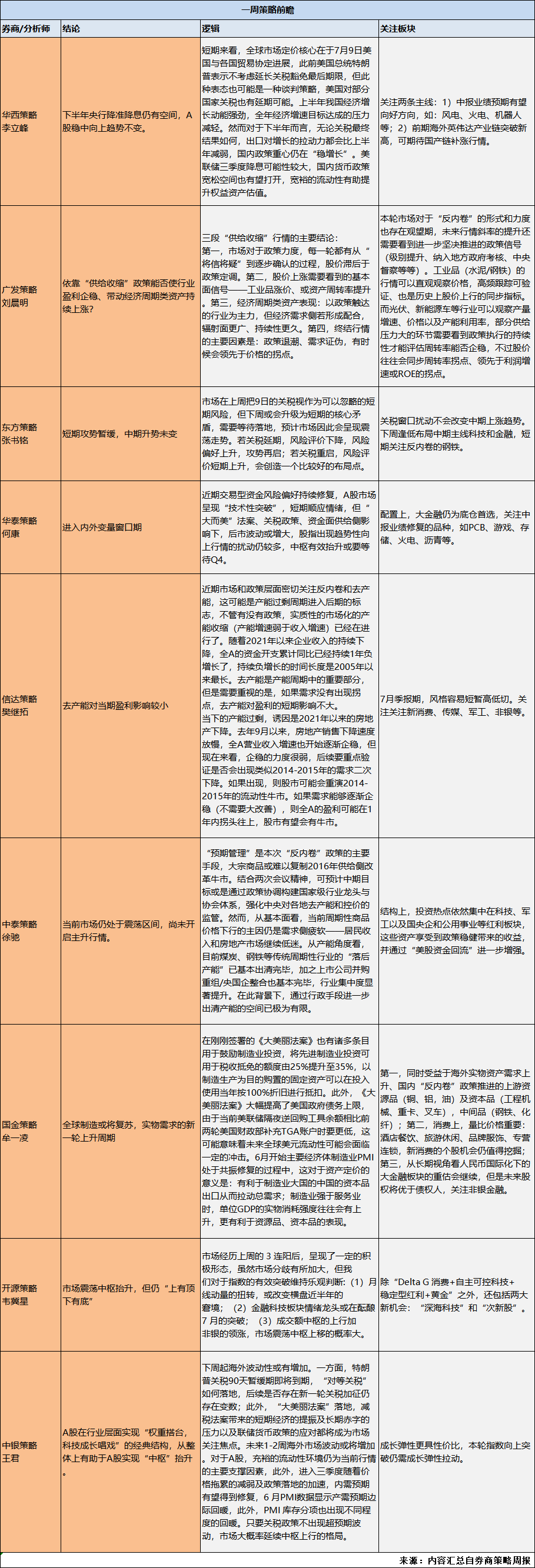
A股分析师前瞻:贸易协定进展是下周的关注焦点
Xuan Gu Bao· 2025-07-06 13:56
Group 1 - The focus of the brokerage strategy discussions this week is on the upcoming trade agreement progress and the sustainability of the "anti-involution" sector [1][2] - The Huaxi strategy team indicates that the core pricing in the global market is centered around the trade agreement progress on July 9, with potential tariff extensions being a negotiation tactic [1][3] - The A-share market is expected to maintain an upward trend, with two main lines of focus: positive mid-term performance expectations in sectors like wind power, thermal power, and robotics, and the potential for domestic chains to catch up following Nvidia's overseas breakthroughs [1][3] Group 2 - The Dongfang strategy team notes that the market previously viewed the July 9 tariff as a negligible short-term risk, but it may escalate into a core issue next week, leading to a volatile market [1][3] - The Zhongyin strategy team emphasizes that the current liquidity environment supports the market, and as the third quarter progresses, domestic demand expectations may improve if tariff policies do not experience unexpected fluctuations [1][3] - The Xuch team's analysis suggests that "expectation management" is a key tool in the "anti-involution" policy, with limited space for further capacity clearance in traditional cyclical industries like coal and steel due to already high industry concentration [2][4] Group 3 - The market is currently in a state of fluctuation, with the potential for increased volatility in the coming weeks due to the expiration of the 90-day tariff grace period and the implications of the "Great Beautiful Act" [5] - The overall sentiment in the A-share market is that the liquidity environment remains a primary support factor, with expectations for recovery in domestic demand as price pressures ease and policies are implemented [5] - The current cycle of capacity reduction is crucial, but its short-term impact on profitability may be limited if demand does not show signs of recovery [4][5]