
茶饮

Search documents
行业降温,加盟成本高,王牌单品缺失……爷爷不泡茶凭什么冲刺5000店?
东京烘焙职业人· 2025-08-25 08:31
Core Viewpoint - The article discusses the rapid expansion and challenges faced by the tea brand "爷爷不泡茶" (Grandpa Doesn't Brew Tea), highlighting its ambition to grow significantly in a competitive market while addressing the need for sustainable business logic in the new tea beverage industry [4][25]. Expansion Strategy - "爷爷不泡茶" aims to increase its store count from under 3,000 to a minimum of 4,500 by 2025, with a target of reaching 5,000 stores [4][12]. - The brand's expansion strategy includes targeting lower-tier markets and introducing various store formats to increase flexibility in location selection [11][12]. - The brand's current store count is reported to be over 2,500, although some data sources suggest it may be below 2,100 [11][12]. Product Development - The brand focuses on creating unique products, such as "荔枝冰酿" (Lychee Ice Brew), which has sold over 38 million cups, positioning it as a leading product in its category [14][16]. - "爷爷不泡茶" emphasizes the use of local ingredients and cultural heritage in its products, aiming to differentiate itself in a crowded market [19][22]. Market Position and Competition - The new tea beverage market is highly competitive, with established brands like "蜜雪冰城" (Mixue Bingcheng) and "喜茶" (Heytea) dominating the landscape [9][12]. - The brand's pricing strategy places it in direct competition with other mid-tier brands, making it challenging to attract franchisees due to uncertain return on investment [12][22]. Financial Performance and Growth Challenges - The brand's growth is hindered by a lack of standout products and reliance on promotional activities, which can erode profit margins for franchisees [23][25]. - Despite achieving recognition among younger consumers, the brand faces scrutiny over product quality and consistency, which could impact its long-term viability [25][26]. Industry Trends - The new tea beverage industry is experiencing a shift, with market share among the top five brands increasing from 38.5% in 2020 to 46.8% in 2023, indicating a trend towards consolidation [12][24]. - The article notes that many brands are adopting similar "national trend" themes, making it difficult for any single brand to stand out [17][19].

手账本多处被质疑抄袭,茶颜悦色道歉:存在部分未经授权挪用
Nan Fang Du Shi Bao· 2025-08-25 07:52
Core Viewpoint - The company, Cha Yan Yue Se, issued an apology on August 24 for allegations of plagiarism regarding its newly launched products, particularly a planner that was criticized by multiple bloggers for similarities to their original designs [1][2]. Group 1: Incident Overview - On August 22, Cha Yan Yue Se collaborated with the Shanghai Rainbow Choir to release several co-branded products, including a planner that faced accusations of copyright infringement from three bloggers [1]. - Blogger "Fei Hua San Qian" highlighted that a page in the planner closely resembled their 2024 calendar design in terms of color, graphics, and overall layout [1]. - Another blogger, "Mai Mai Zi," pointed out that a design featuring a dog on colorful ribbons was strikingly similar to their previous design of a cat on colored tape [1]. Group 2: Company Response - In response to the allegations, Cha Yan Yue Se acknowledged the unauthorized use of certain designs and expressed regret over the management oversight that allowed these issues to occur [2]. - The company plans to establish a dedicated investigation team to conduct a thorough self-examination and implement stricter review processes to prevent future occurrences [2]. - This incident marks the second time in recent months that Cha Yan Yue Se has faced accusations of copyright infringement, with a previous incident involving a snack packaging design that resembled a music album cover [2]. Group 3: Company Background - Cha Yan Yue Se, founded in 2013 in Changsha, is part of Hunan Cha Yue Cultural Industry Development Group Co., Ltd., which has completed four rounds of financing, the latest being in February 2021 [3]. - As of August 15, 2023, the company operates 792 stores nationwide and has expanded its brand portfolio to include coffee and lemon tea brands, as well as a bar brand [3]. - The company has been rumored to be planning an IPO, with recent reports suggesting a shift from Hong Kong to the U.S. market, although company representatives have denied receiving any such information [3].
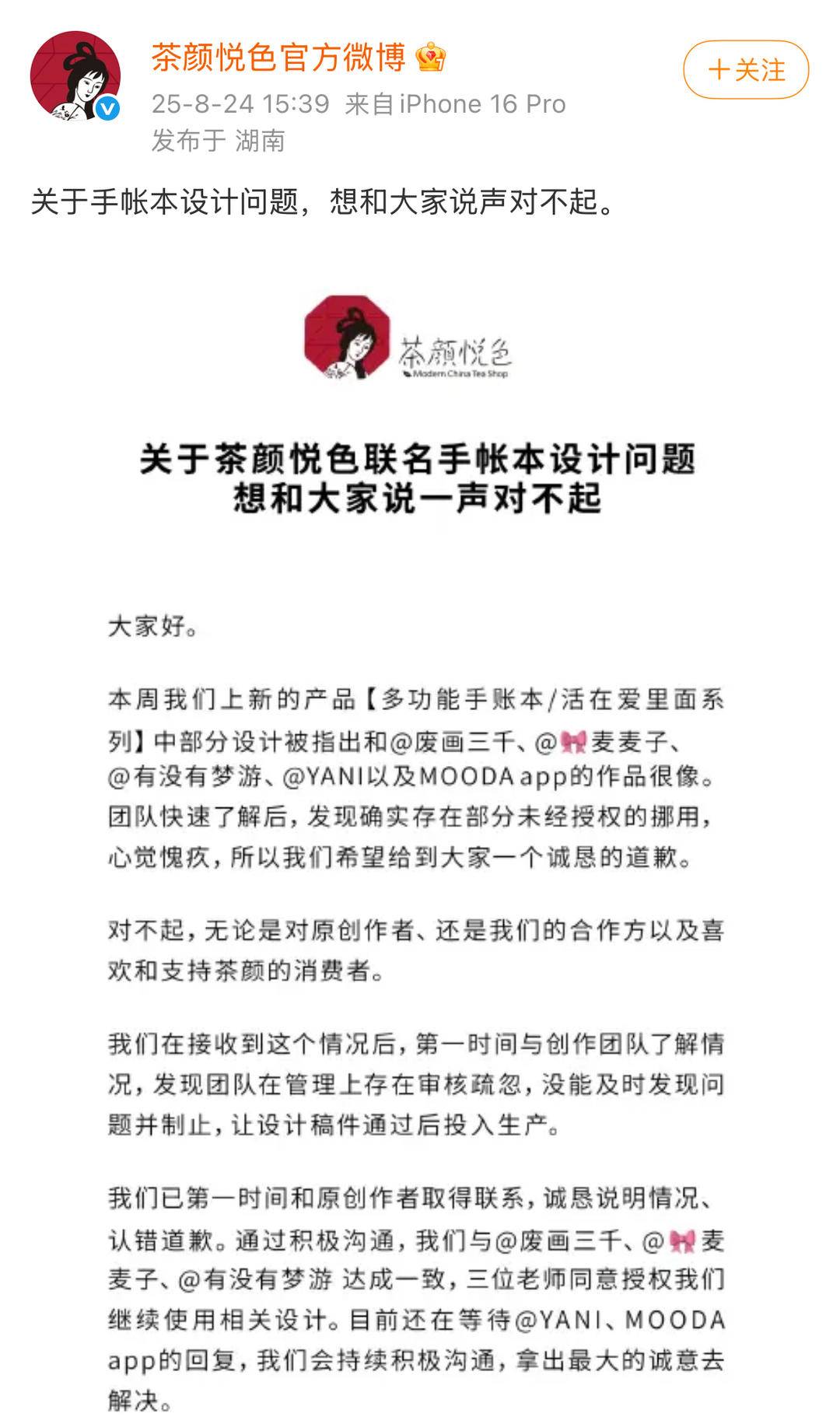
茶颜悦色就联名手帐本涉嫌抄袭道歉:确实存在挪用,将成立调查小组自查
Yang Zi Wan Bao Wang· 2025-08-25 07:35
Core Viewpoint - The company "Cha Yan Yue Se" has faced allegations of design plagiarism regarding its newly launched collaborative product, a multifunctional notebook, leading to public apologies and commitments to rectify the situation [1][4]. Group 1: Apology and Acknowledgment - The company issued an apology on social media, acknowledging that some designs in the new product were similar to those of various original creators [4]. - The team recognized unauthorized use of certain designs and expressed regret, stating they have reached out to the original authors to apologize and seek resolution [4]. Group 2: Response and Actions Taken - The company has established a dedicated investigation team to conduct a thorough self-examination and ensure compliance in future designs [4]. - They plan to enhance management processes and training to improve the team's ability to discern and control content [4]. Group 3: Public Reaction and Impact - Following the allegations, the multifunctional notebook quickly sold out online, with some consumers turning to resale platforms at inflated prices [4]. - Multiple users on social media have reported similar instances of their designs appearing in the notebook, prompting calls for a clear investigation and resolution from the company [11].
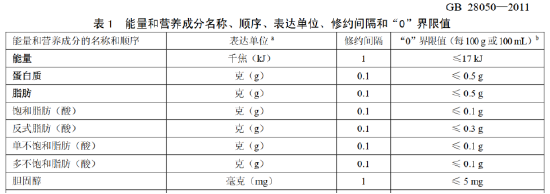
多家品牌被质疑产品有反式脂肪酸,喜茶:不实!完全符合0反式脂肪酸国标
Xin Lang Cai Jing· 2025-08-25 06:48
Core Viewpoint - Recent evaluations have claimed that several tea beverage brands, including Heytea, contain trans fatty acids, which the company has refuted as misleading information [1]. Group 1: Company Response - Heytea stated that the claims regarding trans fatty acids are false and mislead consumers, emphasizing that their products use high-quality ingredients such as real milk, tea, fruit, and sugar [1]. - The company referenced a report from the National Food Safety Risk Assessment Expert Committee, indicating that the average content of natural trans fatty acids in dairy products is 0.83g/100g, which may lead to trace amounts being detected in their products [1]. - Heytea ensures that all its products undergo professional testing and comply with the national standard for "0 trans fatty acids," with their baked brown sugar bubble milk tea containing 0.113g/100g, which is below the threshold of 0.3g/100g set by the national food safety standard (GB28050-2011) [1]. Group 2: Industry Insights - According to food engineering experts, tea beverages made with real milk and light cream are more likely to be detected with natural trans fatty acids, while those using non-dairy creamers are less likely to show such results [2].
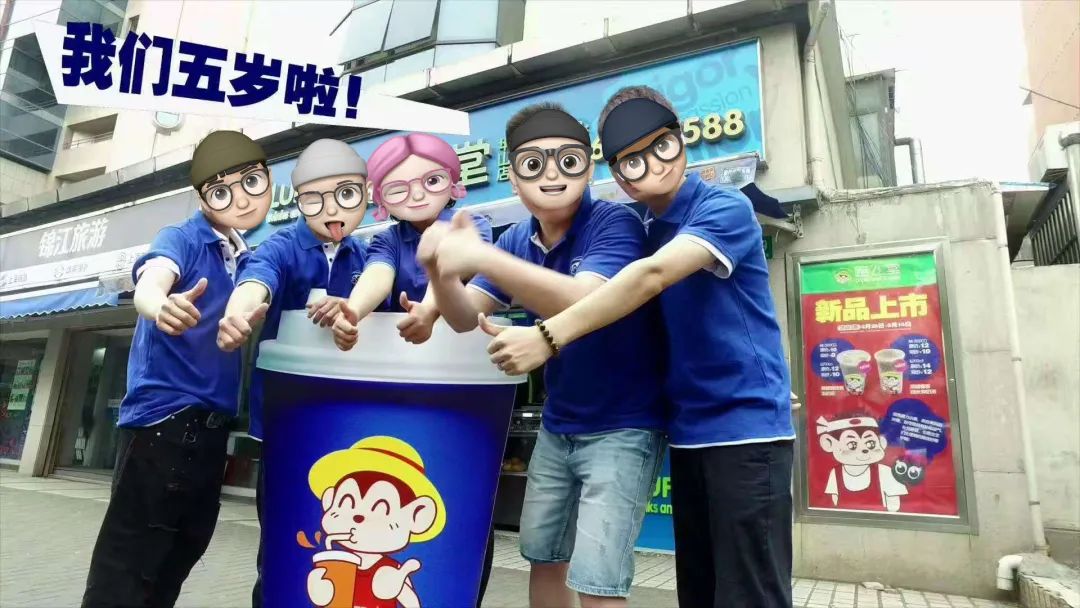
300家店关剩4家,他改卖二手设备,“今年能做3000万”
3 6 Ke· 2025-08-25 01:30
茶饮创业14年,近300家店关得仅剩4家,他果断转行卖二手设备。 没想到在这个不起眼的领域找到了新蓝海,1年就收了1000多家门店,"今年保守预计能做到3000万,后半辈子再也不开店了。" 跟随茶饮"黄金十年"的起伏,他到底经历了什么?我和章鱼聊了聊,希望从一个二手设备商的眼中,看到今年更真实的"茶饮生态"。 近300家店仅剩4家,他果断转行二手设备 "每年都有人说,今年是最难的一年,但其实明年更难!"茶饮创业十几年,这是章鱼最真切的感受。 2011年,他创立的品牌路飞堂龙珠奶茶,在上海开出首店。彼时,国内茶饮还处于蛮荒期,"市场不卷,品牌相对容易做"。 2020年之后,在外部环境影响下"经营愈发吃力",特别是大连锁品牌不断加密门店后,从产品到营销的全面内卷,更让路飞堂这样的腰部品牌生存艰难。 2023年,品牌逐渐凋零,"门店关得所剩无几",但在接连关店中,章鱼发现了一个新商机,"茶饮二手设备领域非常混乱,没有专业的设备商,较多都是 做餐饮设备附带收茶饮设备。" 他做了一个大胆的决定——从茶饮老板转行二手设备收购。2023年5月正式入行,同年10月建了第一个仓库。 万万没想到,在茶饮辗转十多年屡屡受挫的他,在 ...
泡泡玛特半年收益超去年全年;美团外卖品牌上线卡塔尔
2 1 Shi Ji Jing Ji Bao Dao· 2025-08-25 01:25
Industry Overview - The U.S. will suspend tax exemptions on imported packages valued at $800 or less starting August 29, leading to several European postal operators halting package services to the U.S., creating uncertainty in global postal cooperation [1] - In the first seven months of 2025, China's trade with Shanghai Cooperation Organization member countries reached 2.11 trillion yuan, a year-on-year increase of 3%, marking a historical high for the same period [2] - Shenzhen's total import and export volume for the first seven months of 2025 was 2.58 trillion yuan, remaining stable compared to the previous year, with exports at 1.56 trillion yuan and imports at 1.02 trillion yuan [3] Company Developments - Meituan's international food delivery brand Keeta has officially launched in Doha, Qatar, with plans to expand into more Gulf Cooperation Council countries and Brazil in the coming months [3] - Lenovo announced the establishment of a regional headquarters in Riyadh, Saudi Arabia, and is set to begin production at a new manufacturing facility in 2026 [4] - Transsion ranked first in the African smartphone market with 9.7 million units shipped, holding a 51% market share, and second in Southeast Asia with 4.5 million units shipped, representing an 18% market share [5] - AliExpress launched a new marketing AI Agent to help merchants quickly sell new products, resulting in a doubling of new products achieving sales within seven days since July [6] - Amazon launched a project to accelerate the development of local service systems and brand innovation in four provinces in Central China [7] - Cha Bai Dao announced the opening of its first North American store in New York, following its expansion into Singapore and France earlier this year [8] - Great Wall Motors' factory in Brazil has officially commenced production, with an annual capacity of 50,000 vehicles [9] - NIO plans to enter Singapore, Uzbekistan, and Costa Rica markets between 2025 and 2026, marking its first right-hand drive model launch in Singapore [9] - BYD announced plans to build an assembly plant in Malaysia, expected to start production in 2026, alongside the opening of its 43rd store in the country [10] - Pop Mart reported a revenue of 13.88 billion yuan in the first half of the year, a 204.4% increase year-on-year, and plans to expand its overseas store count to over 200 by the end of the year [10] - Miniso's overseas revenue increased by 28.6% year-on-year, contributing to a total revenue of 93.93 billion yuan in the first half of 2025 [11] - Aoki Co. expects a 50% to 62% decline in net profit for the first half of 2025 due to increased costs from tariff policy adjustments and logistics [12] - Muyuan Foods has established an overseas business team to explore international markets, aiming to replicate its domestic success in high-growth potential regions [13]

砸300万开店终翻盘,“创业十年,我想明白了一件事”
3 6 Ke· 2025-08-25 01:13
Core Insights - The tea beverage market is rapidly evolving, with both new entrants and exits occurring frequently. The journey of entrepreneur Wu Mengmeng exemplifies this evolution, showcasing her resilience and adaptability in the face of challenges [1][3][5]. Company Overview - Wu Mengmeng, a 1995-born entrepreneur, has undergone four entrepreneurial ventures in the beverage industry over the past decade, ultimately achieving success with her brand "Xianji" focused on matcha drinks [1][3]. - The flagship store of "Xianji" in Hangzhou has achieved monthly revenues exceeding 700,000 to 800,000 yuan, with daily sales stabilizing at over 10,000 yuan shortly after opening [3][5]. Market Trends - The tea beverage industry has seen a shift towards healthier options, with consumer awareness of health increasing over the years. This has led to a transition from powdered milk tea to fresh fruit tea and now to fresh milk tea, indicating a trend towards cleaner ingredient profiles [5][7]. - The demand for matcha products is rising, with brands like "Qu Tea" and "Treasure Oasis" successfully establishing matcha as a significant product category in regional markets [7][8]. Strategic Decisions - Wu Mengmeng's decision to invest 3 million yuan in a large flagship store contrasts with the industry's trend towards smaller, more efficient models. This move is based on the belief that product education requires supportive environments [8][10]. - The flagship store features a hand-crafted matcha bar, allowing customers to engage with matcha culture directly, which is seen as a crucial differentiator in a crowded market [8][10]. Product Strategy - The product line includes not only matcha but also fruit teas and cocoa, catering to diverse consumer preferences and enhancing cross-selling opportunities [12][13]. - Wu Mengmeng's strategy involves lowering the entry price for matcha drinks to around 20 yuan, making it more accessible while also providing premium experiences for more discerning customers [13][15]. Business Model - The company has shifted from a franchise model to a primarily direct-operated model in Hangzhou, emphasizing the need for control and consistency in brand management [15][16]. - The focus is on ensuring profitability for each store rather than rapid expansion, with a commitment to building a replicable operational system [15][16]. Entrepreneurial Insights - Wu Mengmeng reflects on her decade-long journey, emphasizing the importance of making informed choices and understanding market dynamics. She advises potential entrants to carefully consider their motivations and the competitive landscape before entering the market [16].

约8成爱马仕用户在买老铺黄金;79元迷你版LABUBU即将上市;永辉上半年净亏损2.41亿元 | 品牌周报
3 6 Ke· 2025-08-25 00:35
Group 1: Hermès and Lao Pu Gold - Approximately 80% of Hermès users are purchasing Lao Pu Gold, indicating a strong overlap in customer base [1] - Lao Pu Gold's sales performance for the year ending June 30, 2025, reached 14.18 billion yuan, a year-on-year increase of 249.4%, with adjusted net profit at 2.35 billion yuan, up 290.6% [1] - Lao Pu Gold has achieved the highest average revenue and sales per square meter among all jewelry brands in mainland China, surpassing Hermès [1] Group 2: Bubble Mart - Bubble Mart announced the launch of a mini LABUBU blind box series, priced at 79 yuan per box, with a total set price of 1,106 yuan [3] - The company reported a revenue of 13.88 billion yuan for the first half of the year, a 204.4% increase, with a net profit of 4.574 billion yuan, up 46.37% [4] - Bubble Mart's overseas market revenue reached 5.593 billion yuan, growing by 439.34% [4] Group 3: Yonghui Supermarket - Yonghui Supermarket reported a revenue of 29.948 billion yuan for the first half of 2025, a decline of 20.7%, with a net loss of 241 million yuan compared to a profit of 275 million yuan in the same period last year [6][7] - The revenue drop was attributed to the closure of long-term loss-making stores and the impact of store renovations [7] - The company closed 227 loss-making stores while opening 4 new ones, resulting in a total of 552 operational stores as of June 30 [7] Group 4: KFC's New Ventures - KFC has opened two new fried chicken stores in Shanghai, named "Fried Chicken Brothers," focusing on takeout and delivery with a price point around 30 yuan [8] - This move is part of KFC's strategy to explore new business models and diversify its offerings, following previous launches of brands like KPRO and KCOFFEE [8] Group 5: Under Armour - Under Armour reported a 4% decline in revenue to 1.1 billion USD for the first quarter of the 2026 fiscal year, with a net loss of 3 million USD [13] - The company anticipates a further revenue decline of 6% to 7% in the second quarter, with a projected operating profit range between a loss of 10 million USD and breakeven [13] Group 6: Estée Lauder - Estée Lauder's net sales for the fiscal year ending June 30, 2025, were 14.326 billion USD, down 8% year-on-year, with a net profit drop of 390%, from a profit of 390 million USD to a loss of 1.133 billion USD [14]
美团Keeta在卡塔尔上线并计划进入巴西;长城汽车巴西工厂竣工投产丨36氪出海·要闻回顾
36氪· 2025-08-24 13:35
Core Viewpoint - The article highlights the expansion of various Chinese companies into international markets, showcasing their strategic moves and growth in overseas operations. Group 1: Company Expansions - Meituan's international delivery brand Keeta has launched in Doha, Qatar, with plans to expand into Brazil in the coming months [5] - Great Wall Motors has completed the construction of its factory in Brazil, with an annual production capacity of 50,000 vehicles [5][7] - Tea brand Cha Baidao has announced its first store in North America, located in New York, marking its entry into the U.S. market [5] - Lenovo is establishing a regional headquarters in Riyadh, Saudi Arabia, as part of its strategic expansion in the Middle East [6] Group 2: Financial Performance and Growth - Zero Run Auto reported its first half-year profit, with overseas markets becoming a significant growth driver, exporting 24,980 vehicles in the first seven months of 2025 [8] - Pop Mart plans to expand into emerging markets such as the Middle East and South Asia, expecting to exceed 200 overseas stores by the end of the year [8] - Xiaomi's automotive division aims for profitability in the second half of the year, maintaining its 2027 overseas expansion target [9] Group 3: New Business Models and Innovations - AliExpress has launched an "overseas hosting" model in Australia, following its success in other markets [5] - Yimutian, a major agricultural B2B platform, has gone public on NASDAQ, aiming to expand its offline services and international business [10] - Shouqu Technology has secured nearly 100 million yuan in angel funding to enhance its battery management systems and accelerate global market expansion [11] Group 4: Industry Trends - The global photovoltaic industry is witnessing increased competition, prompting Chinese companies to enhance their international presence and supply chain resilience [15] - The user-side energy storage market is recovering, with significant growth expected in commercial storage due to supportive policies and mature business models [14]






茶颜悦色再陷抄袭风波,品牌形象岌岌可危
Jing Ji Guan Cha Bao· 2025-08-24 13:19
Core Viewpoint - The company Tea Yan Yue Se is facing a significant brand image crisis due to allegations of design plagiarism related to its new product line, which has led to public scrutiny and a need for internal reforms [1][2][4] Group 1: Incident Overview - On August 24, Tea Yan Yue Se issued an apology on social media regarding its new multifunctional notebook design, which was accused of being similar to works by various designers [1] - The company confirmed unauthorized use of designs and acknowledged management oversight that allowed problematic designs to go into production [1][2] - Following the incident, the company has reached agreements with some original creators to continue using their designs while still negotiating with others [1][2] Group 2: Previous Incidents - This is not the first time Tea Yan Yue Se has faced plagiarism accusations; a previous incident involved a snack product whose packaging design closely resembled a music album cover, leading to public backlash [3][4] - The company responded to the earlier incident by quickly recalling the product and apologizing for the oversight in their creative review process [3] Group 3: Brand Impact and Future Actions - Continuous plagiarism allegations have severely damaged Tea Yan Yue Se's brand image, which has been built on a unique Chinese-style tea culture appealing to younger consumers [4] - The company plans to establish an investigation team for self-assessment and improve its design review processes to prevent future issues [1][4] - The ongoing situation serves as a warning to the broader consumer market about the importance of upholding originality and intellectual property rights in brand development [4]