航天

Search documents
全球首富榜揭晓:美首富造火箭,俄首富搞天然气,中国首富在干啥
Sou Hu Cai Jing· 2025-12-20 00:15
Group 1: Wealth Rankings and Key Figures - Elon Musk remains the world's richest person in 2025 with a net worth of $342 billion, largely driven by Tesla's stock price and SpaceX's valuation exceeding $200 billion [1][5][9] - Mukesh Ambani, India's richest man, has built a significant fortune through Reliance Industries, focusing on oil, petrochemicals, and telecommunications, capturing half of India's mobile users [13][16][18] - Russian billionaire Vagit Alekperov has amassed wealth through the oil and gas sector, specifically with Lukoil, despite ongoing geopolitical tensions and sanctions [20][22][24] - China's richest man, Zhong Shanshan, has a projected net worth of $77.1 billion in 2025, primarily from his bottled water company Nongfu Spring and vaccine producer Wantai [26][28][34] Group 2: Business Strategies and Innovations - Musk's approach involves high-risk ventures, such as SpaceX's reusable rockets and the Starlink satellite project, which aims to provide internet access to remote areas [9][11] - Ambani's strategy includes aggressive market penetration in telecommunications and diversification into renewable energy and digital services [18][20] - Alekperov's Lukoil continues to navigate sanctions by finding alternative markets for oil exports, demonstrating resilience in a resource-dependent economy [22][24] - Zhong's dual focus on everyday consumer goods and high-demand medical products illustrates a balanced business model that mitigates volatility [36][34] Group 3: Emerging Trends in Wealth Creation - The 2024 global wealth landscape is evolving, with traditional tech billionaires still prominent, while new entrants from entertainment and sports are emerging [38][40] - Female billionaires remain underrepresented, comprising only about 10% of the total, highlighting ongoing disparities in opportunities [40][42] - The next wave of wealth creation is expected to come from individuals who can excel in seemingly ordinary sectors, emphasizing innovation and uniqueness [43]


24小时闪电“派礼包”!特朗普年末卖力吸引选民
Hua Er Jie Jian Wen· 2025-12-19 23:22
Group 1: Economic Measures and Policies - President Trump announced a $1,776 "warrior bonus" for 1.45 million active-duty military personnel, funded by an additional $2.6 billion from tariffs, benefiting approximately 1.28 million active and 174,000 reserve service members [2] - Federal employees will receive an unprecedented two additional days off for Christmas, creating a five-day holiday period, with the government closing on December 24 and 26 [3] - Trump signed an executive order to relax marijuana regulations, moving it from Schedule I to Schedule III, which will facilitate more clinical research and FDA reviews [4][6] Group 2: Housing and Drug Pricing Initiatives - Trump promised to unveil a housing reform plan to address the housing affordability crisis, while claiming inflation has "stopped" [7] - Major pharmaceutical companies, including Merck and GSK, agreed to voluntarily lower drug prices in exchange for tariff exemptions and regulatory relief, with Novartis committing to invest $23 billion in the U.S. over five years [7] Group 3: Political Context and Challenges - Trump's policy announcements come amid declining approval ratings, with Ipsos polling showing his support at 39%, and challenges related to rising living costs and the upcoming 2026 midterm elections [1][9] - The unemployment rate rose to 4.6% in November, the highest since October 2021, with approximately 7.83 million unemployed, indicating economic pressures that could impact the Republican party's control in Congress [8][9]
与特斯拉(TSLA.US)CEO马斯克渊源深厚 传大摩有望牵头SpaceX史诗级IPO
智通财经网· 2025-12-19 23:12
Core Viewpoint - Morgan Stanley is emerging as a competitive investment bank for SpaceX's potential IPO, leveraging its long-standing relationship with CEO Elon Musk [1][2] Group 1: IPO Details - SpaceX is considering an IPO to raise over $25 billion, which could become one of the largest public offerings globally [3] - The decision on the lead underwriter for the IPO is expected by the end of this year, but the final underwriting arrangement remains uncertain [2] - The IPO plan is contingent on market conditions, with the possibility of postponement or cancellation [2] Group 2: Morgan Stanley's Role - Morgan Stanley has a deep history of collaboration with Musk, having participated in Tesla's IPO in 2010 and advised Musk on the Twitter acquisition in 2022 [2] - Musk appointed Anthony Armstrong from Morgan Stanley as CFO of his AI company, xAI, further solidifying their relationship [2] - The connection extends to Musk's family office, managed by former Morgan Stanley banker Jared Birchall [2] Group 3: Business Operations and Future Plans - SpaceX has evolved from a rocket launch company to the largest satellite operator globally, primarily through its Starlink service [3][4] - The funds raised from the IPO are intended to enhance the launch frequency of the next-generation Starship rocket and support the development of AI data centers in space [3] - SpaceX is a key contractor for NASA's Artemis lunar program, with a contract value of approximately $4 billion [3]
24小时闪电“派礼包”!特朗普年末卖力吸引选民,覆盖军人、公务员、大麻和航天业
Hua Er Jie Jian Wen· 2025-12-19 19:58
Group 1 - President Trump announced a $1,776 "warrior bonus" for 1.45 million active-duty military personnel, attributing the funding to additional revenue from tariffs [2] - The bonus is part of a broader strategy to address declining approval ratings and economic uncertainty, with Ipsos polling showing his approval at 39% [1][7] - Trump also signed an executive order granting federal employees two additional days off for Christmas, creating a five-day holiday period [3] Group 2 - An executive order was signed to reclassify marijuana from a Schedule I to Schedule III substance, which will facilitate more clinical research and FDA reviews [4][5] - The Trump administration announced a housing reform plan and a drug price discount agreement with major pharmaceutical companies, including Merck and Novartis [6] - The drug price agreement aims to lower costs for government insurance programs and includes commitments from companies to invest billions in the U.S. [6] Group 3 - Economic pressures are mounting, with the unemployment rate rising to 4.6%, the highest since October 2021, and a significant number of Americans feeling financial strain [7][8] - Polls indicate that only 33% of Americans approve of Trump's economic policies, marking the lowest approval rating during his second term [8] - Critics, including Senator Mark Warner and economist Paul Krugman, suggest that Trump's recent announcements are attempts to divert attention from economic challenges [9]
SpaceX若上市,特斯拉的“马斯克溢价”还能撑多久?
硬AI· 2025-12-19 14:02
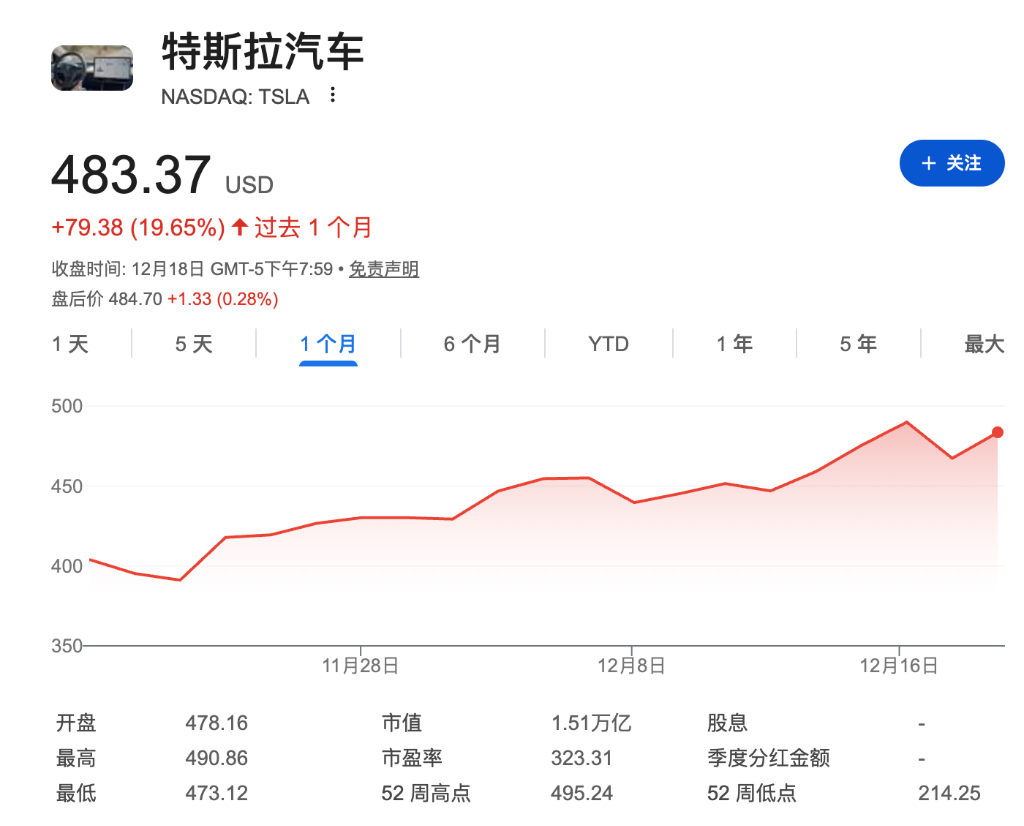
Core Viewpoint - SpaceX's IPO plan may challenge the long-held "Musk premium" associated with Tesla stock, potentially reallocating funds that were previously concentrated in Tesla due to investor support for Musk's vision rather than the automotive business itself [1][2] Group 1: Tesla's Current Situation - Tesla's stock price has increased nearly 20% in the past month and has a year-to-date gain of over 27%, with a forward P/E ratio of approximately 220, ranking second among S&P 500 constituents [1] - Despite the rising stock price, Tesla faces concerns regarding slowing sales growth and declining profitability, compounded by a tightening regulatory environment and reduced consumer spending on automobiles [5] - Analysts express skepticism about Tesla's current valuation, with some stating it lacks fundamental support, leading to significant sell-offs by certain investment firms [5] Group 2: Impact of SpaceX's IPO - The potential IPO of SpaceX is expected to exert selling pressure on Tesla's stock, as some investors primarily hold Tesla shares to gain exposure to Musk's vision rather than its automotive business [6] - Conversely, historical trends suggest that significant milestones for Musk's companies can enhance market sentiment for related firms, potentially attracting more investors to the ecosystem [6] - Analysts note that Tesla's stock price has already been influenced by expectations surrounding SpaceX's IPO, highlighting strategic synergies between the two companies, such as Tesla's Optimus robot aiding Mars colonization and SpaceX's Starlink enhancing vehicle connectivity [6]


周五又普涨?权重搭台消费唱戏,主力可能还在换筹码,下周小心为上
Sou Hu Cai Jing· 2025-12-19 12:12
Group 1 - The market appears to be experiencing a broad rally, but underlying dynamics suggest a shift towards consumer sectors rather than technology, with commercial aerospace influencing consumer trends [1][5] - Despite the overall positive sentiment, trading volumes have not increased significantly, indicating that technology stocks may be underperforming, contributing to the stagnation of the Shanghai Composite Index [1][3] - The current market environment is characterized by a tight liquidity situation, particularly in late December, suggesting that most sectors may remain in a sideways trend with fluctuations between gains and losses [1][3] Group 2 - The main driving force behind market stability seems to be quantitative funds, which are maintaining a narrow trading range despite ongoing selling pressure [3][5] - Recent market movements indicate a potential shift in focus from technology to consumer sectors, with significant participation from new stocks rather than established leaders [5][7] - The number of stocks experiencing consecutive declines has decreased significantly, suggesting a potential market recovery and a shift towards a more favorable trading environment [7]
航天工程(603698.SH):国创基金减持94.90万股公司股份
Ge Long Hui A P P· 2025-12-19 11:41
格隆汇12月19日丨航天工程(603698.SH)公布,2025年12月19日,公司接到国创基金管理有限公司-国创投 资引导基金(有限合伙)和国创(北京)新能源汽车投资基金管理有限公司-北京国创新能源汽车股权 投资基金合伙企业(有限合伙)的通知,2025年12月11日至12月19日,国创基金通过大宗交易的方式减 持公司无限售流通股共计94.90万股,约占公司总股本的0.18%;新车基金通过大宗交易的方式减持公司 无限售流通股共计135.87万股,约占公司总股本的 0.25%;双方合计减持公司股份230.77万股,约占公 司总股本的0.43%。本次权益变动使双方合计所持公司股票比例由10.43%减少至10.00%,触及5%整数 倍。 ...

A股五张图:偷袭!
Xuan Gu Bao· 2025-12-19 10:32
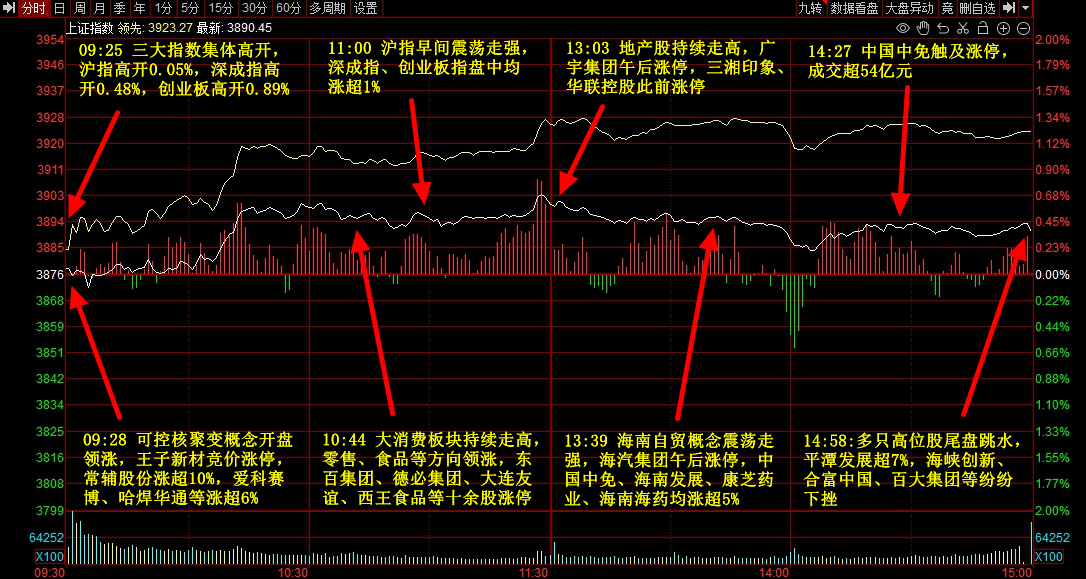
Market Overview - The market experienced a slight collective rise, with indices such as the Shanghai Composite, Shenzhen Component, and ChiNext increasing by 0.36%, 0.66%, and 0.49% respectively, while over 4,400 stocks rose and only about 900 declined [1]. Nuclear Fusion Sector - Trump Media Technology Group and TAE Technologies announced a binding merger agreement, leading to a nearly 42% surge in Trump Media's stock and a positive response in U.S. nuclear fusion stocks [4][7]. - The nuclear fusion sector in A-shares opened strong, with stocks like Wangzi New Materials and others hitting the daily limit [4][8]. - The nuclear fusion sector ultimately closed up by 3.35% after initially rising over 4% [8]. Aerospace Sector - The commercial aerospace sector strengthened again, with stocks like Huati Technology and others achieving consecutive gains [12]. - The sector was buoyed by U.S. President Trump's executive order aimed at enhancing America's "space advantage," which included increased R&D and private sector investment [12]. Education Sector - The education sector saw a sudden surge, with stocks like Xinkai Pu and others collectively rising, driven by news of Alibaba's potential product launch in the education space [13][16]. - The education sector ultimately closed up by 1.67% after an intraday rise exceeding 2% [16]. Fujian Local Stocks - Fujian local stocks rebounded strongly, with stocks like Luyan Pharmaceutical and others achieving consecutive gains [18]. - The sector saw an overall increase of 2.86% by the end of the trading day, despite a late pullback [19].
SpaceX若上市,特斯拉的“马斯克溢价”还能撑多久?
Hua Er Jie Jian Wen· 2025-12-19 10:02
Core Viewpoint - The potential IPO of SpaceX may challenge the unique "Musk premium" that Tesla stock has enjoyed, as investors could reallocate funds from Tesla to SpaceX, which is expected to reach a valuation of $800 billion, making it the highest-valued private company globally [1][4]. Group 1: SpaceX IPO Impact on Tesla - SpaceX's IPO could lead to a redistribution of funds that were previously concentrated in Tesla, as some investors hold Tesla stock primarily for exposure to Musk's vision rather than its automotive business [1][5]. - Analysts have mixed views on the impact of SpaceX's IPO on Tesla, with some suggesting it may create selling pressure on Tesla shares, while others believe it could enhance market sentiment towards Tesla due to the synergistic potential between the two companies [5][6]. Group 2: Tesla's Current Performance and Valuation Concerns - Despite a nearly 20% increase in Tesla's stock price over the past month and a year-to-date gain of over 27%, concerns about the company's fundamentals are rising, including slowing sales growth and declining profits [4]. - Tesla's forward P/E ratio has reached approximately 220, ranking second among S&P 500 constituents, which has led to widespread skepticism regarding its valuation being unsupported by fundamentals [4]. - Technical indicators suggest that Tesla's stock is nearing overbought territory, with historical data indicating a potential decline following similar conditions [4].
「午报」三大指数全线反弹,全市场近4700股飘红,大消费方向再度领涨
Sou Hu Cai Jing· 2025-12-19 09:17
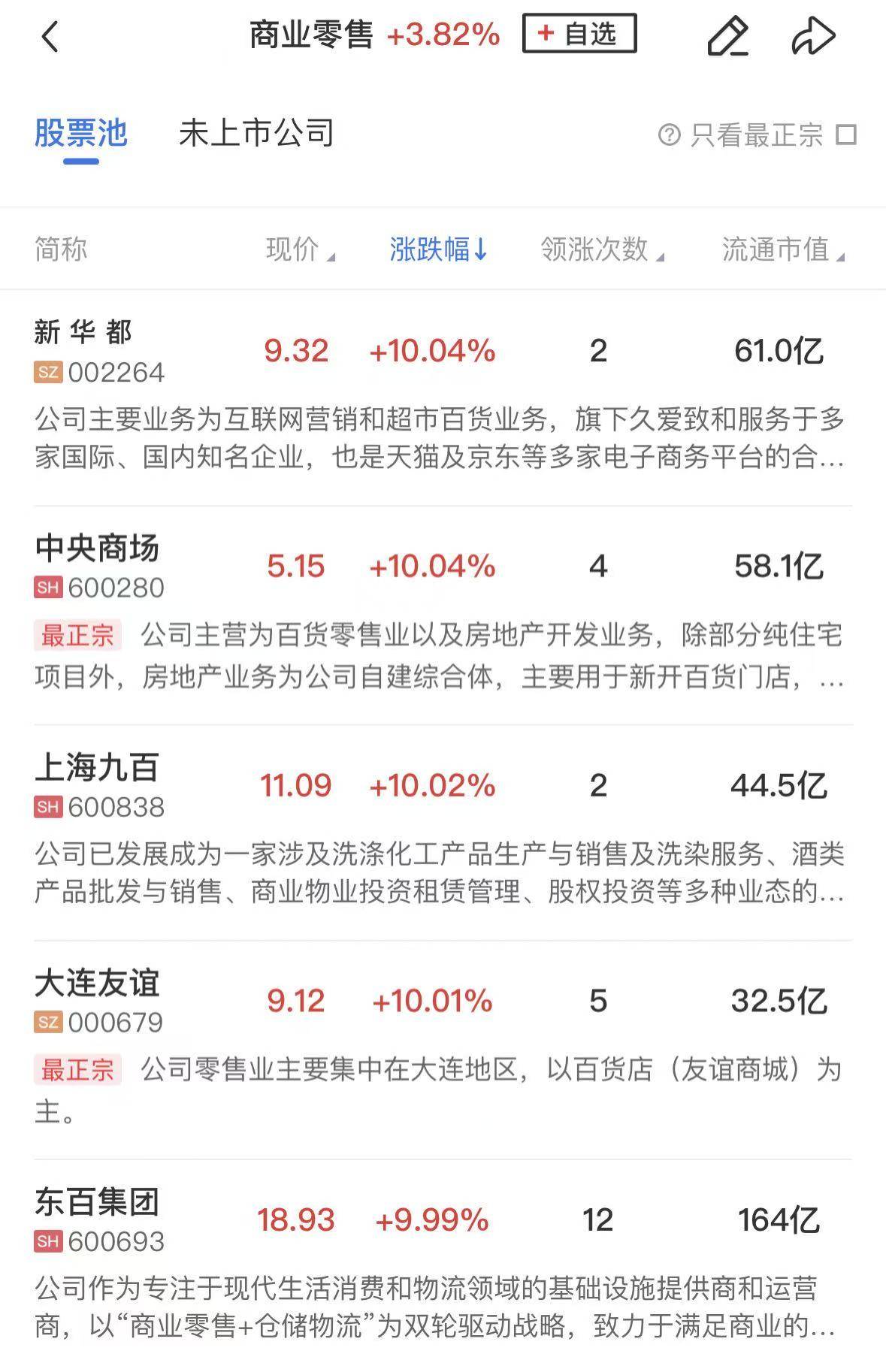
一、【早盘盘面回顾】 智通财经12月19日讯,市场早盘震荡走强,沪指高开高走,创业板指一度涨超1.5%。沪深两市半日成交额1.09万亿,较上个交易日放量421亿。盘面上热点 快速轮动,全市场近4700只个股上涨。从板块来看,大消费板块持续拉升,零售、乳业方向领涨,中央商场、庄园牧场等多股涨停。智能驾驶概念走强,浙 江世宝4连板。路畅科技4天2板。商业航天概念反复活跃,华体科技2连板。可控核聚变概念开盘表现强势,王子新材3天2板。下跌方面,影视院线概念走 弱,博纳影业大跌。截至收盘,沪指涨0.59%,深成指涨0.93%,创业板指涨0.99%。 个股来看,今日早盘涨停数量为59家(不包括ST及未开板新股),封板率为71%,连板股数量为12家,胜通能源6连板,浙江世宝4连板,中天服务、鹭燕医 药、庄园牧场、嘉美包装3连板,三湘印象、中央商场、上海九百、九牧王、华体科技、法狮龙2连板。 板块上,大消费反复活跃,零售板块再度走强,德必集团、大连友谊、东百集团、上海九百等个股涨停。 | | 商业零售 +3.82% + 自选 | | | 02 6 | | --- | --- | --- | --- | --- | | 股票 ...