光伏

Search documents
明冠新材(688560.SH):终止明冠合肥背板、胶膜及功能性膜项目
Ge Long Hui A P P· 2026-02-08 08:29
Core Viewpoint - The photovoltaic industry is experiencing signs of overcapacity and intensified price competition, leading to an industry adjustment cycle with expected widespread losses in 2024 and 2025. The company has decided to terminate the Mingguan Hefei project due to declining profitability and rising operational costs associated with industry competition [1]. Group 1: Industry Overview - The photovoltaic industry is entering a period of overcapacity, with increased competition affecting product pricing [1]. - The industry is expected to face widespread losses in 2024 and 2025 due to ongoing competitive pressures [1]. Group 2: Company Actions - The company has reached an agreement with the Hefei Dong government to terminate the Mingguan Hefei project, which includes the production of solar backplanes and functional films [1]. - The decision to terminate the project was made after careful analysis of market changes and the potential for increased operational costs if the project continued [1]. Group 3: Project Details - The Mingguan Hefei project was initially approved with a total investment of 5 billion yuan, planned to be implemented in two phases [2]. - The first phase aimed to produce 300 million square meters of solar backplanes and 200 million square meters of functional films, with construction of the necessary infrastructure largely completed by the government [2]. - As of now, the project has not commenced equipment installation, with a total expenditure of approximately 1.63 million yuan incurred so far [3].

电新行业周报:国家超算互联网核心节点上线,电力投资聚焦绿色转型-20260208
Western Securities· 2026-02-08 08:29
Investment Rating - The report does not explicitly state an investment rating for the industry Core Insights - The domestic first commercial SAR satellite closed-loop service system is taking shape as Tianyi Research Institute aims for an A-share IPO [1] - The national supercomputing internet core node has been launched, establishing a foundation for a trillion-parameter model computing capacity with a 30,000-card domestic cluster [1] - Tesla has achieved mass production of dry electrode technology, and Changan Automobile will be the first globally to equip sodium-ion batteries from CATL in its vehicles [2] - The State Grid has clarified that the "14th Five-Year Plan" investment will focus on green transformation and enhancing cross-regional transmission capacity [2] - The offshore wind power sector in China is progressing, with an expected addition of 6.12 GW of new grid-connected capacity by 2025 [2] Summary by Sections Section 1: Commercial Space and AI Computing - Tianyi Research Institute is preparing for an A-share IPO, establishing a commercial SAR satellite service system [1] - The national supercomputing internet core node will provide efficient computing services for large-scale AI applications [1] Section 2: Battery Technology and Electric Vehicles - Tesla's dry electrode technology is now in mass production, significantly reducing costs and energy consumption [2] - Changan Automobile's introduction of sodium-ion batteries marks a significant advancement in battery technology for electric vehicles [2] Section 3: Power Infrastructure and Renewable Energy - The State Grid's investment plan for the "14th Five-Year Plan" will reach 4 trillion yuan, focusing on green energy and quality improvement [2] - The offshore wind power sector is set to expand with significant new installations planned for 2025 [2]

人民网经济热点快评|太空光伏能否成为新蓝海?
Ren Min Ri Bao· 2026-02-08 02:43
Core Insights - The recent exploration of China's photovoltaic industry chain by Musk's team has garnered attention, particularly regarding the feasibility of space-based solar power and the potential opportunities for the Chinese photovoltaic sector [2] Group 1: Space-Based Solar Power Concept - Space-based solar power involves deploying photovoltaic components on spacecraft or satellites to convert solar energy into electricity, with the long-term goal of wireless transmission to Earth [2] - The advantages of space-based solar power include higher solar intensity, no day-night or weather impacts, and energy density that can be 7 to 10 times greater than ground systems [2] Group 2: Market Dynamics and Challenges - The interest in space-based solar power has increased due to advancements in reusable rocket technology, which lowers launch costs, and the rapid development of the commercial space economy [3] - Current cost estimates for space-based solar power are around $2 to $3 per kilowatt-hour, while ground-based solar power costs have dropped to $0.03 to $0.05 per kilowatt-hour, indicating a significant economic gap [3] Group 3: China's Photovoltaic Industry Advantages - The Chinese photovoltaic industry has made significant advancements during the 14th Five-Year Plan, achieving 27 breakthroughs in efficiency records, increasing its global share to 55% [3] - The production capacity of photovoltaic cells during the 14th Five-Year Plan is projected to be 5.5 times that of the previous plan, with expectations to dominate global capacity by 2025 [3] - Over the past decade, China has contributed to an 80% reduction in the average cost of electricity generated from global photovoltaic projects [3] Group 4: Industry Initiatives and Future Outlook - Chinese photovoltaic companies are actively pursuing advancements in space-based solar power, with initiatives such as the establishment of a space laboratory by Longi Green Energy and the development of perovskite tandem cell technology by Jinko Solar and Jintai Technology [4] - The journey towards space-based solar power is described as a marathon requiring time and patience, with the potential for significant market opportunities as commercial space transportation capabilities improve and launch costs decrease [4]


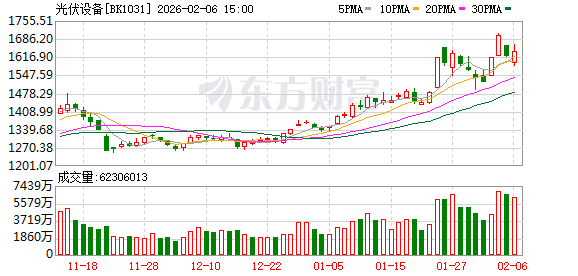
印象|买套光伏作嫁妆
Xin Lang Cai Jing· 2026-02-08 02:01
Group 1 - The core viewpoint of the articles highlights the increasing adoption of solar panels in Pakistan, significantly improving the energy situation for households and reshaping the energy landscape in the country [1][2]. - Over the past decade, global solar panel prices have decreased by 80% to 90%, primarily due to the large-scale production and technological innovations by Chinese photovoltaic companies, which now produce about 80% of the world's solar panels [1]. - The introduction of solar panels has not only provided energy independence for families but has also influenced cultural practices, such as the emergence of "solar dowries" in weddings, where solar panels are now considered valuable gifts alongside traditional items like gold jewelry [2]. Group 2 - The cooperation between China and Pakistan extends beyond energy, as evidenced by the recent mining cooperation forum that emphasized "full value chain" collaboration, attracting around 900 participants from various sectors [3]. - The forum aimed to strengthen bilateral relations and promote investment opportunities, with both countries expressing a commitment to mutual respect and support over the past 75 years [3]. - The presence of solar panels in urban areas symbolizes the tangible benefits of China-Pakistan cooperation, enhancing the quality of life for citizens [3].
广东外贸凭产业韧性持续领跑
Xin Lang Cai Jing· 2026-02-07 22:52
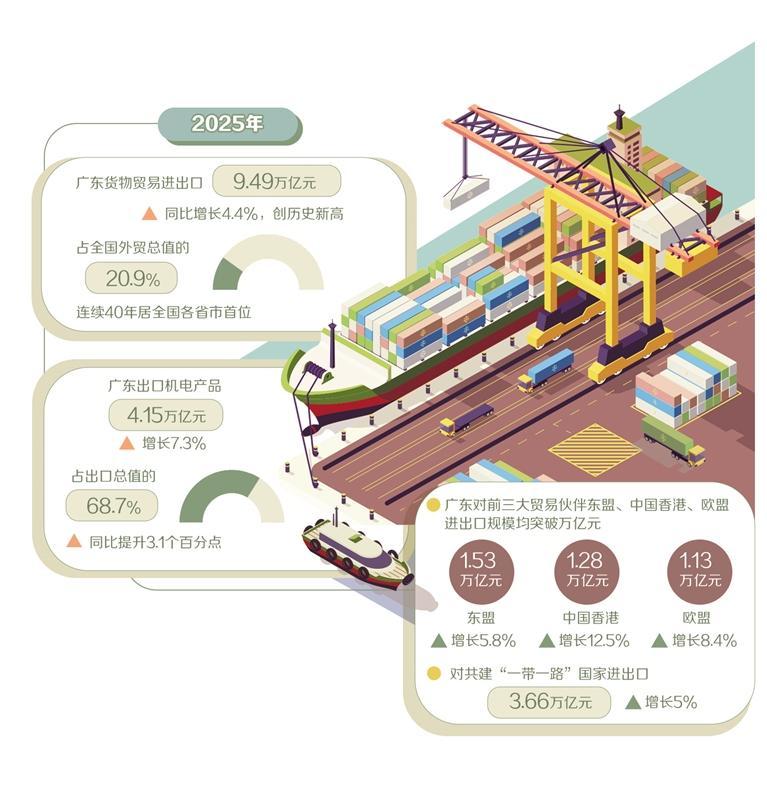
Core Insights - Guangdong's goods trade import and export reached 9.49 trillion yuan in 2025, marking a 4.4% year-on-year increase and setting a historical record, accounting for 20.9% of the national foreign trade total, contributing 24.1% to national foreign trade growth [2] Group 1: Export Structure and Growth - The export structure in Guangdong is shifting towards new and superior products, with new productive forces accelerating growth. In 2025, Guangdong exported 4.15 trillion yuan in electromechanical products, a 7.3% increase, making up 68.7% of total exports, up 3.1 percentage points year-on-year [3] - Exports of electronic components, electrical equipment, and computers grew by 20%, 16.8%, and 9.9% respectively, while green and intelligent products like drones, 3D printers, and industrial robots saw export growth rates of 40.9%, 37.1%, and 33.9% [3] Group 2: Company Performance and Market Expansion - Dongguan's Songling Technology Co., Ltd. reported a 52% increase in orders in 2025 compared to 2024, with an expected stable growth rate of 30% to 40% for the current year. The company exported industrial robots worth 460 million yuan, a year-on-year increase of over 30% [4] - The Guangdong Customs has been actively guiding enterprises in technical trade responses and intellectual property protection, facilitating the expansion of Dongguan's smart manufacturing into global markets [4] Group 3: New Trade Dynamics and Support Measures - The Guangdong Customs has focused on cultivating new trade dynamics and creating a "new engine" for foreign trade, with electric vehicle exports increasing 31 times during the 14th Five-Year Plan period, reaching 153 countries and regions [5] - The number of enterprises with import and export performance in Guangdong reached 172,000 in 2025, a 17.6% increase, with private enterprises accounting for 148,000, up 20% [6] Group 4: International Cooperation and Market Diversification - Guangdong's foreign trade market is becoming more diversified, with imports and exports to ASEAN, Hong Kong, and the EU each surpassing 1 trillion yuan in 2025, growing by 5.8%, 12.5%, and 8.4% respectively [8] - The province's exports to emerging markets in Central Asia, Africa, and the Middle East grew by 23.6%, 10.7%, and 8.5%, all exceeding the overall growth rate of Guangdong [8] Group 5: Infrastructure and Regulatory Improvements - Guangdong has implemented 166 measures to promote cross-border trade facilitation, achieving 24/7 appointment customs clearance at key ports and expanding shipping routes to 73 [6] - The provincial government has introduced 108 measures to optimize the business environment, with general trade growing at an average of 9.9% annually, increasing its share from 51.2% to 58.2% [7]
为因地制宜发展新质生产力提供坚强保障
Xin Hua Ri Bao· 2026-02-07 20:02
Core Insights - The development of new quality productivity is essential for promoting high-quality development and requires effective supervision to ensure the implementation of major decisions from the central government [1] Group 1: Focus on Key Industries - The integration of technological innovation and industrial innovation is a core path for high-quality development, with a focus on cultivating new quality productivity [2] - Nantong Development Zone has established a leading industry structure consisting of "3+1" sectors: new generation information technology, high-end equipment, pharmaceutical health, and new energy, attracting five billion-level enterprises [2] - The zone has been approved as a pilot area for future industries, focusing on aerospace, future communication, future energy, and deep-sea equipment [2] Group 2: Strengthening Execution in Key Areas - Nantong Development Zone aims to become a leading area for high-quality marine industry development, focusing on shipbuilding and marine engineering, with key enterprises like Zhongtian Marine Cable and Huisheng Clean Energy [3] - The supervisory committee is enhancing collaboration among various departments to streamline project approvals and support the implementation of major marine projects [3] - A commitment system for project approvals has been established to expedite the construction process, ensuring full-cycle service support for project delivery [3] Group 3: Enhancing Business Environment - The approval process for the Tongwei high-efficiency photovoltaic component manufacturing project has been optimized, reducing the timeline from three months to 45 working days [4] - Nantong Development Zone is focused on creating a first-class business environment, with ongoing supervision of 109 key tasks related to business environment improvement [4] - Innovative measures such as flexible law enforcement and immediate policy benefits are being implemented to facilitate the flow of capital, technology, and talent [4]
2026太空光伏是主题还是新产业趋势?
Sou Hu Cai Jing· 2026-02-07 18:21
Core Insights - The emergence of space photovoltaics represents a significant energy revolution driven by advancements in commercial space technology, which is expanding the photovoltaic industry's boundaries beyond Earth [1][3] - New players, particularly innovative entrepreneurs, are strategically entering the market, focusing on building a global satellite network and investing in photovoltaic manufacturing to create substantial production capacity [1][3] - The North American region is experiencing a surge in demand for renewable energy sources like photovoltaics due to aging grid infrastructure, manufacturing reshoring, and explosive growth in artificial intelligence [1][3] Group 1: Space Photovoltaics Overview - Space photovoltaics is gaining attention as a new industry trend, moving beyond traditional ground applications to harness infinite space resources [3] - The rapid development of reusable rocket technology is significantly reducing launch costs, facilitating the acceleration of satellite deployments [9][10] - The market for flexible solar arrays for space applications is projected to grow from approximately $1.12 billion in 2024 to $4.36 billion by 2033, with a compound annual growth rate of about 16.4% [11] Group 2: Battery Technology Developments - Gallium arsenide batteries are currently the preferred power source for most spacecraft due to their high conversion efficiency of over 30% and excellent radiation resistance [2][28] - Heterojunction (HJT) batteries are emerging as a balanced solution between performance and cost, while perovskite batteries are seen as a revolutionary option for addressing space energy challenges [2][28] Group 3: Industry Trends and Opportunities - The entire photovoltaic supply chain is expected to experience structural growth opportunities as space applications become more prevalent [2][30] - Equipment manufacturers are positioned to benefit first from the expansion of new technologies, with significant production capacity growth anticipated [31] - The demand for auxiliary materials, such as conductive pastes and specialized encapsulation films, is expected to rise alongside the expansion of photovoltaic production capacity [36] Group 4: Strategic Player Insights - Companies like SpaceX and Tesla are making significant moves in the photovoltaic space, with plans to build 200GW of photovoltaic capacity in the next three years [31] - The U.S. photovoltaic manufacturing sector is expanding rapidly, with production capacity increasing from 8GW to 64.8GW, a growth of over 700% [31] - Key players in the photovoltaic supply chain, such as Oriental Sunrise and Jida Co., are actively positioning themselves in the high-value space photovoltaic market through strategic partnerships and resource integration [38][40]

经济热点快评|太空光伏,能否成为新蓝海?
Sou Hu Cai Jing· 2026-02-07 15:37
Core Insights - The recent exploration of China's photovoltaic industry chain by Musk's team has garnered attention, particularly regarding the feasibility of space-based solar power and the potential opportunities for the Chinese photovoltaic sector [1][3] Group 1: Space Photovoltaics Overview - Space photovoltaics involves deploying solar panels on spacecraft or satellites to convert solar energy into electricity, with the long-term goal of wireless energy transmission to Earth [1] - The efficiency of solar power in space is significantly higher than on Earth, with energy density reaching 7-10 times that of ground systems due to constant sunlight and minimal atmospheric interference [1] Group 2: Market Dynamics - The interest in space photovoltaics has surged due to advancements in reusable rocket technology, which have lowered launch costs, and the increasing demand for electricity from data centers that outpaces ground infrastructure capabilities [1][3] - Current cost estimates for space photovoltaics are around $2-$3 per kilowatt-hour, compared to $0.03-$0.05 for ground-based solar, indicating a significant economic gap that needs to be addressed for scalability [3] Group 3: China's Competitive Advantages - The Chinese photovoltaic industry has made substantial advancements in technology, with 27 breakthroughs in efficiency records during the 14th Five-Year Plan, increasing its global share to 55% [3] - Manufacturing capacity has surged, with photovoltaic cell production during the 14th Five-Year Plan being 5.5 times that of the previous plan, and projections indicate that by 2025, China will account for over 90% of global capacity [3] - Over the past decade, China has contributed to an 80% reduction in the average cost of electricity generation from global photovoltaic projects [3] Group 4: Industry Initiatives - Chinese photovoltaic companies are actively pursuing advancements in space photovoltaics, with notable initiatives such as the record-setting perovskite/silicon tandem cells by Trina Solar and the establishment of future energy space laboratories by LONGi Green Energy [4] - The development of perovskite tandem battery technology is being advanced through collaborations between JinkoSolar and Jintai Technology, indicating a strong commitment to innovation in this field [4] - The journey towards commercializing space photovoltaics is expected to be a long-term endeavor, requiring patience and sustained effort to create competitive, high-efficiency products [4]

后怕!当初决策层要是相信了许小年,中国可能会比现在落后二十年
Sou Hu Cai Jing· 2026-02-07 15:06
Group 1 - Xu Xiaonian is a prominent economist advocating for market self-regulation and minimal government intervention in China's economic development [2][4] - He believes that China's industrial base is still weak and that the country should not rush into high-end technologies like high-speed rail, chips, and new energy vehicles [4][9] - Xu has expressed concerns about the financial risks associated with high-speed rail investments, suggesting that the government should tighten funding and avoid blind expansion [6][7] Group 2 - In the semiconductor sector, Xu argues that China should not aggressively pursue advancements and should allow the market to determine capable enterprises [9][12] - He criticizes the new energy vehicle subsidy policies, suggesting they lead to inefficient spending and do not guarantee competitiveness for private companies [11][12] - Xu has voiced similar concerns regarding solar energy and 5G investments, warning that state-led initiatives could result in overcapacity [12][18] Group 3 - Despite Xu's warnings, China's high-speed rail network has expanded significantly since 2008, with projections to exceed 50,000 kilometers by 2025, accounting for over 70% of the global total [16][23] - The semiconductor industry has seen improvements, with companies like Huawei and SMIC making strides in technology and production capabilities [18][23] - The new energy vehicle market has grown substantially, with BYD surpassing Tesla in global sales, supported by government subsidies [19][23] Group 4 - The solar industry has become a global leader, with China accounting for 85% of component exports and significant cost reductions in production [21][23] - The 5G infrastructure has rapidly developed, with over 400,000 base stations built, enhancing automation in factories and contributing to industrial growth [23][25] - Overall, the combination of state investment and market competition has led to significant advancements in various sectors, countering Xu's more cautious approach [23][29]

粤商闯泰国,拼出“生猛”人生
21世纪经济报道· 2026-02-07 13:51
作者 丨赖镇桃 编辑丨李艳霞 如果商业有记忆,它的基因里一定刻着航线的密码。 十八世纪的"红头船时代",广东商人用季节性贸易的风帆,编织起一条跨越南海的供应链。今天,在泰国一派热火朝天的制造车间里,在曼谷 街头穿梭的电商物流车中,粤商的身影依然是其中最活跃的符号。 "泰国常住人口7000万左右,华人华侨有1000多万,这几年来到泰国寻找商机的广东企业家更是不在少数。"泰国粤商会会长林国鑫告诉21世纪 经济报道记者。 观察那些行走在泰国商界的广东商人,有一些是祖父辈就乘船来到湄南河畔打拼的"泰三代""泰四代",有一些是踩着时代鼓点掘金新大陆的新 粤商。但不谋而合的是,他们勇于穿越边界,始终在创造连接,并将每一次时代潮涌,都转化为同舟共济的航道。 粤商担纲中泰经贸 春江水暖"地"先知。泰国粤商会常务副会长周林省也在曼谷廊曼机场附近经营着一片工业园区,有中资制造业想在泰国投资设厂的,周林省也 会帮着这些企业选地、办证、寻找上游供应商。2019年,看到不少中资企业前后脚纷纷"走出来",周林省便决定在曼谷附近开发厂房和产业 园,为中企出海提供落脚地。这几年出海的火爆,在用地租金上已经有所反映。 贸易方面,广东更在中泰经 ...